Home / Brunch / Healthy Sunday brunch ideas
Healthy Sunday brunch ideas
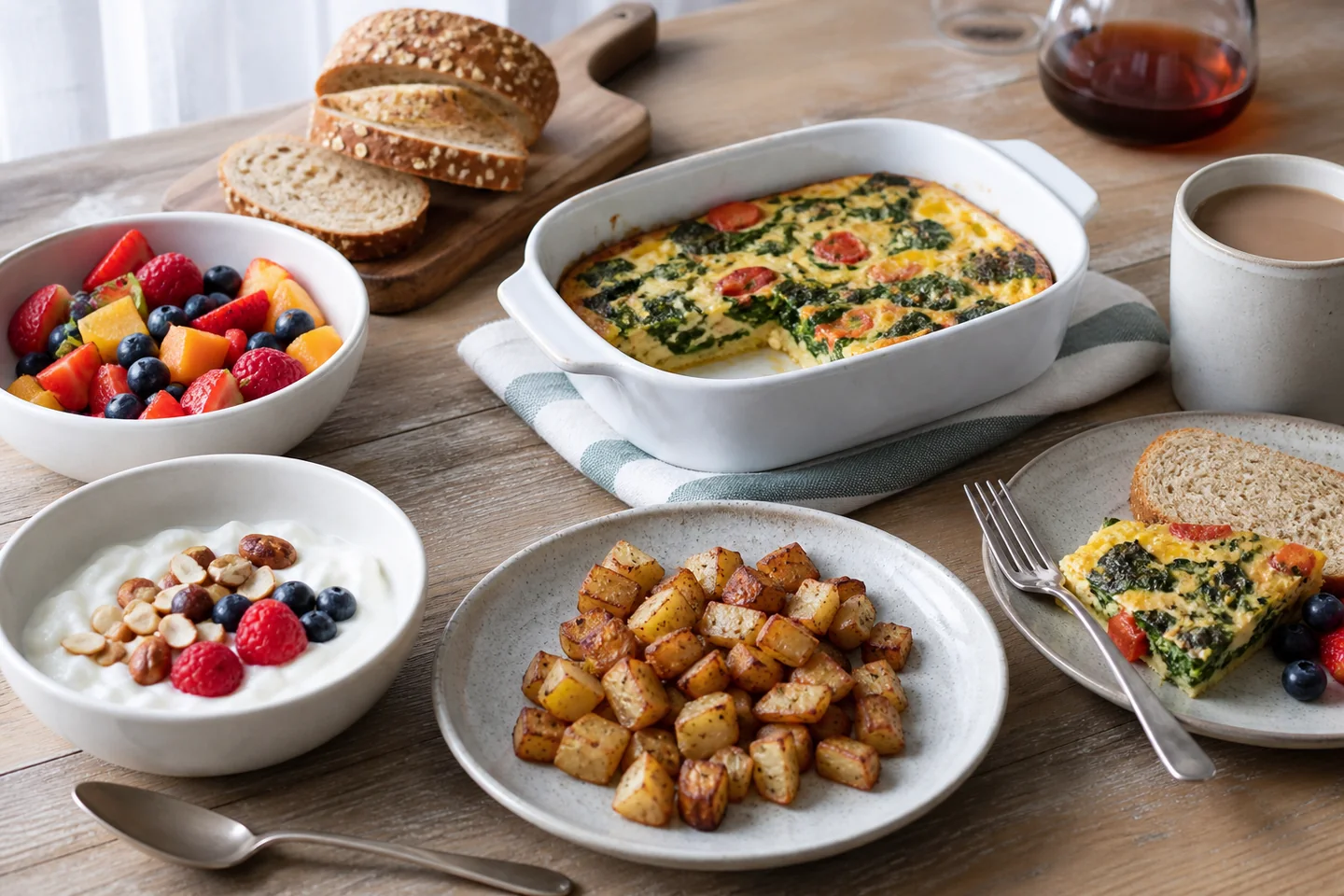
A healthy Sunday brunch is easiest to plan as a choice between three menu shapes: a cold assemble-first table, one warm cooked anchor with simple sides, or a shared spread. Pancake World uses “healthy” as a practical planning term here—not a medical verdict, nutrient score, or promised outcome. Choose the shape that fits your time, equipment, guest preferences, and ability to keep cold food cold. Start with a fruit or vegetable element, a substantial base, and an optional protein-containing element, then keep rich sauces and sweet additions separate.
Browse the brunch collection when you need a wider starting point. This guide compares workable Sunday options rather than declaring one universal best menu.
The direct decision
Choose an assemble-first brunch for low active cooking and staggered arrivals. Choose one warm anchor for a small group with one reliable heat source. Choose a shared spread only when you can serve and replenish it with control.
Balanced brunch criteria
The useful comparison is not “good food” versus “bad food.” It is whether a menu can be served calmly, adapted clearly, and kept appropriate for its ingredients. Compare active effort, holding behaviour, customisation, equipment pressure, and service control.
- Active effort: the cooking and plating attention required.
- Holding behaviour: whether a dish remains useful as people arrive.
- Customisation: whether toppings and components can stay separate.
- Equipment pressure: how many tasks compete for the same heat source.
- Service control: how reliably components can be labelled and handled.
Choice matrix: three Sunday brunch shapes
| Menu shape | Best fit | Useful starting build | Main trade-off |
|---|---|---|---|
| Assemble-first | Staggered arrivals or little cooking time | Yogurt or alternative, fruit, oats, bread, labelled toppings | Cold components need refrigeration; the table can look repetitive |
| One warm anchor | Small group with one reliable heat source | Vegetable-and-egg bake, warm grain dish, fruit, fresh side | Timing concentrates around one cooking task |
| Shared spread | Planned sit-down gathering | One warm anchor, one fresh item, bread or grain, optional toppings | More dishes mean more handling and labelling work |
These are starting ranges for complexity, not nutritional rankings. Ingredients, cultural preferences, and dietary requirements still need individual checking.
Cooking-method trade-offs
An oven bake is useful when its service window overlaps with guests sitting down, but it ties up the oven and needs a clear recipe for safe cook-through. A skillet item gives fast feedback and small batches, but it demands attention at the stove. Cold assembly reduces cooking, yet dairy, prepared foods, and cut produce still need appropriate cold handling.
For an oven-light table, no-cook brunch ideas can supply component logic. For a cooked centrepiece with a group, brunch eggs for a crowd is a more specific next read.
Menu build A: the assemble-first table
Set out fruit, a plain yogurt or suitable alternative, oats or another grain component, and bread. Put nuts, seeds, preserves, and sweeteners in separate labelled bowls. This makes choice visible without asserting that it removes allergen or cross-contact risk. Keep chilled ingredients chilled until close to service and replenish small amounts instead of leaving every portion out.
Menu build B: one warm anchor and two supporting roles
Make one cooked dish do the main work: for example, a vegetable egg bake, bean-and-potato skillet, or baked grain dish. Add one fresh component and one bread or grain side. The starting range is three menu roles, not a rule about portions. It reduces duplicate work: the hot dish brings savoury interest, the fresh item changes texture, and the base makes the table feel complete.
If time is the tight constraint, fast brunch ideas offer a separate decision route. Do not assume “fast” proves a dish’s nutritional quality.
Menu build C: a shared spread with boundaries
A shared spread works when it has a written limit: one hot anchor, one fruit or vegetable dish, one bread or grain, and one optional finishing area. Add a second hot dish only when it solves a different guest need. A meat-free option needs complete ingredient review; “vegetarian” alone does not establish vegan status or allergen suitability.
Scenario analysis
Four people, late morning, one oven
Choose one warm anchor. Assemble fruit and a simple side while it cooks. This lowers equipment competition and gives a defined point to serve.
Eight people, staggered arrival
Choose assemble-first, then replenish in small amounts. Separate components tolerate timing differences better when safely stored.
Mixed preferences, limited certainty
Choose plain bases with optional toppings, but make no safety claim from the layout. Ask for requirements in advance, read labels, and use separate utensils where needed.
Outdoor or travel brunch
Choose shelf-stable or service-ready elements only when their handling instructions support the plan. Fragile chilled dishes are not automatically a good fit for a long outdoor table.
A simple decision tree
- Will people eat together within a short window? If yes, consider one warm anchor.
- Are arrivals staggered or is cooking time scarce? If yes, choose assemble-first components.
- Do two dishes solve clearly different needs? If no, omit the second dish.
- Can you label and hold each component appropriately? If no, simplify before adding variety.
Recommendation by user type
- The unhurried host: one warm anchor plus two supporting roles.
- The time-limited host: assemble-first components and easy replenishment.
- The preference-conscious host: a limited spread with separate toppings and labels.
- The small-space host: one heat source and room to serve.
For more occasion-specific ideas, see elegant brunch ideas and friends brunch ideas.
Limitations and final verdict
This comparison does not calculate nutrition, test recipes, rank ingredients, or guarantee an outcome. It cannot replace ingredient labels, food-safety instructions, or individual advice. Final verdict: choose the smallest menu shape that comfortably covers a warm or substantial anchor, a fruit or vegetable element, and clear optional additions; move to a larger spread only when service control is equally ready.
Sources and editorial references
- USDA MyPlate, “What Is MyPlate?” — food-group planning context: https://www.myplate.gov/eat-healthy/what-is-myplate
- U.S. Food and Drug Administration, “Food Safety at Home” — home storage and handling context: https://www.fda.gov/consumers/consumer-updates/food-safety-home
- USDA FoodData Central — ingredient-label and composition lookup context: https://fdc.nal.usda.gov/
- Food Standards Agency, “Food allergy and intolerance” — allergen and label-checking context: https://www.food.gov.uk/safety-hygiene/food-allergy-and-intolerance