
Quick answer
Easy banana pancakes work best when banana is treated as both flavor and liquid. Use one very ripe medium banana, mash it evenly, measure the remaining wet ingredients, and resist adding extra fruit “for more banana” without recalculating the flour. Banana brings water and sugar, so the pancakes color faster and can stay gummy in the center if portions are too large or heat is too aggressive.
This recipe makes about ten small pancakes. They should be modest in diameter, golden rather than dark, and fully set inside with a moist crumb. It is a banana-flavored American pancake, not a two-ingredient banana-and-egg round and not banana bread cooked in a skillet.
Ingredients
- 180 g all-purpose flour
- 2 teaspoons baking powder
- 1/4 teaspoon fine salt
- 1/2 teaspoon cinnamon, optional
- 1 very ripe medium banana, about 120 g peeled
- 1 large egg
- 220 ml milk, plus only a small measured adjustment if needed
- 30 g melted butter or 2 tablespoons neutral oil
- 1 teaspoon vanilla, optional
- A thin film of cooking fat for the pan
Use a yellow banana with abundant brown speckles and soft flesh, but discard fruit that shows spoilage rather than ordinary ripeness. A very large banana adds significantly more moisture and should be weighed. If your banana weighs more than the formula assumes, save the excess for another use instead of forcing it into the batter.
Milk alternatives vary in solids and sweetness. If substituting, choose a complete compatible plan and assess the rested batter before adding more liquid. Check every ingredient label for dietary needs and allergens.
Mix without creating a gummy batter
Whisk flour, baking powder, salt, and cinnamon in one bowl. In a second bowl, mash the banana until no large slippery chunks remain; a few tiny soft pieces are fine. Whisk in the egg, milk, melted butter or oil, and vanilla.
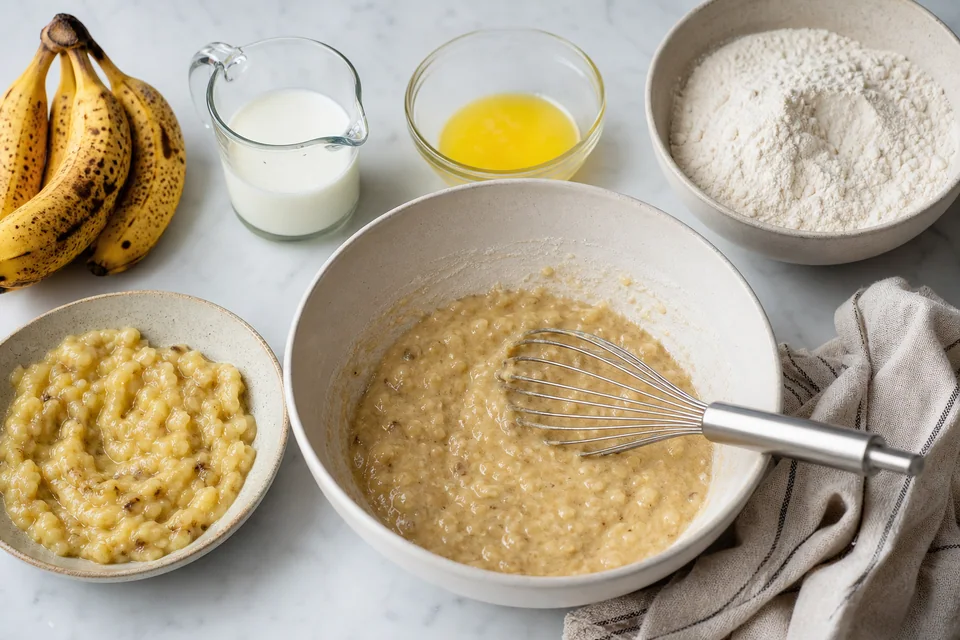
Pour wet into dry and fold just until no pockets of dry flour remain. Small lumps are preferable to prolonged vigorous mixing. Let the batter stand for about five minutes while the pan preheats, then stir once from the bottom. It should fall from a spoon in a thick ribbon and spread slowly.
Do not taste raw batter. Flour is a raw food, and the egg also requires safe handling. Wash the banana peel before it shares a work surface with ready-to-eat items, keep shell contact away from toppings, and cook every center completely.
Cook small pancakes over controlled heat
Heat a broad skillet or griddle over medium-low to medium heat and wipe on a thin fat film. Banana’s sugars encourage browning, so the setting that works for a plain formula may be too harsh here. Use a teaspoon of batter as a calibration test. It should set without immediately turning dark.
Portion roughly two tablespoons per pancake, leaving space between rounds. Do not spread them into thin discs; let the batter settle to its natural small diameter. Cook until edges look matte, bubbles appear and begin to hold open, and the underside is golden. Bubbles alone are not a complete cue.
Slide a broad spatula under the center and turn once. Cook the second side until the middle is fully set. Check the first pancake by cutting through its thickest point. Moist is expected; shiny paste or a compressed wet line needs more controlled cooking.
Transfer to a rack or warm plate and continue. Let the pan recover briefly between batches. If the next round darkens faster, lower the heat rather than shortening cooking until the center remains raw.
Portion and serve the batch
Ten small pancakes usually make three or four breakfast portions depending on appetite and side dishes. Portion by the cooked result, not a universal serving claim. Keep finished rounds loosely covered for only a short time so they stay warm without trapping enough steam to become wet. If serving the whole batch together, warm plates first and bring toppings to the table. A smaller stack with fruit or yogurt beside it is easier to heat through and eat while fresh than one compressed tower under heavy syrup.
Caramelized banana topping without a wet stack
Slice a second firm-ripe banana into thick coins. Warm a small amount of butter or oil in a separate skillet and cook the coins briefly until golden on each side. Do not crowd them or add a pool of syrup. Spoon a few slices over each finished portion immediately before serving.
This topping is optional. Plain banana pancakes already contain fruit and sweetness. Yogurt, toasted nuts, berries, or a restrained drizzle can add contrast; the sweet pancake toppings guide helps match moisture and texture.
Current-batch problems and fixes
The outside browns before the center sets: Move the pan off direct heat briefly, lower the setting, and make the remaining pancakes smaller. Do not press them flat; that creates a dense line rather than safely cooking the center.
The center is gummy: Continue at gentler heat if the exterior can tolerate it. For the next portion, reduce size. If every pancake is gummy, verify banana weight and whether extra milk was added.
The batter is runny: Do not pour flour straight into the full bowl and whisk aggressively. Cook one small test first. If the formula is clearly out of balance because the banana was oversized, a small separately mixed flour correction may help, but the more repeatable fix is accurate weighing next time.
The batter is too thick: Stir from the bottom. Add milk one teaspoon at a time only after the batter has rested. Large splashes make the final pancakes thin and difficult to interpret.
The pancakes stick: Let the first side set, clean off torn residue, and restore a thin fat film. Excess fat can create fried dark rings. Compare cooking pancakes with butter if milk solids are scorching.
Banana pieces burn on the pan: Mash more evenly next time. Remove loose fruit residue before pouring another portion so it does not mark the batch.
Prevent the next batch from failing
Record peeled banana weight, milk amount, flour brand, portion, pan, and the heat cue from the test drop. Use the same ladle and make one calibration pancake. Change one variable: portion for raw centers, heat for fast browning, banana weight for excessive moisture, or mixing for toughness.
Prepare toppings before cooking so the batter does not stand indefinitely. Keep the first cut pancake as evidence: note whether the crumb is open, pasty, dry, or compressed. “Banana pancakes were bad” is not a usable diagnosis.
Make-ahead and storage limits
Banana pancakes can be cooked ahead, cooled promptly in one layer, and refrigerated or frozen in a covered package with separators. Keep wet toppings separate. Reheat until properly hot, using gentle heat so the sugary surface does not burn. The dedicated guide to making banana pancakes ahead covers the full workflow.
Discard batter or cooked pancakes kept outside safe controls. Freezing does not repair an undercooked center. Texture after storage will be softer than a fresh batch, especially when the formula contains abundant banana.
FAQ
How ripe should the banana be?
Use soft fruit with plenty of brown speckles for strong flavor and easy mashing. Weigh the peeled fruit because banana size affects moisture more than peel color alone.
Can I add two bananas?
Not without changing the formula. Extra banana adds water, sugar, and solids, increasing the risk of dense gummy centers and fast browning.
Why are my banana pancakes raw in the middle?
The portions may be too large, heat too high, banana amount excessive, or batter too wet. Lower the heat and make smaller rounds before changing multiple ingredients.
Can I make these without egg?
Use a complete eggless banana-pancake formula rather than omitting the egg from this recipe. The replacement changes structure, moisture, and cooking behavior.
Can I freeze banana pancakes?
Yes. Cool fully cooked rounds promptly, freeze with separators, and reheat safely. Expect a slightly softer texture than fresh pancakes.
Related Pancake World guides
Plan storage with make banana pancakes ahead, choose finishes from sweet pancake toppings, and browse 31 pancake flavors for distinct flavor directions.
Sources and editorial references
- Oregon State University Extension: Banana Pancakes —
https://extension.oregonstate.edu/imported-publication/banana-pancakes - U.S. Food and Drug Administration: Flour Is a Raw Food —
https://www.fda.gov/consumers/consumer-updates/flour-raw-food-and-other-safety-facts - USDA Food Safety and Inspection Service: Shell Eggs from Farm to Table —
https://www.fsis.usda.gov/food-safety/safe-food-handling-and-preparation/eggs/shell-eggs-farm-table - Penn State Extension: Cooking and Freezing Food Pantry Items —
https://extension.psu.edu/cooking-and-freezing-food-pantry-items
For more practical food and breakfast guides, visit Pancakes World.
For the wider topic, start with Guides/pancake Ingredients.
For a closely related guide, see How to Make Banana Pancakes: A Complete Guide.
A useful next comparison is Easy Pancakes from Scratch: A Reliable Golden Stack.
You can also continue with Delicious Homemade Pancakes Recipe.
For another practical angle, read Sweetener Substitutes for Pancakes: Functional Ratios and Texture Control.
