
Quick answer
Caramelized onion, spinach, and pork strata is a savory bread-and-egg casserole. Its success depends on preparing the wet fillings before assembly: brown and fully cook the pork, cook the onions slowly until deeply soft and golden, wilt the spinach, and squeeze or evaporate its excess water. Layer those components with dry bread and cheese, pour over a seasoned egg-and-milk custard, let it absorb, then bake until the centre is fully set.
For the recipe below, use a 23 x 33 cm / 9 x 13 inch baking dish. It makes about eight substantial portions. Assemble it for immediate baking with a short absorption rest, or refrigerate it promptly for a planned make-ahead breakfast. A cold dish will usually need longer in the oven, so judge the centre rather than treating one bake time as a guarantee.
Ingredients for one strata
- 450 g sturdy day-old bread, cut into roughly 2.5 cm / 1 inch cubes
- 350 g plain ground pork or raw pork breakfast sausage, kept refrigerated
- 2 large yellow onions, thinly sliced
- 250 g fresh spinach, washed and dried
- 1 tablespoon neutral cooking oil, plus more only if the pan is dry
- 8 large eggs
- 600 ml / 2 1/2 cups milk
- 1 teaspoon Dijon mustard, optional
- 1 teaspoon fine salt, divided, with less if the sausage or cheese is salty
- black pepper to taste
- 150 g grated firm melting cheese, such as mature cheddar or Gruyere-style cheese
- a small amount of butter or oil for the baking dish
The pork must be a product suitable for crumbling and cooking through in a skillet. If using seasoned sausage, check its salt, allergens, casing, and handling directions. Do not use cured ready-to-eat meat as a direct weight-for-weight substitute without adjusting salt and volume.
The bread should be dry enough to absorb custard but not stale in the food-safety sense. A firm white loaf, sourdough, or restrained whole-wheat bread works better than very soft fresh sandwich bread. Sweet, heavily seeded, or strongly flavored loaves change the balance.
Prepare the bread and dish
Grease the baking dish. Spread very fresh bread cubes on a tray while the other components cook so their surfaces lose a little moisture. Do not soak them separately. The custard needs open crumb to enter, but bread reduced to hard crumbs gives the casserole a pasty base.
If the loaf is extremely crusty, cut the cubes a little smaller and give the assembled dish a longer absorption rest. If it is soft, keep the cubes larger and bake soon after the custard has penetrated. These are texture adjustments, not safety shortcuts.
Caramelize the onions without burning them
Heat a broad skillet over medium-low heat and add the oil. Add the sliced onions with a small pinch of the measured salt. Cook slowly, stirring and scraping the bottom as browned residue develops. Reduce the heat if edges blacken while most slices remain firm.
For this recipe, expect roughly 25 to 35 minutes, depending on pan width, onion moisture, and heat. The endpoint matters more than the clock: the onions should be collapsed, amber to brown, and sweet-smelling, with no raw crunch. A spoonful of water can release flavorful browned material if the pan dries, but let that water evaporate before assembly.
Move the onions to a clean bowl. Do not call quickly scorched onions caramelized; black fragments add bitterness and will not soften in the custard.
Cook the pork completely
Return the skillet to moderate heat. Add the ground pork or sausage and break it into small bite-size pieces. Cook until no raw color remains, moisture has evaporated, and the meat reaches the safe endpoint applicable to ground pork. The cited USDA chart gives 71°C / 160°F for ground meats. Measure a representative thicker cluster with a clean food thermometer rather than touching the probe to the pan.
Drain excessive rendered fat, leaving the pork moist but not swimming. Transfer it to the onion bowl with a clean utensil. Never use the raw-meat plate or spoon for the cooked filling.
The strata bake is not a reliable plan for finishing large raw pork chunks hidden between cold bread. Fully cooking and draining the crumbled pork first provides a verifiable endpoint and prevents rendered fat from flooding the custard.
Control spinach moisture
Add the spinach to the same clean skillet in batches. Turn it only until wilted. Continue cooking briefly until free liquid evaporates, then transfer it to a sieve. When cool enough to handle safely, press or squeeze out additional water and chop the spinach coarsely.
This step is structural. Spinach holds much more water than its finished volume suggests. If that water enters the baking dish, it dilutes the custard around some cubes while leaving other bread dry. Frozen spinach can work only after thawing and squeezing it very thoroughly; use approximately the same cooked, drained volume rather than replacing fresh spinach by raw package weight.
Combine the drained spinach with the onions and pork. Let the filling stop steaming before it meets cold eggs.
Mix the custard
Whisk the eggs until the whites and yolks are uniform. Add the milk, mustard if using, remaining salt, and pepper. Whisk just until blended; a thick cap of foam makes it harder to see whether every bread cube is moistened.
Egg proteins set the liquid around the bread and fillings as the dish heats. That does not mean more eggs always improve the result. Too much binder makes the strata firm and bouncy; too much milk leaves a loose layer. Keep the egg, milk, bread, and dish together as one tested recipe system.
Taste seasoning through the fully cooked onion-pork-spinach mixture, not the raw custard. Cheese and sausage may already contribute substantial salt.
Assemble for even absorption
Scatter half the bread in the greased dish. Distribute half the filling and half the cheese across it, reaching the corners without compressing the cubes. Repeat with the remaining bread, filling, and cheese. Slowly pour custard across the whole surface rather than emptying it into one corner.
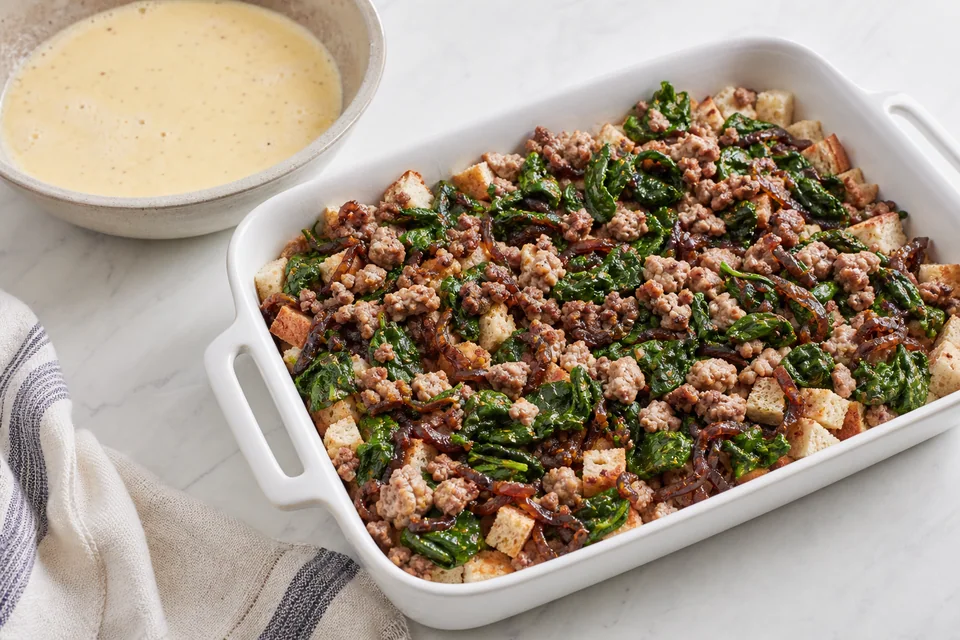
Press the top gently with a clean spatula so dry cubes contact custard, then release them. Do not mash the layers. Let a same-day assembly stand about 25 to 30 minutes in the refrigerator while the oven heats. Check halfway and spoon exposed custard over any dry top cubes.
For an overnight assembly, cover and refrigerate promptly. Keep ingredients cold, do not leave the egg mixture at room temperature, and bake within the planned safe holding window. The dish and its contents may be very cold, so avoid thermal shock with unsuitable glassware and follow its manufacturer instructions.
Bake until the centre is set
Heat the oven to 175°C / 350°F with a rack near the middle. Bake the same-day strata uncovered for about 45 to 55 minutes. Begin checking earlier if the dish is shallow or the ingredients started warm; expect a refrigerated overnight dish to take longer.
The top should be browned, the edges gently puffed, and the centre should not slosh when the dish is nudged. Insert a clean thin knife near the centre: moist crumbs and melted cheese are acceptable, but liquid raw egg is not. The egg-dish endpoint in the cited USDA chart is 71°C / 160°F. Check the centre without touching the thermometer probe to the dish bottom.
If the top becomes dark before the centre is ready, cover it loosely with foil and continue baking. Rest the fully cooked strata for 10 to 15 minutes before slicing. Resting helps the custard settle; it does not make a raw centre safe.
Serving the strata
Cut into eight portions with a sharp knife and lift each piece with a broad turner. Serve with a crisp salad, tomatoes dressed just before eating, or fruit with enough acidity to balance the rich pork and cheese. Keep wet sauces on the plate rather than pouring them over the whole dish.
For another egg-focused brunch, see Eggs Benedict pancakes. If guests prefer griddle-cooked options, the 22 savoury pancake recipes collection offers distinctly different bases and methods.
Current-batch problems and fixes
The centre is liquid: Return the dish to the oven. Cover the top if it is already brown, then verify the centre again. Do not rely on carryover heat to repair visible raw egg.
Water pools around the slices: Spinach or onions retained too much moisture, or the pork was not drained. Finish cooking the centre for safety; then serve with a slotted turner. Improve drainage next time rather than adding extra bread to a wet, partly cooked dish.
The centre is set but the strata is dry: It may have baked too long, the bread may have been exceptionally dry, or the custard ratio was changed. Serve with a cool savory topping and check the centre earlier next time. The savory toppings guide has balanced options.
Top cubes are hard: They did not contact custard. Cover the top briefly only if the centre still needs cooking. Next time pour more evenly and press exposed cubes into the custard during the absorption rest.
The strata is greasy: Sausage or pork fat was not drained, or cheese was increased. Blot the surface carefully and reduce one of those components in the next batch.
Slices collapse: Confirm the centre is fully set, then rest before cutting. Use a broad turner. More eggs are not the automatic solution because they also change tenderness.
Prevent the next batch from drifting
Weigh the bread, pork, drained spinach, and cheese. Record the dish material and dimensions, whether the assembly was same-day or refrigerated, and the actual centre endpoint. Those controls reveal whether a texture problem came from moisture, absorption, depth, or overbaking.
When changing vegetables, cook and drain the replacement first and substitute it for part of the spinach rather than adding unlimited volume. When changing sausage, reconsider salt and rendered fat. Keep the custard ratio stable until one controlled variation succeeds.
The Pancake Troubleshooting hub is useful for shared browning and texture principles, while pancake bake with cinnamon streusel shows how a batter-based oven pancake differs from a bread-and-custard strata.
Storage, reheating, and limits
Cool leftovers promptly and refrigerate them in shallow covered portions. Keep only food whose time and temperature history is known. Reheat individual portions until thoroughly hot through the centre; an oven preserves the browned top better, while a microwave is faster but can firm the egg at the edges.
The site’s pre-made pancake reheating guide explains appliance tradeoffs that also apply to many breakfast bakes. It does not replace current official leftovers guidance or the directions for a packaged pork product.
This recipe has not been framed as vegetarian, gluten-free, dairy-free, or allergen-free. Bread, sausage, mustard, milk, eggs, and cheese require label checks. Cross-contact controls depend on the kitchen and cannot be guaranteed by an ingredient substitution alone.
FAQ
Can I assemble the strata the night before?
Yes. Use cooled cooked filling, cold custard, a covered dish, and prompt refrigeration. Account for the colder starting temperature and verify the centre rather than adding a fixed number of minutes.
Can I use frozen spinach?
Yes, after thawing and squeezing it very dry. Substitute by the approximate cooked, drained volume, not the fresh spinach’s package weight.
Must the pork be cooked before assembly?
Yes for this recipe. Brown and fully cook the ground pork or sausage, verify its safe endpoint, and drain excess fat before layering it with the bread.
Why is my strata watery?
The most likely causes are wet spinach, incompletely reduced onions, undrained pork, too much milk, or an undercooked centre. Correct doneness first, then control component moisture next time.
Can I leave out the cheese?
Yes. The custard provides the main binding. Without cheese, review salt and add a dry aromatic garnish after baking rather than extra liquid.
Related Pancake World guides
Compare this bread-based casserole with pancake bake with cinnamon streusel, plan another savory brunch with Eggs Benedict pancakes, or browse 22 savoury pancake recipes.
Sources and editorial references
- USDA Food Safety and Inspection Service: Safe Minimum Internal Temperature Chart —
https://www.fsis.usda.gov/food-safety/safe-food-handling-and-preparation/food-safety-basics/safe-temperature-chart - U.S. Food and Drug Administration: What You Need to Know About Egg Safety —
https://www.fda.gov/food/buy-store-serve-safe-food/what-you-need-know-about-egg-safety - American Egg Board: Coagulation and Thickening —
https://www.incredibleegg.org/professionals/manufacturers/real-egg-functionality/coagulation-thickening/
For more practical food and breakfast guides, visit Pancakes World.
For the wider topic, start with Guides/pancake Ingredients.
For a closely related guide, see Cheesy Sausage, Egg, and Hash Brown Breakfast Casserole.
A useful next comparison is Cheesy Sausage and Croissant Breakfast Casserole.
You can also continue with Smoky Sausage and Grits Casserole.
For another practical angle, read Savory Vegan Breakfast Bowl: A Component and Reheat Plan.
Related reading
- Easy 3-Ingredient Protein Pancakes with Oats and Cottage Cheese
- How to Make Protein Pancakes with Cottage Cheese
Image note: Editorial images were created and refined with AI.
