Pancake Topping Flavor Combinations That Actually Balance
Balanced pancake toppings do not need a complicated formula: choose one leading flavor, one supporting contrast, and a texture that still makes sense once it meets a warm pancake. Pancake World Home Page. is a useful starting point, but the best combination for a tart berry stack is not automatically the best one for a savory cheese-and-herb stack. This guide helps you make a short, defensible choice rather than piling on several toppings that perform the same job.

25 Best Pancake Toppings for Sweet and Savory Stacks
Choose toppings by role before choosing by color
Give one ingredient the lead
Start by naming the ingredient that should be most noticeable: blueberries, pear, roasted tomatoes, a spoonable yogurt, or a cheese. Everything else should either sharpen, soften, or add texture to that lead. When two sweet sauces both dominate, the result is usually more sweetness without a clearer flavor direction. One lead is a selection rule, not a restriction: a small supporting ingredient can still make the lead easier to notice.
Use contrast with a reason
A tart element can make a rich or sweet topping feel less flat; a creamy element can make a sharp fruit topping feel more rounded; a dry, toasted element can add a different eating sensation. These are useful planning descriptions, not guarantees of a universal reaction. Research on taste mixtures finds that effects depend on the substances and concentrations involved, so treat a first serving as an adjustable draft rather than proof that a pairing will work for everyone.
Exclude the duplicate
Before serving, remove the item that repeats a job. A banana slice, thick caramel sauce, and sweet whipped topping can all be pleasant, but together they may leave no room for acidity or crunch. Likewise, a salty cheese, bacon, and heavily seasoned sausage can compete instead of forming a clean savory topping. The useful question is not whether each item tastes good alone; it is whether it changes the finished bite.
A quick map for building a balanced stack
| Lead topping | Helpful counterpoint | Texture option | Avoid adding when |
|---|---|---|---|
| Blueberries or mixed berries | Lemon zest or plain yogurt for a bright or creamy contrast | Toasted nuts or seeds, if appropriate for the eaters | A second heavy fruit sauce would make the fruit identity less clear. |
| Pear | A small amount of tangy yogurt or a mild cheese | Walnuts or oats for a dry, crisp note | Extra syrup would cover the pear instead of supporting it. |
| Roasted tomatoes | Herbs and a restrained creamy cheese | Peppery greens or a crisp seed topping | Sweet fruit compote would pull the plate into two unrelated directions. |
| Fruit compote | Plain dairy or a neutral plant-based alternative chosen for the eater | A separately held crumble or toasted grain | A second jam or flavored syrup repeats the same soft, sweet role. |
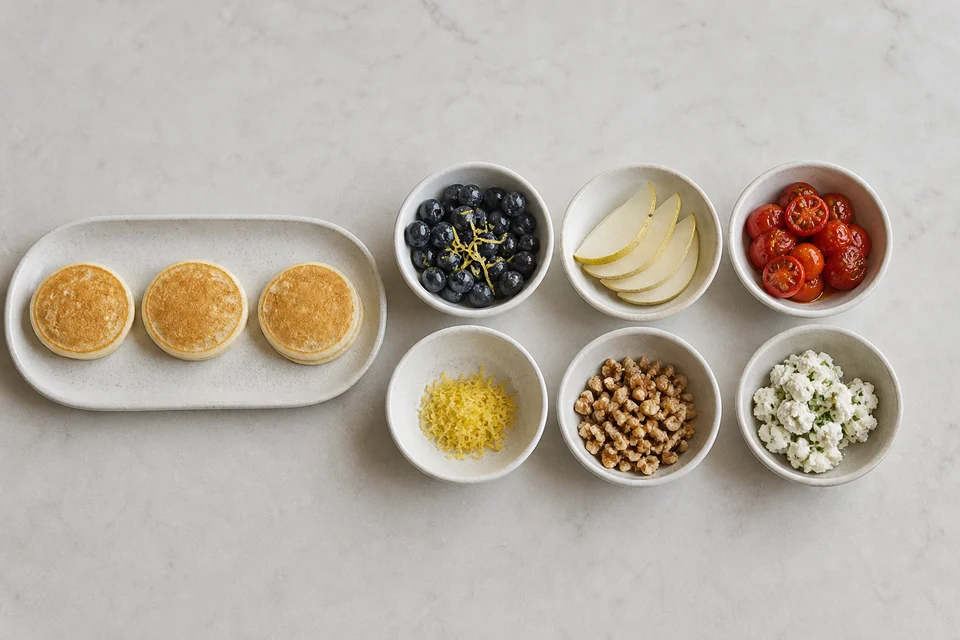
Combination 1: berries, lemon, and yogurt
What makes it distinct
This is a fruit-led combination with three separate jobs. Berries provide the central fruit flavor; a little lemon zest supplies aroma and a sharper edge; yogurt provides a cool, creamy contrast. Keep the lemon as zest or a small finishing squeeze rather than turning the pancake into a sour dressing. The goal is to let the berries remain identifiable, not to make every element equally loud.
When to choose it
Choose it when the pancake itself is mild and you want a fresh-tasting topping without a syrup-heavy finish. If you want a larger set of fruit options first, the fruit toppings guide separates fresh fruit, macerated fruit, cooked fruit, and compote so you can choose the texture as deliberately as the flavor.
Its boundary
Do not assume yogurt, berries, or a nut garnish suits every guest. Select the actual product and serving method around stated dietary needs, and keep nuts separate when that is helpful. For cut or perishable produce, follow the package and food-safety guidance rather than treating a bright-looking bowl as a storage plan.
Combination 2: pear, walnut, and a tangy creamy note
What makes it distinct
Pear is gentle rather than intensely acidic, so this combination uses a tangy creamy element to keep it from reading as only soft and sweet. Walnut contributes a firmer, toasted texture; use a modest amount so it remains a contrast instead of becoming a blanket of crumbs. A mild soft cheese and a spoonful of yogurt are different choices, but each can supply the same creamy role—use one, not both by default.
When to choose it
This is a good option for a thicker, less sweet pancake or for a table where a composed, autumnal flavor direction is wanted. The pancake toppings collection is useful for finding other distinct categories, but do not turn its broad list into a shopping list for one stack.
Its boundary
Pear ripeness changes both juiciness and sweetness, so a fixed amount of added sweetener is not a reliable rule. Taste the pear first, then decide whether the creamy component needs to be plain, tangier, or left out. The contrast should clarify the pear, not bury it.
Combination 3: roasted tomato, herbs, and cheese
What makes it distinct
This option belongs on a pancake intended to work as a savory base. Roasted tomato offers concentrated savory-sweet character and moisture; herbs make the direction more specific; cheese supplies a creamy or salty accent. Keep the tomato portion contained so the pancake stays pleasant to pick up or cut. If the tomatoes are very juicy, drain or spoon them on at the table rather than soaking the whole surface.
When to choose it
Choose it when you want the topping to feel like one coherent savory course rather than breakfast dessert with a token savory garnish. The savory pancake toppings pairing guide can help you compare other savory directions, especially when cheese, herbs, and vegetables would otherwise be chosen at random.
Its boundary
This is not a reason to add every savory ingredient on hand. A strongly flavored cheese, cured meat, hot sauce, and roasted tomato may all be individually appealing but can erase the herb-and-tomato focus. Keep one assertive accent, then make the rest supporting components.
Combination 4: fruit compote with a separately held crunch
What makes it distinct
Compote is soft and spoonable, so it benefits from a contrast that is not another sauce. A toasted oat, seed, or nut topping can provide that contrast if it is added just before eating. Hold it separately until service: moisture is not a flaw in compote, but it will soften a crisp topping long before the diner gets the intended difference in texture.
When to choose it
Use this format when you already have a prepared fruit element and want to vary the bite without making a second fruit mixture. The fruit compote method gives the practical context for a stovetop compote; this article focuses on choosing what should accompany it, not on claiming a single best compote.
Its boundary
Crunchy additions can be unsuitable for an individual eater or incompatible with a particular allergy plan. Offer them as an optional, clearly named separate component instead of presenting the combination as universally appropriate. Avoid calling the combination healthier, lighter, or better for a medical diet; those claims depend on actual ingredients and the person eating them.

Texture additions that do more than add another sweet layer
Toasted nuts or seeds
Use these when the lead topping is soft, such as yogurt, ripe pear, or compote. Their job is a dry, crisp interruption, not sweetness. Sprinkle a small amount over individual pancakes so diners can decline them and the texture stays perceptible.
Fresh herbs or citrus zest
These are aromatic finishers, not a substitute for the lead topping. Herbs suit the tomato combination; lemon zest suits berries. Add them late and sparingly, then stop if they begin to make the stack taste like garnish rather than its main fruit or vegetable.
A cool creamy topping
Plain yogurt or another appropriately chosen creamy component can soften a sharp fruit direction or carry herbs beside tomato. It is most useful when the stack needs a temperature or texture contrast. If the pancake already has rich batter and a soft sauce, another creamy layer may simply duplicate softness.
What does not belong in the same combination
Leave out a topping when it repeats the lead's main role or prevents the intended texture from being noticed. A second syrup beside compote, two creamy spreads beside yogurt, or several forceful savory accents beside tomato are not signs of generosity; they are reasons the reader cannot identify what the combination is trying to do. A topping may return in a different stack with a different lead.
Also exclude a component when its serving requirement cannot be met. Perishable produce or dairy needs an appropriate plan, and a crunchy or allergen-sensitive addition is more useful as a clearly named optional component than as an assumed default. A good short list has a deliberate omission, not merely more ingredients.
Make a short list that survives the first bite
- Choose the lead: fruit, compote, roasted tomato, or one creamy component. State it in a few words before adding anything else.
- Choose one counterpoint: bright, tangy, herby, salty, or creamy. Do not add two counterpoints that solve the same problem.
- Choose one texture only when the lead is mostly soft. Keep it separate until it can stay crisp.
- Taste one assembled pancake. If the lead is missing, remove a competing topping before adding more sweetness, salt, or sauce.
- Serve optional or allergen-sensitive components separately and use current package directions and official handling guidance for the foods actually present.
Sources and editorial references
This is an original selection framework for flavor, texture, and service roles. It does not make nutrition, allergy-safety, medical-diet, or universal preference claims; use the actual ingredients, package information, and applicable food-safety guidance for the serving situation.
- Heterogeneous binary interactions of taste primaries: perceptual outcomes, physiology, and future directions: https://pubmed.ncbi.nlm.nih.gov/25069085/
- Food and beverage flavour pairing: A critical review of the literature: https://pubmed.ncbi.nlm.nih.gov/32466920/
- FDA — Selecting and Serving Produce Safely: https://www.fda.gov/food/buy-store-serve-safe-food/selecting-and-serving-produce-safely