Cottage cheese oatmeal pancakes
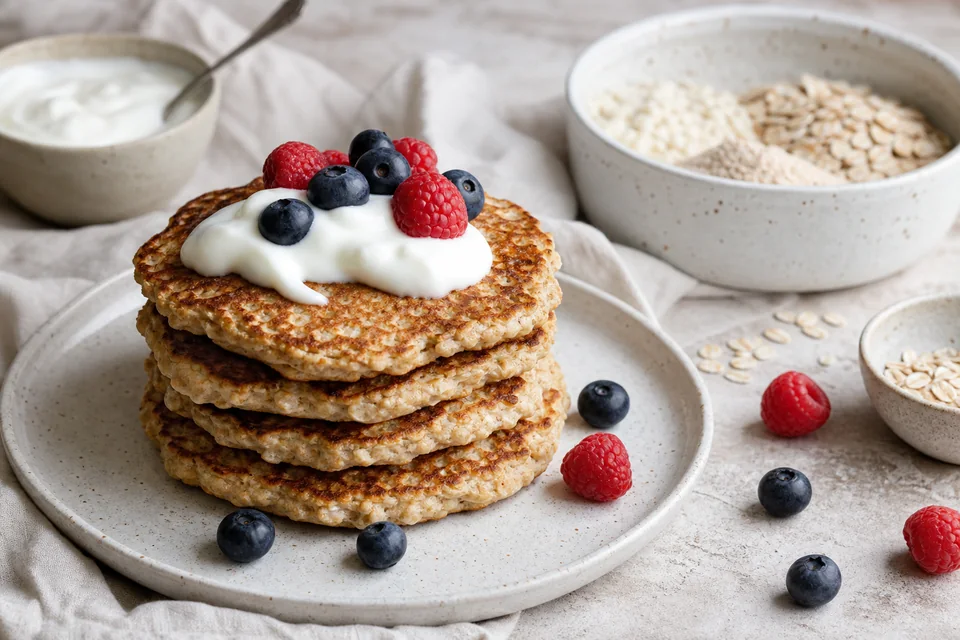
Cottage cheese oatmeal pancakes work best when the batter is treated as a small system: oats need time to take up moisture, cottage cheese brings variable liquid and curds, and egg—when the chosen recipe uses it—helps the pancake set. Start with the recipe’s quantities, rest only as directed, then cook one small test pancake before changing anything. Pancake World frames this as a technique guide, not a universal ratio or a house-tested recipe.
The working formula: match structure, moisture and heat
Use a complete recipe that names its oat form and cottage-cheese style. The useful formula is not one fixed proportion; it is a sequence of controls: measure the specified oat product, combine it with the specified dairy ingredient, wait for the written rest, and judge one small portion in the pan.
Route owner statement: choose a source formula, preserve its measurement system, and change one variable at a time.
Ingredient function map
| Part | Practical job | What to observe |
|---|---|---|
| Oats or oat flour | Provide grain body and take up moisture | Batter can tighten between mixing and cooking |
| Cottage cheese | Adds dairy moisture, milk solids and curd texture | Free liquid and curd size can change the scoop |
| Egg, if used | Helps the cooked portion hold together | A turn becomes easier after the edge has set |
| Leavener, when specified | Supports lift within the formula | It cannot repair a thin or over-rested batter |
| Pan heat and fat | Control spread, browning and release | Colour is not a complete doneness test |
USDA FoodData Central lists oats and cottage cheese as distinct foods with individual composition records. That identifies ingredients; it does not prove that two products behave identically in a pan.
Choose the oat form before measuring
Rolled oats, quick oats and oat flour are not interchangeable labels. Their particle sizes differ, so a recipe written for one form may rely on its hydration pace and texture. Grinding oats at home changes particle size but does not establish a match with commercial flour or the source formula.
Read cottage cheese as a moisture variable
Before mixing, note whether the product looks loose or thick and whether it has small or large curds. Do not drain, dilute or substitute it automatically: each action changes the liquid-to-solid balance of the selected formula. If you switch brands or fat levels, keep the scoop, pan and routine fixed for the first batch.
Batter consistency: a controlled range, not a guessed number
At the recipe’s cooking point, the batter should portion consistently: it should fall in the intended mound or spread in the intended amount without being forced thin. Compare the first and second scoops after the same rest interval. If the second is tighter, confirm oat form and rest time before adding liquid. If it is looser, confirm measurements and the cottage-cheese product.
Use a small pan trial
- Preheat according to the chosen recipe.
- Portion a small, repeatable amount.
- Watch for edge set, a less-wet surface and clean spatula entry.
- Turn only when the portion supports the turn rather than smearing.
- Cool briefly, then assess the centre rather than relying on colour.
Pan material, fat, sweetener and heat can alter browning. A small trial reveals spread and handling before the full bowl is affected.
Doneness cues that travel better than colour
Look for a stable edge, a surface that has lost its wet shine, and a portion that releases without tearing. After turning, follow the source recipe’s timing and centre check. Do not taste raw batter containing flour or egg. FDA consumer guidance supports safe handling boundaries; this article does not set a storage window or internal temperature for an unspecified recipe.
Troubleshooting by one variable
| Signal | First check | Controlled next move |
|---|---|---|
| Batter thickens quickly | Oat form and rest duration | Return to the source method before adding liquid |
| Pancake spreads and tears | Measurement, pan heat and edge set | Make a smaller test portion; change one listed variable only |
| Centre seems pasty | Portion thickness and heat guidance | Reduce portion size or follow the source heat adjustment |
| Texture feels rubbery | Blend duration and structural ingredients | Compare one small batch with one changed variable |
Substitutions must preserve a function
Replacing rolled oats with oat flour changes grain structure and hydration behaviour; replacing cottage cheese changes dairy moisture and curd texture; omitting an egg from a formula that uses one changes how the cooked pancake holds together. None is a verified one-for-one swap unless the source formula says so. For broader pan mechanics, use the pancake troubleshooting guide; for breakfast planning, see muesli breakfast ideas.
A comparison protocol for the next batch
Keep the pan, scoop, heat routine and evaluation point constant. Change one source-permitted variable in one small portion and leave the other untouched. Record spread, edge set, turn, centre and cooled texture. This is a practical record, not a claim of laboratory testing. The American pancakes guide covers a separate basic griddle method.
Storage boundary
Cool cooked pancakes and refrigerate them according to the handling guidance applicable to the ingredients and complete recipe. A warm exterior is not evidence that the centre is adequately reheated.
Related reading
Practical formula checklist
Choose the oat form named by the recipe; note cottage-cheese texture; measure in that formula’s system; wait only for its stated rest; make one small pan trial; use edge set and centre cues instead of colour alone; then change one variable only. This makes cottage cheese oatmeal pancakes more predictable without inventing a universal ratio.
Sources and editorial references
- USDA FoodData Central, food-composition database: https://fdc.nal.usda.gov/
- U.S. Food and Drug Administration, Food Safety at Home: https://www.fda.gov/consumers/consumer-updates/food-safety-home
- University of Nebraska–Lincoln, Food science resources: https://food.unl.edu/article/nutrition-education-program-nep/food-science/
- USDA FoodKeeper food-storage guidance: https://www.foodsafety.gov/keep-food-safe/foodkeeper-app