
Quick answer
Yes. Fully cooked ham-and-cheese pancakes can be frozen when they are cooled promptly, separated so they do not weld together, wrapped against air, labelled, and reheated thoroughly. The filling makes the job more demanding than freezing a plain pancake: cheese releases fat and moisture as it warms, ham is perishable, and a thick folded pancake can heat unevenly. Freeze only pancakes that have been handled safely and still have a known storage history.
For the best texture, keep the filling modest, cook away excess vegetable or meat moisture before assembly, and cool the pancakes in a single layer. Freeze individual pieces first if they are soft, then pack them together with parchment. Reheat only the portions you will eat. A dry skillet or oven gives more surface control; a microwave is faster but softens the exterior.
Decide whether this batch is suitable
Freezing preserves the condition of food; it does not repair a doubtful batch. Start with pancakes whose ham was cooked or ready to eat as specified by the recipe, whose cheese was kept chilled, and whose centres were fully cooked. If the pancakes were left at room temperature for an uncertain period, repeatedly warmed and cooled, or stored without a date, do not use the freezer as a reset button.
Check the construction too. A pancake with a restrained cheese-and-ham layer freezes more evenly than an overfilled parcel. Wet tomato, undrained spinach, thin sauce, or watery mushrooms create steam during reheating and can soak the crumb. That is a quality problem rather than proof of danger, but it is easier to prevent before freezing than fix afterward.
Plain cooked pancakes follow the broader freeze homemade pancakes guide. This page owns the filled-pancake question and accounts for the meat-and-dairy centre.
Cool without trapping steam
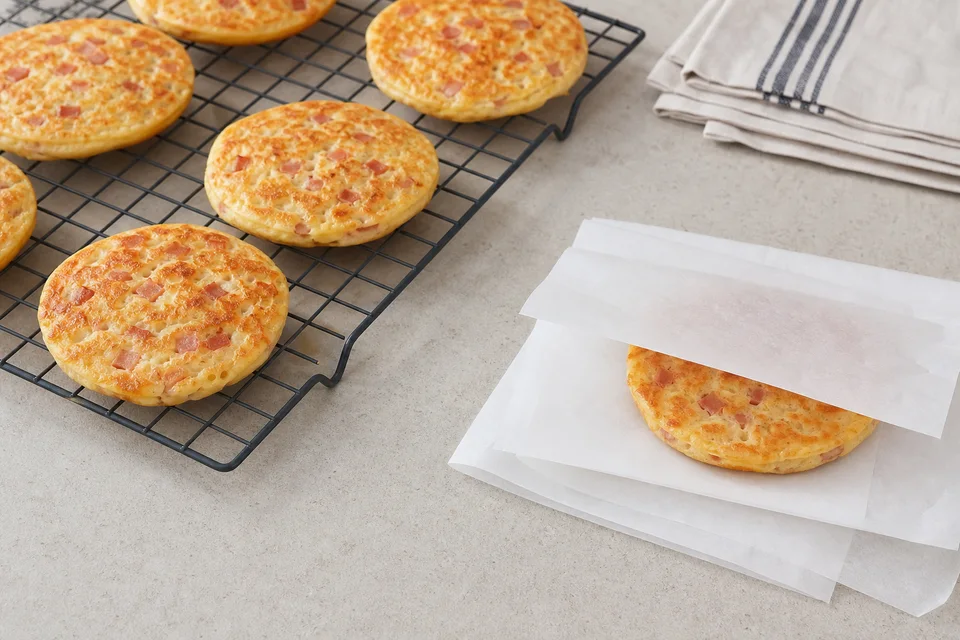
Move cooked pancakes out of the hot pan and arrange them in one loose layer on a clean rack or tray. Do not immediately stack hot pieces in a sealed container. Trapped steam condenses on the surfaces, and that moisture later freezes into crystals and returns to the crumb during reheating.
Cooling should be prompt, not an hours-long display on the counter. Divide a large batch across two racks if necessary. Once the pancakes are no longer steaming and are ready for cold storage, continue to the freezer workflow rather than leaving them out while the rest of breakfast is served. Follow current official leftovers guidance for time and temperature boundaries.
Wrap and freeze step by step
- Inspect the pancakes. Confirm that each one is cooked through and that no filling is leaking heavily.
- Cool in a single layer. Let surface steam escape through a prompt cooling plan.
- Add separators. Place a square of baking parchment between pancakes so cheese at the edges cannot bond the stack.
- Firm soft pieces first. If the pancakes bend or compress easily, freeze them in one layer on a tray until firm.
- Pack against air. Transfer the separated pieces to a freezer-safe container or bag and remove excess air without crushing them.
- Label clearly. Record the food, filling, and freezing date. Note any allergen or recipe variation if several batches share a freezer.
- Freeze flat. Keep the package level until the fillings are firm, then store it where it will not be bent by heavier items.
Small meal-size packages are more useful than one large block. They let you take out two pancakes without warming and refreezing the rest. The full pancake storage guide explains the same packaging logic for other pancake types.
Thaw or reheat from frozen?
Thin, modestly filled pancakes can often be reheated from frozen. Thick folded pancakes may warm more evenly after a refrigerator thaw. Do not default to a long counter thaw for a perishable ham-and-cheese filling. If commercial ham, cheese, or prepared pancakes carry instructions, those product directions take priority.
Pieces frozen separately are easier to reheat. If two pancakes are stuck, do not pry them with a sharp knife while frozen. Move the package to the refrigerator until the separator releases, or use the selected reheating method only if it safely separates and heats the pieces.
Reheat in a skillet
A covered skillet is useful when you want a drier outside and a thoroughly warmed centre. Begin with gentle heat, place one or two pancakes in the pan, and cover briefly so warmth reaches the filling. Turn as needed for even heating. Remove the cover near the end if the exterior needs to dry.
Do not use a dark crust as the only endpoint. A thick pancake can brown before the cheese-and-ham centre is hot. Cut the first reheated piece or use an appropriate thermometer when the structure permits a reliable reading. USDA leftovers guidance gives 165°F / 74°C as the reheating endpoint for leftovers.
Reheat in an oven
An oven suits a family-size batch. Arrange pancakes in one layer on a suitable tray rather than stacking them. Covering at the beginning can limit drying; uncovering briefly at the end can improve the surface. Exact time depends on thickness, whether the pancakes are frozen or thawed, the tray, and the appliance, so use the centre rather than a universal minute count.
Keep wet toppings out of the oven. Yogurt, chutney, fresh herbs, or salad belong on the plate after reheating. A light cheese garnish can brown before the interior warms and should not be used to judge doneness.
Reheat in a microwave
The microwave is fastest for one portion, but it encourages a soft surface and can create hot and cold pockets. Place the pancake on a microwave-safe plate, cover as appropriate for the appliance, and heat in short stages. Pause, turn or rotate, then verify the centre. Let the piece stand briefly so heat can distribute before checking again.
Avoid heating a deep stack. The outside pieces can toughen while the middle remains cool. If a microwave makes the surface damp, a brief finish in a dry skillet may restore some texture, provided the pancake is still handled promptly and the extra step does not become repeated reheating.
Why the filling can become watery
Cheese does not return to its exact freshly melted state after freezing. Fat can separate and moisture can migrate into the pancake. Ham may also release liquid, particularly when thick pieces or a wet glaze were used. That does not mean freezing failed; the practical goal is a pleasant reheated pancake, not a perfect duplicate of the pan-fresh one.
For the next batch, dice ham small, blot obvious surface moisture, use a cheese that works in the recipe, and avoid overfilling. Cook mushrooms, onions, or spinach until their free moisture is controlled. Cool the finished pancakes uncovered in one layer before packaging.
Current-batch fixes
The outside is hot but the centre is cool: Lower the intensity and give the centre more time through a covered skillet or oven method. Do not keep scorching the surface.
The pancake is soggy: Remove excess condensation, then finish briefly in a dry skillet or uncovered oven if the recipe tolerates it. A wet pancake cannot be made fresh again, but surface moisture can be reduced.
Cheese has leaked out: Let it set briefly before moving the pancake. Use a broad spatula and reduce filling in the next batch.
The edges are dry: Stop reheating. Serve with a small suitable moist accompaniment rather than adding more heat.
The handling history is unclear: Discard rather than relying on smell, appearance, or reheating to resolve uncertainty.
For general texture diagnosis, use the Pancake Troubleshooting hub.
Prevent the next batch from becoming soggy
Build freezer success into the recipe. Make pancakes of similar size and thickness, keep fillings away from the edge, and cook one test piece before assembling the full batch. Record which cheese, ham cut, portion, and reheating method worked. If the batch is intended mainly for freezing, package one pancake as a trial and reheat it the next day before committing the remaining mixture.
Separate toppings from the pancakes. Fresh tomato, lettuce, yogurt sauce, and herbs do not need to be frozen inside. Keeping them fresh protects the pancake structure and gives the reheated plate contrast.
FAQ
Can I freeze pancakes with deli ham and cheese?
Yes, if every product was stored and used as directed, the pancakes were fully cooked, and they enter a prompt cooling and freezing workflow. Check labels because deli meats and cheeses differ.
Should I freeze them cooked or uncooked?
Freeze them fully cooked. Raw batter, raw flour, egg, ham, and cheese create a different handling problem and may not cook evenly from frozen.
Can I freeze a whole stack together?
You can pack a stack only with separators, but meal-size packages are better. They reduce sticking and let you remove a portion without disturbing everything else.
Do I need to thaw before reheating?
Not always. Thin separated pieces can often reheat from frozen; thick filled pancakes may warm more evenly after refrigerator thawing.
How do I keep the cheese filling from making the pancake wet?
Use a restrained filling, control moisture in all additions, cool before wrapping, and reheat in a single layer. Add wet accompaniments only after heating.
Related Pancake World guides
Read how to freeze homemade pancakes for the plain-pancake baseline, review how to store pancakes for packaging choices, and compare reheating appliances in easy steps for cooking pre-made pancakes.
Sources and editorial references
- USDA Food Safety and Inspection Service: Leftovers and Food Safety —
https://www.fsis.usda.gov/food-safety/safe-food-handling-and-preparation/food-safety-basics/leftovers-and-food-safety - U.S. Food and Drug Administration: Food Safety at Home —
https://www.fda.gov/consumers/consumer-updates/food-safety-home
For more practical food and breakfast guides, visit Pancakes World.
For the wider topic, start with Guides/storing And Reheating Pancakes.
For a closely related guide, see Can You Freeze Eggless Pancakes?.
A useful next comparison is Recipes to Make with Leftover Ham.
You can also continue with Freeze Pancakes Without Sticking Together.
For another practical angle, read How to Compare Frozen Pancakes by Label and Reheating Method.
