
Quick answer
Savoury vegan crêpes can be thin, flexible, and easy to fold without eggs or dairy. The dependable guide is a simple flour-and-liquid batter with a little oil, enough rest for full hydration, a properly preheated pan, and a filling cooked separately so it does not flood the crêpe with moisture. Egg replacer is not automatically necessary: wheat flour can provide the basic structure when the batter ratio and handling are right.
This recipe makes about eight medium crêpes and fills them with mushrooms, spinach, garlic, and herbs. It is vegan only when every ingredient—including plant drink, cooking fat, stock or seasoning, and any finishing sauce—is verified from its label. It is not gluten-free. If that is your requirement, use the dedicated vegan gluten-free crêpe guide rather than swapping flour inside this formula and expecting the same behavior.
Ingredients
For the crêpes
- 150 g all-purpose flour
- 350 ml unsweetened plant drink, plus a small amount only if needed after resting
- 1 tablespoon neutral oil, plus a thin film for the pan
- 1/4 teaspoon fine salt
- 1 teaspoon mild mustard, optional, for savoury depth
- Black pepper or finely chopped soft herbs, optional
Choose a plant drink without strong sweetness or vanilla. Different products vary in solids, gums, protein, and thickness, so the post-rest consistency is more useful than brand-independent promises. The batter should pour easily and sweep across a tilted pan in a thin film; it should not sit like American pancake batter or run like plain water.
For the mushroom-spinach filling
- 300 g mushrooms, sliced evenly
- 200 g spinach, washed and dried
- 1 small shallot, finely sliced
- 1 garlic clove, finely chopped
- 1 tablespoon neutral oil
- 1 teaspoon lemon juice, added to taste
- Chopped parsley or chives
- Salt and black pepper
The filling is deliberately simple. White beans, cooked lentils, roasted peppers, or sautéed leeks can make it more substantial, but add-ins should be fully cooked, drained, and not excessively bulky. The collection of 22 savoury pancake recipes offers other formats when a thin folded crêpe is not the best carrier.
Make the batter
Whisk the flour and salt in a bowl. Make a well, add roughly one third of the plant drink, and whisk from the center until a smooth thick paste forms. Add the remaining liquid gradually, then whisk in the tablespoon of oil and optional mustard. This staged mixing is easier than chasing dry flour lumps through a full bowl of thin liquid.
Rest the batter for 30 minutes at cool room temperature while you prepare the filling and pan. The rest lets flour hydrate and bubbles settle. It is not a magic timer: a very warm kitchen, a different flour, or an unusually thick plant drink changes what you observe. After resting, stir from the bottom. If the batter no longer flows readily, add plant drink one teaspoon at a time. Avoid a large correction before cooking a test crêpe.
Raw flour is not ready-to-eat, so do not taste the uncooked batter. Wash utensils and surfaces that contact it before they touch finished crêpes or garnishes.
Cook a dry, flavorful filling
Heat a wide skillet, add the oil, and cook the mushrooms in a roomy layer. Let released moisture evaporate before adding the shallot. When the mushrooms are browned and the shallot is soft, add garlic briefly, then add spinach in batches. Cook until the leaves are wilted and free liquid has evaporated.
Remove the pan from the heat. Season with salt, pepper, herbs, and enough lemon to brighten the mixture without making it wet. Transfer the filling to a bowl rather than leaving it on a hot surface where it can continue shrinking. If liquid collects at the bottom, drain it before filling. Moisture control matters more than an oversized pile: a thin crêpe tears when asked to contain a steaming puddle.
Cook the vegan crêpes
Preheat and oil lightly
Use a well-seasoned or reliable nonstick skillet with a broad flat base. Warm it over medium heat, then wipe on a very thin film of oil. One fixed burner number cannot describe every pan and appliance. A small batter drop should set in a controlled way; smoking oil or immediate dark speckles indicate too much heat.
Run one calibration crêpe
Stir the batter, lift a measured ladleful, and pour it just off center. Immediately tilt and rotate the pan so the batter travels into a thin round. Stop adding batter once the base is covered. Cook until the top loses its wet shine, the edge looks dry, and a thin spatula can slide beneath without pulling a gummy trail.
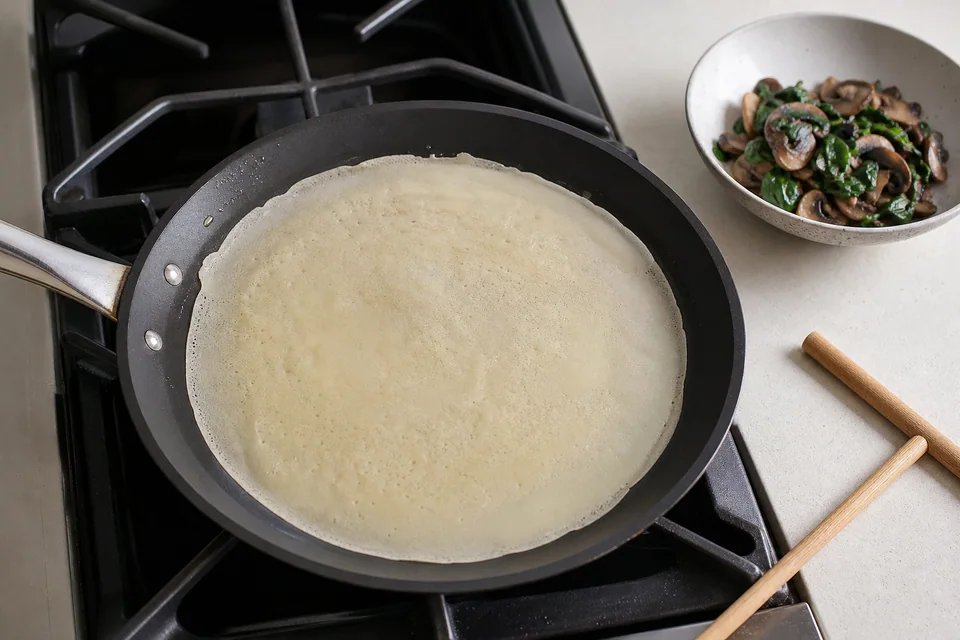
Turn once. The second side normally needs less time because the structure is already set. Transfer to a plate and assess the calibration crêpe before continuing. If it is thick but flexible, use slightly less batter. If it tears while spreading, let the pan recover heat and check whether the batter is too thin. If it becomes brittle, reduce cooking time before changing the formula.
Keep the batch consistent
Stir gently before each pour because flour settles. Reapply only a trace of oil when the pan looks dry; visible pools leave lacy fried edges and make browning uneven. Stack cooked crêpes and cover them with a clean towel so retained steam keeps them supple. Do not seal piping-hot crêpes in an airtight container, where condensation can make them wet.
Fill and fold
Place one warm crêpe with its best-looking side down. Spoon filling along one quadrant or in a short line through the center, leaving a clear border. Fold in half and then into a triangle, or roll it loosely. A crêpe that must be stretched around the filling is overfilled.
Serve two per person with a crisp salad, roasted vegetables, or a spoonful of a verified vegan sauce. For more pairing logic, the savory pancake toppings guide explains how to balance a soft base with acidity and crunch.
Current-batch problems and fixes
The batter will not spread: Take the pan off the heat for the next pour and work faster. If the rested batter is genuinely thick, whisk in plant drink one teaspoon at a time. Do not pour a second layer over a half-set first layer.
The crêpe tears during turning: Let the first side set longer and slide the spatula under a wider area. A tear that occurs before the edge dries usually points to timing or a cool surface. If every crêpe tears even after a full set, cook a smaller round before adjusting liquid.
The surface sticks: Stop scraping. Let the damaged crêpe cook through, remove it in pieces, clean the pan, and restore a thin oil film. Residue from one tear will make the next one stick. For a wider diagnostic, use the Pancake Troubleshooting hub.
The crêpe is crisp rather than flexible: Shorten the cook after the turn and stack it under the towel while warm. If the pan is aggressively hot, lower it slightly and allow the surface to stabilize before the next pour.
The filling leaks: Return the filling to a pan and evaporate free moisture. Keep the cooked crêpes covered while you do so. Do not use flour to thicken a finished wet filling unless you will cook that flour fully and accept a changed texture.
The flavor is flat: Season the filling, not the entire batter bowl, first. A pinch of salt, herbs, lemon, or mustard can clarify flavor without making all eight crêpes increasingly salty.
Prevent problems in the next batch
Weigh the flour, use the same ladle, and note the plant drink. Record the batter’s appearance immediately after mixing and after its rest. Measure how much fills your specific pan, and identify the surface cue that preceded a clean release. That record is more transferable than “medium heat for two minutes.”
Cook the filling before the first crêpe so the batter does not sit indefinitely and the pan is not abandoned mid-batch. Keep mushrooms in a roomy layer, dry spinach well, and cool or drain the finished filling. Change one variable per retry: portion for thickness, heat for color, first-side set for tearing, or filling moisture for leakage.
Make-ahead, storage, and limitations
Cool unfilled crêpes promptly on a rack or separated plates, then stack them with reusable separators or parchment once steam has dispersed. Refrigerate in a covered container under applicable leftovers guidance. Reheat briefly in a skillet until flexible. Fill after reheating for the best surface and to keep moist vegetables away from the crêpes during storage.
Store the cooked filling separately and follow safe cold-storage practices for every ingredient. Do not leave the batter or cooked food at room temperature for an open-ended period. Discard food that has exceeded safe handling limits rather than relying on smell or appearance.
This is a wheat-flour vegan home recipe, not a definitive French regional galette. Buckwheat terminology and traditional formulas need their own context; the guide to French savory crêpes and galettes owns that distinction.
FAQ
What replaces the egg in vegan crêpes?
In this formula, no single ingredient imitates an egg. Hydrated wheat flour provides the basic network, oil limits dryness, and correct pan setting makes the thin round handleable. Other vegan formulas use starches, flax, or commercial replacers, but they require their own ratios.
Can I make these crêpes gluten-free?
Not by swapping flour one for one. Gluten-free batters have different hydration and binding needs. Use the complete vegan gluten-free crêpe method instead.
Why is the first vegan crêpe often uneven?
It calibrates pan heat, oil, portion, and batter flow. Use its result to make one small correction. If it is pale and sticky, allow the pan to recover; if it sets before spreading, cool the pan slightly or reassess thickness.
Can I use water instead of plant drink?
Another formula may use water, but changing all the liquid here alters flavor, browning, and consistency. If you experiment, make a small test batch and adjust from the observed flow rather than assuming an identical result.
Which fillings stay inside best?
Cooked, drained, finely cut fillings work best: mushrooms and greens, lentils with roasted vegetables, or soft beans with herbs. Cool very hot fillings briefly and keep sauces restrained until serving.
Related Pancake World guides
Browse 22 savoury pancake recipes for different bases, use the savory toppings guide to build a plate, and switch to the vegan gluten-free crêpe guide when wheat is unsuitable. Persistent sticking or tearing belongs at Pancake Troubleshooting.
Sources and editorial references
- U.S. Food and Drug Administration: Handling Flour Safely —
https://www.fda.gov/consumers/consumer-updates/handling-flour-safely-what-you-need-know - USDA Food Safety and Inspection Service: Leftovers and Food Safety —
https://www.fsis.usda.gov/food-safety/safe-food-handling-and-preparation/food-safety-basics/leftovers-and-food-safety - U.S. Food and Drug Administration: Food Allergies —
https://www.fda.gov/food/buy-store-serve-safe-food/food-allergies-what-you-need-know
For more practical food and breakfast guides, visit Pancakes World.
For the wider topic, start with Guides/pancake Ingredients.
For a closely related guide, see Vegan Waffles: Build Crisp Edges Without Eggs.
A useful next comparison is Scrambled Egg and Crêpe Breakfast Casserole.
You can also continue with 9 Vegan Chocolate Crepe Ideas.
