
Quick answer
A combination-building guide spanning sweet toppings and enclosed fillings, emphasizing balance and structure. The practical target is a topping or filling that supports the pancake rather than making it soggy, unstable, or monotonous. The emphasis is pairing logic and filling structure; related guides offer a fixed topping list and a breakfast-only decision path.
Begin the test for pancake toppings and fillings: build better combinations with “Start with the pancake.” Watch how one cooked pancake base suited to the planned format behaves as the edge sets and the underside releases, then inspect the thickest center for a topping or filling that supports the pancake rather than making it soggy, unstable, or monotonous. That first result tells you more than borrowing a pan setting or cooking time from a different batter.
What success looks like
The finished result should show a topping or filling that supports the pancake rather than making it soggy, unstable, or monotonous. It should also fit the promised serving format: a stack must remain stable, a fold must stay flexible, and a delicate foam or alternative-flour pancake must be supported during turning. Flavor, texture, and safety are separate judgments; a browned surface is useful culinary information but not proof that a raw egg center is safe.
The build plan runs from one cooked pancake base suited to the planned format to one restrained sauce or creamy element, and the first method decision is “Start with the pancake.” Keep those controls stable while calibrating portion and heat; otherwise a change in the formula can be mistaken for a pan problem.
Ingredients or build plan
- one cooked pancake base suited to the planned format
- one main flavour: fruit, vegetable, cheese, nut, or chocolate
- one contrasting element: acidity, salt, bitterness, or gentle spice
- one texture: toasted nuts, seeds, crisp vegetables, or fresh fruit
- one restrained sauce or creamy element
Treat one cooked pancake base suited to the planned format as the opening control and one restrained sauce or creamy element as the final recipe-specific addition, not as parts of a universal pancake ratio. Make a measured adjustment only when the test pancake fails to approach a topping or filling that supports the pancake rather than making it soggy, unstable, or monotonous.
Prepare before cooking
Decide whether the pancake will be stacked, folded, or rolled. A stack tolerates loose toppings better than a filled roll. Cool wet compotes until thick, drain cooked vegetables, and keep crunchy items separate until serving.
This guide starts with cooked pancakes and one cooked pancake base suited to the planned format. Keep chilled components chilled, warm components hot, and crunchy elements dry until plating. The preparation rule that matters most here is: Decide whether the pancake will be stacked, folded, or rolled. A stack tolerates loose toppings better than a filled roll. Cool wet compotes until thick, drain cooked vegetables, and keep crunchy items separate until serving.
Method
Start with the pancake
A thick American pancake benefits from spoonable toppings. A thin pancake can wrap a filling but needs a drier mixture. A delicate alternative-flour pancake should carry lighter toppings so it does not tear.
Choose one lead flavour
Let berries, apples, mushrooms, spinach, or cheese establish the plate. Too many equal-strength leads create clutter. Supporting elements should add contrast rather than repeat the same sweetness or richness.
Control moisture
Reduce fruit until it coats a spoon, drain yogurt if it is loose, and cook vegetables until excess water is gone. Put sauces over the finished plate, not into a filling that must hold a fold.
Add contrast
Acid brightens a rich filling; salt sharpens a sweet one; toasted nuts add crunch to soft pancakes. Use contrast in a small amount so the lead flavor remains identifiable.
Assemble at the right moment
Spread fillings while pancakes are warm and flexible, but add crisp components at the table. Serve a stack soon after saucing because every pancake surface continues absorbing moisture.
Fix the current batch
Start current-batch triage with “Stack slides,” because it is the first likely failure for this formula. Preserve any pancake already showing a topping or filling that supports the pancake rather than making it soggy, unstable, or monotonous, and change only the part of the process connected to that observed defect.
Stack slides
Remove excess sauce and use a thicker creamy layer between pancakes. Keep the stack shorter. Record what changed so the correction can be repeated or rejected on the next pancake.
Rolled pancake tears
Reduce filling, chop pieces smaller, and use a more flexible pancake. Keep sauce outside the roll. Record what changed so the correction can be repeated or rejected on the next pancake.
Plate tastes too sweet
Add plain yogurt, citrus, toasted nuts, or a small pinch of salt instead of another sweet topping. Record what changed so the correction can be repeated or rejected on the next pancake.
Savory filling tastes heavy
Add lemon, herbs, or crisp salad and reduce cheese or cream rather than increasing batter seasoning. Record what changed so the correction can be repeated or rejected on the next pancake.
Variations and serving
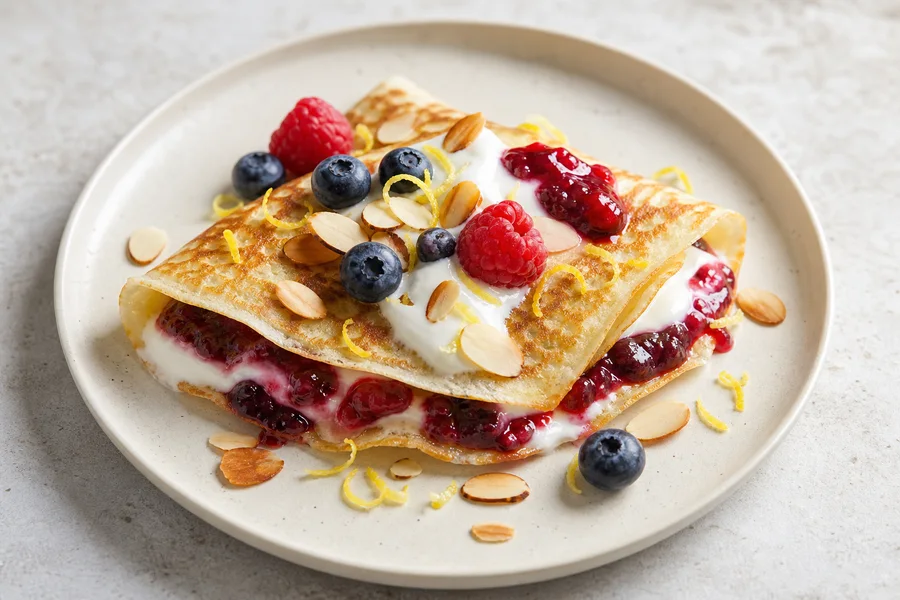
Reliable sweet combinations include berries with yogurt and toasted almonds; apple with cinnamon and walnuts; banana with tahini and cocoa; and citrus curd with lightly sweetened cream. Savory combinations include mushroom with spinach and herbs; roasted pepper with cheese; smoked fish with cucumber and dill; and sweetcorn with spring onion and yogurt.
Plate pancake toppings and fillings: build better combinations so a topping or filling that supports the pancake rather than making it soggy, unstable, or monotonous remains visible. The serving direction begins “Reliable sweet combinations include berries with yogurt and toasted almonds; apple with cinnamon and walnuts; banana with tahini and cocoa; and citrus curd with lightly sweetened cream”; keep that addition restrained enough to show whether the pancake itself reached the intended texture.
Prevent problems in the next batch
Write down the pan, burner setting, portion size, and the one adjustment that improved the current batch. For pancake toppings and fillings: build better combinations, the most useful record is whether the result moved closer to a topping or filling that supports the pancake rather than making it soggy, unstable, or monotonous. A note such as “lower heat” is incomplete without the pancake size and observed center.
After “Stack slides,” alter only the correction named in that diagnostic before repeating “Start with the pancake.” Changing portion, heat, and one cooked pancake base suited to the planned format together would hide which action moved the result toward a topping or filling that supports the pancake rather than making it soggy, unstable, or monotonous.
Use the first pancake to test the relationship between one cooked pancake base suited to the planned format and one restrained sauce or creamy element. Its spread shows whether the build plan is coherent, its release tests the pan, and its center reveals whether “Start with the pancake” produced a topping or filling that supports the pancake rather than making it soggy, unstable, or monotonous.
Food safety
These topping plans begin with fully cooked pancakes, so the safety boundary moves to the accompaniments: one cooked pancake base suited to the planned format and one restrained sauce or creamy element must be stored and served as their ingredients require. Prepare only what can be plated promptly, keep perishable toppings out of prolonged warm holding, and never use appearance alone to judge a questionable ingredient.
A practical batch notebook
Before cooking, record the starting formula and the intended serving format. During cooking, note the first pancake’s diameter, visible edge behavior, underside color, and center texture. After cooking, record only the correction that genuinely improved a topping or filling that supports the pancake rather than making it soggy, unstable, or monotonous. This creates evidence for the next batch without turning one kitchen result into a universal claim.
When changing one cooked pancake base suited to the planned format or one restrained sauce or creamy element, restart with the same pan and portion used for “Start with the pancake.” Compare the new result with a topping or filling that supports the pancake rather than making it soggy, unstable, or monotonous, then apply the smallest correction suggested by “Stack slides” instead of forcing the variation to behave like a different formula.
Frequently asked questions
What is the difference between a topping and a filling?
A topping sits on the finished pancake and can be looser. A filling must remain contained during folding or rolling, so moisture and piece size matter more.
Can I mix sweet and savory?
Yes, when the bridge is deliberate: fruit with salty cheese, honey with herbs, or apple with a savory sausage plate. Start with one small crossover element.
How do I keep fruit from soaking pancakes?
Cook it to a spoon-coating consistency, cool briefly, and assemble close to serving. Keep fresh watery fruit in a separate layer.
Should every plate have syrup?
No. Compote, yogurt, nut butter, sautéed vegetables, or a thick filling may provide enough moisture and flavor.
Related Pancake World pages
- 31 delicious pancake flavors for breakfast
- delicious sides to serve with pumpkin pancakes
- Pancake troubleshooting
Sources and editorial references
- U.S. Food and Drug Administration, Flour Is a Raw Food and Other Safety Facts —
https://www.fda.gov/consumers/consumer-updates/flour-raw-food-and-other-safety-facts - USDA Food Safety and Inspection Service, Shell Eggs from Farm to Table —
https://www.fsis.usda.gov/food-safety/safe-food-handling-and-preparation/eggs/shell-eggs-farm-table
For more practical food and breakfast guides, visit Pancakes World.
For the wider topic, start with Guides/pancake Toppings.
For a closely related guide, see Best Pancake Toppings for the Breakfast You Want.
A useful next comparison is Best Toppings for a Balanced Pancake Plate.
You can also continue with Savoury Pancake Fillings for a Better Brunch.
For another practical angle, read 18 Crepes with Leek Fondue and Coconut Bacon.
