Whole wheat flour pancakes
At Pancakes World, for reliable whole wheat flour pancakes, choose the flour strategy before choosing the toppings: use a 50:50 blend of wholemeal and white flour for a gentler texture, or follow a formula written specifically for 100% wholemeal flour when you want the fuller grain character. Weigh or carefully measure the flour, add liquid as the chosen recipe directs, mix only until the dry patches disappear, and let the batter rest before judging thickness. Whole-grain flour can absorb liquid more slowly, so thinning immediately may produce an over-loose batter later. Cook a small first pancake over medium heat and adjust from evidence in the pan, not from guesswork.
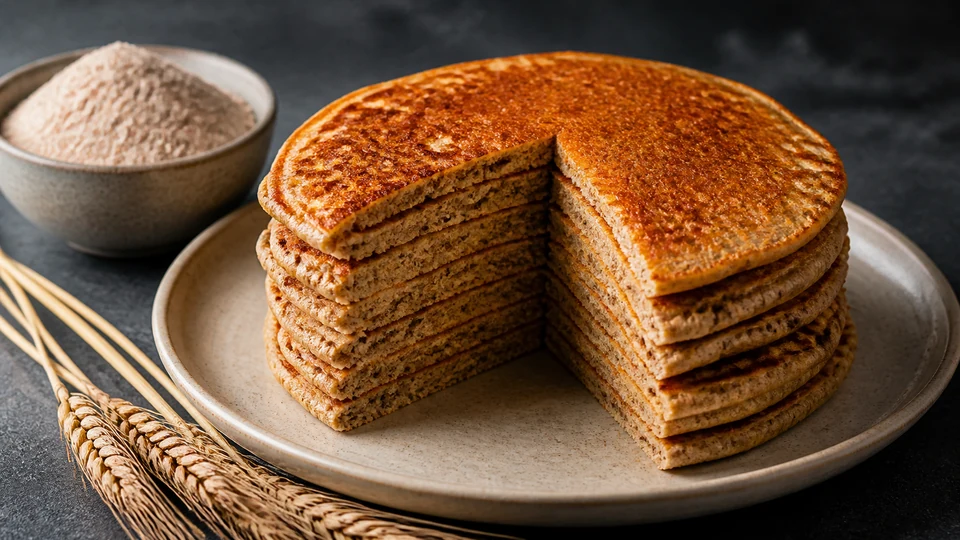
This is a technique and selection guide, not a recipe claimed as tested by Pancake World. The pancake science hub explains related batter decisions, while Pancake World connects the broader collection.
For broader context, continue with Pancake Ingredients and Substitutions.
Direct answer: which flour approach should you use?
Choose one of these two defensible paths.
| Your priority | Better starting route | What to expect | What not to do |
|---|---|---|---|
| An easier transition from ordinary pancakes | A published recipe using half wholemeal and half white flour | The white flour moderates the wholemeal proportion while the recipe controls the rest of the structure | Do not replace the remaining white flour without revisiting the liquid and method |
| A clearly wholemeal pancake | A published formula developed around whole-grain or wholemeal flour | More pronounced grain flavour and a batter whose thickness may change during rest | Do not convert a white-flour recipe cup for cup and assume the same result |
| A thin British-style pancake | Find a complete thin-pancake formula that explicitly calls for wholemeal flour | A pourable batter and a thinner cooked profile | Do not apply thick American-style bubble cues blindly |
| A thick breakfast stack | Use a complete thick-pancake formula with chemical raising or aerated egg as specified | A spoonable batter and thicker centre that needs time to set | Do not turn up the heat merely to accelerate browning |
Good Food publishes a documented 50:50 pancake recipe using equal weights of self-raising and wholemeal flour. It adds milk gradually and uses separated, whipped egg whites for lift. King Arthur Baking publishes a whole-grain pancake formula with a 15-minute rest and a mix-until-moistened method. These are different systems. Follow one complete system rather than taking the flour from one, the liquid from another, and the leavening from a third.
Wholemeal, whole wheat and flour labels
The route phrase says “whole wheat,” while UK packs and recipes commonly say “wholemeal.” For a practical buying decision, the exact label and ingredient list matter more than assuming all brown-looking flour is the same. Wholemeal wheat flour includes the whole wheat grain components; a flour blend contains whatever proportion its label states. Spelt is a type of wheat, not a gluten-free substitute, and a darker colour alone does not prove a particular wholegrain percentage.
If a recipe specifies plain wholemeal flour, do not silently replace it with self-raising wholemeal flour. Self-raising flour already contains raising agents, so the swap changes more than the grain. Likewise, bread flour, very finely milled wholemeal flour and coarse stoneground flour may not produce identical batter behaviour. Use the type written in the chosen formula on the first attempt.
For someone avoiding gluten for coeliac disease, wheat allergy or another diagnosed reason, ordinary wholemeal wheat flour is not suitable. A wholemeal pancake is also not automatically dairy-free or egg-free. Read every ingredient label and choose a formula designed around the required exclusions instead of relying on an improvised one-for-one substitution.
Why the batter changes while it rests
King Arthur Baking’s whole-grain guide notes that whole-grain flours absorb liquid more slowly than all-purpose flour. Its whole-grain pancake recipe illustrates the practical consequence: the batter initially appears liquid and thickens during a 15-minute rest.
That does not establish one compulsory resting time for every flour and every pancake. It establishes a safer decision order:
- Mix the selected recipe as written.
- Stop when the dry ingredients are evenly moistened unless the method explicitly calls for another treatment.
- Give the batter the rest specified by that recipe.
- Stir only as the formula instructs, then observe whether it pours, ribbons or mounds as that style requires.
- Cook one sample before making a small correction.
This order prevents a common error: adding a large amount of extra milk while the flour is still hydrating. The eventual batter can then spread too far, cook too thinly or become difficult to turn. The opposite mistake is treating a rested batter as fixed. If the trial pancake scarcely spreads and remains pasty in the centre, a small measured liquid adjustment may be reasonable, but record it and reassess after mixing. Do not pour freely from the bottle.
A controlled mixing method
The Food Standards Agency’s pancake reformulation guidance describes how flour supplies structure, liquid hydrates the flour, egg can contribute structure and aeration, fat affects mouthfeel, and sugar affects sweetness and browning. These ingredients work as a system. Changing several at once makes the result hard to diagnose.
Set up the batter in this order unless your selected recipe says otherwise:
- weigh the flour for repeatability, or use the source’s stated measuring technique;
- distribute salt and chemical raising evenly through the dry mixture;
- combine the wet ingredients separately when directed;
- add wet to dry and mix only to the recipe’s endpoint;
- scrape the bottom and sides once so hidden flour pockets do not remain;
- rest for the specified interval;
- reserve additions such as berries, nuts or chocolate until the base consistency is established.
Small lumps are not necessarily a reason to keep beating a chemically raised pancake batter. Aggressive mixing can develop more structure and can also knock air from a method that relies on whipped egg whites. But “never mix” is equally unhelpful: unhydrated pockets of flour are a defect. The useful endpoint is even moisture with the minimum manipulation required by the chosen formula.
How to judge consistency without inventing a ratio
There is no honest universal milk-to-wholemeal-flour ratio for every pancake. Flour fineness, grain variety, storage, eggs, yoghurt or buttermilk, added oats and the desired thickness all change the system. Instead, compare the rested batter with the style promised by the source.
For a thick pancake, a portion should settle into a round rather than run across the entire pan. It must still relax enough that the centre is not a raw mound. For a thin pancake, the batter must flow readily enough to coat the pan, but it should not separate into watery edges and flour sediment.
Use the first pancake as a diagnostic:
- It spreads into a lace-edged puddle: confirm that the batter rested, the flour quantity was correct and no liquid was doubled. If the recipe permits adjustment, add only a small measured amount of the specified flour, then rest again.
- It stays as a tall mound: check whether the recipe expects a thick stack. If not, add a small measured amount of its specified liquid, mix gently and try again.
- It is brown before the centre sets: reduce the pan heat. Do not use a dark surface as proof that the interior is cooked.
- It is pale and dry after a long cook: the heat may be too low, the pan may be losing temperature between batches, or the formula may have been altered.
- It tears during turning: wait until the underside is set and the top provides the recipe’s stated cue; also check that the pancake is not too large for the turner.
Change one variable per trial. A note such as “five grams more milk after the rest” is useful next time. “Added some milk and more flour” is not.
Pan heat, portioning and the first pancake
Preheat a heavy pan or griddle gradually. Medium heat is a practical starting point for the Good Food formula, while the King Arthur formula specifies its own griddle setting. The correct temperature is the one that sets the underside and allows the middle to cook before the surface scorches.
Lightly grease only as the recipe directs. A pool of fat can fry irregular edges and make later batches different from the first. Use the same scoop or ladle for every portion, leave room for spreading, and resist pressing the pancake with a turner. Pressing does not repair an unset centre; it changes the structure and squeezes moisture from the cooked crumb.
Watch the entire pancake rather than one bubble. Thick formulas often signal readiness to turn through a combination of bubbles, drier-looking edges and a set underside. A bubble alone can appear before the structure will release cleanly. Slide the turner under the centre, lift enough to check colour, then turn once in a controlled motion. The second side often needs less visual drama; follow the source cue and confirm that no wet batter remains in the centre.
Between batches, remove burnt crumbs and allow the pan to recover. If each round darkens faster, reduce the heat rather than shortening cooking until the middle is uncertain. If the pan cools after a large pour, give it time before the next batch.
100% wholemeal versus a blended flour: a real decision
A blend is useful when the household is uncertain about a stronger grain flavour or when the chosen source explicitly designs the structure around two flours. It is not a “failed” wholemeal pancake; it is a different formulation. The Good Food example offers a concrete, complete 50:50 path.
A 100% wholemeal route is useful when the grain itself is the priority and a suitable formula is available. It is not simply the blended recipe with the white flour deleted. Follow a source that establishes its own flour, liquid, egg, fat, raising and rest decisions.
The NHS explains in its guidance on starchy foods that wholegrain and wholemeal versions generally provide more fibre than white equivalents and frames them as part of an overall balanced diet. That supports a modest reason to choose wholemeal flour. It does not make a pancake automatically “healthy,” cancel the contribution of toppings, or guarantee fullness, weight change or a medical outcome.
When comparing two recipes, examine the whole plate:
- flour proportion and type;
- added sugar and salty ingredients;
- fat used in batter and pan;
- serving size;
- toppings and accompaniments;
- allergens and dietary needs.
Avoid turning a flour choice into a moral label. A dependable breakfast that fits the eater’s needs is more useful than an unsupported health promise.
Toppings that do not hide the diagnostic result
For the first batch, keep at least one pancake plain enough to assess. Strong sauces can conceal scorching, gumminess or excessive salt. Once the base works, choose toppings by contrast and moisture.
Fresh fruit and plain yoghurt add coolness and acidity, but wet fruit can soften a stack if assembled too early. Nut or seed butter adds richness and must be labelled for allergens. A savoury plate can use cooked mushrooms, tomatoes, greens or a modest cheese portion, provided each component is cooked and held safely. Syrup, honey or sweet spreads are optional rather than necessary to make the flour work.
Serve toppings separately for a mixed group. This preserves texture, lets guests control sweetness, and reduces—but does not eliminate—the risk of accidental allergen contact. Separate serving spoons are needed when exclusions matter.
Raw flour, eggs and kitchen safety
The FSA’s raw-flour safety guidance applies to wheat flour and other flours. Flour is not normally processed to kill every food-poisoning organism, so do not taste uncooked batter. Thorough cooking is the control, not home heat treatment of loose flour.
Practical handling means:
- keep flour in a sealed bag or container so dust does not spread;
- wash hands before and after handling flour and raw batter;
- wash bowls, whisks, ladles and work surfaces with warm soapy water;
- keep uncooked batter away from ready-to-eat toppings;
- follow storage and handling instructions on ingredient packs;
- cook pancakes through rather than judging only the browned outside.
Typical pancake formulas can contain wheat, egg and milk. Toppings can add nuts, sesame, soya or other allergens. If you are cooking for someone with an allergy or coeliac disease, check every label, avoid shared utensils and surfaces, and use a recipe designed for that requirement. Picking wholemeal wheat does not make the dish wheat-free or gluten-free.
Troubleshooting by symptom
Dense or heavy centre
First check whether the pancake was too large or the pan too hot. A scorched exterior with a wet centre is primarily a heat-and-size problem. If colour is even but the crumb is heavy, check expired raising agent, overmixing, omitted rest, or an unplanned flour substitution. Do not add more raising agent blindly; excess can affect flavour and still will not correct a poor heat setting.
Dry or crumbly result
Confirm that flour was not packed into a cup or added repeatedly during shaping. Check whether fat, egg or liquid was reduced. A wholemeal batter may need time to absorb its liquid; dryness after cooking is not proof that it needed vigorous mixing. On the next controlled attempt, follow the original formula exactly before changing one measured variable.
Gummy line through the middle
Reduce pancake diameter or portion size, lower excessive heat, and allow more time for the centre. Check whether the batter was thinned beyond the source specification. A gummy centre should not be served as “moist”; raw batter must be cooked thoroughly.
Bitter or soapy flavour
Verify the amount and type of raising agent and whether self-raising flour was used in addition to a full measure of baking powder. Old wholemeal flour can also develop unpleasant flavours; inspect the date and storage instructions. Do not cover an obvious formulation error with more syrup.
First batch works, later batches burn
The pan is accumulating heat or burnt residue. Wipe away crumbs safely, reduce the setting and allow temperature to stabilise. Keep portions consistent so the later result can be compared with the first.
A repeatable workflow for next time
Record the flour brand and exact product name, formula URL, weighed amounts, rest time, portion size, heat setting and any measured correction. Also note the useful visual cue: for example, “edges looked dry before the centre bubbles stayed open.” Those observations are more transferable than a claim that a particular number on an uncalibrated hob is universally correct.
On the next batch, reproduce the accepted version before experimenting. If you want to move from a 50:50 blend toward more wholemeal flour, make a modest change and expect to reassess hydration after the prescribed rest. If you want a fully wholemeal result immediately, use a formula already written for it.
The central decision is simple: select the flour percentage deliberately, preserve the recipe as a coherent system, and let the rested batter plus the first pancake tell you what to adjust. That produces a more reliable result than treating wholemeal flour as a cosmetic swap.
Explore related Pancakes World guidance on American Pancakes, American Breakfast: Pancakes, Diner Plates and Brunch, and Maple Syrup.
Sources and editorial references
- Food Standards Agency: pancake technical reformulation guidance —
https://www.food.gov.uk/sites/default/files/media/document/Pancake%20technical%20reformulation%20guidance%20-%20final%20document.pdf - Food Standards Agency: handling flour and flour products safely —
https://www.food.gov.uk/safety-hygiene/handling-flour-and-flour-products-safely - NHS: starchy foods and carbohydrates —
https://www.nhs.uk/live-well/eat-well/food-types/starchy-foods-and-carbohydrates/ - Good Food: healthy pancakes —
https://www.bbcgoodfood.com/recipes/healthy-pancakes - King Arthur Baking: whole-grain pancakes —
https://www.kingarthurbaking.com/recipes/whole-grain-pancakes-recipe - King Arthur Baking: whole grains guide —
https://www.kingarthurbaking.com/learn/guides/whole-grains