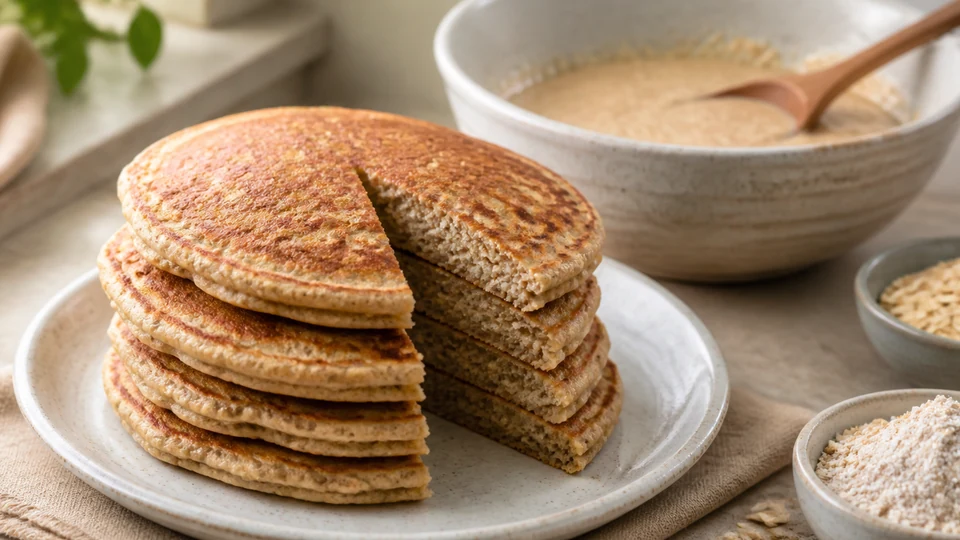
Whole grain pancake batter
At Pancakes World, choose a whole grain pancake batter by reading the flour line, not by judging the batter’s color. For a 100% whole-grain version, every grain ingredient in the complete formula should be a whole grain, such as whole wheat flour or qualifying rolled oats; a blended batter can combine whole-grain and refined flour but should say so. Follow one source-tested formula because whole-grain flours and oat forms do not share one universal liquid ratio. Measure accurately, mix only to the source’s texture cue, honor any stated rest, and cook a small first pancake before scaling service. Never taste raw batter. Cook the egg-and-flour center completely, then adjust only within the chosen recipe’s documented range.
This page helps select and execute a formula; it does not supply project-tested ingredient quantities, yield or timing. The pancake science hub covers broader batter mechanics, while Pancake World opens the full collection.
| Guide sections |
|---|
| Define “whole grain” at the ingredient level |
| Pick one of three honest formula lanes |
| Use an authoritative formula as the control |
| Audit the formula before mixing |
For broader context, continue with Pancake Ingredients and Substitutions.
Define “whole grain” at the ingredient level
FDA draft guidance considers a cereal grain whole when the intact, ground, cracked or flaked grain retains its principal bran, germ and endosperm in the same relative proportions found in the intact grain. Grinding a grain into flour does not by itself stop it from being whole. Removing key parts does.
For wheat, the exact label wording matters. FDA identifies whole wheat flour as whole grain because it contains the bran, germ and endosperm. The agency also notes that “wheat flour” is a synonym for ordinary flour under the relevant standard and should not automatically be treated as whole-grain flour. Brown color, the word “wheat,” or visible flecks are not enough.
FDA guidance also says rolled oats and quick oats produced by simply flattening and/or steaming whole oats should be considered whole grains because all three anatomical parts remain. That does not make every oat-containing pancake 100% whole grain: another refined grain ingredient may still appear in the formula.
Added bran alone does not recreate a whole grain. Bran is only one component. A mixture of refined flour and wheat bran may be a useful recipe in its own right, but this page will not relabel it as 100% whole grain without evidence that the full grain components are present in the required relationship.
Pick one of three honest formula lanes
Lane 1: 100% whole-grain flour system
Every grain ingredient is identified as whole grain. A formula based entirely on whole wheat flour can fit this lane. So can a deliberately designed mixture of whole-grain flours, provided no refined grain ingredient is hidden in a blend.
This is the clearest lane when “100% whole grain” is the actual requirement. It is also the lane least suited to casual conversion. A recipe created with refined flour may need a different liquid amount, mixing method or rest when moved to whole-grain flour. Use a complete formula written for its grain system.
Lane 2: whole-grain and refined blend
The batter includes a meaningful named whole-grain ingredient and one or more refined grain ingredients. This can be an intentional texture choice. Call it a blended whole-grain batter, not automatically 100% whole grain.
The recipe should state exact proportions. “Made with whole grain” does not tell the cook how much of the total grain is whole, and this page does not infer a percentage from the title. When a commercial blend is used, read its ingredient statement rather than treating the product name as a formula.
Lane 3: oat-containing whole-grain batter
Rolled oats, quick oats or oat flour can be part of a whole-grain pancake formula when the ingredient meets the whole-grain definition. The form must be explicit. Whole rolled oats, quick oats and oat flour do not hydrate or disperse identically.
A source may use oats alongside refined wheat flour. That is an oat-containing blended batter, not a 100% whole-grain batter. A source may grind oats before mixing or ask them to absorb liquid for a stated period. Follow that process; do not move a rest instruction between formulas.
Use an authoritative formula as the control
University of Illinois Extension publishes “Light as a Feather Whole Wheat Pancakes,” a complete formula using whole wheat flour, baking powder, salt, brown sugar, egg, low-fat buttermilk and oil. The method separates dry and wet mixing, combines them only until moistened, describes the batter as thick and slightly lumpy, specifies a measured griddle portion, and calls for one turn when bubbles appear.
That reference proves a documented whole-wheat pancake architecture exists. It does not prove that every whole-grain flour works in the same quantities, that the formula meets every dietary need, or that Pancake World tested it. Use the complete Extension recipe for its amounts, yield and time if that specific style suits the goal.
Utah State University Extension also hosts a whole-wheat pancake mix system. Its dry mix combines whole-wheat flour with leavening, dry milk and salt, then a complete preparation adds water, oil and eggs. The booklet allows a defined liquid range and says to stir just until combined. That is a documented mix architecture, not authority to improvise an indefinite amount of water in any batter.
Together the two sources show why “whole grain batter” is a category, not one master recipe. One is a fresh buttermilk formula; the other begins with a stored dry mix. Ingredients, storage and liquid controls belong to the chosen system.
Audit the formula before mixing
Read every grain ingredient
Highlight whole wheat flour, whole oat flour, rolled oats or another specifically named whole grain. Circle refined flour, starch or a blend whose contents are unclear. Decide whether the formula belongs in the 100%, blended or oat-containing lane.
If the title says “whole wheat” but the ingredient list begins with ordinary wheat flour and later adds bran, do not resolve the conflict by appearance. Use the ingredient identities and the FDA definition.
Record the flour form
Whole wheat flour, whole white wheat flour, whole rye flour, oat flour and a multigrain blend are not one functional product. The source recipe should name its exact form. “One cup whole grain” is not a reproducible flour specification.
If milling is done at home, the recipe still needs a measurable amount and a grind appropriate to the formula. This page does not claim that a particular mill setting produces a universally suitable pancake flour.
Check the leavening system
Whole-grain identity does not supply leavening. Baking powder, baking soda plus an appropriate acid, whipped egg, or another system must come from the complete formula. Do not add more leavener because the first pancake feels dense without checking measurement, freshness, mixing and formula design.
Check liquid and fat
The recipe may use milk, buttermilk, water or another specified liquid. Buttermilk is not merely interchangeable with milk in a formula whose soda or flavor balance relies on acidity. Oil, melted butter or another fat also has source-specific amounts and handling.
Check allergen and dietary boundaries
Whole grain does not mean gluten-free, dairy-free, egg-free, vegan or suitable for a wheat allergy. FDA major-allergen guidance supports checking current ingredient lists and “Contains” statements for wheat, egg, milk, soy, peanuts, tree nuts, sesame and other regulated allergens. Kitchen cross-contact remains a separate decision.
Mix the batter without inventing hydration
Measure by the source method
Weigh ingredients when the source gives weights. If it uses volume, follow its flour-measuring instruction rather than packing the cup. A measurement change can look like a hydration problem even when the formula is sound.
Keep the exact liquid within the source range. Whole-grain batters are not corrected by one universal splash. The amount appropriate for whole wheat flour may be wrong for oat flour or a mixed-grain blend.
Combine dry ingredients evenly
Distribute leavener, salt and any dry flavoring through the flour before wet ingredients are added when the formula directs. This prevents one pancake receiving a concentrated pocket while another receives too little.
Do not taste the dry mixture or raw batter. FDA guidance explains that flour is a raw food and ordinary processing does not necessarily kill harmful bacteria. Keep flour away from ready-to-eat ingredients, and clean hands, bowls, utensils and work surfaces after contact.
Prepare wet ingredients separately when required
Beat egg and combine liquid and fat as the source directs. FDA recommends using refrigerated eggs with clean, uncracked shells and washing hands and food-contact surfaces after raw-egg contact.
Pour wet into dry or dry into wet according to the formula. The order matters because it controls how easily the mixture combines and how long flour is worked.
Stop at the stated cue
The Illinois Extension formula calls for a thick, slightly lumpy batter mixed just until moistened. That instruction belongs to that formula. Another formula may require a smoother blend, especially if oats are processed in a blender.
Do not continue stirring solely to remove every small lump when the source expects some. Do not leave large dry pockets either. Scrape the bottom and sides, then stop at the documented cue.
Rest only when instructed
A rest can allow a source formula to change consistency, but this page does not invent a standard rest time for all whole grains. If the recipe gives a duration and storage condition, follow them. If it says cook promptly, do that. Raw egg batter should not sit at room temperature on an improvised schedule.
Use the first pancake as a controlled check
Preheat the griddle or skillet according to the source. Prepare the surface with the specified amount of fat. A pan advertised as nonstick does not erase the recipe’s heat and release controls.
Measure one portion. The Illinois source uses a defined portion and a hot, lightly oiled griddle. Keeping the first pancake at the source size makes its bubbles, edge set and cooking interval meaningful.
Observe five things:
- Does the batter spread to the expected diameter?
- Do bubbles appear in the pattern described by the source?
- Do the edges begin to set before the underside becomes too dark?
- Can the spatula lift the pancake without tearing?
- Is the center fully cooked after the second side?
This is batch execution, not a project-owned recipe test. Record a discrepancy and compare it with measurements, ingredient identity, pan heat and portion before altering the batter.
Diagnose whole-grain batter problems
Batter is much thicker than the source
Confirm flour type and measurement. Oat flour may have been substituted for whole wheat flour, a cup may have been packed, or a liquid may be missing. Check whether the formula’s stated rest has already changed the batter.
Add liquid only when the source gives an adjustment range. Utah State’s mix booklet includes such a range for its own system; that does not authorize an unlimited correction elsewhere.
Batter spreads too far
Verify liquid amount, egg size, flour identity and any required standing time. Do not add an arbitrary handful of flour, because that changes leavening and seasoning ratios. If the recipe has no supported correction, restart accurately or choose a more complete source.
Pancakes are dense
Audit leavener identity and measurement, mixing duration, rest, griddle temperature and portion thickness. Density is not proof that whole grains always make heavy pancakes. It may indicate a process mismatch or simply the intended style of a particular formula.
Outside darkens before the middle cooks
Reduce heat within the source method, allow the griddle to stabilize, and keep portions at the specified size. A thicker-than-intended batter may also create an undercooked center. Do not compensate by accepting a raw middle.
Pancake breaks at the turn
Wait for the formula’s edge and bubble cues, slide a broad spatula fully underneath, and turn once. The Illinois recipe specifically uses a one-turn approach. If the underside is over-browned before the top is ready, correct heat rather than turning early.
Result tastes bitter or overly salty
Recheck leavener and salt measurements and the identity of a commercial mix. Do not add more sweetener to hide a formula error. If the mix was measured incorrectly, the safe editorial decision is to remake it.
Variations that preserve honest labeling
Adding fruit, spice, nuts or seeds does not change whether the grain itself is whole, but it changes batter weight, moisture, allergen scope and ingredient count. Use a complete variation or add only within the base recipe’s documented allowance.
Replacing part of whole wheat flour with refined flour moves a 100% whole-grain formula into the blended lane. That can be an intentional choice, but the name should change with the formula.
Replacing refined flour with whole-grain flour is not a label-only edit. It may require a tested hydration and mixing adjustment. Do not promise a one-for-one conversion.
Using a commercial whole-grain pancake mix can shorten preparation, but its package directions are the recipe. Read the grain ingredients, allergen statement, required additions and serving calculation on the current package. This page does not endorse a product or assume availability.
Cook, hold and store safely
Raw flour and raw egg batter must be cooked, not sampled. FoodSafety.gov lists 160°F (71°C) for egg dishes. Because a thin pancake can be hard to probe accurately, combine the applicable temperature guidance with the complete recipe’s portion, time and set-center cues. A browned surface is not permission to leave wet batter inside.
Serve promptly, or use a documented holding method. Refrigerate perishable cooked pancakes within two hours, or within one hour when ambient temperature is above 90°F (32°C). Keep the refrigerator at 40°F (4°C) or below.
FDA egg guidance gives three to four refrigerated days for leftover cooked egg dishes, and FoodSafety.gov advises using cooked leftovers within four days. Use the shorter window required by the complete recipe or any topping. Reheat leftovers to 165°F (74°C).
Dry pancake mix storage depends on its ingredients and source. The Utah State booklet provides an airtight-container and time instruction for its own mix. Do not transfer that shelf-life claim to a mix containing different flour, milk powder, fat or packaging.
Freezer quality also depends on the formula. Whole-wheat, oat and blended pancakes can respond differently after thawing. Do not claim a universal freezer result without recipe evidence.
Frequently asked questions
What makes pancake batter whole grain?
Its grain ingredients. FDA guidance describes whole grains as retaining bran, germ and endosperm in their original relative proportions. Whole wheat flour qualifies; ordinary “wheat flour” is not automatically whole grain. Inspect every grain ingredient in the formula.
Is whole wheat flour the same as wheat flour?
No for this labeling decision. FDA treats whole wheat flour as containing all parts of the grain, while ordinary wheat flour is not automatically a whole-grain flour. Use the precise package wording.
Are rolled oats whole grain?
FDA guidance says rolled and quick oats that are simply flattened and/or steamed should be considered whole grain because bran, germ and endosperm remain. A pancake containing oats may still include refined flour, so the entire formula determines whether it is 100% whole grain.
Can I replace all-purpose flour one-for-one?
Do not assume so. Choose a complete whole-grain formula or a tested conversion with its own liquid, mixing and rest controls. This page provides no universal ratio.
Should whole-grain batter rest?
Only when the selected formula instructs it. Grain form and recipe architecture differ. Follow the stated duration and refrigeration condition rather than importing a rest from another recipe.
Why is my whole-wheat batter lumpy?
Small lumps can be intentional. The Illinois Extension formula describes a thick, slightly lumpy batter mixed only until moistened. Large dry pockets signal incomplete combining; relentless mixing is not the automatic correction.
Is whole-grain pancake batter healthier?
This page makes no health outcome or nutrition comparison. Nutrition depends on exact grain ingredients, amounts, milk, egg, fat, sugar, toppings, yield and portion. USDA FoodData Central can support values for specified food records, but no tested Pancake World formula exists here for calculation.
Is it gluten-free?
Not automatically. Whole wheat contains wheat, and other grains or commercial mixes need product-specific review. Use a dedicated formula and verified ingredients for a gluten-related requirement.
Can batter be refrigerated overnight?
Only if the complete recipe permits it and states how. Leavening behavior and raw-egg handling must both be considered. Do not create an overnight method from a same-day formula.
Final formula acceptance checklist
Accept a whole-grain pancake source only when:
- every grain ingredient is precisely named;
- the page distinguishes 100% whole grain from a blend;
- flour or oat form and amount are reproducible;
- liquid, egg, fat, sweetener and leavener are complete;
- mixing order and final batter cue are present;
- any rest has a time and storage condition;
- pan type, heat and surface preparation are specified;
- portion, turn cue, second-side cue and yield are supplied;
- raw flour and egg are handled safely;
- current allergen labels can be checked;
- storage belongs to that formula rather than another mix;
- no universal conversion, nutrition result or project test is invented.
The reliable route to whole-grain pancakes is not making an ordinary batter darker. It is selecting a complete formula whose named grain ingredients satisfy the intended lane and whose liquid, mixing and griddle controls were designed around those ingredients.
Explore related Pancakes World guidance on American Pancakes, American Breakfast: Pancakes, Diner Plates and Brunch, and Maple Syrup.
Sources and editorial references
- U.S. Food and Drug Administration, “Draft Guidance for Industry and FDA Staff: Whole Grain Label Statements”:
https://www.fda.gov/food/guidance-documents-regulatory-information-topic/draft-guidance-industry-and-fda-staff-whole-grain-label-statements - University of Illinois Extension, “A Hot Breakfast to Start Your Day”:
https://extension.illinois.edu/blogs/simply-nutritious-quick-and-delicious/2016-02-22-hot-breakfast-start-your-day - Utah State University Extension, “Master Mixes Booklet”:
https://extension.usu.edu/utah/files/MasterMixesBooklet.pdf - U.S. Food and Drug Administration, “Handling Flour Safely: What You Need to Know”:
https://www.fda.gov/food/buy-store-serve-safe-food/handling-flour-safely-what-you-need-know - U.S. Food and Drug Administration, “What You Need to Know About Egg Safety”:
https://www.fda.gov/food/buy-store-serve-safe-food/what-you-need-know-about-egg-safety - FoodSafety.gov, “Cook to a Safe Minimum Internal Temperature”:
https://www.foodsafety.gov/food-safety-charts/safe-minimum-internal-temperatures - FoodSafety.gov, “People at Risk of Food Poisoning”:
https://www.foodsafety.gov/people-at-risk - U.S. Food and Drug Administration, “Food Allergies”:
https://www.fda.gov/food/nutrition-food-labeling-and-critical-foods/food-allergies - USDA Agricultural Research Service, “FoodData Central”:
https://fdc.nal.usda.gov/