Vegan whole wheat banana pancakes: a source-led practical guide
At Pancakes World, for vegan whole wheat banana pancakes with a deliberately soft whole-grain structure, use the published Love & Lemons formula: 1 tablespoon ground flaxseed with 3 tablespoons water, 1/2 cup mashed banana, 2 tablespoons olive oil, 1 teaspoon vanilla, 3/4 cup plus 2 tablespoons almond milk, 1 1/2 cups whole wheat pastry flour, 1/2 cup oat flour, 2 teaspoons baking powder, 1/2 teaspoon baking soda, cinnamon, nutmeg and salt. Rest the flax-banana mixture for 5 minutes, keep the finished batter thick but scoopable, cook 1/3-cup portions on a lightly oiled nonstick surface, and lower the heat when the pan retains heat. This is a source-led guide reviewed by the editorial platform , not a Pancake World kitchen test.
| Guide sections |
|---|
| Direct answer |
| What this guide is — and is not |
| Step-by-step method |
| Why the flour name matters |
For broader context, continue with Healthy Pancake Guides.
Direct answer
The decisive detail is whole wheat pastry flour, not an unspecified whole wheat flour. The source names that flour and pairs it with oat flour. Replacing it cup-for-cup with regular whole wheat flour, changing the banana volume, or pouring in extra milk without observation creates a new variable. For a first attempt, preserve the formula, make one test pancake, and adjust only if the batter is too stiff to scoop or the exterior colors before the middle sets.
What this guide is — and is not
This page solves one narrow problem: how to follow and understand a whole-grain, vegan banana pancake formula built around whole wheat pastry flour, oat flour, hydrated flax and mashed banana. It is not a claim that every flour labeled “whole wheat” behaves identically. It is also not a new recipe developed or tested by Pancake World.
Love & Lemons is the primary source because its ingredient list and method match the route precisely. Forks Over Knives supplies a separate whole-wheat banana model with materially different liquid and binder choices. Food Network Kitchen supplies a separate vegan banana model based on all-purpose flour. Those comparisons help explain why a substitution may require a different published formula rather than an improvised one-for-one swap.
No nutrition totals are calculated here. Banana size, flour brand, plant beverage, oil retained by the pan, toppings and actual yield can all change a calculation. The sources' own yield or nutrition statements belong to their formulas and are not converted into Pancake World results.
Explore related Pancakes World guidance on American Pancakes, American Breakfast: Pancakes, Diner Plates and Brunch, and Maple Syrup.
Sources and editorial references
Love & Lemons publishes the following formula for eight pancakes:
- 1 tablespoon ground flaxseed
- 3 tablespoons water
- 1/2 cup mashed banana, described as about 1 large banana
- 2 tablespoons extra-virgin olive oil, plus more for brushing the pan
- 1 teaspoon vanilla extract
- 3/4 cup plus 2 tablespoons almond milk, with more only if needed
- 1 1/2 cups whole wheat pastry flour
- 1/2 cup oat flour
- 2 teaspoons baking powder
- 1/2 teaspoon baking soda
- 1 teaspoon cinnamon
- 1/2 teaspoon nutmeg
- a heaping 1/4 teaspoon sea salt
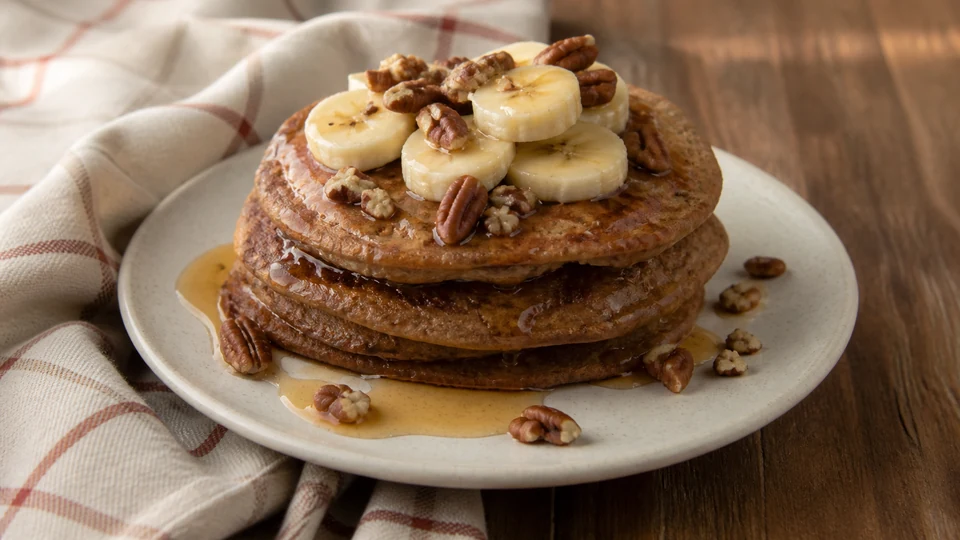
- optional maple syrup, banana slices and pecans for serving
The source gives a count of eight, but count depends on following its 1/3-cup portion and spreading instruction. Treat eight as the source's yield, not a guarantee for a differently portioned batch. If a cook changes the scoop or leaves more batter in the bowl, the observed count can differ.
Equipment
- a large mixing bowl
- fork or small whisk for the flax and banana
- dry and liquid measuring tools
- a level or scale-stable work surface
- flexible spatula for scraping the bowl
- nonstick skillet or griddle
- brush or folded towel suitable for applying a thin film of oil safely
- 1/3-cup measure
- broad, thin turner
- rack or plate for finished pancakes
The primary method uses one bowl. That convenience does not remove the need to measure the two flours separately and distribute both leaveners. A crowded work surface also makes it easier to confuse the tablespoon used for flax with the teaspoons used for baking powder and baking soda.
Step-by-step method
- Read every label before mixing. Confirm that the plant beverage, vanilla, pan fat and toppings fit the eater's vegan and allergen requirements. “Plant-based” on one ingredient does not certify the complete meal.
- Measure the banana by volume for source fidelity. Mash ripe banana, then measure 1/2 cup. The source describes that as about one large banana, but the measured volume is the reproducible quantity it actually supplies.
- Start the flax mixture. In the large bowl, combine 1 tablespoon ground flaxseed, 3 tablespoons water and the measured mashed banana. Mix thoroughly and let it stand for 5 minutes. This rest is part of the published sequence.
- Measure the remaining wet ingredients. Add 2 tablespoons olive oil, 1 teaspoon vanilla and 3/4 cup plus 2 tablespoons almond milk. Whisk them into the banana mixture.
- Add both flours. Measure 1 1/2 cups whole wheat pastry flour and 1/2 cup oat flour. Add them to the bowl without compacting a volume measure.
- Distribute the leaveners and seasoning. Sprinkle 2 teaspoons baking powder, 1/2 teaspoon baking soda, 1 teaspoon cinnamon, 1/2 teaspoon nutmeg and the heaping 1/4 teaspoon salt evenly over the flour rather than depositing each in one wet pocket.
- Stir only to combine. The source says the batter may remain a little lumpy. Scrape the bottom and sides so no dry flour pockets remain, but do not chase a perfectly smooth appearance.
- Judge scoopability before changing it. The intended batter is thick. If it is too stiff to scoop, the source permits one additional tablespoon of almond milk. Do not turn that allowance into an automatic addition.
- Preheat the cooking surface. Heat a nonstick skillet or griddle over medium and brush it lightly with olive oil. A visible pool of oil is not the source baseline.
- Cook one diagnostic pancake. Portion 1/3 cup onto the surface and use the back of the measure to spread it gently. Keep the remaining batter in the bowl while the first pancake reveals the relationship between batter depth and pan heat.
- Watch the first side. The source uses bubbles and roughly 1 1/2 minutes as its turn point. Confirm that the underside has set enough to release before sliding the turner underneath.
- Turn once and finish. Flip and cook about another 1 1/2 minutes, until golden and set. Open the first pancake if the center is uncertain; the source does not give an internal temperature.
- Manage residual heat. Love & Lemons explicitly notes that the pan may retain heat after each batch and recommends moving from medium toward low as needed. Make the heat change before the next exterior darkens too quickly.
- Repeat with the same portion. Keep the 1/3-cup measure and gentle spread consistent. Add only a thin film of oil as needed.
- Serve or cool promptly. Serve with the source's optional toppings, or cool uneaten pancakes without stacking them while they are still steaming if they are intended for storage.
This method paraphrases the source and adds observation points. It does not add a Pancake World cooking time, doneness temperature, texture guarantee or independently verified yield.
Why the flour name matters
The primary formula does not say “two cups whole wheat flour.” It specifies 1 1/2 cups whole wheat pastry flour and 1/2 cup oat flour. That is the recipe architecture to preserve.
Whole wheat pastry flour and ordinary whole wheat flour are sold as different products. The article therefore does not promise that regular whole wheat flour will absorb, spread or set exactly like the named ingredient. If the package in the kitchen says only “whole wheat flour,” the honest options are to obtain the specified pastry flour or choose a published recipe developed for regular whole wheat flour.
Forks Over Knives provides the latter kind of comparison. Its vegan banana pancake recipe uses 1 1/2 cups whole wheat flour, 2 teaspoons baking powder, salt, a commercial egg replacer, 3/4 to 1 cup mashed banana, 1 1/2 cups plant milk and up to 1 cup sparkling water. It cooks 1/4-cup portions on a dry nonstick griddle. That is a different formula, not evidence that regular whole wheat flour can enter the Love & Lemons formula without other changes.
The oat flour in the primary formula also counts. Omitting it while leaving every liquid unchanged is not “keeping the recipe mostly the same”; it removes one quarter of the stated two-cup flour system. Replacing it with rolled oats, steel-cut oats or an unmeasured handful changes particle form and distribution. Use oat flour for the baseline.
What each structural ingredient is doing in this formula
Banana is measured wet bulk
The primary source calls for 1/2 cup mashed banana. That makes ripeness useful for flavor and mashability, but size alone is not the measure. A very large banana can exceed the stated volume, and two small bananas may or may not reach it.
Do not treat more banana as free sweetness. Extra mashed fruit also brings more water and solids into the batter. That can alter spread and the time needed for the center to set. Measure first; put any remainder into another dish rather than hiding it in the bowl.
Hydrated flax is a defined component
Love & Lemons combines 1 tablespoon ground flaxseed with 3 tablespoons water and rests it with the banana for 5 minutes. Ground flax, water amount and rest all belong to the source method. Whole seeds are not an equivalent physical form, and adding dry flax late is not the same sequence.
This ratio must not be confused with the larger flax system in banana flaxseed pancakes. That neighboring route follows a University of California formula using 2 tablespoons ground flax plus 6 tablespoons water with banana and oats. The present route has a different flour structure, portion and method.
Two leaveners are specified
The primary formula uses both baking powder and baking soda. The guide preserves both amounts without inventing a chemical explanation or promising a fixed height. Check that each package is the intended product: baking powder and baking soda are not interchangeable names.
Distribute them across the flour. A concentrated pocket can leave one bite unpleasant while the rest of the batch receives less of the measured leavener.
Oil appears in two roles
Two tablespoons olive oil go into the batter, and more is used to brush the skillet. Oil in the batter and oil on the pan are not one combined, unspecified amount. Measure the batter oil, then keep the surface film light enough that the pancakes cook rather than shallow-fry.
Plant beverage is part of the allergen check
The primary source uses almond milk and says another milk can work. This article does not declare every plant beverage equivalent. Almond is a tree nut, while other beverages can contain soy, oats, additives or cross-contact statements relevant to an individual eater.
FDA identifies milk, eggs, fish, crustacean shellfish, tree nuts, peanuts, wheat, soybeans and sesame as the nine major allergens under United States labeling rules. Read every packaged label each time, including plant beverage, oat flour, baking powder, vanilla, chocolate, yogurt, granola and toppings. A vegan formula still contains wheat and may contain tree nuts; “vegan” does not mean allergen-free.
How to read the batter without inventing a new recipe
The primary source gives a useful boundary: the batter should be thick, but if it is too thick to scoop, add 1 tablespoon almond milk. That instruction supports one measured correction, not an unlimited pour.
Use a simple sequence:
- finish mixing and scrape the bowl;
- lift a full 1/3-cup portion;
- ask whether it can leave the cup with gentle help;
- if it cannot, add the one tablespoon permitted by the source;
- mix briefly and reassess;
- cook a test pancake before deciding anything else.
Do not diagnose the batter only by comparison with a thin diner-style batter. This formula is supposed to be thick enough that the source tells the cook to spread each portion gently. A mound that cannot be scooped is too stiff by the source's standard; a portion that holds briefly and spreads with the cup may be exactly within it.
If the batter is unexpectedly loose before any optional milk is added, stop. Check whether the banana was measured after mashing, whether 1/2 cup oat flour was included, and whether the almond milk was measured as 3/4 cup plus 2 tablespoons rather than a larger guessed amount. Adding extra flour to compensate would create a changed formula before the measuring error is understood.
Pan management: solve heat before changing batter
A thick banana batter can show a dark underside while its center still needs time. That observation does not automatically mean the batter needs more liquid. It may mean the cooking surface is too hot for the portion's depth.
Love & Lemons begins at medium heat and specifically advises reducing the heat as the pan holds residual heat. Food Network Kitchen gives a similar independent diagnostic for its different vegan banana formula: cook over medium, but reduce to medium-low if the pancakes brown too quickly. Together, these sources support a heat-first response when color races ahead of setting.
First pancake checklist
Before portioning the full batch, inspect one pancake:
- Did the 1/3-cup portion leave the measure and spread with gentle help?
- Did the round hold together rather than running across the pan?
- Were bubbles visible near the source's approximate turn point?
- Could a broad turner get under it without scraping?
- Was the underside golden rather than dark before the top showed progress?
- After turning, did the center set without the second side scorching?
If only the color is too dark, lower the heat. If the pancake is extremely deep, confirm that it was spread as the source instructs. If it tears during a premature turn, wait for more release on the next one. Change one observable cause at a time.
Residual heat is a batch problem
The first pancake and the fifth do not meet the same pan. Metal accumulates heat, and the source acknowledges that fact directly. A setting that was workable during preheat can become aggressive later.
Watch the time-to-color from one batch to the next. If it shortens, reduce the heat before the next pour and allow the pan to stabilize. Do not keep cooking at the original setting and compensate by flipping earlier; that trades surface color for a less-set interior.
Portion depth matters
The source uses 1/3 cup and asks the cook to spread the batter a little. A larger scoop makes a deeper pancake, and a deeper center cannot be assumed to finish on the same schedule. A smaller scoop changes the source yield and time relationship too.
For repeatability, scrape the measure level enough to keep portions similar and use the same spreading motion. Record the actual count privately if planning a future batch. Do not relabel a personal result as a universal yield.
Common mistakes and direct corrections
Mistake: buying regular whole wheat flour by assumption
What changes: the named primary ingredient has been replaced before mixing starts.
Correction: use whole wheat pastry flour for this formula. If regular whole wheat flour is the ingredient available, use a recipe written for it, such as the separate Forks Over Knives model, and follow that formula in full.
Mistake: measuring banana by fruit count only
What changes: banana volume becomes unpredictable.
Correction: mash first and measure 1/2 cup. The source's “about 1 large” is a shopping cue, while the volume is the working quantity.
Mistake: forgetting the oat flour
What changes: one half cup of the two-flour system disappears.
Correction: measure oat flour separately and mark it off the list before stirring. Do not substitute whole oats without a source that validates that change.
Mistake: skipping the flax rest
What changes: the cook abandons a stated 5-minute source step.
Correction: mix flax, water and banana first, set a timer, and measure other ingredients during the rest.
Mistake: making the batter thin on sight
What changes: a deliberately thick batter is altered to resemble a different pancake style.
Correction: test whether it is scoopable. Use the source's one-tablespoon milk correction only if it is too stiff to scoop.
Mistake: blending or beating until perfectly smooth
What changes: the method exceeds the source, which accepts a slightly lumpy batter.
Correction: fold and stir until dry pockets disappear, then stop. Lumps and dry flour are not the same thing.
Mistake: pouring a large pool of oil
What changes: the surface cooking method moves away from a lightly brushed skillet.
Correction: brush on a thin film. If sticking persists, verify the pan condition, release and heat rather than repeatedly flooding it.
Mistake: turning only because the timer rang
What changes: approximate time is treated as proof of release and structure.
Correction: use the source's 1 1/2-minute timing as a checkpoint alongside bubbles, underside color and release. Pan material and burner output are not standardized here.
Mistake: correcting every pancake differently
What changes: the batch stops producing useful information.
Correction: diagnose the first pancake, make one controlled correction, then keep scoop and spreading motion consistent.
Mistake: tasting raw batter
What changes: the cook treats egg-free batter as ready to eat.
Correction: do not taste it. FDA states that flour is a raw food, processing grain into flour does not reliably kill harmful bacteria, and consumers should not eat or taste raw flour, dough or batter. Vegan batter removes egg but not the raw-flour safety boundary. Wash hands, utensils and surfaces after contact with flour and raw batter.
Choosing the right nearby pancake approach
Not every vegan banana pancake question belongs to this flour system. Choose by the ingredient and outcome that cannot change.
Choose this route when
- whole wheat pastry flour is available;
- oat flour is acceptable;
- banana is wanted as a measured flavor and wet ingredient;
- hydrated ground flax is acceptable;
- a thick, spreadable batter is the intended format;
- wheat and any selected plant-beverage allergens fit the eater.
Choose a regular whole wheat formula when
Forks Over Knives expressly uses regular whole wheat flour with commercial egg replacer, plant milk and sparkling water. It is the closer source when whole wheat pastry flour is unavailable and the cook is willing to use that complete ingredient system. Do not combine half of its liquid system with half of the primary formula.
Choose an all-purpose flour formula when
Food Network Kitchen's vegan banana pancakes use 1 1/2 cups all-purpose flour, 1/2 cup banana, 1 1/4 cups almond milk, vegan butter, sugar and baking powder. That model excludes flax and oat flour. It demonstrates that banana pancakes can be vegan without flax, but it does not validate removing flax from the present whole-grain recipe.
Choose a gluten-free route when wheat must be excluded
This page is not gluten-free: whole wheat pastry flour is the main flour. A reader avoiding wheat needs a formula developed for a gluten-free flour system, not a casual replacement inside this one. The brown rice flour vegan pancake guide addresses a different flour architecture, and the related vegan gluten-free buttermilk pancake guide belongs to another evidence set. Ingredient labels and cross-contact requirements still need individual review.
Choose a savory direction when banana sweetness is not wanted
Removing banana from this formula removes 1/2 cup of measured wet fruit and changes more than flavor. For a savory target, start with a purpose-built formula such as vegan savory buckwheat pancakes instead of trying to neutralize this one with extra flour or salt.
Variations that remain within honest boundaries
The primary source suggests blueberries or chocolate chips in the batter and cardamom or ginger as spice options. It also suggests peanut or almond butter, vegan yogurt with granola, berries, toasted nuts, maple syrup, banana slices and pecans as toppings.
Those are source ideas, not evidence that unlimited additions leave cooking unchanged. Keep the first pancake plain if troubleshooting. Heavy, wet or cold additions can obscure whether the base batter and heat are working.
Berry option
Use blueberries only if they fit the eater and the package is in good condition. The source allows them, but does not state a measured amount in the primary recipe card. This guide therefore does not invent one. Add a modest, recorded amount after the base batter is combined, or place berries on individual portions so the baseline remains visible.
Chocolate option
Check that the chocolate meets the intended vegan standard and all allergen needs. “Dark” does not by itself answer those questions. The primary source suggests chocolate chips but supplies no amount, so treat the quantity as a personal variation rather than an editorial formula.
Spice option
The baseline already contains cinnamon and nutmeg. Cardamom or ginger can change the flavor, but the source gives no measured replacement. Additions should not be presented as tested Pancake World quantities.
Topping option
Maple syrup and banana slices keep the banana profile straightforward. Pecans, peanut butter, almond butter, yogurt and granola introduce additional label and allergen checks. Serve toppings separately when different eaters have different requirements; separation at serving does not correct cross-contact that occurred during mixing or cooking.
Plant-beverage choice
Love & Lemons allows another milk, but its measured baseline is almond milk. A different beverage may change flavor or consistency. Substitute only when it meets dietary needs, begin with the stated volume, and use the batter's scoopability as the observable check. Do not promise identical results.
Food safety and allergen boundaries
Raw flour remains raw in vegan batter
FDA's guidance is direct: flour is generally made from raw grain, milling does not reliably destroy harmful bacteria, and raw flour, dough or batter should not be eaten. Keep flour and splashed batter away from ready-to-eat toppings. Wash hands, bowl rims, utensils and work surfaces with warm soapy water after preparation.
Cooking guidance in the cited recipes relies on set structure, bubbles and golden surfaces; none publishes a pancake-specific safety temperature. This article does not invent one. Cook the pancake through and do not use exterior color alone when a thick center still looks raw.
“Vegan” and “allergen-free” answer different questions
The formula excludes eggs and dairy ingredients when compliant plant products are selected, but it contains wheat and the baseline almond milk contains tree nut. Possible toppings can add peanuts, other tree nuts, soy, sesame or other concerns. FDA advises consumers with food allergies to read packaged-food ingredient and allergen statements.
If cross-contact is a medical concern, a clean-looking shared pan is not necessarily enough. Use the eater's established safety plan and appropriately controlled ingredients and equipment. This guide cannot certify a household or product as allergen-safe.
Storage and reheating
The primary source serves the pancakes after cooking and does not publish a dedicated storage protocol. For a conservative general boundary, USDA Food Safety and Inspection Service says leftovers can be refrigerated for 3 to 4 days or frozen for 3 to 4 months; frozen food can remain safe longer but lose moisture and flavor.
Cool cooked pancakes promptly, place them in a covered container, and refrigerate or freeze rather than leaving them at room temperature for an extended period. Separate layers if sticking is a concern. Mark the date so the storage interval is visible.
Reheat only the portion needed until hot throughout. A toaster, skillet, oven or microwave may produce different surface textures; this article does not claim one was tested for this formula. Discard food with unsafe handling history rather than using smell or a small taste as a safety test.
Make-ahead planning without changing the recipe
The batter contains leaveners and a hydrated whole-grain flour system, while the sources do not instruct readers to refrigerate the mixed batter overnight. This guide therefore does not promise that an overnight batter will behave like a freshly mixed one.
For a faster morning:
- measure the pastry flour and oat flour into separate covered containers;
- pre-measure cinnamon, nutmeg and salt while keeping leaveners dry and clearly labeled;
- set out the 1/3-cup measure and turner;
- verify plant beverage and topping labels in advance;
- cook the complete pancakes ahead and use the USDA leftover boundary, if that suits the schedule.
Do not pre-mix wet and dry ingredients simply for convenience unless following a source that validates that holding method.
Final decision checklist
Before starting:
- [ ] I have whole wheat pastry flour, not merely a bag labeled whole wheat flour.
- [ ] I have oat flour, ground flaxseed and both named leaveners.
- [ ] I will measure 1/2 cup mashed banana rather than rely on fruit count.
- [ ] All packaged ingredients and toppings meet vegan and allergen requirements.
- [ ] I understand this is a source-led guide, not a Pancake World-tested recipe.
Before cooking:
- [ ] The flax, water and banana rested for 5 minutes.
- [ ] The almond milk baseline is 3/4 cup plus 2 tablespoons.
- [ ] The batter is thick but scoopable.
- [ ] Any extra tablespoon of almond milk was added only because the batter was too stiff to scoop.
- [ ] The pan has a thin brushed film of oil.
During cooking:
- [ ] The first test portion is 1/3 cup and is gently spread.
- [ ] Bubbles, release and underside color support the turn; the timer is only a checkpoint.
- [ ] Heat is reduced if the exterior browns before the center sets.
- [ ] Raw batter is not tasted.
- [ ] Portion size and spreading remain consistent.
After cooking:
- [ ] The center of the test pancake is set before the batch continues.
- [ ] Serving additions have been checked separately.
- [ ] Leftovers are cooled and stored promptly in a covered container.
- [ ] Personal changes and observed yield are recorded as personal results, not universal claims.
More vegan pancake paths
For a broader breakfast collection rather than this particular whole-wheat architecture, use the vegan breakfast pancake guide. For a closely related griddle format with its own evidence and ingredient choices, see vegan hotcakes. The main vegan pancakes hub organizes additional flour systems and intents without treating them as interchangeable.
The practical rule is simple: preserve a complete source formula until the first pancake provides evidence. Measure the banana, keep the named pastry and oat flours, hydrate the flax for the stated time, and correct heat before rewriting the batter. That approach protects the recipe's unique intent and makes any later personal adjustment traceable.
- Love & Lemons, Vegan Banana Pancakes —
https://www.loveandlemons.com/vegan-banana-pancakes/ - Forks Over Knives, Vegan Banana Pancakes —
https://www.forksoverknives.com/recipes/vegan-breakfast/banana-pancakes/ - Food Network Kitchen, Vegan Banana Pancakes —
https://www.foodnetwork.com/recipes/food-network-kitchen/vegan-banana-pancakes-11603394 - U.S. Food and Drug Administration, Handling Flour Safely —
https://www.fda.gov/food/buy-store-serve-safe-food/handling-flour-safely-what-you-need-know - U.S. Food and Drug Administration, Have Food Allergies? Read the Label —
https://www.fda.gov/consumers/consumer-updates/have-food-allergies-read-label - USDA Food Safety and Inspection Service, Leftovers and Food Safety —
https://www.fsis.usda.gov/food-safety/safe-food-handling-and-preparation/food-safety-basics/leftovers-and-food-safety