Vegan russian blini
At Pancakes World, vegan Russian blini are best approached as a deliberate adaptation, not as one ingredient swap. First decide which blini you mean: thin, flexible, pan-sized pancakes for folding or rolling, or small, thicker, often yeast-raised rounds built around buckwheat. Choose a complete tested recipe for that form, then replace dairy and egg according to what each does in that formula. Use an unsweetened plant beverage where milk supplies liquid, a suitable binder where egg provides cohesion, and the recipe’s own leavening system for lift. Cook by visible cues, never taste raw batter, and describe the result as vegan blini in a chosen style rather than the single “authentic” Russian formula.
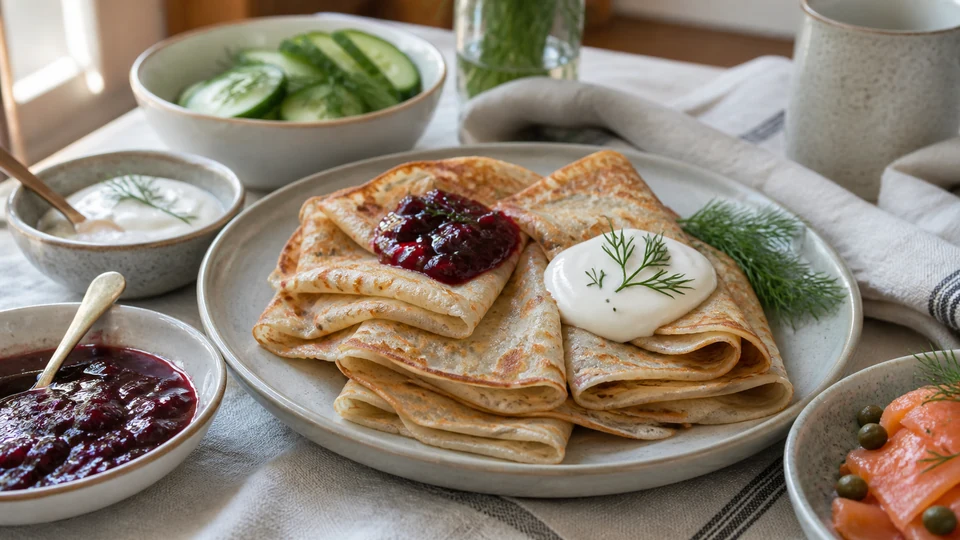
This is a construction and decision guide, not a tested Pancake World recipe.
For broader context, continue with Healthy Pancake Guides.
What “Russian blini” covers
The search phrase sounds singular, but the food category is not. Russian sources use blini for pancakes, and English-language food writing has applied the word to more than one size and structure. In one kitchen, the expected result may be a thin wheat pancake that reaches across the pan and can wrap a filling. In another, it may be a small buckwheat-forward, yeast-raised round served as a base for toppings. Those forms do not take the same batter or the same vegan conversion.
University cultural pages also connect blini with Maslenitsa, a Russian celebration in which pancakes and varied fillings are visible parts of contemporary events. That context is worth acknowledging without turning it into a claim that every family, region, occasion or period used the same flour, leavener, richness or serving style. A vegan version is a present-day dietary adaptation. It can be careful and recognizable without being passed off as an unchanged historical standard.
Use the title as a useful description rather than a certificate of authenticity. A precise menu label is stronger:
- thin vegan wheat blini with mushroom filling;
- small yeast-raised vegan buckwheat blini;
- vegan blini-style pancakes with fruit preserve;
- modern dairy-free, egg-free blini adaptation.
Each label tells the eater what has actually been made. None claims ownership of a whole cuisine.
Choose the form before choosing substitutions
Write a one-sentence target before shopping or mixing. Describe diameter, thickness, flexibility, flour emphasis, leavening and intended service. For example: “I want a thin, neutral pancake that can be rolled around a savory filling,” or “I want a small buckwheat-forward round with a tender interior and a fermented aroma.” This single decision prevents most contradictory advice.
Thin, pan-sized blini
The thin form depends on flow, even spreading and enough cohesion to lift a wide pancake without tearing. The batter needs to move quickly when the pan is tilted. Excessive thickening from ground seed gel, purée or highly absorbent flour can work against that goal. Too much chemical leavener can create a puffy surface that resists tight rolling.
For this style, begin with a complete tested thin-pancake formula that already excludes egg and dairy if one is available. If adapting a conventional formula, identify whether egg supplies most of the binding and whether milk contributes only liquid or also richness. Select a neutral plant beverage and a restrained binder that will not turn the batter into spoonable paste. The finished pancake should bend when warm and release cleanly from the pan.
Small, yeast-raised buckwheat blini
The small form permits a thicker batter and more vertical lift. A documented conventional example from King Arthur Baking uses a staged yeast sponge, buckwheat flour, dairy and separated eggs. It is useful evidence for the existence and workflow of this style, but it is not vegan and is not a drop-in formula for this page. Removing milk, dry milk, butter, yolks and whipped whites changes hydration, fat, binding, browning and aeration at once.
Choose either a complete tested vegan yeast-raised formula or run a documented development test before publishing fixed quantities. Do not merely replace every animal ingredient and assume the original timing, volume and texture remain valid. Fermentation activity, batter thickness and pan behavior must all be checked in the chosen formula.
A useful boundary: blini versus oladyi
English terminology can blur small blini, thin blini and other Russian pancakes. Avoid correcting a reader’s family vocabulary from a distance. Instead, describe the physical result. If the batter is spooned into compact, thick pancakes, say so. If it spreads into thin rounds, say so. Clear sensory and structural language is more useful than claiming a single universal translation.
Start from a complete formula, not a visual guess
A photograph cannot tell you the flour ratio, hydration, fermentation stage, binder strength or pan temperature. Nor can a list of familiar ingredients prove that the formula works once eggs and dairy are removed. Select a source that provides the entire ingredient list, quantities, method, rest or proofing time, cooking cues and expected yield. Confirm that the source actually tested the vegan version you intend to make.
Before changing anything, make a function map:
| Formula part | Likely job | Question before changing it |
|---|---|---|
| Wheat flour | structure and flexibility | Is rolling more important than buckwheat intensity? |
| Buckwheat flour | flavor, color and solids | Does the tested formula balance its lack of gluten? |
| Milk | liquid, dissolved solids, flavor and browning | Which characteristics does the selected plant beverage bring? |
| Egg | binding, moisture, richness or aeration | Which of those roles is critical in this style? |
| Fat | tenderness, pan release and flavor | Is it in the batter, on the pan, or both? |
| Yeast | fermentation and gas | Does the formula include a warm rest and observable rise? |
| Chemical leavener | prompt gas production | Is acid present if the formula depends on baking soda? |
| Sugar | sweetness and browning support | Is the batter savory, neutral or dessert-oriented? |
This table is diagnostic, not a recipe. The selected complete formula still controls amounts.
Replace egg by function
University of Illinois Extension separates egg replacement into binding, leavening and moisture functions and warns that substitutes can change flavor and texture. That is the right framework for blini. “One vegan egg” is not a single behavior.
For a thin flexible pancake, the priority is usually cohesion without excessive bulk. A ground-flax or ground-chia gel may bind, but visible seed particles and water absorption can alter a delicate batter. Smooth purées add moisture and body, yet banana or strongly flavored fruit can redirect a neutral savory pancake toward dessert. Silken tofu can add body but may make a thin batter less fluid. A commercial vegan egg replacer has its own directions and ingredient profile; follow its package and the tested recipe.
For a thicker yeast-raised style, the removed egg may have supplied both structure and aeration. If the conventional method whips egg whites, a simple moisture replacement does not reproduce that foam. Aquafaba is sometimes used as an aerating ingredient, but its performance depends on concentration, whipping and the rest of the formula. Use it only when the complete source method was developed around it, or treat the trial as recipe development rather than a guaranteed conversion.
Do not stack several replacements “for insurance.” A seed gel plus starch plus purée plus commercial replacer can make the batter gummy or heavy. Choose the smallest intervention supported by the formula. Change one structural variable at a time during development and record what happened.
Choose the plant beverage deliberately
An unsweetened, unflavored beverage is the least disruptive starting point for a savory or neutral formula, but products are not interchangeable in nutrition, protein, sugar, thickness or added ingredients. FDA advises comparing Nutrition Facts and ingredient labels because plant-based beverages vary by plant source, processing and formulation.
For cooking behavior, ask:
- Is the beverage thin enough for the intended spread?
- Does it contain added sugar or flavoring that changes the batter?
- Does its protein or stabilizer system make it noticeably thicker?
- Does the selected product introduce soy, tree nuts, sesame or another concern for the eater?
- Does the complete tested formula specify a particular beverage type?
Water may be part of some traditional or modern pancake formulas, but replacing a formula’s milk with water is still a formula change. It removes more than dairy: it can change solids, flavor, browning and tenderness. Use water when the tested vegan formula calls for it, not because every liquid is assumed equivalent.
Likewise, a plant beverage is not automatically nutritionally equivalent to dairy milk. This page makes no nutrition comparison and does not prescribe a product for health reasons.
Decide how much buckwheat the structure can support
Buckwheat is not a type of wheat. University of Missouri Extension notes that buckwheat flour lacks gluten and is used in pancakes, while its lack of gluten limits the structure it can provide in raised bread. In blini, that means buckwheat can be central to flavor and identity for one style, but it cannot be assumed to behave like all-purpose wheat flour.
A wheat-and-buckwheat blend can use wheat gluten for stretch and handling while retaining some buckwheat character. A formula based entirely on buckwheat needs another plan for cohesion and gas retention. That may come from the formula’s starch balance, binder, fermentation method or compact size. The correct balance is recipe-specific.
Do not infer “gluten-free” from the word buckwheat. A blend may contain wheat, and a package of buckwheat flour may be subject to the manufacturer’s own handling and labeling conditions. If gluten avoidance is medically necessary, use a suitable tested gluten-free recipe and verify every current package and preparation surface. Vegan and gluten-free are independent requirements.
For a thin form, finely milled flour and sufficient hydration help spreading. For a small raised form, the batter must retain enough gas to avoid flattening immediately. These are observable goals, not permission to invent a universal flour percentage.
Pick one leavening system and respect its clock
Yeast and chemical leaveners are not merely alternative labels for “fluffy.” They impose different workflows.
Yeast-raised route
A yeast formula needs suitable liquid temperature, time and an environment in which the culture can become active. Follow the source formula rather than using a generic clock. Look for evidence described by that recipe: expansion, bubbles, a changed surface or a fermented aroma. A cold kitchen may slow the process; excessive heat can damage yeast. Do not promise that a fixed rest will work in every room.
Once a developed yeast batter is ready, avoid vigorous stirring that destroys the gas the method intends to retain. If the formula adds a foamed component late, fold it as directed and cook without an unnecessary delay.
Chemical-leavener route
Baking powder and baking soda act through chemical reactions. Baking soda requires adequate acid in the formula; adding it to an arbitrary plant beverage without understanding the acid balance can leave poor lift or an unpleasant taste. Baking powder contains its own acid components but still follows the tested formula’s amount and timing.
Mix and cook according to the source. A long rest that suits yeast may not suit a batter whose gas begins forming as soon as wet and dry ingredients meet.
Unleavened thin route
A very thin pancake may rely primarily on spreading and steam rather than noticeable rise. In that case, smooth hydration, pan control and flexibility matter more than creating a tall crumb. Do not add leavener simply because a different pancake style uses it.
Mix for the chosen texture
Set up all measured ingredients before combining them. This is especially helpful for yeast batters, where late corrections can disturb development, and for thin batters, where hurried additions can create lumps.
Use this sequence unless the tested formula directs otherwise:
- Verify every package and measure with the source recipe.
- Prepare any binder or yeast stage exactly as instructed.
- Combine the formula’s dry ingredients evenly.
- Combine liquids, fat and dissolved ingredients in their designated bowl.
- Add wet to dry in the order the recipe specifies.
- Mix only to the degree needed for that structure.
- Rest or ferment for the source-defined purpose.
- Reassess flow visually before cooking, without tasting raw batter.
A few small lumps may hydrate during a rest in some formulas. Other formulas require a smooth, pourable batter. Treat the source instructions as controlling. “Do not overmix” is too vague unless you know whether the formula needs gluten development, merely even hydration, or protection of an established foam.
If the batter is clearly outside the source’s described consistency, pause. Check measurement errors, ingredient substitutions and room conditions before adding flour or liquid. Random correction makes the first problem hard to diagnose.
Control the pan instead of chasing a fixed heat setting
Stove labels are not standardized. Pan material, burner size, batter temperature, pancake diameter and added sugar all affect browning. Use the complete recipe’s starting guidance, then evaluate the first cooked piece as calibration.
For thin blini, the pan needs enough heat to set a film after a quick swirl but not so much that the batter locks before it spreads. Apply a light, even layer of suitable fat if the method calls for it. Pour the measured portion, rotate promptly, and stop moving the pan once the surface is covered. Loosen only after the edges and underside have enough structure. A broad thin pancake often tears when flipped prematurely or when its binder is inadequate.
For small thick blini, portion consistently so the batch cooks at a similar rate. Watch the surface and edge cues specified by the tested recipe. Bubbles alone do not prove the center is done, and dark color alone does not prove safety. Flip when the first side has structure; finish the second side without crushing the pancake.
Troubleshoot by pattern:
- The first side scorches before the center sets: reduce pan heat and allow the surface to stabilize.
- Thin batter refuses to spread: confirm the recipe’s hydration, rest and binder; do not keep forcing a thick-pancake formula into a crêpe form.
- The pancake tears during turning: let the first side set, use a suitable spatula, and review binding if every piece tears.
- Small rounds spread flat: check yeast or leavener handling, batter thickness and delay before cooking.
- The surface is greasy: reduce excess pan fat rather than adding more flour automatically.
- Later pancakes darken faster: accumulated heat is rising; adjust the burner or briefly move the pan.
Record the burner position, pan, portion and visual result when developing a formula. “Medium heat” alone is not a repeatable test record.
Build vegan toppings and fillings separately
The pancake can be vegan while its topping is not. Traditional and contemporary blini service may include dairy, fish or other animal-derived foods, so audit the entire plate rather than relying on the base batter’s label.
For a savory thin pancake, consider cooked mushrooms and onions, braised cabbage, seasoned beans, lentils, roasted vegetables, or a plant-based cultured topping. These are editorial directions, not fixed recipes. Cook and season fillings independently; drain wet mixtures so they do not dissolve the pancake. Cool very hot fillings slightly before rolling if steam makes the wrapper fragile.
For small rounds, choose toppings that can sit neatly without flooding the surface: mushroom spread, bean purée, chopped roasted vegetables, or a clearly labeled plant-based topping with herbs. A spoonable garnish should not be so loose that it runs before service.
For sweet service, fruit preserve, cooked berries, apples, citrus zest, or a modest dusting of sugar can fit. Verify that chocolate, caramel, margarine, cultured toppings and decorative ingredients meet the vegan and allergen brief. Honey is not accepted by many vegans; do not assume the eater includes it.
Keep the flavor direction coherent. Buckwheat-forward rounds can carry earthy savory toppings, while a neutral thin pancake can support either savory or sweet fillings. That is an editorial pairing judgment, not a cultural rule.
Vegan does not mean allergen-free
A vegan formula excludes animal-derived ingredients according to the eater’s standard, but it may still contain wheat, soy, tree nuts, peanuts or sesame. Packaged egg replacers, plant beverages, spreads and toppings can introduce allergens or cross-contact statements. FDA requires major allergen sources to be declared on covered packaged foods in the United States, so read the full current label every time.
Clarify the actual requirement before cooking:
- Is the request vegan only?
- Must milk and egg also be controlled as allergens rather than preferences?
- Is wheat or gluten avoidance required?
- Are soy, sesame, peanuts or particular tree nuts excluded?
- What shared-equipment standard does the eater need?
If an allergy is involved, ingredient substitution alone is insufficient. Review advisory labeling, equipment, utensils, pan seasoning, work surfaces, towels, topping spoons and storage containers. Do not promise “safe for everyone” or “free from” without evidence matching that exact claim.
Handle raw flour and leftovers safely
FDA states that flour is a raw food and that processing grain into flour does not necessarily kill harmful bacteria. Never taste vegan batter merely because it contains no raw egg. Keep flour and uncooked batter away from ready-to-eat toppings, wash hands and utensils, and clean work surfaces after mixing. Cook according to the complete tested recipe.
Serve the cooked blini promptly or hold them according to a validated method. If saving leftovers, refrigerate them promptly in shallow containers under USDA guidance. Separate layers if needed to prevent sticking, label the batch, and keep wet toppings apart when that improves storage. Reheat leftovers thoroughly and discard food that was mishandled or has uncertain history. This page does not assign a formula-specific quality life because no Pancake World batch was tested.
A practical decision path
Use this sequence when planning vegan Russian blini:
- Define the physical form. Choose thin and flexible or small and raised.
- Name the adaptation honestly. Do not claim one universal historic formula.
- Select a complete tested recipe. Prefer one already vegan and in the intended form.
- Map ingredient functions. Identify liquid, binding, aeration, structure, fat and flavor.
- Choose flour architecture. Decide whether wheat flexibility or buckwheat prominence leads.
- Choose one proven leavening path. Yeast, chemical leavener or an unleavened thin method must match the source.
- Verify the whole plate. Batter, pan fat, filling, garnish and packaged toppings all count.
- Check allergens separately. Vegan status is not a substitute for an allergy plan.
- Use the first pancake as calibration. Adjust pan heat from observed cooking, not raw-batter tasting.
- Document changes. If you are developing a formula, record exact ingredients, amounts, times and outcomes before calling it tested.
This process is slower than an unsupported one-line substitution, but it gives the cook a defensible route to the intended result.
Frequently asked questions
Are Russian blini always made with buckwheat?
No single flour statement covers every use of the term. Wheat and buckwheat appear in documented blini contexts, and the intended style matters. Describe the flour used in the specific formula instead of turning one example into a universal rule.
Are blini always small and thick?
No. English-language recipes often feature small raised rounds, while Russian usage also covers thin pan-sized pancakes. Decide which result the eater expects and label it plainly.
Can I veganize any blini recipe with flax?
Not reliably. Flax gel can contribute binding, but it also absorbs water and changes texture. It does not automatically replace egg aeration, richness and emulsification. Use a tested vegan formula or develop and document the conversion.
Can I replace dairy milk one-for-one with any plant milk?
Plant beverages differ in thickness, protein, sugar, fat, stabilizers and flavor. Follow a tested formula that names the product type, and check the current package. A volume swap can still change cooking behavior.
Is buckwheat flour gluten-free?
Buckwheat itself is not wheat and does not supply gluten, but a blini formula may blend it with wheat flour and packaged flour requires label review. A gluten-free need requires a complete appropriate formula plus ingredient and cross-contact verification.
Do I need yeast?
Only if the chosen style and complete recipe use it. Small raised buckwheat blini may use yeast; thin pancakes may use a different leavener or no meaningful leavening. Do not combine systems casually.
Why does the first blini fail?
The first piece exposes pan temperature, fat level, batter spread and turning timing. Treat it as calibration. If every piece repeats the same failure, investigate formula structure rather than assuming the pan alone is responsible.
Can raw vegan batter be tasted?
No. Vegan batter can still contain raw flour, which FDA says should not be eaten uncooked. Judge consistency visually and cook the batter fully according to the tested recipe.
What makes the result authentically Russian?
Authenticity is not a single technical checkbox this page can award. Recipe lineage, household practice, region, occasion and language all matter. State what you made, cite cultural context carefully, and describe vegan substitutions as adaptations.
Explore related Pancakes World guidance on American Pancakes, American Breakfast: Pancakes, Diner Plates and Brunch, and Maple Syrup.
Sources and editorial references
- Lomonosov Moscow State University Institute of Russian Language and Culture, “How IRLC students celebrated Maslenitsa”:
https://en.irlc.msu.ru/about_irlc/news_archive/how_irlc_students_celebrated_maslenitsa - University of Iowa, “Russian Bliny/Blini (Pancakes)”:
https://dwllcdishesanddips.sites.uiowa.edu/news/2020/04/russian-blinyblini-pancakes - King Arthur Baking, “Blini”:
https://www.kingarthurbaking.com/recipes/blini-recipe - University of Illinois Extension, “Egg substitutes when baking”:
https://extension.illinois.edu/blogs/live-well-eat-well/2023-02-10-egg-substitutes-when-baking - University of Missouri Extension, “Growing Buckwheat for Grain or Cover Crop Use”:
https://extension.missouri.edu/publications/g4163 - U.S. Food and Drug Administration, “Plant-Based Milk and Animal Food Alternatives”:
https://www.fda.gov/food/nutrition-food-labeling-and-critical-foods/plant-based-milk-alternatives-pbma - U.S. Food and Drug Administration, “Handling Flour Safely: What You Need to Know”:
https://www.fda.gov/food/buy-store-serve-safe-food/handling-flour-safely-what-you-need-know - U.S. Food and Drug Administration, “Food Allergies”:
https://www.fda.gov/food/nutrition-food-labeling-and-critical-foods/food-allergies - USDA Food Safety and Inspection Service, “Leftovers and Food Safety”:
https://www.fsis.usda.gov/food-safety/safe-food-handling-and-preparation/food-safety-basics/leftovers-and-food-safety