Vegan pancakes cups
At Pancakes World, when a vegan pancake formula is written in cups, use one internally consistent measuring system and keep the source's cup standard. Do not combine a flour cup from one market, a liquid conversion from another and spoon measures from a third. Cup-based cooking can work, but only when ingredients are measured consistently and checked against the complete formula.
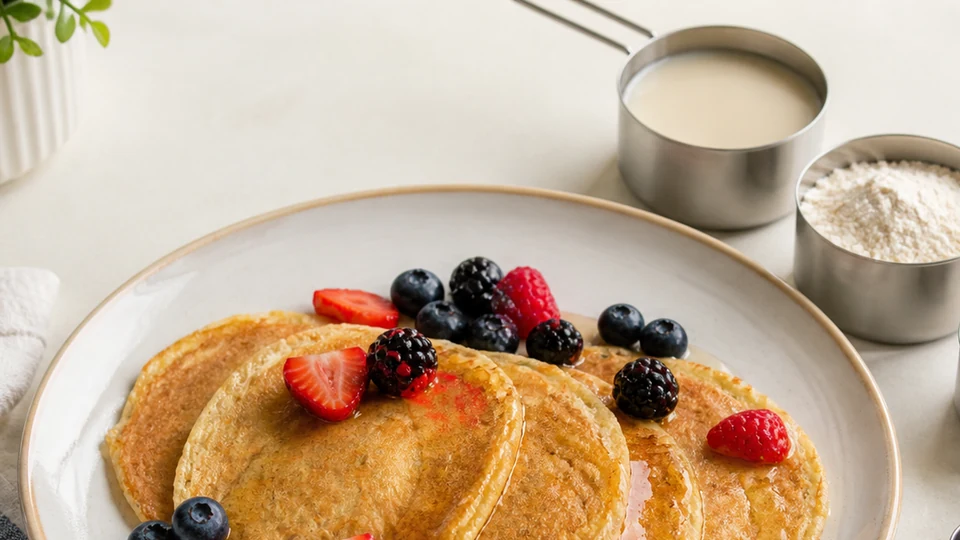
This guide helps execute and compare cup-based formulas; it does not invent quantities. Pancake World opens the broader vegan pancake collection.
| Guide sections |
|---|
| Identify what “cups” means |
| Keep measuring routines separate |
| Protect the vegan boundary |
| Scale by batches |
For broader context, continue with Healthy Pancake Guides.
Identify what “cups” means
The word can refer to volume measures, portions served in cups or batter baked in cup-shaped moulds. For measurement intent, confirm the source market and declared cup convention. A cup instruction also depends on whether the author expects spoon-and-level, scooping, packing or a liquid measure read at eye level.
Flour, sugar, oil and plant beverage occupy volume differently. If the source gives weights, preserve them rather than reverse-engineering another conversion.
Keep measuring routines separate
For dry ingredients, avoid compressing flour unless packing is explicit. Level the surface without shaking in extra powder. For liquids, place the vessel on a level surface and read the marked line rather than holding it aloft. Use the named spoon size for small ingredients; “a little extra” leavener is not a dependable correction for dense batter.
Give the portion scoop a separate role. Fill it consistently and pour from a similar position so diameter changes are not confused with batter changes.
Protect the vegan boundary
Check plant beverage, pan fat, chocolate, flavourings, sweetener and prepared toppings. Vegan status and allergen status are different questions. A plant beverage is also not a neutral placeholder: products differ in solids, sugar, acidity, thickness and flavour. Record a switch as a real formula change.
Scale by batches
If the formula yields too little, use its own scaling guidance. Otherwise, repeated normal batches are easier to trace than multiplying every small spoon measure and holding one large bowl. A large batch may change while waiting between the first and last portions.
Write down the number of batches, cup standard, measuring technique and portion tool. Reset the routine for each batch instead of estimating the remainder.
Let the batter expose errors
Observe how it falls from a spoon, whether dry pockets remain, how far a portion spreads and whether the bowl tightens over time. Unexpected stiffness should trigger checks of cup standard, ingredient identity and filling technique before an unmeasured liquid addition. Thin batter should trigger a check for under-filled flour and the exact plant beverage.
Use one small pancake. Watch edge coherence, top-surface change and spatula entry together. Bubbles are not a standalone guarantee. If a correction is needed, make a new small comparison with one measured change.
Make a local conversion note
To convert a trusted formula to weight, record the weight produced by your exact cup technique for each ingredient across careful fills. The result is a local note for that product and method, not a universal density chart. Label it with product, technique and date; do not reuse one flour's result for another flour, meal or starch.
A repeatability check for cup-based batches
Before calling the cup method successful, make the same formula twice with the same vessel and filling technique. Compare total batter state, portion count and the spread of the first diagnostic pancake. If the second batch differs, investigate how the cup was filled and levelled before changing ingredients. This turns a vague volume concern into a traceable measuring problem and avoids publishing a false conversion.
Frequently asked questions
Are all cups the same size?
No. Sources can use different conventions, and dry-ingredient handling adds another variable. Follow one declared system throughout.
Can I double cup amounts?
Only with attention to every ingredient and batch behaviour. Two normal batches can be more reproducible than one oversized bowl.
Does vegan mean allergen-free?
No. Verify each package and manage cross-contact for the actual diners.
Explore related Pancakes World guidance on American Pancakes, American Breakfast: Pancakes, Diner Plates and Brunch, and Maple Syrup.
Sources and editorial references
- USDA FoodData Central, ingredient definitions and composition records:
https://fdc.nal.usda.gov/ - FoodSafety.gov, food-safety charts:
https://www.foodsafety.gov/food-safety-charts - U.S. Food and Drug Administration, food labeling and nutrition information:
https://www.fda.gov/food/nutrition-food-labeling-and-critical-foods