Vegan keto coconut flour pancakes
At Pancakes World, vegan keto coconut flour pancakes require a recipe designed for all three constraints, not a conventional coconut-flour pancake with the eggs removed. Look for a formula that uses coconut flour in a measured amount, a specified vegan binder, unsweetened plant liquid, compatible fat and leavening, and nutrition information calculated for the actual ingredients and serving. Keep the pancakes small and let the first side become firm before turning. “Keto” is not proved by coconut flour alone: sweeteners, companion flours, plant drinks, toppings, and serving size all affect the carbohydrate information a reader may be tracking.
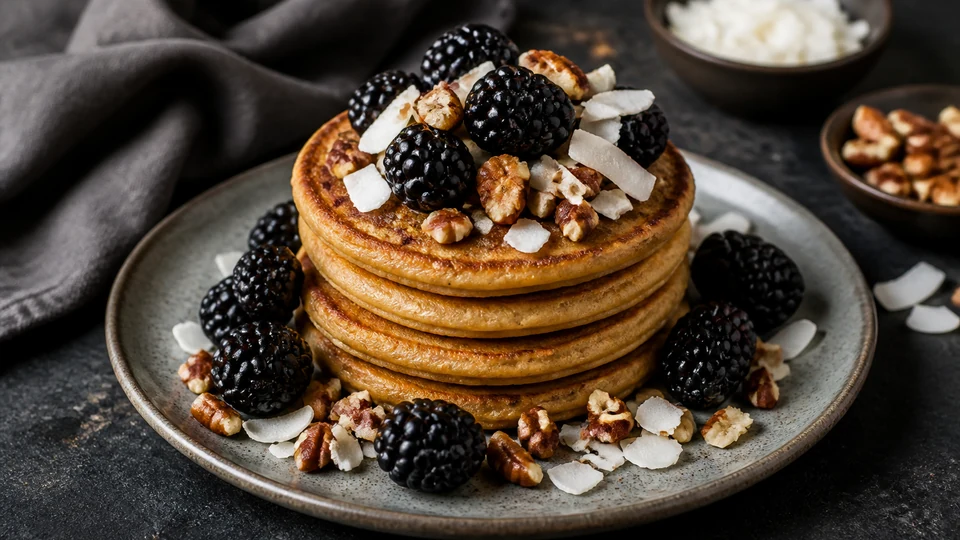
For broader context, continue with Healthy Pancake Guides.
Direct answer for vegan keto coconut flour pancakes
The dependable decision is to select a complete formula whose default method is both vegan and intentionally low in carbohydrate, then verify its coconut-flour role and serving calculation. Recipes based on eggs, dairy buttermilk, whey, or butter do not become vegan through a casual substitution. Recipes labeled vegan do not become keto simply because one ingredient is coconut flour.
Use the exact flour weights, binder, liquid, rest, and portion size provided. Read the Nutrition Facts labels of packaged ingredients and recalculate when brands or quantities change. For a medically prescribed ketogenic diet, follow the clinician and specialist dietitian’s plan rather than a general recipe page. This article provides culinary selection and troubleshooting guidance; it does not prescribe a diet, promise ketosis, or assign a universal carbohydrate limit.
What the reader needs to know
Three constraints create a narrow formula
“Vegan” sets an ingredient-origin boundary: no egg, dairy milk, butter, whey, or other animal-derived component. “Coconut flour” sets a flour-system boundary because that flour absorbs liquid and structures batter differently from wheat or a general gluten-free blend. “Keto” is a dietary label whose practical meaning depends on a defined eating plan, ingredient quantities, and serving size. The terms overlap only when the whole formula satisfies all three.
This distinction prevents several misleading shortcuts. Almond flour plus a token spoonful of coconut flour may be a workable low-carbohydrate recipe, but it is not a coconut-flour-only pancake. A coconut-flour pancake containing three eggs and buttermilk may be promoted as keto-friendly, but it is not vegan. A vegan coconut-flour pancake sweetened heavily or served with ordinary syrup may not fit the carbohydrate target a particular reader uses.
The page therefore treats “keto” as a verification task, not a health claim. It cannot tell a reader that eating the pancakes will create or maintain ketosis. Individual targets, medical conditions, medication, and the rest of the day are outside a cooking article’s scope.
What published culinary formulas can and cannot prove
King Arthur Baking publishes a keto-friendly buttermilk pancake formula containing almond flour, a smaller quantity of coconut flour, three eggs, butter, and dairy buttermilk. It is useful evidence that coconut flour may be one measured component in a deliberately formulated low-carbohydrate pancake and that the formula’s dry and wet ingredients operate as a system. It is not evidence for replacing all four animal-derived ingredients at once.
The same publisher’s gluten-free pumpkin coconut-flour pancakes use eggs, milk, whey protein, almond flour, and coconut flour. The method notes that the batter thickens while standing and that adding too much liquid can make the pancakes fragile. Those observations help explain handling, but the recipe remains non-vegan and should not be presented as a template with automatic egg replacements.
King Arthur’s easy vegan pancakes demonstrate that egg-free, dairy-free pancakes can be built as a complete recipe. They do not establish a keto or coconut-flour formula. The honest synthesis is narrow: purpose-built recipes exist for each constraint, but combining constraints requires its own tested formulation.
Why coconut flour raises the difficulty
Coconut flour can turn a liquid mixture into a scoopable batter during rest. If a cook keeps pouring in plant drink to recover the flowing texture of wheat batter, the pancake may lose the strength needed for turning. On the other hand, copying a multi-egg coconut-flour recipe and replacing each egg with a seed gel can produce a heavy concentration of binder and water.
A successful vegan version may use coconut flour with almond flour, a seed meal, psyllium, starch, plant protein, puree, or a commercial replacer. Each choice affects hydration and cooking. These are not a menu of interchangeable one-for-one options. The formula author should state the specific combination and the point at which the batter is ready for the pan.
Small size is functional. A short diameter reduces the unsupported span during turning and allows the center to set before the exterior becomes too dark. Moderate heat is also functional: the structure needs time to form. A broad, thin disk over high heat may color quickly yet remain too weak to lift.
How to read carbohydrate information without inventing numbers
FDA’s Nutrition Facts guidance instructs readers to start with serving size and servings per container. The label lists Total Carbohydrate and separately identifies Dietary Fiber, Total Sugars, Added Sugars, and, when applicable, sugar alcohol information. A recipe page that reports a nutrient total should disclose its serving definition and calculation basis. Changing the yield, plant drink, sweetener, flour brand, or topping changes the result.
The phrase “net carbs” is widely used in consumer diet discussions, but it is not the line labeled Total Carbohydrate on the FDA Nutrition Facts panel. Different publishers may subtract fiber and some sugar alcohols in different ways. Do not compare two recipe claims until their definitions and serving sizes match. For a packaged ingredient, use its current label; for a homemade formula, use a transparent calculation tool and actual weights rather than guessing from the ingredient names.
This page deliberately supplies no nutrient total because it does not publish a tested, fixed-yield recipe. A number without a complete formula, named products, and serving weight would create false precision.
Medical ketogenic therapy is outside the recipe decision
NHS hospital guidance describes therapeutic ketogenic diets used for conditions such as drug-resistant epilepsy as medically supervised and closely monitored. That clinical use is not the same as choosing a consumer recipe tagged “keto.” Anyone following a prescribed ketogenic therapy should use the ratios, products, portions, and monitoring process supplied by the clinical team. A blog recipe must not replace that plan.
For non-medical cooking, the safer editorial boundary remains: define the reader’s own target, check the whole formula, and avoid promises about weight, blood glucose, seizure control, or other health outcomes.
Practical options and examples
Option A: a verified complete recipe
Prefer a source that provides:
- weights for coconut flour and every companion dry ingredient;
- an explicit egg-free and dairy-free default method;
- one defined binder system rather than a list of speculative swaps;
- unsweetened liquid with a named type;
- a post-rest batter cue;
- a small portion or diameter;
- yield and serving size;
- a transparent nutrition calculation with a stated definition for any nonstandard term.
Run the formula unchanged on the first attempt. If a different plant drink is necessary, choose one within the source’s approved alternatives and update the calculation. Do not change the binder and liquid simultaneously, because a failed pancake will reveal little about the cause.
Option B: a low-carbohydrate vegan mix
A packaged mix may solve the flour balance, but its label and directions control the outcome. Confirm that the dry mix is vegan, that its required additions can be vegan, and that coconut flour is genuinely part of the formulation. Read the declared serving size and Total Carbohydrate rather than relying only on a front label.
If the package requires eggs and offers no supported egg-free preparation, it is not an established vegan solution. If it offers one, use the exact replacer and method. Adding coconut flour to thicken a prepared mix can disturb its hydration and yield, so it also invalidates the package nutrition calculation unless the addition is accounted for.
Option C: make coconut flour a supporting ingredient
Many workable formulas use more almond flour than coconut flour. This can still answer the query when the page clearly says “made with coconut flour,” but it may not satisfy someone seeking a coconut-flour-only recipe or avoiding almonds. Identify the dominant flour and all allergens before selecting it.
A companion seed flour may fit some households, while a starch-heavy blend may conflict with a particular carbohydrate target. There is no universal best partner. The useful choice is the one documented in a complete formula and compatible with the reader’s defined constraints.
Option D: abandon the coconut-flour requirement
If vegan and low-carbohydrate requirements matter more than coconut flour, choose a formula designed around another flour or seed. If vegan and coconut flour matter more than the keto label, use vegan gluten-free coconut flour pancakes and evaluate the complete recipe without forcing an additional claim. Narrowing the goal is often more truthful than stacking substitutions until the batter no longer resembles the published method.
For a thin pancake, use vegan crepe ingredients rather than trying to spread a thick coconut-flour batter like a crepe. For a larger meal pattern, Indian breakfast menu offers planning options but does not promise that its dishes are keto, vegan, or gluten-free.
Choosing the right approach
Start with the reader, not the trend label:
- Write down the non-negotiable constraints: vegan, coconut flour, and the reader’s exact carbohydrate framework.
- Add any separate allergies or exclusions. Almond, soy, pea, sesame, coconut, and specific sweeteners require their own review.
- Decide whether coconut flour must be the only flour or merely a significant component.
- Compare recipe formulas, not headline adjectives.
- Check serving size and calculation method.
- Choose the formula with the fewest unsupported substitutions.
- Make a small batch with the listed products before scaling.
The broader vegan pancakes guide covers egg- and dairy-free foundations. Pancake World separates this keto/coconut question so the extra nutritional and structural conditions are not silently attached to every vegan pancake.
Common mistakes
Using coconut flour as proof of keto suitability. One ingredient does not determine the finished serving. Companion flour, sweetener, beverage, puree, and toppings count too.
Using “sugar-free” as a substitute for total carbohydrate review. A product can have no added sugar while containing other carbohydrate. Read the full label and serving size.
Comparing nutrient numbers with different portions. One source may define a serving as one small pancake and another as a stack. Normalize the actual serving before comparing.
Subtracting ingredients by intuition. Do not invent a net-carbohydrate number from a list. Use the declared label data and a disclosed calculation rule.
Starting from an egg-heavy recipe. Multiple eggs may be central to coconut-flour structure. A generic egg-replacer chart does not establish an equivalent pancake.
Adding plant drink until the batter pours. Coconut-flour batter may be meant to scoop and spread gently. Over-thinning often increases fragility.
Turning as soon as bubbles appear. Wait for stable edges and a base that releases. Bubbles are only one cue.
Making restaurant-size rounds. Begin with the small diameter specified by the formula. Larger pancakes demand more turning strength and longer center cooking.
Changing sweetener and binder together. Some granular sweeteners affect moisture or cooling texture. A binder change adds another variable. Test only one approved variation at a time.
Treating vegan as allergen-free. Vegan food may include coconut, almond, soy, or sesame. Confirm the actual person’s needs.
Applying a consumer recipe to clinical therapy. Therapeutic ketogenic plans are individualized and monitored. Follow the clinical team’s directions exactly.
Step-by-step checklist
Define and verify
- State what “keto” means for this meal without converting the article into medical advice.
- If a clinician prescribed the diet, stop using general recipe calculations and follow that plan.
- Confirm that coconut flour is required and decide whether companion flours are allowed.
- List vegan exclusions and any separate allergens.
- Select a recipe whose default ingredients meet the full scope.
- Record the published yield, serving size, and nutrition method.
- Read current labels on flour, plant drink, binder, sweetener, leavener, fat, flavoring, and toppings.
- Use the Total Carbohydrate line and serving size as the common label reference.
Measure the formula
- Weigh coconut flour rather than packing it into a volume cup.
- Weigh or accurately measure the companion flour and binder.
- Prepare seed gel or commercial replacer only as the method directs.
- Use the specified unsweetened liquid; do not confuse coconut beverage, canned milk, and coconut cream.
- Measure leavener and salt carefully.
- Keep toppings out of the base calculation until their amounts are known.
- Record any product replacement before mixing and update the nutrition estimate.
Hydrate and assess
- Combine dry ingredients evenly so the small coconut-flour quantity is dispersed.
- Mix wet ingredients and binder in the stated order.
- Join the mixtures without prolonged beating.
- Scrape dry pockets from the bottom of the bowl.
- Wait for the complete prescribed rest.
- Compare the hydrated batter with the source’s description.
- Make only a supported, measured adjustment.
- Avoid a repeated flour-liquid cycle that changes both yield and calculation.
Cook the first pancake
- Warm a suitable skillet at a moderate setting.
- Apply a thin film of compatible cooking fat.
- Portion a small round using the source’s scoop or weight.
- Spread gently only when instructed.
- Wait until the perimeter looks set and the base releases.
- Support most of the pancake with a broad spatula.
- Turn once and leave it unpressed.
- Check that the center is set before serving.
- If it colors too quickly, lower heat rather than thickening the bowl.
Audit the serving
- Count the actual yield; do not force the mixture into the published number by changing pancake size halfway through.
- Define how many pancakes form one serving.
- Add cooking fat retained, toppings, and accompaniments to the meal calculation where relevant.
- Recalculate if the yield differs materially or an ingredient changed.
- Label stored portions so the serving definition remains clear.
- Do not claim ketosis, weight loss, or a therapeutic outcome from the serving.
A decision table for substitutions
| Proposed change | Main risk | Better decision |
|---|---|---|
| Egg to flax in a three-egg coconut recipe | Structure and water change together | Find a formula developed around flax from the start |
| Dairy buttermilk to almond drink | Acidity, protein, and viscosity change | Use the exact vegan liquid system in the chosen recipe |
| Almond flour to coconut flour | Major absorption shift | Do not substitute; select a coconut-flour formula |
| Sugar to a low-calorie sweetener | Moisture, bulk, and aftertaste can change | Use a source-approved sweetener variation and recalculate |
| Canned coconut milk to coconut beverage | Fat and concentration differ | Match the named product type |
| Large pancake to several small ones | Cooking time and yield change | Prefer the stated small portion; update serving definition |
| Ordinary syrup to sugar-free syrup | Label and serving still matter | Read the current label and include the actual amount |
| Added berries or nuts | Meal carbohydrate and allergens change | Measure separately and account for the topping |
The table is intentionally conservative. It directs the reader toward complete formulas rather than pretending a replacement list constitutes evidence.
Troubleshooting without breaking the calculation
Batter is extremely stiff
Confirm the flour weight and product type. Make sure coconut flour was not confused with shredded coconut or a blend containing coconut. Verify that the binder did not absorb its liquid separately and then receive a second full liquid allowance. If the recipe provides an adjustment range, use the named liquid within that range and record the amount. Extra liquid may change yield even when it does not add meaningful carbohydrate, so the serving count still needs revision.
Batter is loose after resting
Check for omitted coconut flour, companion flour, or binder. Make the first pancake small before changing the bowl. If it spreads uncontrollably and the author gives a coconut-flour correction, weigh the small addition. An improvised dry ingredient changes both structure and nutrient calculation; do not hide it in a footnote.
Pancakes tear at the turn
Allow the first side more time at lower heat, reduce diameter, and support the whole round. Confirm that the binder was prepared correctly. Do not assume more binder is the first answer; excessive gum or seed gel can create a wet, rubbery center.
Exterior is dark, center is unset
Lower the burner, clean scorched residue from the surface, and use a smaller portion. Sweetener and dark cookware can accelerate color. Surface brownness is not a carbohydrate or doneness test.
Texture is gritty or dry
Review the rest, flour weight, and overcooking. Coconut flour needs the formula’s hydration time. If the pancake spent too long over high heat, correcting the pan may be enough. Do not pour on unmeasured syrup and retain the original serving calculation.
Flavor feels overly coconut-heavy
Use neutral oil and a neutral compatible plant drink if the formula permits. Choose a recipe where coconut flour is supported by another flour rather than increasing flavorings. Reducing coconut flour directly will change the hydration balance.
Variations or substitutions when relevant
Almond-free version
Select a recipe formulated with an allowed seed flour, plant protein, or other companion. Almond flour cannot simply be removed from the published keto-friendly buttermilk example; it is the principal flour there. Verify the replacement’s package label, allergen context, and nutrition data.
Soy-free version
Avoid soy drink, soy protein, and soy-based egg replacers, but do not select the alternative solely by name. Pea drink, almond drink, or coconut beverage may produce different viscosity and nutrition. Use a formula that lists the permitted option.
Sweet versus savory
For sweet pancakes, use the formula’s supported sweetener and add measured toppings at service. For savory pancakes, choose a version developed without sweet flavoring and use herbs or small cooked inclusions. Large raw vegetables release water and make a fragile center harder to set.
Coconut-flour-only claim
This is the most restrictive version. The recipe must establish structure without almond flour, starch, grain flour, egg, or dairy. Do not infer that a mixed-flour formula can be converted by removing its companion ingredients. If no credible formula meets the entire list, revise the claim instead of publishing a speculative method.
Make-ahead use
Coconut-flour batter may keep thickening, so a fresh mixed bowl is often easier to control than an overnight one unless the source explicitly supports refrigeration. Cooked pancakes can be cooled in a single layer and stored according to the chosen recipe. Record the serving before freezing stacks together.
Related pages do not inherit this route’s dietary label. Greek yogurt breakfast ordinarily includes dairy, buttermilk hotcake normally uses cultured milk, and millet flour pancakes vegan uses a different flour system. They are useful comparisons, not automatic keto alternatives.
Explore related Pancakes World guidance on American Pancakes, American Breakfast: Pancakes, Diner Plates and Brunch, and Maple Syrup.
Sources and editorial references
Before committing ingredients, copy the candidate recipe’s facts into a simple worksheet. Under formula, record every flour, binder, liquid, fat, leavener, sweetener, and optional topping. Under dietary status, mark which evidence supports vegan status and which evidence supports the carbohydrate description. Under execution, record rest time, portion size, heat cue, turning cue, yield, and serving definition. Blank cells reveal where the source expects the cook to guess.
Then ask five questions. First, is the displayed ingredient list the same formula used for the nutrition calculation, or does the page calculate an optional variation? Second, is the serving one pancake, several pancakes, or a weight? Third, does the nutrition figure include cooking fat and toppings? Fourth, are any branded ingredients responsible for an unusually low total? Fifth, does the default method actually exclude egg and dairy, or are those changes confined to reader comments?
Reject the candidate when its central evidence is circular—for example, “keto because it is keto-friendly”—or when it provides a nutrient number without yield. Also reject a formula that describes an egg replacement as optional but supplies no handling instructions for the egg-free batter. Attractive presentation cannot compensate for missing structure or arithmetic.
When two credible recipes remain, choose by constraints rather than a “best” claim. One may suit almond users and another may suit a seed-based pantry. One may produce thick, small rounds while another uses a thinner, starch-supported batter. Keep the comparison factual: ingredient compatibility, disclosure quality, equipment, and time. Taste preference is personal and should not be converted into an unsupported ranking.
After cooking, complete the worksheet with the actual yield and any authorized adjustment. If the result is shared with someone tracking carbohydrate closely, provide the ingredient labels and serving definition rather than only a promotional adjective. This gives the reader auditable information while avoiding a guarantee that the serving fits every keto plan.
Keep the worksheet with the recipe rather than relying on memory. On a later batch, compare only like with like: the same serving definition, the same flour system, and the same included toppings. A neat record is especially useful when a manufacturer updates a label or a package changes size, because the cook can identify which input must be recalculated.
- U.S. Food and Drug Administration: How to Understand and Use the Nutrition Facts Label —
https://www.fda.gov/food/nutrition-facts-label/how-understand-and-use-nutrition-facts-label— serving-size and Total Carbohydrate label-reading framework. - U.S. Food and Drug Administration: Industry Resources on Changes to the Nutrition Facts Label —
https://www.fda.gov/food/nutrition-food-labeling-and-critical-foods/industry-resources-changes-nutrition-facts-label— placement of Total Carbohydrate, Dietary Fiber, sugars, and sugar alcohol declarations. - University Hospitals Bristol NHS Foundation Trust: Ketogenic diet —
https://www.uhbristol.nhs.uk/transition/epilepsy/treatment/diet/— authoritative boundary for medically supervised therapeutic ketogenic diets. - King Arthur Baking: Keto-Friendly Buttermilk Pancakes —
https://www.kingarthurbaking.com/recipes/keto-friendly-buttermilk-pancakes-recipe— recognized culinary example of a measured almond/coconut flour system; explicitly non-vegan. - King Arthur Baking: Gluten-Free Pumpkin-Spice Coconut Flour Pancakes —
https://www.kingarthurbaking.com/recipes/gluten-free-pumpkin-spice-coconut-flour-pancakes-recipe— coconut-flour hydration and handling evidence; explicitly non-vegan. - King Arthur Baking: Easy Vegan Pancakes —
https://www.kingarthurbaking.com/recipes/easy-vegan-pancakes-recipe— complete vegan pancake construction evidence, not a keto or coconut-flour formula.
Evidence checked 16 August 2026. Recipe formulas, packaged-food labels, serving sizes, and clinical guidance can change; verify current sources and follow individualized professional advice where applicable.