Vegan keto almond flour pancakes
At Pancakes World, vegan keto almond flour pancakes need one tested formula that passes four separate gates: no animal-derived ingredients; almond flour as the specified flour rather than a casual swap; a carbohydrate amount that fits the eater’s own ketogenic plan; and enough defined binder and leavening for the pancake to hold together. Do not convert an egg-based almond-flour recipe by simply deleting the egg, and do not call a recipe keto from its ingredient names alone. Use the exact product labels and source serving size to review total carbohydrate, choose a formula developed with its stated vegan binder, and seek clinician or dietitian guidance when diabetes, medication or a therapeutic ketogenic diet is involved.
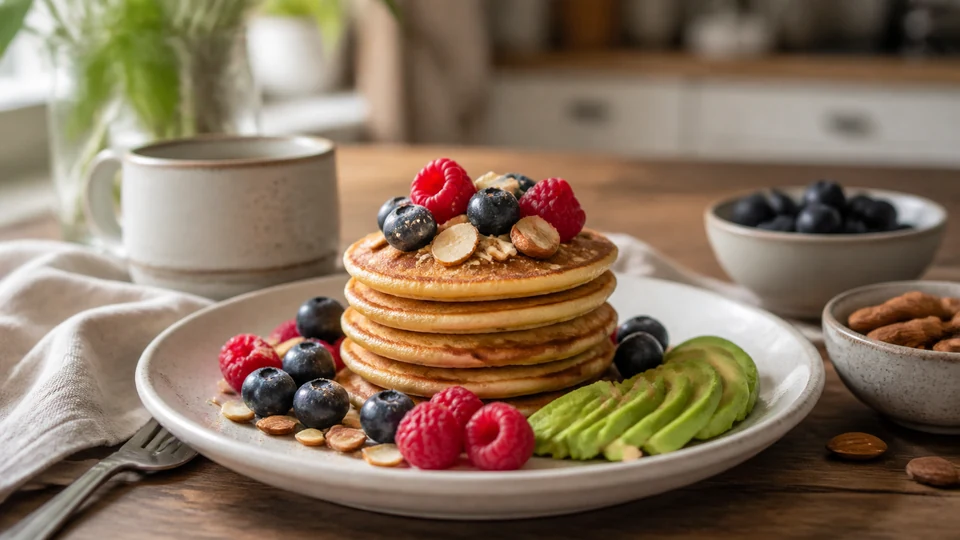
This is a selection and execution guide, not a tested Pancake World recipe or a prescription. No quantity, yield, nutrition panel or ketosis result is invented.
| Guide sections |
|---|
| The four gates must all pass |
| What keto does and does not tell you |
| Compare common vegan binder roles |
| Almond flour and almond meal are not a health claim |
For broader context, continue with Healthy Pancake Guides.
The four gates must all pass
Gate 1: vegan
The complete formula must exclude egg, dairy, honey and other animal-derived ingredients according to the eater’s practice. Check the plant beverage, chocolate, sweetener, cooking fat, protein powder, flavoring and toppings. A recipe title cannot substitute for an ingredient review.
Gate 2: almond-flour-based
The formula must be designed around almond flour or almond meal as named by the source. These products are not interchangeable with wheat flour by volume simply because both are sold as flour. A recipe developed for wheat structure may fail when the flour is replaced without new binder, hydration and cooking instructions.
Gate 3: compatible with the individual keto plan
“Keto” does not have one universal food list or carbohydrate threshold. Harvard’s Nutrition Source notes that ketogenic approaches vary and that very low carbohydrate plans can require professional monitoring. The total meal matters, not the pancake name alone.
Review the exact formula, exact products, source yield and every topping with the method used by the eater’s clinician-informed plan. Do not promise that one serving will create or maintain ketosis.
Gate 4: tested pancake structure
Egg usually contributes more than one function. A vegan formula may need binding, moisture, aeration or some combination. Illinois Extension explains that egg replacements are role-dependent and can change flavor and texture. The chosen recipe must specify its replacement and method; a list of possible substitutes is not evidence that each works in almond-flour pancakes.
If any gate fails, choose another complete formula rather than fixing the batter through guesses.
What keto does and does not tell you
A ketogenic diet is generally a very-low-carbohydrate, high-fat pattern, but there is no single standard version. Individual plans can differ in targets, protein allowance, fiber treatment, medical purpose and monitoring. A general article cannot set a safe personal target.
The phrase “net carbs” needs special care. Harvard’s review describes net or impact carbs as unregulated terms and notes that calculations and physiologic effects, especially around sugar alcohols, can vary. FDA’s Nutrition Facts panel gives total carbohydrate and dietary fiber for the labeled serving. Use the method required by the relevant care plan instead of inventing a universal subtraction rule.
For a packaged almond flour, plant beverage, sweetener or topping:
- Check the labeled serving size.
- Check how many servings the package contains.
- Read total carbohydrate and dietary fiber from the same serving basis.
- Review sugar alcohol information only according to the individual plan.
- Multiply by the actual amount used in the complete formula.
- Divide only by the verified recipe yield.
This calculation requires real measured inputs. A photo, ingredient category or online nickname cannot establish the result.
People who use insulin or certain diabetes medicines should not make major carbohydrate or meal-timing changes from a recipe page. NIDDK explains that meal timing and carbohydrate planning can interact with medicines and blood glucose. The health care team should set the personal approach.
Explore related Pancakes World guidance on American Pancakes, American Breakfast: Pancakes, Diner Plates and Brunch, and Maple Syrup.
Sources and editorial references
Look for a complete formula with all of the following:
- almond flour or almond meal named precisely;
- a vegan binder identified by type and amount;
- plant beverage or other liquid specified;
- leavener and any acid stated;
- pan heat or appliance setting;
- portioning instruction;
- turn cue and total cooking sequence;
- yield and serving definition;
- storage guidance if advance preparation is claimed;
- nutrition based on that exact formula when carb accounting is offered.
Reject pages that provide only a promotional photograph, omit yield, combine several vague substitutions or attach nutrition to an undefined serving. Also reject a conventional almond-flour recipe that says “use any egg replacer.” The replacement must be part of the tested structure.
Recipe reviews are not a substitute for method detail. A reader’s success with a different brand, pan or substitution does not verify the formula you intend to use.
Compare common vegan binder roles
This is a functional comparison, not a substitution table.
Ground flax mixture
Flax can form a gel after hydration and may contribute binding. It also adds visible flecks and can alter flavor and browning. Use it only when the complete almond-flour formula specifies the grind, hydration and waiting step.
Chia mixture
Chia can create a strong gel and a distinct seed texture. Whole and ground chia behave differently. Do not replace flax with chia by assumption or copy the same amount without source support.
Mashed banana
Banana contributes moisture, sweetness and flavor as well as some binding. Those properties affect carbohydrate accounting and make it unsuitable as a neutral universal replacement. A banana formula needs its own measured nutrition and yield.
Applesauce or fruit purée
Fruit purée changes moisture, sweetness and carbohydrate. It may make a pancake tender but does not guarantee sufficient structure. Use only within a formula developed for it.
Silken tofu
Silken tofu can supply moisture and body while introducing soy as a major allergen. The amount and blending method matter. It is not interchangeable with firm tofu.
Commercial egg replacer
A packaged replacer has its own ingredients and directions. Confirm vegan status, carbohydrate information, allergens and compatibility with the source recipe. Different products cannot inherit the same result.
Aquafaba
Bean liquid can contribute aeration in some formulas. Its concentration varies, and a recipe must specify how it is used. It should not be added merely because a batter appears thick.
The correct decision is the binder proven by the selected formula, not the ingredient with the lowest-looking number on a search snippet.
Almond flour and almond meal are not a health claim
Product naming and grind can vary. Fine blanched almond flour, coarser meal and homemade ground almonds can absorb and spread differently. Follow the product type stated by the recipe and do not promise the same texture after changing it.
Almond is a tree nut and a major allergen. FDA requires packaged foods containing a major allergen to identify its food source; tree nuts must be named by type. Anyone with an almond allergy should not use almond flour. Removing almonds from this concept changes the defining ingredient and requires another complete recipe.
Almond flour is not wheat flour, but that fact alone does not prove the complete pancake is gluten-free. Leavener, flavoring, protein powder, plant beverage, toppings and shared equipment still matter. FDA defines a voluntary gluten-free claim for packaged foods. When gluten control is medically necessary, choose labeled products and manage kitchen cross-contact under the eater’s required standard.
Do not use the same scoop in wheat flour and almond flour. Clean the counter, bowl, whisk, spatula and griddle. Keep opened packages closed and labeled.
Evaluate every supporting ingredient
Plant beverage
Choose the exact beverage specified. Almond beverage adds another almond exposure; soy beverage adds soy; coconut beverage differs in solids and flavor. Sweetened and unsweetened versions change the formula and label totals. A different beverage is a substitution even when both are vegan.
Leavener
Baking powder and baking soda are not interchangeable. Baking soda requires sufficient acid in the formula. Use the named product and check serving labels when carbohydrate accounting is unusually strict.
Sweetener
Sugar, syrup, fruit purée, high-intensity sweeteners and sugar alcohol products behave differently. Some contribute bulk and browning; some affect digestion; some packaged blends include carbohydrate-containing carriers. Use the tested ingredient and the care plan’s accounting method.
Fat
Oil, melted coconut fat, nut butter and vegan butter-style products are not automatic structural substitutes. They differ in water content, flavor and allergens. Use the source ingredient and amount.
Flavoring and protein products
Vanilla, cocoa, spices and protein powder need label review. A protein powder can dramatically change batter absorption and may include animal-derived ingredients or allergens. Do not add it unless the formula was developed with that exact type.
Read nutrition without transferring numbers
Published nutrition belongs to the exact recipe, brand assumptions, yield and serving. Changing almond flour brand, binder, plant beverage, sweetener, cooking fat or topping can change the calculation.
Align every product to the actual measured amount. If the label serving is two tablespoons and the recipe uses a weight, convert only with reliable product-specific information. Do not convert volume to weight using a number from another almond flour.
Then confirm yield. Four pancakes are not necessarily four servings. If a formula makes eight pancakes and defines two per serving, making four oversized pancakes does not preserve the per-piece value.
Keep toppings separate. Berries, nut butter, coconut, syrup alternatives, vegan cream products and packaged sauces each need their own measured input. “Keto-friendly” on the front of a package is not a nutrition calculation.
No nutrition numbers appear here because no Pancake World formula has a completed test record and defined products.
Mix the batter according to its structure
Read the complete method before combining anything. Bring ingredients to the temperature specified. Hydrate flax, chia or another binder for the stated time. Mix dry ingredients evenly so small amounts of leavener and salt do not remain concentrated.
Combine wet ingredients according to the source. Add dry to wet, or wet to dry, exactly as directed. Almond-flour batters may not look like wheat batters. Do not chase a familiar appearance by adding liquid or flour unless the source gives a correction range.
Respect the rest. A rest can hydrate a binder and thicken the batter; an indefinite rest can overthicken it. Start heating the pan at the point specified so the batter and cooking surface are ready together.
Never taste the raw mixture. FDA warns that flour is generally a raw food and raw batter should not be eaten. That handling rule remains prudent for almond flour and for any formula containing other raw ingredients. Clean flour-contact surfaces and utensils.
Cook small, controlled pancakes
Use the pan material, heat range and fat application stated by the recipe. Almond-flour vegan pancakes can be fragile before the binder sets. Smaller portions are generally easier to turn only when the source formula calls for them; do not change the published yield without changing the nutrition calculation.
Portion consistently. Leave room to reach each pancake with a thin spatula. Wait for the recipe’s combined cues, which may include edge appearance, surface bubbles, firmness and time. Bubbles alone are not universal across binders.
Slide the spatula fully underneath and turn once with a controlled motion. If the first pancake spreads too far, breaks or burns, pause. Check whether the correct product, measurement, rest, pan temperature and portion were used. Do not add random dry ingredients and continue to cite the original nutrition.
Cook the center completely under the source instructions. Dark edges do not prove the interior is done. Reduce heat if the exterior colors before the structure sets.
Troubleshoot without inventing a new formula
Batter spreads into a thin sheet
Check measurement, binder hydration, product type and rest. If all matched, use only the source’s correction. A different almond grind may be the cause.
Pancake breaks at the flip
The portion may be too large, the first side may not be set, or the binder step may be wrong. Return to the recipe cues. Do not add an egg, which would violate the vegan gate.
Center remains wet
Use smaller source-defined portions and the stated moderate heat. Verify that an extra liquid or purée was not added. Continue cooking according to the source rather than serving from surface color.
Pancake is dry or crumbly
Check whether almond flour was packed, whether liquid was undermeasured, and whether the pancake cooked too long. Do not add oil or beverage without accepting that the formula and nutrition have changed.
Pancakes brown too quickly
Lower the pan heat and allow it to stabilize. Sweeteners and nut solids can brown differently from a plain wheat batter.
Batch thickens while standing
Follow the source’s allowed adjustment, if any. Otherwise cook within the intended window. An unverified splash of beverage changes consistency and measured inputs.
Toppings and the complete serving
Select toppings after the base formula passes the four gates. A small measured portion of berries, nut or seed butter, coconut, vegan yogurt-style product or a labeled syrup alternative may fit some plans, but none is universally keto or medically appropriate.
Review total carbohydrate on the actual label and serving. Confirm vegan ingredients. Identify almond, peanut, other tree nuts, soy or coconut as relevant. If several people share breakfast, provide separate spoons and keep packages available.
For a savory plate, use a source-developed topping or serve suitable vegetables and a defined plant-protein dish separately. Beans and many common vegan breakfast foods can be carbohydrate-significant under some keto plans; the individual method must decide, not a generic vegan list.
Storage and reheating
Use the recipe’s own storage instruction first. If cooked pancakes are saved, refrigerate promptly in shallow containers. USDA FSIS advises refrigerating perishable food within two hours, or one hour above 90°F, and generally using cooked leftovers within three to four days.
Reheat leftovers to 165°F. Reheat only the portion needed. A skillet, oven or toaster may preserve texture better than a microwave, but follow the source and avoid a method that overheats nut-rich edges before the center is hot.
Freeze only when the complete recipe supports it. Separate pancakes as directed, label the container and date, and do not attach the original quality promise to an improvised freeze-thaw cycle.
Do not store leftover raw batter unless the source provides a specific safe method. Cooking the planned batch is clearer.
Who needs individual guidance
A restrictive vegan ketogenic pattern removes or limits several common food categories simultaneously. Harvard recommends physician and dietitian involvement when starting a ketogenic diet, particularly to tailor it to existing conditions and reduce complication or deficiency risk.
Talk with the appropriate care team before using the diet for diabetes, epilepsy or another medical purpose; when taking insulin or glucose-lowering medicine; during pregnancy, breastfeeding or growth; or with kidney, liver or eating-disorder concerns. This article cannot set a macro ratio, supplement plan or medication adjustment.
A pancake that meets ingredient gates is still only one meal component. It does not establish nutritional adequacy for a day or a long-term eating pattern.
Frequently asked questions
Is almond flour keto?
An ingredient alone cannot establish whether a measured serving fits an individual ketogenic plan. Use the exact product label, formula amount, verified yield and prescribed accounting method.
Is almond flour vegan?
Plain almond flour is plant-derived, but the complete pancake must also exclude egg, dairy, honey and other animal-derived ingredients.
Are almond-flour pancakes gluten-free?
Not automatically. Check every ingredient, packaged claim and cross-contact condition. Almond flour does not certify the leavener, flavoring, plant beverage, topping or shared equipment.
What replaces egg?
Only the replacement specified by a tested formula. Flax, chia, banana, applesauce, tofu, aquafaba and packaged replacers perform differently and are not universal equivalents.
Can I replace wheat flour with almond flour in a vegan pancake recipe?
Not as a simple one-for-one swap. Choose a formula developed for almond flour because structure, hydration and cooking differ.
How do I calculate net carbs?
Use the method set by the relevant clinician-informed plan. “Net carbs” is not a regulated universal label term, and sugar-alcohol treatment can vary. FDA labels report total carbohydrate and dietary fiber.
Will these pancakes put me in ketosis?
No recipe page can guarantee that outcome. Ketosis varies with the complete dietary pattern and individual factors.
Can I add protein powder?
Only if the tested formula includes the specified type. Powder changes absorption, structure, ingredients, allergens and nutrition.
Can I freeze them?
Only when the selected recipe provides a tested freezing method. Follow its packaging, thawing and reheating directions.
Final selection checklist
- complete formula is explicitly vegan;
- almond flour or meal type matches the source;
- binder is built into the tested method;
- exact products and amounts are available;
- yield and serving are unambiguous;
- total carbohydrate is reviewed on a consistent serving basis;
- no universal net-carb shortcut is assumed;
- almond and other allergens are labeled;
- gluten-free status is verified separately when needed;
- raw batter is never tasted;
- no ketosis, weight-loss or medical outcome is promised;
- no ingredient substitution inherits the original nutrition;
- clinician or dietitian guidance is used when medically relevant;
- no Recipe schema is used without a genuine project test record.
Vegan keto almond flour pancakes are a constrained formula-selection problem, not an ingredient-swap challenge. Find a complete recipe that was developed with almond flour and a named vegan binder, calculate from exact labels and verified yield, apply the individual plan’s rules, and cook by the source method. If any gate is uncertain, choose another verified formula instead of improvising.
- Harvard T.H. Chan School of Public Health, “Diet Review: Ketogenic Diet for Weight Loss”:
https://nutritionsource.hsph.harvard.edu/healthy-weight/diet-reviews/ketogenic-diet/ - National Institute of Diabetes and Digestive and Kidney Diseases, “Healthy Living with Diabetes”:
https://www.niddk.nih.gov/health-information/diabetes/overview/healthy-living-with-diabetes - Utah State University Extension, “Plant-Powered: A Guide to Balanced Vegan and Vegetarian Eating”:
https://extension.usu.edu/nutrition/research/vegan-and-vegetarian-eating - Illinois Extension, “Egg substitutes when baking”:
https://extension.illinois.edu/blogs/live-well-eat-well/2023-02-10-egg-substitutes-when-baking - U.S. Food and Drug Administration, “How to Understand and Use the Nutrition Facts Label”:
https://www.fda.gov/food/nutrition-facts-label/how-understand-and-use-nutrition-facts-label - U.S. Food and Drug Administration, “Food Allergies”:
https://www.fda.gov/food/nutrition-food-labeling-and-critical-foods/food-allergies - U.S. Food and Drug Administration, “Gluten-Free Labeling of Foods”:
https://www.fda.gov/food/nutrition-food-labeling-and-critical-foods/gluten-free-labeling-foods - U.S. Food and Drug Administration, “Flour Is a Raw Food and Other Safety Facts”:
https://www.fda.gov/consumers/consumer-updates/flour-raw-food-and-other-safety-facts - USDA Food Safety and Inspection Service, “Leftovers and Food Safety”:
https://www.fsis.usda.gov/food-safety/safe-food-handling-and-preparation/food-safety-basics/leftovers-and-food-safety