Vegan gluten free buttermilk pancakes
At Pancakes World, vegan gluten-free buttermilk pancakes are made with a gluten-free flour system, no eggs or dairy, and an acidic plant-based liquid that supplies the tang people associate with buttermilk. The dependable route is to begin with a complete vegan gluten-free pancake formula and make its cultured-liquid component dairy-free; it is not dependable to remove the wheat, egg, and buttermilk from a conventional recipe all at once. Use plain plant drink, the acid and leavener specified by the formula, verify every label, rest the batter as directed, and cook one small pancake before adjusting consistency.
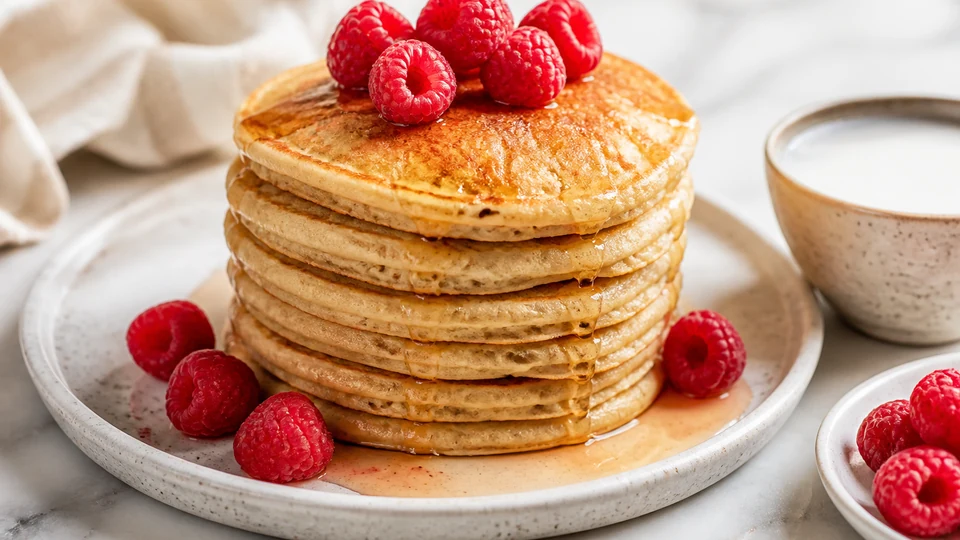
For broader context, continue with Healthy Pancake Guides.
Direct answer for vegan gluten free buttermilk pancakes
Three requirements have to be solved independently. “Vegan” excludes dairy buttermilk and egg. “Gluten-free” requires suitable ingredients and, when relevant, controls against gluten cross-contact. “Buttermilk” describes the intended acidity and flavor here, not the use of dairy. A purpose-built formula normally combines a gluten-free flour blend with plant drink, a measured food acid, oil, leavening, salt, and an egg-replacement strategy chosen for that formula.
Do not assume that curdling plant drink recreates dairy buttermilk in every functional detail. It creates an acidic liquid and a useful flavor direction, but plant drinks vary in protein, fat, sugar, gums, and thickness. Likewise, gluten-free blends differ in starches, whole-grain flours, and binders. Those two variables determine how much liquid the batter accepts. Follow the selected formula first; use visual consistency only for a small final correction.
This is a decision and troubleshooting guide rather than a claim that one unpublished universal recipe has been tested. It helps a cook select a credible formula, keep the three requirements intact, and make cautious corrections without inventing ratios.
What the reader needs to know
The three labels do different jobs
A pancake can be dairy-free without being vegan because it may contain egg. It can be vegan without being gluten-free because ordinary wheat flour is vegan. It can be gluten-free without being vegan because a gluten-free recipe may use milk, butter, or egg. Check each condition rather than treating one label as proof of the others.
For people who must avoid gluten, the United States Food and Drug Administration explains that use of “gluten-free” on packaged foods is voluntary but regulated: foods bearing the claim must meet the rule’s criteria, including the threshold of less than 20 parts per million gluten. That standard governs labeled packaged food in the United States; it does not turn an ordinary shared kitchen into a controlled gluten-free environment. Read the complete label on the flour blend, plant drink, baking powder, flavorings, toppings, and cooking spray. If the requirement is medical, the cook should use the person’s own clinician-led plan and appropriate cross-contact controls rather than relying on this page.
The word “buttermilk” also needs precision. Cultured dairy buttermilk is a dairy product. In a vegan pancake, “buttermilk-style” usually means plant drink combined with a measured acid, or a purpose-made cultured non-dairy product. The aim is tang and an acidic partner for the recipe’s leavening. The acid amount cannot be chosen separately from the baking soda and baking powder. Excess baking soda can leave an unpleasant alkaline flavor; excessive acid can make the batter sharply sour and does not automatically create more lift.
Why a standard wheat conversion is risky
Wheat flour, egg, and cultured dairy contribute different forms of structure, water management, browning, and flavor. Removing all three is a multi-variable redesign. Adding extra gluten-free flour whenever the batter looks thin can make the interior pasty or dense after the blend hydrates. Adding more plant drink whenever batter looks thick can make a fragile pancake spread too far. Adding extra leavener can produce fast surface bubbles without a center strong enough to hold them.
King Arthur Baking’s gluten-free guidance emphasizes that gluten-free flours do not all behave alike and that recipes developed for a particular blend give more predictable results than casual substitutions. Its vegan pancake formula demonstrates the same principle from the other direction: egg-free and dairy-free pancakes can be constructed as a complete system. Neither source proves that combining any two recipes will work. Together they support the safer editorial recommendation to select one formula already designed around both restrictions.
Ingredient roles at a glance
| Component | Its practical job | What to verify | Poor shortcut |
|---|---|---|---|
| Gluten-free flour blend | Forms the bulk and manages water | The exact blend and gluten-free label where required | Replacing wheat flour with any single flour by volume |
| Plant drink | Supplies liquid and some flavor, fat, or protein | Plain or flavored; sweetened or unsweetened; allergens | Treating canned coconut milk and drinking coconut beverage as identical |
| Food acid | Supplies tang and participates in the formula’s acid balance | Type and measured quantity specified by the recipe | Pouring in extra vinegar to force visible curdling |
| Leavener | Generates gas during mixing and cooking | Gluten-free status and freshness; formula quantity | Adding more after a flat first pancake without diagnosing heat or consistency |
| Binder or egg strategy | Helps the pancake hold together | Whether the flour blend already contains a binder | Combining several binders “for insurance” |
| Fat | Supports release, tenderness, and flavor | Vegan status and suitability for cooking | Assuming every margarine is dairy-free |
| Salt and sweetener | Balance flavor and influence browning | Hidden ingredients and desired sweetness | Using a sweetened plant drink without adjusting expectations |
The table is a planning aid, not a substitute formula. A blend that already contains xanthan gum may need no additional binder. A recipe based on oat flour may use a different rest and liquid level from one based on rice flour and starch. A formula using mashed banana is not interchangeable with one using ground flax or a commercial egg replacer. Respect the architecture already present.
Practical options and examples
Option 1: choose a complete dual-purpose recipe
This is the most reliable approach. Look for a formula that explicitly says both vegan and gluten-free, lists weights as well as volumes, identifies the flour or blend, and provides a batter cue. The instructions should say when to add acid, how long to rest the batter, how large to portion it, and what visual sign indicates the first side is ready to turn. A source that shows only an attractive photograph but omits those operational details leaves too much unresolved.
Use the formula exactly on the first attempt. Do not replace its flour blend, plant drink, binder, and acid at the same time. Record the brands used because two products with the same front-of-pack description can produce different batter thickness. If the result works, change one variable in the next batch and keep the rest constant.
Option 2: adapt the liquid in a tested vegan gluten-free base
If a trusted vegan gluten-free pancake formula uses ordinary plant drink but no buttermilk-style element, a cautious adaptation is possible only when the recipe publisher gives a supported acidic-liquid variation. Use that exact variation. Do not improvise an acid quantity and then leave the leavener unchanged. The goal is not to make the plant drink visibly dramatic; it is to preserve the recipe’s acid-base balance.
When no publisher-supported variation exists, add tang at service instead of redesigning the batter. A tart fruit topping or suitable cultured non-dairy spoonable topping can create contrast without changing the pancake structure. Verify its vegan and gluten-free status separately.
Option 3: use a labeled mix with compatible additions
A packaged gluten-free pancake mix can reduce the flour-blend decisions, but its instructions control. Some mixes require egg or milk; some offer substitutions; others are formulated as add-water products. Choose one whose manufacturer expressly provides a vegan preparation method. Check whether “may contain” or shared-equipment information matters for the eater’s needs, and recheck labels on every purchase because formulations can change.
Do not call the result buttermilk-style merely because a conventional mix contains dairy buttermilk powder. That would fail the vegan condition. Conversely, adding acidified plant drink to a mix that asks for water may upset the mix’s existing leavening. Manufacturer directions take priority over generic pancake advice.
Option 4: separate flavor from structure
When the triple requirement feels too fragile, solve the structure with a proven vegan gluten-free pancake and put the tang in a topping. Suitable examples include a plain cultured plant-based topping, tart berry compote, or lemon served at the table, provided every product meets the required restrictions. This produces a similar flavor contrast without pretending it is the same chemical system as cultured dairy buttermilk.
For a different flour-specific route, compare the limitations in vegan gluten-free coconut flour pancakes. Coconut flour is not a direct substitute in the blend described here. The more restrictive vegan keto coconut flour pancakes adds a separate carbohydrate constraint and should not be used as shorthand for ordinary gluten-free cooking. If thin pancakes are the actual goal, vegan crepe ingredients explains why a pourable crepe batter needs a different structural plan.
Choosing the right approach
Choose according to the cost of failure and the strictness of the restrictions:
- For a medical gluten-free requirement: use appropriately labeled ingredients, a controlled preparation area, clean equipment, and the eater’s established safety protocol. Select a formula that names the exact flour system. Do not use a shared toaster, flour-dusted griddle, or wooden utensil if those conflict with the protocol.
- For a vegan household breakfast: use a complete vegan gluten-free formula and focus on flavor and texture. A plain plant drink keeps the result easier to tune than a heavily flavored one.
- For occasional guests with several requirements: confirm the requirements before shopping. “No dairy” and “vegan” are not interchangeable, and individual allergy needs may extend beyond both.
- For a large brunch: make a small advance batch with the same products and equipment. This is a reader-performed trial and is not presented as first-party test evidence. Freeze or refrigerate only if the chosen recipe gives appropriate storage guidance.
- For an unfamiliar flour blend: weigh ingredients, respect the rest, and make a smaller test pancake. Avoid scaling a new formula for a crowd until its behavior is known.
The broader vegan pancakes guide helps with egg- and dairy-free choices. This page remains narrower: it is about preserving gluten-free, vegan, and buttermilk-style requirements at once. Pancake World links these routes so readers can move to the ingredient system that actually matches their question.
Common mistakes
Starting from a conventional buttermilk recipe. Replacing wheat flour with a random blend, egg with a binder, and buttermilk with acidified plant drink is recipe development, not a simple substitution. Begin with a dual-purpose base.
Using plant drink as the only egg replacement. More liquid does not replace the structural role assigned to egg in a conventional formula. The chosen vegan recipe needs its own binder, starch, fruit puree, seed gel, or other strategy.
Assuming all gluten-free flour blends are exchangeable. Blend composition changes absorption and texture. A cup-for-cup claim applies only within the manufacturer’s stated use and still does not guarantee success in an egg-free pancake.
Adding several gums or seed binders. A blend may already contain xanthan gum. Extra binder can make batter elastic or the center gummy. Read both the recipe and the ingredient panel before adding anything.
Chasing visible curdling. Some plant drinks separate visibly when acid is added; others change little. Visible curds are not an accuracy test. Measure what the formula specifies.
Treating bubbles as the sole flipping signal. Gluten-free batter may show bubbles before the underside is stable. Look for a dry or matte edge, a surface that has begun to set, and easy spatula release. Turn once rather than repeatedly lifting and tearing the edge.
Cooking too hot. Added sugar, a sweetened drink, or a dark pan can accelerate browning. A dark exterior does not prove that the center has set. Reduce heat and use a smaller portion if the first pancake colors too quickly.
Flattening after the turn. Pressing with a spatula expels steam and can compress a delicate interior. Let the second side cook without pressure.
Equating vegan with allergen-free. Soy, nuts, oats, and other ingredients may be relevant allergens or cross-contact concerns. The vegan designation addresses animal-derived ingredients, not every dietary requirement.
Writing “gluten-free” from memory. Baking powder, spice blends, toppings, and packaged egg replacers deserve the same label review as flour. Recheck each package rather than relying on a prior purchase.
Step-by-step checklist
Before mixing
- Confirm whether the need is preference, vegan practice, diagnosed gluten-related care, allergy management, or a combination. Apply the strictest relevant control.
- Select one recipe explicitly developed for vegan and gluten-free pancakes.
- Confirm that it uses an acidic liquid or provides an approved buttermilk-style variation; otherwise plan a tangy topping instead.
- Buy the exact flour blend or flours named by the recipe.
- Read every packaged ingredient label, including baking powder, plant drink, oil or spread, flavoring, and toppings.
- Check whether the blend already includes xanthan gum or another binder.
- Clean the work surface and equipment to the level the eater’s requirements demand.
- Use a scale when weights are supplied. Volume measures introduce more variability, especially with compressible flour blends.
- Bring out only the ingredients in the selected formula. Multiple optional substitutes invite accidental combinations.
Mixing and resting
- Combine dry ingredients thoroughly so leavener and salt are distributed.
- Prepare the plant-based acidic component exactly as directed. Do not increase acid to make it look more like dairy buttermilk.
- Mix wet ingredients separately when the formula calls for it.
- Add wet to dry and stir only to the texture described by the source. Scrape the bottom for hidden dry pockets.
- Let the batter rest for the stated time. Gluten-free flours and binders often continue to absorb liquid during this period.
- Judge consistency after the rest, not immediately after the first stir.
- If the source permits correction, add liquid or blend in the smallest stated increment. If it gives no adjustment instruction, avoid redesigning it mid-bowl.
Cooking
- Preheat a clean skillet or griddle over moderate heat.
- Use a cooking fat that satisfies the vegan and gluten-free requirements.
- Portion one small test pancake. Small rounds are easier to turn while learning how the batter sets.
- Wait for the source’s combined cues: surface change, set edges, and easy release. Do not depend on a timer alone.
- Slide a thin spatula fully underneath and turn once.
- Cook until the center is set. If the exterior darkens first, lower the heat for the next pancake.
- Change only one factor after the test. Heat is the first correction for rapid browning; batter consistency is the correction for uncontrolled spread or a mound that never relaxes.
- Keep notes on brand, weight, rest, pan setting, portion size, and correction. These observations make the next batch repeatable without being presented as universal test data.
Serving and leftovers
- Serve with toppings that have been checked independently. Syrups, spreads, granola, and cultured products are separate label decisions.
- Prevent shared knives, butter dishes, or serving utensils from reintroducing excluded ingredients.
- If holding a batch briefly, place pancakes in a single layer or loose stack so trapped steam does not make them wet.
- Follow the source’s storage instructions. Where none are provided, cool leftovers promptly, cover, refrigerate, and use ordinary food-safety judgment rather than leaving a moist cooked food at room temperature for an extended brunch.
- Label stored pancakes when several dietary versions share a refrigerator or freezer.
Diagnosing the first pancake
The first pancake should be treated as information. It does not need to be perfect, and it should not trigger multiple simultaneous changes.
| Observation | Most useful first check | Cautious response |
|---|---|---|
| It spreads into a very thin, irregular sheet | Was the correct blend weighed, and did the batter rest? | If the recipe permits, add a small measured amount of its specified dry blend |
| It stays as a tall mound | Was a liquid omitted or the blend overmeasured? | Add only the recipe-approved liquid in a small increment |
| It browns before the edge sets | Is the pan too hot or the drink sweetened? | Lower heat and make the next pancake smaller |
| It tears during turning | Is the underside released and the edge set? | Wait longer; use a thin, broad spatula; reduce diameter |
| It is gummy in the middle | Was extra binder added, or was the pancake oversized? | Do not add more gum; cook smaller at lower heat and review the formula |
| It tastes sharply acidic | Was acid measured and paired with the stated leavener? | Do not neutralize the whole bowl by guesswork; review quantities |
| It tastes alkaline or soapy | Was extra baking soda added? | Stop adding leavener and verify the recipe measurements |
| It sticks despite browning | Is the pan surface clean and lightly greased? | Clean between batches if residue burns; use suitable cooking fat |
This diagnostic order matters. Heat problems are solved at the pan. Consistency problems are solved cautiously in the bowl. Label or cross-contact problems cannot be cooked away; if the ingredient status is wrong, the batch does not meet the requirement.
Variations or substitutions when relevant
Plant-drink choices
Plain unsweetened soy or oat drink is often a practical starting point because it is widely available and less likely to add vanilla flavor or extra sweetness. That is a shopping heuristic, not a guarantee of identical performance. Almond, cashew, pea, rice, and coconut beverages differ substantially. Choose the product specified by the recipe when possible. If nuts or soy must also be avoided, search for a formula developed with the permitted drink rather than substituting silently.
Canned coconut milk is concentrated and fat-rich compared with refrigerated coconut beverage. It can alter both spread and tenderness. Do not exchange the two merely because both say coconut. For coconut flour, move to the dedicated route because its absorption and structure are a separate problem.
Acid choices
Lemon juice and vinegar are common culinary acids, but they are not automatically interchangeable in every formula. Flavor, concentration, and total liquid can differ. Use the type and amount named by the tested source. A cultured vegan yogurt may supply tang and body, but it also changes solids and viscosity; use it only in a formula written for it.
Flour and oat decisions
A bag labeled gluten-free all-purpose flour is a blend, not a universal substance. Compare its ingredient list with the blend named by the recipe. Some contain binders; some do not. Single flours such as almond, coconut, buckwheat, millet, rice, or oat cannot be swapped one-for-one for a balanced blend. Oats present an additional sourcing question for people avoiding gluten, so follow applicable labeled-product guidance and the individual’s plan.
Flavor without structural disruption
Once the plain batter works, add low-impact flavoring in a later batch: citrus zest, cinnamon, or vanilla are easier to evaluate than a large quantity of watery fruit. For berries or chocolate pieces, sprinkle them onto portioned pancakes rather than stirring a heavy load through a fragile bowl. Check labels and use modest pieces so turning remains manageable.
For savory pancakes, omit sweet flavorings only when the base formula allows it, then use herbs or finely cut cooked vegetables. Raw vegetables can release water and prevent the center setting. A topping bar is safer for mixed preferences because it leaves the known batter unchanged.
Scaling for guests
Scale by weight and preserve the formula’s proportions. A double batch may take longer to mix evenly, and batter can thicken while early pancakes cook. Do not keep thinning the bowl automatically. If the formula instructs a rest, divide into batches and time them consistently. Use two pans only when the cook can control both without leaving pancakes to scorch.
If dietary versions must be separated, prepare the strictest version first on cleaned equipment, identify it clearly, and keep its serving utensils separate. This workflow reduces confusion but is not a guarantee suitable for every allergy or clinical setting.
A final decision rule
Use a complete vegan gluten-free formula when structure matters; use its approved acidic variation when buttermilk-style tang matters; use verified labels and appropriate preparation controls when gluten avoidance matters. If one of those three pieces is missing, do not hide the gap behind a recipe title. Choose another formula or describe the result more narrowly.
One final check prevents many errors: read the finished ingredient list aloud against the three requirements before heating the pan. That short pause can catch dairy in a spread, wheat in a mix, or egg in a packaged replacer instruction before the ingredients are combined. It also gives the cook a clear record of what was actually served.
Readers looking beyond pancakes can compare menu planning in Indian breakfast menu and the dairy-based options in Greek yogurt breakfast. Those pages answer different intents and should not be treated as automatic vegan or gluten-free recommendations.
Explore related Pancakes World guidance on American Pancakes, American Breakfast: Pancakes, Diner Plates and Brunch, and Maple Syrup.
Sources and editorial references
- U.S. Food and Drug Administration: Gluten and Food Labeling —
https://www.fda.gov/food/nutrition-education-resources-materials/gluten-and-food-labeling— U.S. definition and conditions for voluntary gluten-free labeling on packaged foods. - U.S. Food and Drug Administration: Questions and Answers on the Gluten-Free Food Labeling Final Rule —
https://www.fda.gov/food/nutrition-food-labeling-and-critical-foods/questions-and-answers-gluten-free-food-labeling-final-rule— scope, oats, ingredients, and the limits of the federal labeling rule. - King Arthur Baking: Easy vegan pancakes —
https://www.kingarthurbaking.com/recipes/easy-vegan-pancakes-recipe— recognized culinary example of a complete egg-free and dairy-free pancake system. - King Arthur Baking: Gluten-free baking guide —
https://www.kingarthurbaking.com/blog/2024/06/19/gluten-free-baking-guide— guidance on why gluten-free flours and blends are recipe-specific rather than universally interchangeable. - King Arthur Baking: Best non-dairy milk for baking —
https://www.kingarthurbaking.com/blog/2024/08/12/best-non-dairy-milk-for-baking— comparative discussion of how plant drinks differ in baking. - Utah State University Extension: Buttermilk —
https://extension.usu.edu/preserve-the-harvest/buttermilk— background on cultured dairy buttermilk and its culinary use, supporting the distinction from acidified plant drink.
Evidence checked 16 August 2026. Product formulations, labels, and regulatory guidance can change; verify current labels and the current source before relying on them.