Vegan brunch dishes
At Pancakes World, a complete vegan brunch table needs more than fruit and toast. Choose one substantial centerpiece such as tofu scramble, baked falafel, a bean-and-potato hash or a rice-and-bean dish; add one baked or griddled item, one fresh vegetable or fruit dish, and one sauce or spread with clearly checked ingredients. Give every menu an explicit plant-protein anchor from tofu, tempeh, beans, lentils, chickpeas, edamame, nuts or seeds. Use complete authoritative recipes for quantities and cooking, keep hot and cold service lanes separate, label soy, wheat, sesame, peanut and tree-nut risks, and never assume that “plant-based” or “vegan” also means allergen-free.
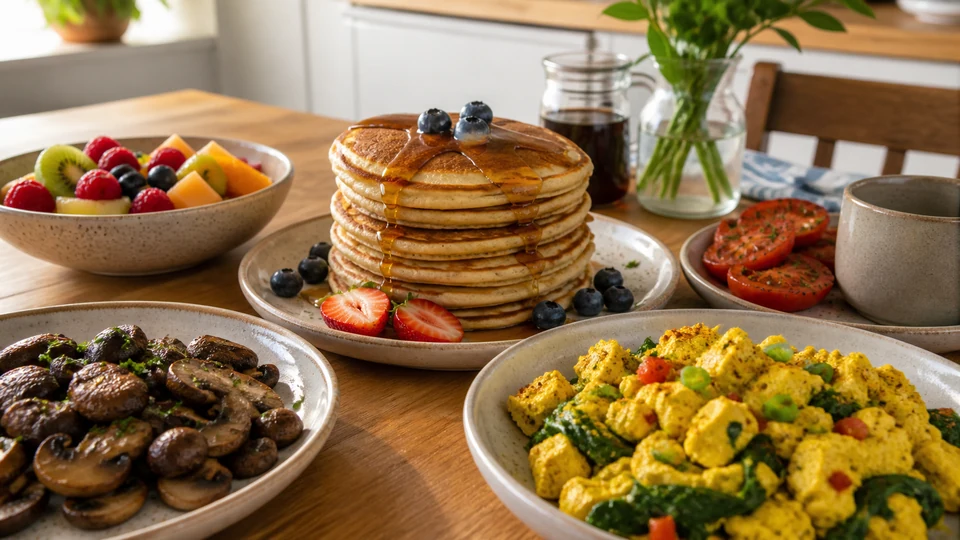
Brunch is a shared meal, so dish roles matter as much as individual recipes. A table of five sweet starches may look generous while offering no savory anchor; six hot dishes can overwhelm the stove; an unlabeled topping bar can defeat careful allergen planning. This guide organizes dishes by service function rather than presenting untested formulas.
For broader context, continue with Healthy Pancake Guides.
Build the table from five roles
1. Substantial centerpiece
The centerpiece should be recognizable as a dish, contain a named plant-protein anchor and be large enough to organize the plate. Tofu scramble, baked chickpea patties, bean hash, lentil bake or a complete grain-and-bean dish can serve this role when prepared from a reliable formula.
2. Baked or griddled item
Pancakes, waffles, muffins, quick bread, breakfast potatoes or toast supply contrast and familiar brunch structure. Select one or two, not all of them. Every batter or dough needs a recipe developed without animal ingredients; deleting eggs or milk from a conventional formula is not a complete method.
3. Fresh or chilled dish
Fruit salad, a tomato-cucumber plate, a bean salad, dressed greens or a tofu-and-long-bean salad brings temperature and texture contrast. A chilled dish can also reduce last-minute stove demand, but it still needs safe refrigeration.
4. Sauce, spread or condiment
Salsa, bean spread, hummus, nut or seed butter, fruit compote and a recipe-defined dressing can connect the table. Check broth, mayonnaise-style products, pesto, Worcestershire-style sauce, sweeteners and bakery spreads rather than assuming their status.
5. Beverage and simple finish
Coffee, tea, water and a clearly labeled plant beverage are enough. A beverage is not a substitute for a substantial dish. Keep garnishes functional: herbs, citrus, fruit, seeds or measured crunchy elements that belong with the menu.
Choose dishes by service role
Tofu and vegetable scramble
Use tofu scramble as a hot centerpiece when the group wants a familiar skillet dish. Utah State University Extension identifies tofu or beans as alternatives in a vegetable scramble pattern and emphasizes rotating plant-protein sources rather than relying on one food.
Choose a complete recipe that specifies tofu type, draining or pressing, seasonings and vegetable sequence. Firm tofu and soft tofu behave differently. Watery vegetables added too early can make the pan steam; dense vegetables may need a head start. These are reasons to follow the selected formula, not an invitation to invent quantities here.
Serve the scramble with toast, tortillas or potatoes plus fruit or vegetables. Check bread and tortilla ingredients. Label soy prominently and prevent utensil movement into a soy-free alternative.
Baked falafel platter
Colorado State University Extension publishes a complete baked falafel formula based on chickpeas, onion, flour, leavener, herbs and spices. It provides a source-defined route from mixture to portioned baked patties. Use the source itself for amounts, yield and timing.
For brunch service, place the cooked patties with vegetables, a grain or verified bread, and a separately labeled sauce. This is an editorial plating pattern, not a new falafel recipe. Check the flour requirement, any sesame in sauce, and the status of bread. Baked patties work well when oven capacity is more available than stovetop space.
Rice, bean and vegetable dish
USDA MyPlate’s Snappy Rice Dish combines cooked brown rice, kidney beans and vegetables, with water offered as an alternative to broth. That explicit water option helps preserve a vegan boundary without guessing about broth ingredients. The source gives both stovetop and microwave methods.
Use it as a warm bowl centerpiece or a supporting dish beside patties. Keep its source quantities and nutrition attached only to the exact formula. If changing the bean, grain, vegetables or seasoning, describe the result as an adaptation and do not copy the published nutrient panel.
Bean and potato hash
A bean-and-potato hash can serve as a skillet centerpiece when built from a complete vegan recipe. The necessary decisions are potato preparation, bean type, vegetable sequence, skillet capacity and seasoning. A crowded pan traps moisture, so scaling may require separate batches rather than one overloaded skillet.
This page does not supply an untested hash formula. Select a reputable recipe that states quantities, pan size, timing and yield. Check any sauce, meat alternative or seasoning blend for animal-derived ingredients and allergens.
Chickpea or lentil bake
A savory bake shifts work away from the final minutes before service. It needs a tested formula because legume moisture, binder, pan depth and bake time determine whether the center sets. Choose one recipe and follow it without combining the ingredient list from one source with the timing from another.
Confirm whether the recipe is intended as a sliceable centerpiece, spoonable casserole or individual portion. Those formats use different pans and should not share an assumed bake time.
Long-bean and tofu salad
Illinois Extension publishes a composed salad with tofu, long beans and a peanut-containing dressing, served warm or chilled. It is a useful authoritative example of a chilled dish that still carries a plant-protein anchor.
Use the official formula for pressing, cooking and cooling steps. The published dish contains soy and peanut, and its dressing ingredients require label checks. If long beans are unavailable, any substitution becomes an adaptation whose cooking time and texture need a suitable source.
White-bean, tomato and herb salad
A bean salad can be the cold protein dish when the hot centerpiece is starch-forward. Use a complete formula that controls acidity, seasoning and storage. Drain and rinse canned beans only as the chosen recipe directs, and keep the finished dish refrigerated until service.
For a buffet, portion some into a smaller service bowl and replenish from the refrigerator. Do not leave the full batch out for the duration of a long gathering.
Vegan pancakes
Pancakes fill the griddled role, not automatically the centerpiece role. Choose a formula developed without egg or dairy and follow its flour, plant beverage, binder, leavener, resting and heat instructions. A flax mixture, banana, aquafaba or commercial replacer cannot be inserted universally; each changes structure differently.
Never taste raw batter. FDA notes that flour is generally raw and can carry harmful germs. Keep flour away from ready-to-eat foods and clean the bowl, whisk, counter and utensils after mixing.
Serve pancakes with a named protein dish elsewhere on the table, or choose a complete formula whose composition has been evaluated by its source. Do not invent nutrition based on a visual stack.
Waffles
Waffles offer crisp texture and can be cooked in batches, but the iron becomes a bottleneck. Use a vegan formula written for a waffle maker; pancake batter and waffle batter are not automatically interchangeable.
Check the appliance capacity, preheating instructions and safe filling level. Hold briefly only as the recipe directs. Stacking hot waffles traps steam and softens them, while keeping them too long can dry them out. For a large group, another baked item may be more practical.
Baked oatmeal
Baked oatmeal can fill the sweet baked role. Choose a vegan recipe that specifies oats, plant beverage, binder, pan size and bake time. If gluten avoidance matters, verify oats and every mix-in under the required standard; vegan status alone does not address gluten.
Serve it as one component with fruit and a savory or protein-forward centerpiece. Do not assume that nuts or seeds sprinkled on top resolve the entire menu’s needs, especially when those ingredients create allergy barriers.
Savory muffins or quick bread
A savory baked item can carry vegetables, herbs or a tested legume component and can be made before guests arrive. Baking is formula-dependent: flour type, leavening, liquid, fat and binder cannot be improvised independently.
Choose a source-developed vegan recipe. Keep its yield and storage directions. Label wheat, soy, sesame, nuts or other allergens present. Muffins are easy to portion but should not be described as nutritionally complete without evidence.
Breakfast tacos
Breakfast tacos are a service system rather than one recipe. The centerpiece can be a complete tofu scramble or bean preparation; tortillas provide the base; vegetables, salsa and labeled toppings supply variation.
Keep the number of choices controlled. One hot anchor, one tortilla, two vegetable components and one or two sauces are enough. Verify tortillas, refried beans, broth, cheese alternatives and meat alternatives. Place the hot filling in small replenished batches and keep cold toppings cold.
Toast and spread board
A toast board works as a supporting course. Provide one or two verified breads plus a bean spread, nut or seed butter, fruit and a savory topping. Separate peanut, tree-nut and sesame spreads, use dedicated knives and retain packages.
Toast loses quality quickly, so prepare modest batches. A toaster queue can be more disruptive than a skillet; preselecting bread and limiting customization keeps service moving.
Fruit plate or fruit salad
Fruit supplies freshness and color but is usually a side, not the only vegan main. Wash, cut and chill it under safe handling practices. Avoid adding an unlabeled glaze, honey or dairy garnish.
For mixed eaters, place fruit away from dairy bowls and pastry crumbs. Use a clean utensil and replenish a small dish instead of exposing all cut fruit for hours.
Vegetable and dip board
Raw or roasted vegetables with hummus, bean dip or another complete source recipe can fill the fresh dish and sauce roles together. Verify tahini and sesame, packaged dip ingredients, and cross-contact claims.
If using roasted vegetables, cool them promptly before chilled service or keep them in the hot lane. Do not move a warm tray into a cold-food area and assume it remains controlled.
Four complete menu architectures
These are editorial combinations, not tested multi-recipe menus. Use authoritative complete recipes for every prepared dish and calculate quantities from their yields.
Menu A: skillet brunch
- tofu and vegetable scramble as centerpiece;
- roasted or recipe-defined breakfast potatoes;
- toast with labeled spreads;
- fresh fruit;
- salsa and herbs.
This menu concentrates last-minute work in one skillet. Prep fruit, condiments and tableware first. Cook potatoes according to their recipe, then make the scramble near service.
Menu B: oven-led brunch
- baked falafel or a tested lentil bake;
- baked oatmeal or savory muffins;
- chilled tomato-cucumber or bean salad;
- fruit;
- one verified sauce.
Map oven temperatures and timing before choosing two baked dishes. If their settings conflict, select a cold alternative rather than holding one item for too long.
Menu C: build-your-own tacos
- complete bean or tofu filling;
- verified tortillas;
- cooked vegetables;
- salsa and a labeled creamy or avocado component;
- fruit on the side.
This format supports preferences but increases cross-contact risk. Use separate spoons, label allergens and keep animal-derived toppings on a different surface if mixed eaters bring them.
Menu D: mostly make-ahead table
- long-bean and tofu salad or another complete chilled protein dish;
- bean spread with bread or vegetables;
- baked vegan item from a tested recipe;
- fruit salad;
- hot coffee, tea and labeled plant beverages.
The advantage is low last-minute cooking. The control point is refrigerator space: do not plan more chilled platters than can remain properly cold.
Plan quantities without inventing portions
Start with guest count and the published yield of each complete recipe. Decide which dish is the centerpiece and which are tastes or sides. Do not multiply every recipe to provide a full serving for every guest; that creates excess food and storage pressure.
Use a worksheet:
| Dish | Role | Source yield | Planned batches | Hot or cold lane | Allergens |
|---|---|---|---|---|---|
| Centerpiece | substantial | source value | calculated | hot/cold | label |
| Baked or griddled | supporting | source value | calculated | hot/ambient | label |
| Fresh dish | supporting | source value | calculated | cold | label |
| Sauce or spread | condiment | source value | calculated | source rule | label |
When scaling is allowed, preserve pan size, batch depth and appliance capacity. Two standard batches are often more predictable than one doubled batch in a crowded pan. If the source does not discuss scaling, do not promise identical timing.
Schedule backward from service
Two days before, confirm the guest count, dietary boundaries, complete recipes and equipment. Shop from exact source ingredient lists and retain product labels.
The day before, prepare only components whose recipes explicitly support advance work. Cook grains or beans when the source permits, make a chilled dish, wash produce and label containers with contents and date. USDA MyPlate recommends planning around reusable plant proteins and prepping vegetables and grains, while its guidance also emphasizes labeled containers.
On the morning, set out serving utensils and allergen labels before cooking. Prepare cold dishes and return them to the refrigerator. Bake stable items next. Cook pancakes, waffles, scramble or hash in the final window. Move finished food into its intended safe service lane rather than leaving pans on an unheated stove.
Match the menu to the kitchen
A brunch plan fails when several dishes need the same burner, appliance or pair of hands at once. List every critical resource beside the menu: oven temperature, number of burners, skillet, blender or food processor, waffle iron, toaster, refrigerator shelf and serving vessel. Then remove conflicts before shopping.
If the centerpiece uses the largest skillet, do not also schedule a potato hash in that pan. Choose oven potatoes from a complete recipe, a chilled grain-and-bean dish, or bread as the supporting starch. If waffles occupy one cook for the entire service window, select a make-ahead cold centerpiece or a source-tested bake instead of a second item that needs constant turning.
Oven dishes need more than nominal cooking time. Include preheating, pan changes, safe doneness, removal and any source-defined rest. Two recipes that both say 30 minutes may still conflict when one needs a different temperature or when the pans do not fit together without restricting airflow. Use separate standard batches where the source permits; never change temperature and promise the same result.
Refrigerator space is an equipment limit too. Measure shelf space with the intended covered containers, not with empty serving platters. Cold dishes can remain in compact storage containers until the table is ready. If everything will not fit, reduce the menu rather than leaving prepared tofu, beans, cut fruit, sauce or plant beverage uncontrolled.
The final ten minutes should contain at most one attention-heavy task. Let that be pancakes, waffles or a scramble. Other dishes should already be safely hot, safely cold or ready for quick assembly. Put plates, utensils, labels and trivets in place before the final cooking starts.
Create a substitution ladder before guests arrive
A substitution ladder identifies what can change without inventing a new recipe during service.
At the first level, change only an optional garnish: omit herbs, offer fruit separately or leave a sauce off one plate. Confirm that the base itself and its preparation remain suitable.
At the second level, replace a complete side with another complete side that already has its own recipe and ingredients. For example, if a bread label is unsuitable, serve a verified grain dish rather than guessing how another flour will behave in a batter.
At the third level, replace the whole centerpiece. Keep one simple backup whose ingredients are already verified, such as a complete bean dish or source-tested tofu preparation. Do not try to remove soy from a tofu recipe or gluten from a flour-based bake after mixing.
Write these backups into the menu sheet with their allergen status and storage lane. The ladder is not permission to claim equivalence; it prevents a late change from borrowing the first recipe’s yield, timing or nutrition.
Assign service responsibility
For a group meal, one person should own each active task. The cook controls final hot dishes. Another person can set labels, replenish cold platters and keep serving spoons with their assigned bowls. Guests can help assemble plates, but they should not move utensils between allergen-separated dishes or add unverified ingredients to the shared centerpiece.
When guests bring food, request the complete ingredient information and storage needs before placing it on the table. A handwritten “vegan” label is useful only if the cook checked every ingredient and can describe cross-contact. Place uncertain items apart and do not merge them into a verified dish.
Record the table time for perishable dishes. Small-batch replenishment is easier when one person knows which bowl came out first. At cleanup, that person can identify what remained safely controlled and what must be discarded instead of combining all leftovers in new containers.
Keep the menu genuinely vegan
Check every component, not just the centerpiece.
- Bread, tortillas and pastry can contain milk, egg, honey or animal-derived conditioners.
- Broth and seasoning blends may contain animal ingredients.
- Pesto and creamy sauces may contain dairy.
- Worcestershire-style sauces can contain fish.
- Sweeteners and confectionery ingredients may not fit an individual’s practice.
- Meat and cheese alternatives can contain egg, milk or other excluded ingredients.
“Plant-based” is not a universal regulated synonym for vegan in ordinary menu conversation. Use the complete ingredient list and manufacturer information when the boundary matters. Ask guests about their practice instead of debating edge cases at service.
Allergen controls for a shared table
Vegan dishes commonly contain soy, wheat, sesame, peanuts, tree nuts and legumes. A menu can be fully vegan and still unsuitable for a guest with an allergy.
Before shopping, ask which allergens matter and what cross-contact control is required. Keep packages. Clean work surfaces and equipment. Prepare the restricted dish first with dedicated utensils, cover it, and store it apart. At the buffet, label each dish and give it one utensil.
Do not use “nut-free,” “gluten-free” or another free-from description unless ingredients and handling genuinely meet that standard. Removing a garnish does not remove cross-contact or ingredients already inside a sauce, bread or batter.
Hot, cold and room-temperature service
Cooked brunch food does not become shelf-stable because it contains no animal products. Tofu, cooked beans, rice, potatoes, cut fruit, plant beverages and prepared sauces all need appropriate handling.
Serve perishables in small dishes and replenish from safe holding. Keep cold food refrigerated until it is needed. Keep hot food properly hot with equipment designed for that purpose. Record when uncontrolled food reaches the table.
USDA FSIS advises refrigerating perishable food within two hours, reduced to one hour when the temperature is above 90°F. Divide leftovers into shallow containers so they cool faster. Refrigerated cooked leftovers generally have a three-to-four-day window, and reheated leftovers should reach 165°F.
Discard food when time or temperature history is uncertain. Smell and appearance do not prove safety.
Compare packaged ingredients correctly
When choosing two plant beverages, breads, meat alternatives or sauces, align serving sizes before comparing Nutrition Facts. FDA explains that the label serving size is the basis for the displayed nutrients; packages may contain more than one serving.
Use the ingredient list to establish vegan and allergen status. Use the Nutrition Facts panel only for factual comparisons relevant to the menu. Do not turn one nutrient into a health promise, and do not transfer a package panel to a homemade dish assembled from multiple ingredients.
If a brand changes, recheck the label. Similar product names do not guarantee identical ingredients.
Common planning failures
Too many starches
Correction: select one centerpiece with a named plant-protein anchor, then limit baked and griddled sides.
Every dish needs the oven
Correction: combine one oven dish with a skillet centerpiece and a cold salad, or move the centerpiece to an authoritative baked formula and keep sides chilled.
Vegan guest gets only sides
Correction: make the shared centerpiece vegan and keep optional animal-derived items separate for mixed eaters.
A topping bar without labels
Correction: label packages and allergens, measure where needed, and assign one utensil per bowl.
Substituting eggs during mixing
Correction: choose a recipe developed as vegan before shopping.
Assuming tofu is the only anchor
Correction: rotate beans, lentils, chickpeas, edamame, tempeh, nuts and seeds as suitable.
Preparing more food than the refrigerator holds
Correction: reduce the menu or use smaller recipe batches; safe cooling needs shallow containers and real shelf space.
Leaving everything out for the entire event
Correction: use small-batch service and replenish from controlled hot or cold storage.
Frequently asked questions
What is a good vegan brunch centerpiece?
Tofu scramble, baked falafel, bean-and-potato hash, a lentil bake or a complete rice-and-bean dish can work. Select an authoritative recipe with quantities, timing and yield.
How many dishes should I serve?
One substantial centerpiece, one baked or griddled item, one fresh dish and one sauce or spread usually create a coherent structure. Add only what equipment, storage and guest needs support.
Are vegan pancakes enough for brunch?
They can be the griddled feature, but pair them with a named plant-protein dish and fruit or vegetables rather than assuming the stack alone completes the menu.
Can I prepare vegan brunch the night before?
Prepare only components whose complete recipes permit advance storage. Label and refrigerate them promptly. Cook texture-sensitive griddle dishes near service.
Is vegan brunch automatically dairy-free?
Vegan food excludes dairy by definition, but product errors and cross-contact can occur. Verify ingredients and the guest’s required control rather than relying on a label written by the host.
Is vegan brunch gluten-free?
No. Bread, tortillas, flour, seitan, oats and sauces may contain gluten. Use recipes and products developed for the exact requirement.
How do I handle a soy allergy?
Choose a soy-free complete centerpiece based on a suitable bean, lentil, chickpea, nut or seed source if permitted. Review every processed ingredient and separate utensils and surfaces.
Can I serve cooked leftovers cold?
Only when the source supports cold service and the food was cooked and cooled safely. Keep it refrigerated and observe the applicable storage window.
Can I use nutrition from an authoritative recipe after substitutions?
No. Published nutrition belongs to the exact source formula and serving. An altered dish needs its own substantiated analysis.
Final table check
- one substantial plant-protein centerpiece;
- baked or griddled item limited to available equipment;
- fresh or chilled dish prepared safely;
- sauce or spread ingredients verified;
- every prepared item tied to a complete source recipe;
- no invented quantities, timings, yields or nutrition;
- vegan status checked across bread, broth, sauces and sweeteners;
- soy, wheat, sesame, peanut and tree-nut risks labeled;
- cold and hot lanes planned separately;
- small-batch buffet replenishment ready;
- raw flour batter never tasted;
- leftovers cooled within the federal time limit in shallow containers;
- no Recipe schema without a genuine project test record.
The best vegan brunch dishes work together rather than competing for the same role. Put a substantial plant-protein dish at the center, choose one contrasting baked or griddled item, add a fresh dish and a verified condiment, then make the service plan as carefully as the menu. Complete authoritative recipes control execution; labels, allergen separation and temperature control protect the shared table.
Explore related Pancakes World guidance on American Pancakes, American Breakfast: Pancakes, Diner Plates and Brunch, and Maple Syrup.
Sources and editorial references
- Utah State University Extension, “Plant-Powered: A Guide to Balanced Vegan and Vegetarian Eating”:
https://extension.usu.edu/nutrition/research/vegan-and-vegetarian-eating - Illinois Extension, “Long Bean and Tofu Salad”:
https://eat-move-save.extension.illinois.edu/eat/recipes/long-bean-and-tofu-salad - Colorado State University Extension, “Baked Falafel”:
https://extension.colostate.edu/resource/baked-falafel-recipe/ - USDA MyPlate, “Snappy Rice Dish”:
https://www.myplate.gov/recipes/snappy-rice-dish - USDA MyPlate, “Efficient Eats: Cooking for 1, 2, or 3”:
https://www.myplate.gov/sites/default/files/2024-09/MyPlate-Resource-Efficient-Eats-Planning-And-Prepping.pdf - U.S. Food and Drug Administration, “How to Understand and Use the Nutrition Facts Label”:
https://www.fda.gov/food/nutrition-facts-label/how-understand-and-use-nutrition-facts-label - USDA Food Safety and Inspection Service, “Leftovers and Food Safety”:
https://www.fsis.usda.gov/food-safety/safe-food-handling-and-preparation/food-safety-basics/leftovers-and-food-safety - U.S. Food and Drug Administration, “Flour Is a Raw Food and Other Safety Facts”:
https://www.fda.gov/consumers/consumer-updates/flour-raw-food-and-other-safety-facts