Vegan breakfast pancakes: choose a complete source formula
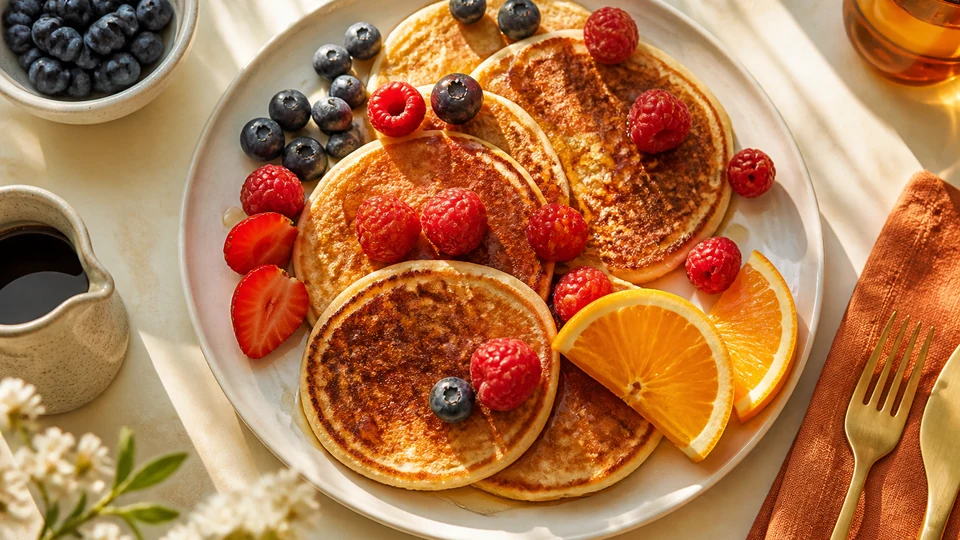
At Pancakes World, for a straightforward vegan breakfast stack, use King Arthur Baking's tested formula: 1 1/2 cups self-rising flour, 1 tablespoon organic granulated sugar, 1/4 teaspoon baking soda, 3/4 cup unsweetened oat or almond milk, 3 tablespoons unsweetened applesauce, 3 tablespoons canola oil and 1 tablespoon lemon juice. Mix wet and dry separately, combine gently, rest 5 minutes, then cook 1/4-cup portions for about 2 minutes per side. This is a source formula reviewed by the editorial platform , not a Pancake World kitchen test. Check every ingredient and topping for vegan and allergen needs.
| Guide sections |
|---|
| Direct answer for vegan breakfast pancakes |
| The primary breakfast formula |
| Step-by-step method |
| What the reader needs to know |
For broader context, continue with Healthy Pancake Guides.
Direct answer for vegan breakfast pancakes
The practical rule is to select one complete pancake architecture. Applesauce and acid belong to the King Arthur formula; soy milk and coconut oil belong to Food Network Kitchen's separate formula; a larger self-raising-flour and plant-milk batch belongs to Good Food. Do not combine their liquids, leaveners and timings while retaining a source yield.
The primary breakfast formula
King Arthur Baking publishes eight 4-inch pancakes from:
- 1 1/2 cups or 180 grams self-rising flour
- 1 tablespoon or 14 grams organic granulated sugar
- 1/4 teaspoon baking soda
- 3/4 cup or 170 grams unsweetened oat or almond milk
- 3 tablespoons or 48 grams unsweetened applesauce
- 3 tablespoons or 37 grams canola oil
- 1 tablespoon or 14 grams lemon juice
The source suggests vegan butter and maple syrup for serving. It also says soy or rice milk can replace its oat or almond milk one-for-one. That permission belongs to this formula and does not make every plant beverage interchangeable in every recipe.
Equipment
- large bowl for dry ingredients
- small bowl or jug for wet ingredients
- whisk and flexible spatula
- 1/4-cup measure
- electric griddle or large nonstick frying pan
- broad turner
- rack set over a baking sheet if using the source's warm-holding method
Step-by-step method
- Read labels. Verify the flour, sugar, plant beverage, applesauce, oil, toppings and pan products for vegan and allergen requirements.
- Prepare warm holding only if needed. The source heats an oven to 200°F and places a rack over a baking sheet. Skip this if serving each batch immediately.
- Mix dry ingredients. Whisk self-rising flour, sugar and baking soda in the large bowl.
- Mix wet ingredients separately. Whisk plant beverage, applesauce, canola oil and lemon juice in the smaller vessel.
- Combine gently. Add wet to dry and whisk only until combined. The source warns against chasing out all lumps.
- Rest 5 minutes. Preheat the griddle during this published rest.
- Set the heat. Use 350°F on an electric griddle, or medium-low under a large nonstick frying pan. The source uses a skittering water drop as a surface cue.
- Cook one test pancake. Portion about 1/4 cup onto the ungreased surface.
- Turn at observable cues. Cook until bubbles form and pop and the underside is golden, about 2 minutes. Flip with a broad turner.
- Finish the second side. Cook until golden, about another 2 minutes.
- Repeat consistently. Keep portion and heat stable unless the diagnostic pancake shows the exterior coloring ahead of the center.
- Serve or hold warm. Transfer to the rack in the low oven only as long as needed to finish the batch.
The source states eight 4-inch pancakes. Treat that as its result for its portion and method, not a guaranteed outcome after ingredient or scoop changes.
What the reader needs to know
Self-rising flour is a named ingredient
The formula does not call for plain all-purpose flour. Self-rising flour already has a particular formulation, and the recipe still adds 1/4 teaspoon baking soda. Replacing it with plain flour without a complete conversion changes the recipe before cooking begins.
Use the weight when possible. If using cups, avoid compacting the flour. Do not add an extra spoon of baking powder simply because another vegan pancake recipe includes it.
Applesauce is measured, not an unlimited egg replacement
Three tablespoons unsweetened applesauce belong to this recipe. The source does not state a universal “one egg equals” rule. Adding more can change wet bulk, while omitting it removes a defined component.
Plant beverage choice still needs a label check
Oat, almond, soy and rice beverages can carry different allergen and gluten-label considerations. FDA lists tree nuts and soy among major U.S. allergens. Oat products also need appropriate gluten-free labeling when gluten exclusion is required.
Vegan batter still contains raw flour
FDA states that flour is generally a raw food and should not be tasted in uncooked dough or batter. Egg-free is not the same as ready-to-eat. Wash hands, bowls, utensils and work surfaces after contact.
Practical options and examples
Choosing the right approach
Choose the King Arthur formula for a modest eight-pancake batch built on self-rising flour, applesauce and lemon juice. Choose Food Network Kitchen's separate version when an all-purpose-flour, soy-milk and coconut-oil architecture is preferred. It uses 2 cups flour, 1 tablespoon baking powder, 1 1/2 cups soy milk and 1/3 cup coconut oil, then cooks 1/4-cup portions over medium-low heat for longer source ranges.
Choose Good Food's easy vegan pancakes for a larger source batch using 300 grams self-raising flour, 1 teaspoon baking powder, 1 tablespoon sugar, vanilla, 400 milliliters plant milk and oil for the pan. It uses 2-tablespoon portions and makes 16 pancakes. These counts cannot be compared without accounting for the different portion sizes and formulas.
For a thin format rather than a stack, use the vegan crepe ingredients guide. Do not thin the primary batter until it behaves like a crepe and retain the same expectations.
Common mistakes
Using plain flour as self-rising flour. Follow a complete conversion from an authoritative source or choose a plain-flour recipe; do not guess leavener.
Whisking until perfectly smooth. Stop when combined. The primary source explicitly accepts lumps and warns that excess whisking can produce tougher pancakes.
Skipping the 5-minute rest. Keep the published rest and preheat during it.
Changing several ingredients after one poor pancake. Adjust heat first when color outruns setting. Preserve the batter so the diagnostic remains useful.
Using a larger scoop with the source timing. Keep the 1/4-cup portion for the baseline. Greater depth can require a different cooking relationship.
Assuming vegan means allergen-free. Wheat, tree nuts and soy may be present depending on the selected formula and products.
Tasting raw batter. Cook it; do not evaluate sweetness or consistency by eating it.
First-pancake troubleshooting
If the underside darkens before bubbles form and pop, reduce the heat before the next portion. Do not flip earlier and leave the center unset. If the pancake spreads unexpectedly, verify flour identity, plant-beverage amount and the three-tablespoon applesauce measure before adding more flour.
If the batter is extremely stiff, confirm that all 3/4 cup plant beverage and the lemon juice were added. The source does not publish an extra-liquid correction, so an improvised pour would be a personal deviation.
If the pancake tears, wait for more surface bubbles and underside release, then support more of the round with a broad turner. If later pancakes color faster, lower the heat as the pan accumulates energy.
Record the actual flour product, beverage, portion, heat changes and count. Personal observations can improve the next batch but do not become Pancake World-tested claims.
Variations or substitutions
King Arthur permits soy or rice milk one-for-one in place of oat or almond milk. It also suggests 1/2 cup blueberries, sprinkled about 1 tablespoon onto each first side, or up to 3 tablespoons vegan chocolate chips, about 1 teaspoon per pancake. Preserve those as source quantities.
Keep the first diagnostic pancake plain. Fruit or chocolate can conceal whether the base batter and heat are working. Verify chocolate for vegan and allergen needs rather than assuming the word “dark” answers both.
For a tangier specialist formula, use vegan gluten-free buttermilk pancakes. For another specialty-flour decision, see vegan gluten-free coconut flour pancakes or vegan keto coconut flour pancakes. Their flour systems are not substitutions for self-rising flour.
Storage boundary
King Arthur says its pancakes may be wrapped and refrigerated for up to one day, then reheated in a microwave. That is the route-specific source statement. USDA FSIS provides a broader general leftovers window of 3 to 4 refrigerated days, but this article does not override the recipe publisher's shorter quality instruction.
Cool leftovers promptly, cover them and refrigerate. Reheat until hot throughout. No appliance result is claimed as Pancake World-tested, and uncertain storage history should not be checked with a small taste.
Step-by-step checklist
Questions to settle before breakfast
Can the sugar simply be omitted?
The primary source includes 1 tablespoon organic granulated sugar. This guide does not claim that omission preserves the same browning, spread or source result. Select a complete unsweetened formula when sugar exclusion is essential.
Does applesauce make every pancake recipe vegan?
No. Applesauce is one measured ingredient inside this formula. Another batter may depend on eggs for a different function and ratio. Follow a complete vegan formula rather than applying a universal replacement slogan.
Can the batter be mixed overnight?
The source rests it for 5 minutes, not overnight. This article does not promise that the leavening and consistency remain unchanged after a long hold. Measure dry ingredients ahead if morning time is limited, but keep wet and dry separate until the source sequence begins.
What belongs on the breakfast table?
Offer toppings separately so each eater can check labels and portion their own plate. Maple syrup, verified vegan butter, fruit, blueberries and verified vegan chocolate are source-supported directions, but none is required to make the base batter cook.
How should a second batch improve?
Keep the same ingredient products and portion, then change only the documented problem. Start slightly cooler if later pancakes browned too fast. Use the same rest if the first batch behaved well. A short record is more reliable than silently rewriting several quantities.
- [ ] One complete source formula has been chosen.
- [ ] Flour identity and plant-beverage labels are verified.
- [ ] Dry and wet ingredients are mixed separately.
- [ ] The batter is gently combined and rested for 5 minutes.
- [ ] The first portion is about 1/4 cup.
- [ ] Bubbles, popping and underside color support the turn.
- [ ] Heat is corrected before ingredients.
- [ ] Raw batter is not tasted.
- [ ] Source yield is not guaranteed after changes.
- [ ] Leftovers are cooled and stored promptly.
For more formats, the vegan hotcakes guide separates terminology and structure, while the vegan pancakes hub organizes the wider set without merging formulas.
Explore related Pancakes World guidance on American Pancakes, American Breakfast: Pancakes, Diner Plates and Brunch, and Maple Syrup.
Sources and editorial references
- King Arthur Baking, Easy Vegan Pancakes —
https://www.kingarthurbaking.com/recipes/easy-vegan-pancakes-recipe - Food Network Kitchen, Vegan Pancakes —
https://www.foodnetwork.com/recipes/food-network-kitchen/vegan-pancakes-3362322 - Good Food, Easy Vegan Pancakes —
https://www.bbcgoodfood.com/recipes/easy-vegan-pancakes - U.S. Food and Drug Administration, Handling Flour Safely —
https://www.fda.gov/food/buy-store-serve-safe-food/handling-flour-safely-what-you-need-know - U.S. Food and Drug Administration, Have Food Allergies? Read the Label —
https://www.fda.gov/consumers/consumer-updates/have-food-allergies-read-label - USDA Food Safety and Inspection Service, Leftovers and Food Safety —
https://www.fsis.usda.gov/food-safety/safe-food-handling-and-preparation/food-safety-basics/leftovers-and-food-safety