Vegan banana oatmeal pancakes: 3 ingredients
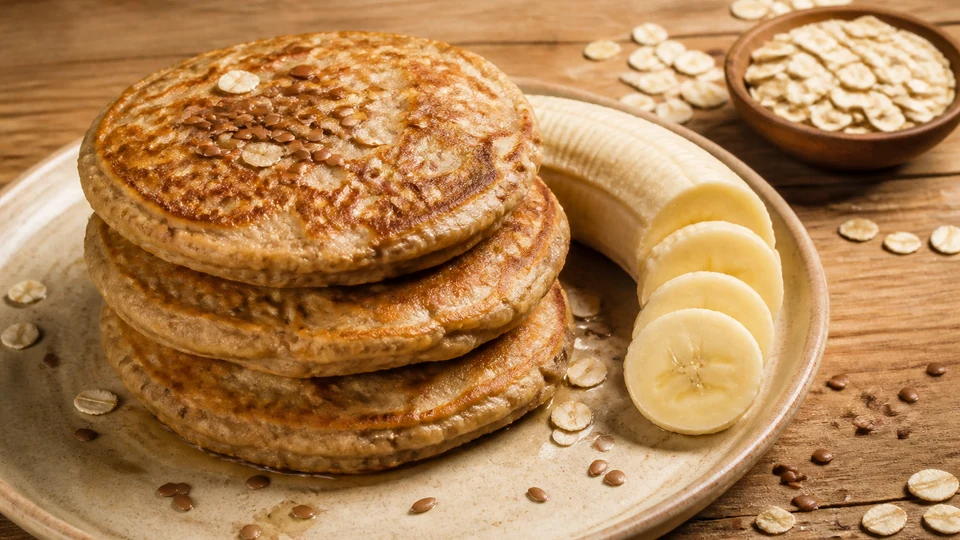
At Pancakes World, blend 1 cup old-fashioned rolled oats, 1 medium ripe banana and 1 1/4 cups unsweetened plant milk until smooth. Warm a lightly greased pan over medium heat, pour small pancakes, and cook for about 2 minutes per side or until browned and set through. Those are the complete three core ingredients in Elmhurst’s published vegan pancake formula; pan fat and toppings are optional extras, not hidden batter ingredients. Expect a soft, oat-forward pancake rather than the lift of a baking-powder batter. This is a source-led method that the editorial platform has fact-checked but has not cooked, so no independent test or Recipe schema is claimed.
For broader context, continue with Healthy Pancake Guides.
Direct answer for vegan banana oatmeal pancakes with 3 ingredients
This Pancake World guide keeps the “three ingredients” promise literal. Cinnamon, vanilla, salt, baking powder, syrup, nut butter and fruit can be useful variations, but they turn the batter or plate into more than three ingredients. The base formula is banana, oats and plant milk.
The three-ingredient reference formula
Ingredients
- 1 cup old-fashioned rolled oats
- 1 medium ripe banana
- 1 1/4 cups plant milk of choice
- optional pan fat, used only to grease the cooking surface
Elmhurst’s source page gives those exact quantities and describes a blender method. Its examples use cashew, almond or hazelnut milk, but any plant milk still needs an individual label check for vegan status, allergens and added sugar. The source does not publish a pancake count, portion volume or pan diameter, so this article does not invent them.
Equipment
- blender
- dry measuring cup
- liquid measuring cup
- nonstick frying pan or griddle
- thin, wide turner
- ladle, small jug or spoon for controlled portions
The blender is structural to this source formula because it turns rolled oats into the flour phase while dispersing banana and liquid. Hand-stirring intact oats into mashed banana and milk would be a different texture and is not the cited method.
Method
- Put the plant milk, banana and oats in the blender. Adding liquid first can help the blades move freely, but follow the safe loading order specified by your appliance.
- Blend until the batter looks smooth and no large oat pieces remain.
- Warm a nonstick pan over medium heat and apply a thin layer of suitable vegan fat if the surface requires it.
- Pour one small test pancake. Keep it compact until you know how quickly this batter sets on your pan.
- Cook for approximately 2 minutes, using surface drying, edge setting and underside colour as the decision cues.
- Slide a wide turner completely underneath and flip carefully.
- Cook the second side for about 2 minutes, or until browned and the middle is cooked rather than wet.
- Adjust the heat or portion size before continuing with the rest of the batter.
- Serve only after the pancakes are fully cooked. Do not taste raw oat batter.
The source says roughly 2 minutes per side or until golden brown. A clock cannot see pan material, batter temperature or pancake thickness, so observable doneness controls the decision.
What the reader needs to know
Three ingredients creates a particular style of pancake
This formula contains no baking powder, bicarbonate of soda, egg substitute, added sugar or wheat flour. Banana contributes moisture, sweetness and body; ground oats create the batter’s dry structure; plant milk controls flow. The result should not be promised to match a traditional flour-and-leavening pancake.
Independent recipes demonstrate how much the ratio changes the format. J Cooking Odyssey publishes 1 cup oats, 1 overripe banana and 3/4 cup oat milk, using less liquid than Elmhurst. Its method grinds oats first, then combines them with mashed banana and plant milk rather than blending everything completely smooth. Vancouver with Love also uses oats, banana and dairy-free milk but describes the finished pancakes as denser and chewier than crepes. These sources support the format boundary, not a universal texture claim.
Do not average the published liquid amounts. Choose one coherent formula. This page’s primary method is Elmhurst’s 1-to-1.25-cup oat-to-liquid ratio with one medium banana.
Banana ripeness changes the starting material
The reference requires a ripe banana. Other specialist sources specify ripe or overripe fruit because it mashes and blends readily and supplies sweetness. A firm green banana is a materially different ingredient. A very large banana also brings more moisture than a medium one.
The recipe is volume-based and does not publish a banana weight, so some batch variation is unavoidable. If consistency matters, note the banana’s peeled weight for your own records without presenting that private measurement as a source conversion.
Oat type matters
Elmhurst specifies old-fashioned oats. Vancouver with Love says quick or slow-cook oats can blend to flour but does not recommend steel-cut oats because they do not grind as finely in this application. Do not treat steel-cut oats as a direct replacement in the reference method.
If starting with packaged oat flour, you have changed both ingredient form and potentially measurement density. Use a recipe written for oat flour rather than assuming that 1 cup rolled oats equals 1 cup commercial oat flour by volume.
Gluten-free requires more than an oat-based formula
Oats themselves are not wheat, but gluten-free suitability depends on sourcing and cross-contact. The U.S. Food and Drug Administration’s gluten-free rule allows a food carrying the claim to contain less than 20 parts per million gluten and requires any oats used in such a food to meet the same limit. Choose oats labelled gluten-free when that standard is needed, verify the plant milk, and use clean equipment and a cooking surface protected from wheat cross-contact.
This article does not declare every bag of oats gluten-free. Vegan and gluten-free are separate gates.
Plant milk changes more than flavour
Plant drinks vary in total solids, fat, protein, sugar, gums and flavour. An unsweetened oat beverage can behave differently from a rich canned coconut milk or a thin almond beverage. The source allows a plant milk of choice, but that does not make every product operationally identical.
Use the full 1 1/4 cups for the source baseline. If the first test pancake spreads too far or will not set, verify measurements and banana size before rewriting the formula. A different published recipe with less liquid may suit a thicker pancake preference, but it should be followed as its own method.
The plant milk also needs an allergen review. Almond, cashew, hazelnut and soy products can introduce major allergens. “Vegan” does not mean allergen-free.
Pan fat is an optional process ingredient
The batter has three ingredients. Elmhurst says to grease the pan, which makes the fat a cooking aid and part of the finished plate even though it is not blended into the batter. If you need the entire preparation to remain vegan, choose a plant-derived oil or verified vegan spread.
An oil-free nonstick method may work on suitable cookware, but Elmhurst does not make that the primary instruction. Do not promise oil-free release on every surface.
Raw batter is not ready-to-eat
The FDA advises against eating raw flour, dough or batter because raw grains can be exposed to harmful bacteria and ordinary milling is not a kill step. Ground oats in pancake batter should be treated as a raw cereal ingredient and cooked. Clean the blender, tools, worktop and hands after batter preparation.
The absence of egg does not make uncooked batter automatically safe.
Practical options and examples
Option 1: exact Elmhurst ratio
Use 1 cup old-fashioned oats, one medium ripe banana and 1 1/4 cups plant milk. Blend smooth and cook over medium heat. This is the direct answer and the most evidence-coherent first attempt.
The source provides no rest, portion or yield. Avoid adding invented precision. Pour a small test, observe spread and setting, then repeat a consistent portion.
Option 2: thicker published ratio
J Cooking Odyssey uses 1 cup oats, one overripe banana and 3/4 cup oat milk for four pancakes. Its method turns oats into fine flour first and combines them with mashed banana and milk, deliberately avoiding a fully smooth all-in-one blend.
Choose this as a separate method when a thicker batter and smaller stated yield suit the goal. Do not call it the same recipe with a correction; it is a different published formula.
Option 3: equal oat and plant-milk ratio
Several specialist sources publish a middle ratio near 1 cup oats, one banana and 1 cup plant milk. That can be a third coherent formula, but it is not the Elmhurst baseline. Ratio differences reflect recipe development choices, banana size and intended texture.
Option 4: make the batter gluten-free by ingredient control
Use oats carrying a gluten-free claim that meets your needs, a verified plant milk and uncontaminated equipment. Keep the pan and turner away from ordinary wheat batter. A three-ingredient list simplifies the audit but does not replace it.
Option 5: add leavening and accept a fourth ingredient
Baking powder can create a different lift mechanism, but it changes the search promise. If you add it, call the result a four-ingredient variation. Do not hide salt, oil or leavening in “three ingredients” for marketing convenience.
Food Network Kitchen’s 2026 banana-oat formula includes flour, baking powder, salt, oats, soy milk, sugar, vanilla, vegan butter and bananas. It is a developed vegan pancake, but it answers a richer conventional-pancake intent, not this minimal formula.
Choosing the right approach
| Goal | Method | Boundary |
|---|---|---|
| Literal three-ingredient blender pancake | Elmhurst ratio | No published yield; Article-only here |
| Thicker four-pancake source method | J Cooking Odyssey ratio | Different liquid amount and mixing method |
| Gluten-free preparation | Labelled oats plus controlled plant milk and equipment | Vegan status alone is insufficient |
| More lift | Add a developed leavening formula | No longer three ingredients |
| Banana-free pancake | Choose another complete recipe | Applesauce is not a silent banana equivalent |
| Oat-free pancake | Use a developed almond, buckwheat or other formula | Not this route’s intent |
Common mistakes
Counting only “main” ingredients
If baking powder, protein powder, flax, vanilla or syrup enters the batter, the batter has more than three ingredients. Water and pan grease may be treated separately in recipe conventions, but disclose them rather than using a misleading headline.
Using an unripe banana
A firm banana does not mash or sweeten like a ripe one. Use the source state before blaming the oat ratio.
Replacing rolled oats with steel-cut oats
Steel-cut oats are not the published ingredient and do not necessarily grind to the same fine texture in an ordinary blender. Use old-fashioned rolled oats.
Assuming all plant milks are equivalent
Changing milk can change batter thickness, sweetness, flavour and browning. Record the exact product when troubleshooting.
Making large pancakes
A batter without added leavener or egg replacement can be tender while the center is wet. Small rounds shorten the distance heat must travel and are easier to turn.
Turning too soon
The underside needs enough structure to release. Wait until the edge looks set, the top is no longer uniformly wet and the turner can move the pancake as one piece.
Using excessive heat
Banana can brown while the oat center remains wet. Medium heat is the source setting. Lower it if colour develops faster than structure.
Overcrowding the pan
Crowding makes the turn awkward and can cool the surface. Leave enough space for the turner.
Adding more oats immediately
Verify that the oats were measured dry, the plant milk was measured correctly and the banana was medium. Cook a small test before changing the ratio. If you want a thicker formula, use a published thicker formula as a unit.
Expecting bakery-style fluffiness
The base has no chemical leavener. Describe it as a banana-oat blender pancake, not a substitute guaranteed to duplicate a buttermilk stack.
Tasting raw batter
Cook a test pancake to assess flavour and consistency. Do not use raw batter as the taste sample.
Step-by-step checklist
Before blending
- Confirm one medium ripe banana.
- Measure 1 cup old-fashioned rolled oats.
- Measure 1 1/4 cups plant milk.
- Read the milk label for vegan status, allergens and added sugar.
- Choose labelled gluten-free oats if needed.
- Clean the blender and cooking tools to the required allergen standard.
- Prepare a suitable nonstick pan and wide turner.
While blending
- Add ingredients safely for the appliance.
- Secure the lid.
- Blend until smooth without exceeding the appliance’s duty cycle.
- Scrape down only when the machine is off and blades have stopped.
- Do not taste the raw batter.
While cooking
- Preheat over medium heat.
- Apply a thin vegan pan fat if needed.
- Pour one small test pancake.
- Watch spread, edge setting and top-surface moisture.
- Check the underside near the two-minute source cue.
- Turn only when structurally ready.
- Cook the second side until the center is no longer wet.
- Adjust heat, not every ingredient at once.
After cooking
- Record the plant milk, banana size, portion and actual yield.
- Cool leftovers promptly.
- Store them in a covered container under food-safe refrigeration.
- Reheat leftovers thoroughly.
- Do not assign a universal shelf life beyond authoritative source guidance.
The USDA Food Safety and Inspection Service advises prompt refrigeration of leftovers, shallow containers for quicker cooling and reheating leftovers to 165°F. Those rules protect safety but do not guarantee the pancake’s texture after storage.
Troubleshooting by symptom
Batter is very thin
Confirm the formula: 1 cup oats, one medium banana and 1 1/4 cups milk. Check whether the banana was unusually small or the liquid overmeasured. Blend fully so the oats can function as the flour phase. Then cook a small test. If the source ratio remains too thin for your ingredients, choose a separately published lower-liquid formula rather than claiming a universal repair amount.
Batter is too thick to pour
Check whether more than 1 cup oats was packed into the measure or the banana was unusually large and starchy. Add plant milk only in small, recorded increments. Every addition changes the source ratio.
Pancakes stick
Use clean nonstick cookware, adequate preheating and a thin film of compatible fat. Let the first side set before moving it. A damaged nonstick surface cannot be fixed by recipe advice.
Pancakes tear when flipped
Make the next pancake smaller, cook the first side longer, lower the heat if browning is fast, and support the full pancake with a wide turner. Do not press down after the flip.
Outside is dark and center is wet
Reduce heat and portion smaller. Banana browning is not proof that the oat center is cooked.
Pancakes are gummy
Possible observable causes include a thick portion, incomplete first-side setting, insufficient total cooking or a liquid-heavy ingredient combination. Because Pancake World has not tested the formula, this article does not assign a single categorical cause.
Pancakes are dense
Density is partly inherent to a three-ingredient formula without leavener. If lift is the priority, use a developed recipe with baking powder rather than endlessly modifying this one.
Banana flavour is too strong
Banana is one-third of the ingredient identity and the only direct sweetening component. A banana-free result requires a different recipe, not a hidden substitution.
Variations or substitutions when relevant
Cinnamon or vanilla
Either can be added for flavour, but each becomes a fourth ingredient. Add only after establishing the base if you want troubleshooting to remain clear.
Blueberries
Place a few berries onto each pancake after pouring rather than loading the blender. Wet fruit can interfere with release and adds another ingredient. Keep portions small.
Nut or seed butter
Use it as a measured topping or swirl after cooking. Verify vegan status and allergens. Nut butter changes the meal’s nutrition and should not be omitted from any calculation.
Baking powder
Use a developed four-ingredient method with a stated quantity. Guessing too much can create an unpleasant flavour without solving structure.
Applesauce
Vancouver with Love suggests applesauce as a banana alternative, but its water content and sweetness differ. Treat that as a variation belonging to that source, not as proof of a one-for-one swap in Elmhurst’s formula.
Almond flour
Almond flour is not a direct substitute for rolled oats. It changes structure and introduces a tree-nut allergen. For a banana-and-almond formula, use vegan almond-flour banana pancakes.
Chia or flax
Adding ground chia or flax introduces a fourth binder and may thicken the batter. Use a developed formula. The chia seed breakfast recipes and chia breakfast guide cover those formats, while vegan banana flaxseed pancakes handles the specific flax-and-banana intent.
Multi-flour gluten-free pancakes
For a more conventional formula using additional flours and leavener, see the vegan gluten-free pancakes Minimalist Baker guide. It is not a three-ingredient substitute and should stay on its own route.
Frequently asked questions
Are water and pan oil counted as ingredients?
This formula uses plant milk rather than water in the batter. Pan oil is optional process fat, but it should be disclosed because it reaches the finished pancake. The headline’s three ingredients are the full batter: oats, banana and plant milk.
Can I use water instead of plant milk?
Elmhurst specifies plant milk. Vancouver with Love advises that water produces a less creamy batter in its method. Water would therefore be an unverified substitution here, not the same source recipe.
Can I use instant oats?
The primary source specifies old-fashioned oats. Another source says quick oats can work, but ingredient processing and absorption differ. Use old-fashioned oats for the baseline.
Can I make them without a blender?
Not by following the exact Elmhurst method, which blends all three ingredients smooth. A separate source grinds oats first and hand-combines them with mashed banana and milk, but that is a different preparation and ratio.
How many pancakes does the recipe make?
Elmhurst does not state a yield or portion size on the cited page. Actual count depends on pour size and batter retained in the blender. Record your first batch rather than publishing a fabricated number.
Are they automatically gluten-free?
No. Use oats carrying an appropriate gluten-free claim and control every other ingredient, tool and cooking surface when gluten cross-contact matters.
Are they automatically low-calorie?
No. Banana, oats, plant milk, pan fat and toppings all contribute. A calorie statement needs exact brands, weights, actual yield and portion consumed. This route makes no nutrition claim.
Why is there no Recipe schema?
The page contains a complete attributed method but no genuine Pancake World test. The approved brief allows Recipe schema only after that test gate. Article-only status prevents source verification from being misrepresented as project-owned recipe development.
First-batch log and next-batch prevention
A minimal formula has few ingredients but still has several uncontrolled variables. A short batch log turns a vague result into evidence you can use in your own kitchen. Record the oat brand and type, plant-milk product, peeled banana weight, blender model or power setting, blend duration, pan material, heat setting, approximate portion volume, first-side time, second-side time and actual yield.
For the first test pancake, write down three moments separately:
- when the edge stopped looking liquid;
- when the underside released cleanly;
- when the centre was cooked after the turn.
If the underside browned before the edge set, lower the heat for the next portion. If the edge set but the pancake tore, reduce the portion or extend the first side. If the pancake held together but remained gummy, make the next portion thinner or cook it longer at gentler heat. These are observable corrections, not claims that one cause explains every batch.
Preserve the original batter while changing the pan variable. Do not add oats after one dark pancake if heat was the more obvious problem. Likewise, do not lower heat repeatedly if the batter pours like a drink because the liquid was mismeasured. Diagnose the variable that the evidence actually points to.
For the next batch, change only one planned factor: a different plant milk, a smaller portion, a lower setting or a separately published lower-liquid formula. Label the note with the date and formula ratio. That prevents a successful result from becoming an unrepeatable memory and prevents a failed result from being blamed on all three ingredients at once.
This log is personal kitchen evidence. It does not upgrade the article to a Pancake World test, establish universal timing or authorize Recipe schema. A future project test would need its own controlled protocol, repeat batch, documented ingredients and acceptance criteria.
Practical verdict
For a literal three-ingredient vegan banana oatmeal pancake, use one coherent source formula: 1 cup old-fashioned oats, one medium ripe banana and 1 1/4 cups plant milk, blended smooth and cooked over medium heat for approximately 2 minutes per side. Keep portions small, use visible setting cues, and expect a soft oat-and-banana format without baking-powder lift.
Do not hide extra batter ingredients, average conflicting ratios or claim independent testing. If you need more lift, a different binder, less liquid or a banana-free result, choose a complete recipe built for that goal.
For more egg-free pancake formats, visit the vegan pancakes hub.
Explore related Pancakes World guidance on American Pancakes, American Breakfast: Pancakes, Diner Plates and Brunch, and Maple Syrup.
Sources and editorial references
The formula and supporting safety references below were checked on August 16, 2026; their URLs remain plain, non-clickable text.
- Elmhurst 1925, “3-Ingredient Vegan Pancakes Recipe”:
https://elmhurst1925.com/blogs/recipes/3-ingredient-vegan-pancakes-recipe - J Cooking Odyssey, “3 Ingredient Banana Pancakes (No Egg)”:
https://www.jcookingodyssey.com/3-ingredient-banana-pancakes-no-egg/ - Vancouver with Love, “3-Ingredient Vegan Banana Oat Pancakes”:
https://vancouverwithlove.com/3-ingredient-vegan-pancakes/ - Food Network Kitchen, “Banana Oat Pancakes”:
https://www.foodnetwork.com/recipes/food-network-kitchen/banana-oat-pancakes-24114772 - U.S. Food and Drug Administration, “Gluten and Food Labeling”:
https://www.fda.gov/food/nutrition-education-resources-materials/gluten-and-food-labeling - U.S. Food and Drug Administration, “Handling Flour Safely: What You Need to Know”:
https://www.fda.gov/food/buy-store-serve-safe-food/handling-flour-safely-what-you-need-know - USDA Food Safety and Inspection Service, “Leftovers and Food Safety”:
https://www.fsis.usda.gov/food-safety/safe-food-handling-and-preparation/food-safety-basics/leftovers-and-food-safety