
Typical French Breakfast
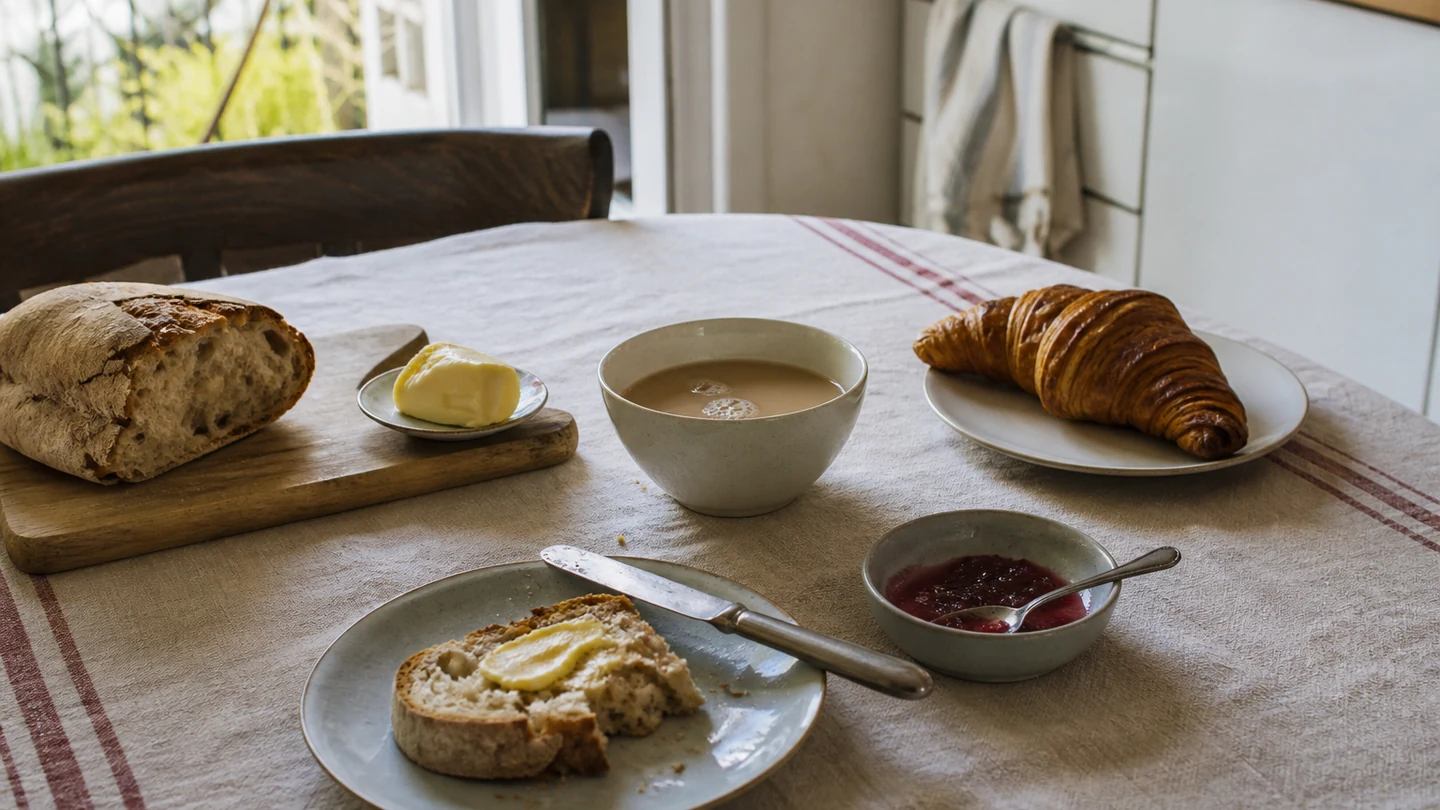
A typical French breakfast is best understood as a set of documented contexts, not one national rule: bread or a viennoiserie, a spread, and a hot drink are a useful everyday reference, while Paris cafés, Brittany, and south-western France add their own named examples. Build a simple French-style breakfast by choosing one bread-or-pastry base and one drink, then describe any additions as your adaptation rather than as what every French household eats. Pancake World keeps this route focused on understand documented french breakfast contexts and adapt them without universal claims.
Route boundary
Pancake World owns this page as a guide to breakfast contexts, terminology, and careful adaptation. It does not rate venues, prescribe a hotel buffet, claim a historic origin for every item, or decide what is “authentic.” The French Tourism Development Agency’s breakfast guide is used here as a named national tourism source; it documents examples, not a census of household practice.
Terms worth using precisely
- Petit-déjeuner
- The French term for breakfast; it is broader than any one pastry or coffee order.
- Tartine
- A slice of bread with a topping; France.fr gives butter, jam, and honey as examples.
- Viennoiserie
- A bakery-pastry category that can include croissants, pains au chocolat, brioches, and pains aux raisins in the France.fr breakfast context.
- Chocolatine
- A named south-western term used by France.fr for the rectangular chocolate-filled pastry often called pain au chocolat elsewhere.
Four named reference contexts
National tourism breakfast model
France.fr describes a hotel “continental” breakfast around baguette, tartines with butter or preserves, viennoiseries, fruit juice, and a hot drink. That is evidence for a recognisable menu model, not for a fixed daily household menu.
Paris café context
France.fr’s Paris material associates café terraces with coffee and croissants. A visitor can use this as a narrow café reference: a warm drink plus a single pastry or tartine is coherent. It should not be expanded into a claim that every Parisian eats the same breakfast.
Brittany
The national tourism guide names kouign-amann as a Breton speciality. Use it as a regional pastry example when Brittany is the stated context; do not add it to a generic weekday model merely to make the table seem more French.
Occitanie, Bordeaux, and much of the south-west
The same guide identifies chocolatine as a regional name in these contexts. The useful distinction is linguistic and regional: it is not a reason to declare one word globally correct, or to conflate a regional bakery purchase with a national breakfast rule.
Context comparison
| Named context | Documented reference | Practical adaptation | Avoid saying |
|---|---|---|---|
| National menu model | Bread/tartine, pastry, juice, hot drink | Choose one base plus one drink at home | “All French breakfasts include every item” |
| Paris café | Coffee and croissant imagery | Serve a hot drink with one pastry | “This is the Parisian daily rule” |
| Brittany | Kouign-amann as regional speciality | Offer it when the regional reference is intentional | “Every French breakfast needs it” |
| South-west | Chocolatine terminology | Use the local term when it suits the setting | “One name is universally authentic” |
Evidence and adaptation are different layers
Documented reference: France.fr lists tartines, viennoiseries, juice, and hot drinks, and names regional examples. Our adaptation: at home, select one bread or pastry, one spread if wanted, and one drink; add fruit or yogurt only as a practical choice for your table. The adaptation is not presented as a French custom.
Build a bounded French-style breakfast
- Choose the context you mean: everyday bread-and-drink model, café-style stop, Breton reference, or south-western terminology.
- Choose one base: baguette or other bread for a tartine, or one viennoiserie.
- Keep the spread proportionate to the bread; do not turn the table into an unlabelled buffet.
- Add a hot drink; juice is optional rather than required.
- If serving more people, place pastries and spreads separately so choices remain clear.
Food handling and labels
For a table with butter, dairy, nuts, or packaged pastries, check the actual ingredient information and prevent cross-contact where it matters. Wash and prepare fruit according to current official food-safety guidance. These are practical safety measures, separate from the cultural question of what a French-style breakfast looks like.
Limitations
This guide intentionally separates regional examples from universal claims. It does not provide current café hours, recipe quantities, nutritional comparisons, or a single historical account of the croissant. People’s breakfasts vary by household, region, budget, schedule, and preference.
Use accurate wording when describing the table
For a home menu, say “French-style breakfast with tartines and coffee” when that is the practical arrangement. Say “a Breton-inspired pastry option” only when kouign-amann is the named reference, and use chocolatine as a regional term rather than a correction for another guest. Avoid menu labels such as “the authentic French breakfast” or “what French people eat every morning.” Clear wording preserves the difference between a documented example and your own table.
Cultural conclusion
A careful French-style breakfast uses a modest named reference—tartine, viennoiserie, Paris café, Brittany, or the south-west—then lets the household make its own practical choices without turning a regional example into a national command.
Sources and editorial references
- France.fr / French Tourism Development Agency, Breakfast: regional traditions and good places to eat —
https://www.france.fr/en/article/art-french-breakfast/ - France.fr / French Tourism Development Agency, Petit-déjeuner : traditions régionales et bonnes adresses —
https://www.france.fr/fr/article/petit-dejeuner-francaise/ - France.fr / French Tourism Development Agency, Paris destination guide —
https://www.france.fr/en/destination/paris/ - France.fr / French Tourism Development Agency, French pastry from A to Z —
https://www.france.fr/fr/article/patisserie-francaise/ - U.S. Food and Drug Administration, Selecting and Serving Produce Safely —
https://www.fda.gov/consumers/consumer-updates/selecting-and-serving-produce-safely - U.S. Food and Drug Administration, Food Allergies —
https://www.fda.gov/food/nutrition-food-labeling-and-critical-foods/food-allergies