Teff flour pancakes vegan
At Pancakes World, for vegan teff-flour pancakes, begin with one published formula developed for teff and containing no egg or dairy; do not replace wheat flour cup-for-cup in an unrelated pancake recipe and expect the same structure. Decide first whether you want a 100-percent-teff pancake or a flour blend, then keep that source’s liquid, binder, raising agents, rest, portion and pan instructions together. Teff batter can look and move differently from wheat batter, so judge it against the chosen formula rather than a generic “pancake consistency.” For coeliac safety, buy flour labelled gluten-free and check every plant drink, raising agent and topping. These are quick breakfast pancakes, not a shortcut version of fermented Ethiopian injera.
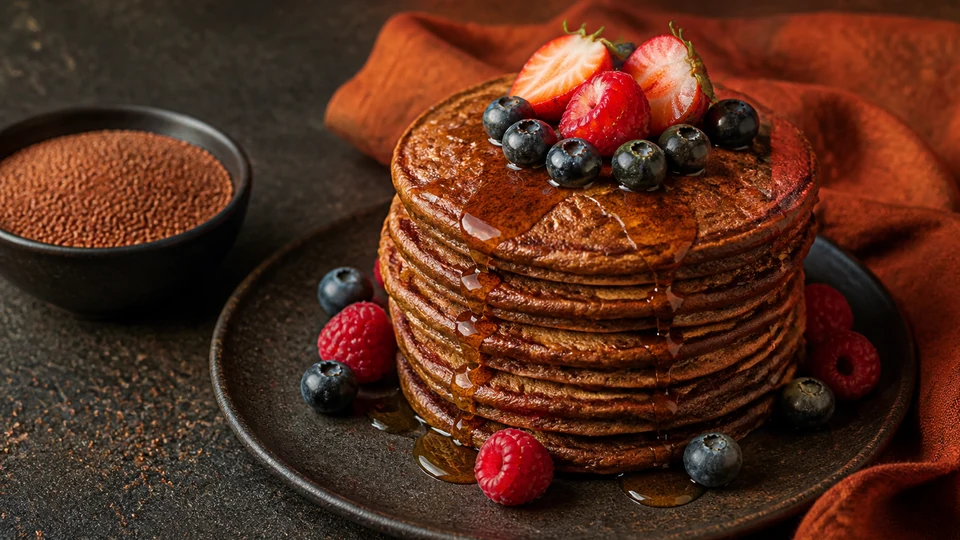
This is a route-selection and cooking guide, not a newly tested Pancake World recipe. Explore more flour and binder approaches in the vegan pancake collection, or return to Pancake World for the complete editorial library.
| Guide sections |
|---|
| Teff is a specific grain, not a flavour powder |
| Choose one of two breakfast-pancake lanes |
| Treat a producer’s substitution claim as product guidance |
| Brown and ivory teff are a real shopping decision |
For broader context, continue with Healthy Pancake Guides.
Teff is a specific grain, not a flavour powder
Teff is the grain of Eragrostis tef. The Food and Agriculture Organization identifies Ethiopia as its place of origin and says it is now grown primarily in Ethiopia and Eritrea, with cultivation in several other countries. Its very small grain is milled into flour and has longstanding importance in Ethiopian food.
That background should guide the tone of a teff pancake article. Teff is not a newly invented wellness ingredient, and a breakfast stack does not replace or recreate every traditional teff food. The FAO post-harvest compendium describes teff as central to injera, the fermented flatbread that is a major food in Ethiopia. Fermentation, batter management and the way injera is cooked belong to a distinct method and cultural context.
A raised breakfast pancake made with teff flour is a separate format. It may use baking powder or bicarbonate of soda, plant drink, fruit purée, oil, starch or another binder depending on its source. Calling it “injera” because the flour is teff would erase the method difference. Calling injera an ordinary American pancake would be equally inaccurate.
Use these labels precisely:
- teff-flour breakfast pancake: a quick pancake whose chosen recipe uses teff flour;
- 100-percent-teff pancake: all flour in that formula is teff, though other non-flour ingredients remain;
- teff blend: teff flour is combined with another flour or starch;
- injera: a separate fermented flatbread tradition that should be followed from an appropriate source.
Choose one of two breakfast-pancake lanes
There is no defensible universal teff pancake ratio. Published recipes show two practical lanes, and the cook should select the lane before measuring.
Lane A: a 100-percent-teff formula
A recipe explicitly written around teff as its only flour answers the strongest version of the query. HappyCow’s recipe library publishes an easy vegan teff pancake formula using white teff flour. Use that complete page if the goal is a direct 100-percent-teff route, and preserve its exact ingredients and quantities.
This lane is not automatically equivalent to replacing all-purpose flour with teff in a favourite batter. The liquid, binder and raising system were selected for the teff formula. If the source uses a fruit component, plant drink or another structural ingredient, removing it changes more than flavour.
Choose this lane when:
- you have the exact teff flour type the source expects;
- every binder and liquid is acceptable;
- you want teff to be the only flour;
- you can use the source’s portion and pan method;
- the flour and all other ingredients meet any gluten-free requirement.
Lane B: a vegan teff blend
A blended recipe combines teff with another flour or starch to create a different balance. Markal publishes a vegan teff-flour pancake recipe and labels it without milk or egg. A blend can be useful when a cook wants teff flavour but prefers the structure specified by that source.
The second flour is not filler to be deleted casually. It may change cohesion, spread and the ability to turn the pancake. A recipe developed with teff plus rice, oat, buckwheat, wheat or a starch must be evaluated as that whole formula. If coeliac safety is required, every flour in the blend needs to be appropriate and labelled for that use.
Choose this lane when:
- the published blend matches the flours already available;
- you want the developer’s intended texture rather than a 100-percent-teff experiment;
- all ingredients meet vegan and allergen needs;
- the source supplies a clear cooking method;
- you will not silently remove the supporting flour.
Treat a producer’s substitution claim as product guidance
Maskal Teff’s FAQ says its teff flour can be used on its own or blended and describes a one-for-one wheat-flour substitution in no-rise applications including pancakes. That is useful producer guidance for its product. It should not be converted into a universal law covering every brand, recipe and pancake style.
“One-for-one” also does not specify the rest of the batter. A wheat pancake may depend on gluten development, egg, dairy, a particular acid balance or a measured rest. Replacing only the flour can still change handling. The reliable decision is to follow a complete teff recipe first, then use producer guidance in a controlled experiment if you accept that the result is untested by Pancake World.
If experimenting later, document:
- the original recipe and flour mass;
- teff brand, colour and label status;
- every other ingredient kept or changed;
- batter appearance after mixing and after any rest;
- measured portion and pan heat;
- whether the pancake could be turned and whether its centre set.
That record turns “it did not work” into useful information. It still does not establish a publishable universal ratio.
Brown and ivory teff are a real shopping decision
Maskal describes brown teff as earthy or nutty and ivory teff as subtler and slightly sweet. Those are producer descriptions, not sensory findings from this project. The colour named by a recipe should control the first batch.
Do not assume the colour changes only appearance. A different flour product can influence how the finished pancake tastes and how much visual browning is easy to see. With brown teff, a dark batter may make “golden” a less useful cue than edge set, surface bubbles and centre doneness.
Read the package for:
- whole-grain or flour identity;
- brown or ivory designation;
- gluten-free claim where required;
- precautionary allergen statements;
- storage directions;
- use-by or best-before information;
- whether the package is flour rather than whole teff grain.
Whole teff grain cannot be substituted directly for teff flour in a batter. Grinding is a separate processing step, and home equipment may not produce the fineness expected by the recipe.
Explore related Pancakes World guidance on American Pancakes, American Breakfast: Pancakes, Diner Plates and Brunch, and Maple Syrup.
Sources and editorial references
The following workflow does not supply a new ingredient list. It helps execute whichever complete vegan teff recipe you select.
1. Make a formula card
Copy the source title, flour lane, exact measures, liquid, binder, raising agents, salt, sweetener or flavouring, pan fat, portion and timing onto one card. Add the source’s date or retrieval date. Do not copy quantities from one recipe and a method from another.
Mark three decisions visibly:
- Is the flour 100-percent teff or a blend?
- Is the formula itself vegan, not merely egg-free?
- Is every ingredient suitable for required allergens and gluten status?
2. Weigh the flour where the source provides grams
Teff flour is fine, and volume measures can be affected by settling and scooping. If a source publishes grams, use them. If it publishes only cups, use proper dry measuring cups and the source’s stated method. Do not obtain a gram equivalent from a different recipe and present it as the original formula.
Measure small raising-agent and salt quantities with proper spoons. A dark flour can make small white powders visible at first; distribute them through the dry mixture rather than leaving a concentrated streak.
3. Confirm the vegan boundary ingredient by ingredient
Plant drink does not make an entire recipe vegan if the source also contains egg, honey, dairy yoghurt or butter. Select a formula intentionally published as vegan and check current product labels.
Pay attention to:
- plant drink flavouring and sweetening;
- yoghurt or butter alternatives;
- chocolate, protein powder or baking mixes;
- cooking sprays;
- toppings and syrups;
- shared-equipment warnings.
The FSA cautions that vegan labelling is not an allergen-free guarantee. A product can be intentionally vegan yet carry a milk or egg cross-contact statement.
4. Mix to the source’s endpoint
Some teff recipes may direct a smooth batter; others may use a different endpoint. Follow the selected wording. Do not import the “leave lumps” rule from wheat pancakes unless the teff formula says so. Teff contains no wheat gluten, but other flour in a blend may affect how mixing should be handled.
Scrape the bowl so dry teff is not hidden underneath. If the source gives a rest, time it. A rest can change hydration and apparent thickness; judging the batter before the stated rest is complete can lead to unnecessary liquid.
5. Use a measured calibration pancake
Preheat the specified pan and use the source’s fat. Pour one measured portion. Watch how far it spreads, how the edge forms and how the top changes. Do not fill the pan with a whole batch before knowing that the heat and portion work together.
The Vegan Society’s general American-pancake guidance points to central bubbles and a surface beginning to firm before turning. Use those as supporting observations only when they fit the chosen recipe. A teff formula’s own timing and directions remain primary.
6. Check the centre, not just the colour
Teff colour can reduce the usefulness of a generic “golden brown” instruction. Look for a set edge, released underside, opened bubbles and a top that is no longer liquid. After turning, allow the source’s second-side cook.
Inspect the first pancake. A centre that smears or looks like raw batter needs more cooking or a process correction. A moist crumb is not automatically raw, so compare it with the chosen recipe’s images and description rather than a wheat-pancake expectation.
Troubleshoot by failure class
Pancake breaks during turning
Possible causes include turning too early, using a portion wider than the source, changing a binder, omitting a supporting flour or using excess pan fat. Let the calibration pancake set fully and use a broad turner. Verify the formula before adding an untested binder.
If a blended recipe was converted to 100-percent teff, return to the published blend. That single reversal provides better evidence than adding starch, flax and more liquid at once.
Batter is much thicker after resting
First confirm that the rest was part of the source and that all liquid was measured. Check whether a ground seed, starch or absorbent flour was added. Follow a source-provided adjustment if one exists; otherwise treat added liquid as a recorded experiment, not as a universal rule.
Additions should be measured in small steps. An undocumented splash makes the next batch impossible to reproduce.
Pancake spreads and will not set
Check for excess liquid, omitted flour, missing raising agent or binder, and an underheated pan. Confirm that “teff grain” was not mistaken for flour. Return to the exact portion.
Do not correct a runny 100-percent-teff formula by adding wheat flour if the goal includes gluten-free or 100-percent-teff status. Select a verified blend recipe instead.
Exterior darkens before the centre cooks
Reduce the pan heat, make the source-sized portion and allow the surface temperature to settle. Dark teff can also make browning harder to judge, so use time, bubbles, edge set and centre inspection together.
A thick pancake needs enough time for heat to reach the centre. Pressing it flat after turning changes the intended form and can produce a dense result.
Flavour is stronger than expected
Confirm whether brown teff was used where the source specified ivory. Review plant drink, oil and sweetener too. Do not describe the flavour as defective simply because it differs from refined wheat. If a gentler teff presence is preferred, choose a tested blend or an ivory-teff formula rather than diluting a 100-percent recipe without records.
Texture seems gritty
Check flour fineness, storage and hydration. Whole grain accidentally used instead of flour will not behave as batter flour. A source-specified rest may be relevant, but inventing a long rest is not automatically safe or effective. Use the product and method named by the recipe.
Gluten-free status needs two checks
FAO classifies teff among gluten-free millets, and Coeliac UK lists teff among naturally gluten-free grains. That answers the grain-identity question. It does not answer the product and kitchen questions.
Coeliac UK warns that naturally gluten-free flours can be contaminated when milled where wheat, barley or rye are present and advises choosing flour labelled gluten-free. For a complete pancake, also check:
- every additional flour or starch;
- baking powder and bicarbonate of soda;
- plant drink and yoghurt alternative;
- flavourings and protein powders;
- pan sprays and toppings;
- shared bowls, whisks, scoops and cooking surfaces.
A vegan claim cannot replace these checks. A gluten-free teff flour also does not prove that a blended recipe is gluten-free if it contains wheat or ordinary oats.
Nutrition claims should stay attached to evidence
FAO’s millet resource provides a teff composition profile per 100 g of raw grain and flags that its values come from a single data source. It also notes that nutrient contents vary with soil, climate, genetics, production, storage, processing and preparation. This article therefore does not convert the raw-grain table into a per-pancake nutrition panel.
The finished value would depend on flour amount, number of pancakes, plant drink, oil, binder and toppings. A brand label or analysed tested recipe is needed for a defensible serving calculation. “Teff contains nutrients” is not evidence that any stack produces a health, weight or blood-sugar outcome.
Keep cultural description as precise as the ingredient list
Teff’s Ethiopian importance is not decorative background for marketing copy. If the selected breakfast-pancake recipe is a modern quick batter, describe it that way. Do not add “traditional Ethiopian” merely because teff appears in the flour line. Tradition depends on a food, method, context and community—not on one ingredient viewed in isolation.
The same restraint applies in the other direction. A teff breakfast stack does not misuse the grain simply because it is not injera. Flour can enter new formats, and producer resources explicitly discuss pancakes and other baking uses. The editorial task is to name the format accurately and avoid borrowing the identity of a different dish.
Before publishing or serving with a cultural description, ask:
- Is this recipe actually sourced to an Ethiopian or Eritrean preparation?
- Does it use fermentation when the named dish requires fermentation?
- Am I calling every round teff item “injera” because of appearance?
- Is “inspired by” supported by a real method relationship, or is it only a promotional phrase?
- Would “quick vegan teff breakfast pancake” be more accurate?
For the formulas compared here, the last description is the safest default unless the recipe publisher explicitly establishes another identity. This boundary improves search usefulness too: someone seeking a fast raised pancake receives the right method, while someone seeking injera is not diverted to a baking-powder shortcut.
Store flour and pancakes under separate rules
Maskal advises keeping teff flour cool and dry and says refrigeration or freezing can help maintain freshness. Follow the current package, because products and packaging differ. Seal the flour against moisture and record the opening date.
For cooked pancakes, use the selected recipe’s storage directions if it publishes them. Do not transfer a flour producer’s shelf-life statement to cooked batter or pancakes. Where no cooked-storage direction exists, prepare only what is needed or apply authoritative general food-safety guidance rather than inventing a multi-day claim.
Raw batter may contain plant drink, fruit or other perishable ingredients. A flour’s long cupboard life does not make mixed batter shelf-stable.
Frequently asked questions
Is teff flour vegan?
Plain teff flour is milled grain and contains no intentional animal ingredient. The complete pancake is vegan only when every added ingredient and processing decision meets that boundary. Check the current flour package for cross-contact information.
Is teff flour gluten-free?
Teff is naturally gluten-free, but Coeliac UK advises using flour labelled gluten-free because contamination can occur during milling. Every other ingredient and the kitchen environment must also be suitable.
Can teff flour replace all-purpose flour one-for-one?
One producer gives that guidance for its product in no-rise applications including pancakes, but it is not a universal guarantee. Start with a complete teff pancake formula. If you experiment, record the brand, mass, liquid, binder and result.
Do teff pancakes taste like injera?
Not necessarily. Injera is a fermented flatbread with its own process. A quick vegan breakfast pancake may use raising agents and different supporting ingredients. Shared flour does not make the two methods identical.
Should I choose brown or ivory teff?
Use the colour specified by the recipe. A producer describes brown teff as earthier or nuttier and ivory as subtler and slightly sweet. These are product descriptions, and individual perception can differ.
Why does my teff pancake fall apart?
Check whether it was turned before the edge set, whether the portion was oversized, and whether any binder or supporting flour was omitted. Return to the exact published formula before adding new ingredients.
Does Pancake World provide a tested teff recipe here?
No. This page compares published lanes and explains execution and safety decisions. Without a project-owned test record, it uses Article framing and does not claim an original yield or formula.
- FAO — International Year of Millets:
https://www.fao.org/millets-2023/about/en - FAO — Tef post-harvest operations compendium:
https://www.fao.org/fileadmin/user_upload/inpho/docs/Post_Harvest_Compendium_-_TEF.pdf - HappyCow — Easy teff pancakes:
https://www.happycow.net/recipes/easy-teff-pancakes - Markal — Vegan teff-flour pancakes:
https://www.markal.fr/fiche_recette/99-pancakes-fluffly-a-la-farine-de-teff - Maskal Teff — Frequently asked questions:
https://teffco.com/pages/faq - Coeliac UK — Gluten-free grains:
https://www.coeliac.org.uk/grains/ - Coeliac UK — How to read food labels:
https://www.coeliac.org.uk/living-with-coeliac-disease/food-and-drink/food-and-drink-information/how-to-read-food-labels/ - UK Food Standards Agency — Vegan food and allergen risk:
https://www.food.gov.uk/news-alerts/news/fsa-launches-campaign-highlighting-risk-of-food-labelled-as-vegan-to-people-with-allergies - The Vegan Society — How to make the best vegan pancakes:
https://www.vegansociety.com/news/blog/how-make-best-vegan-pancakes