Tater tot brunch casserole
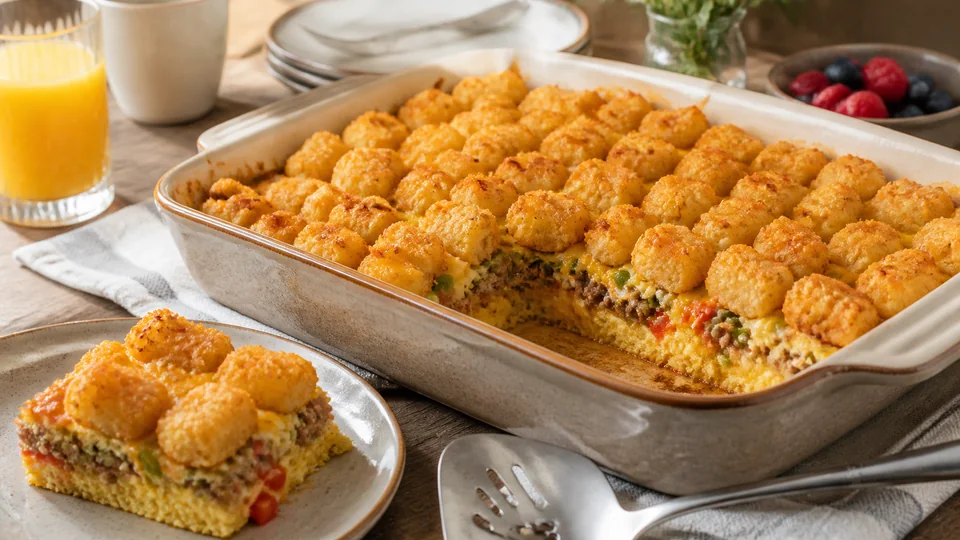
At Pancakes World, a tater tot brunch casserole works best when the filling is cooked and not watery, the egg mixture is sized for the selected tested recipe, and the frozen tots form a single exposed top layer instead of disappearing into liquid. Choose a sausage-and-vegetable, bacon-and-egg, meatless vegetable, or bean-and-pepper direction, but do not improvise quantities from unrelated recipes. Cook raw ground meat first, drain excess moisture, follow the formula’s instruction on frozen versus thawed tots, and bake until the center of the casserole reaches 165°F. Rest only as directed, then serve while the potato top still contrasts with the tender filling.
This page explains how to choose and evaluate a tater-tot-topped brunch casserole. It is not a Pancake World tested recipe: there is no project test record supporting original ingredient amounts, pan size, yield or timing, so Recipe schema is not appropriate. Use a complete tested formula for execution and this guide for the decisions around it. The brunch hub covers other group formats, while Pancake World leads to the wider collection.
| Guide sections |
|---|
| What makes it a brunch casserole? |
| Choose the structure before the flavor |
| Build the filling by role |
| Four useful flavor directions |
For broader context, continue with American Breakfast: Pancakes, Diner Plates and Brunch.
What makes it a brunch casserole?
The dish has three functional zones:
- a cooked savory filling, often containing meat or vegetables;
- a binder or sauce that connects the filling;
- a layer of frozen formed potato pieces that browns on top.
An egg-and-milk binder shifts the dish toward breakfast or brunch. A condensed soup or gravy base shifts it toward the tater-tot hotdish tradition. Both are legitimate casserole structures, but they do not share quantities, temperature behavior or timing automatically.
Utah State University Extension documents a tater-tot casserole made from cooked ground meat and onion, condensed soup, cheese and a top layer of frozen potato pieces. Its broader casserole framework separates starch, protein, vegetables, sauce, flavors and topping. Illinois Extension provides complete breakfast casseroles using eggs, milk, meat, vegetables and either shredded frozen potatoes or bread. Taken together, these sources support the structural decisions below; they do not create a new tested formula when combined.
Choose the structure before the flavor
Egg-bound brunch style
This version behaves like an egg bake. Cooked meat and vegetables sit below or within an egg-and-dairy mixture, while tots create the upper crust. It is appropriate when you want clean brunch portions and an obvious egg component.
Main risk: too much liquid. Wet vegetables, undrained meat and an oversized egg mixture can keep the center loose while the potatoes brown.
Use a tested recipe that specifies:
- number and size of eggs;
- milk or other liquid amount;
- pan dimensions;
- whether tots are frozen or thawed;
- layer order;
- oven temperature and bake time;
- safe final internal temperature;
- stated yield.
Sauce-bound hotdish style
This version uses a thick sauce, often a soup or gravy structure, to hold cooked filling. The tots remain the top starch. It can be adapted for a brunch table through seasoning or accompaniments, but adding eggs without reformulating changes the liquid and set.
Main risk: a heavy, salty or wet filling that softens the potato layer. Compare packaged ingredients on an equivalent serving basis and avoid adding extra liquid simply because the mixture looks dense before baking.
Layered rather than mixed
For maximum exposed potato surface, arrange tots over the filling. The top layer receives direct oven heat and remains visually distinct.
Integrated potato layer
Some formulas mix part of the potato into the filling or place tots between layers. This produces more soft potato contact and less crisp area. Choose it because the tested recipe intends that result, not as a shortcut after the filling is already too wet.
Build the filling by role
Protein
Common directions include breakfast sausage, bacon, ham, ground beef, ground turkey, beans or a meatless protein. Use a complete formula for quantity and safe preparation.
Raw ground meat should not be buried in an egg casserole and expected to cook by guesswork. USDA FSIS lists 160°F for ground beef, pork, lamb and veal, and 165°F for poultry. Cook the meat to its category endpoint, drain as the source directs, and then assemble. The completed casserole still needs its own 165°F endpoint.
Pre-cooked meats can contribute salt and fat, so read their labels before adding extra seasoning. “Cooked” on the package does not answer how the product should be handled in the chosen recipe.
Vegetables
Onion and peppers bring aroma and color. Mushrooms, spinach, zucchini, tomatoes and frozen vegetables can release significant water. Cook or drain them when the source recipe says to do so.
The goal is not to remove every drop of moisture. It is to keep unplanned liquid from pooling beneath the tots. A vegetable that is delicious in a skillet can behave differently when enclosed under potatoes and cheese.
Use one aromatic base and one or two vegetables until the structure is familiar. A crowded mix makes it hard to predict water, seasoning and portioning.
Binder or sauce
An egg mixture sets through protein coagulation during baking. A soup or gravy binder thickens differently. They are not interchangeable cup for cup.
If using an egg formula, measure rather than adding eggs until the dish “looks covered.” Too little may leave disconnected filling; too much may submerge the tots or demand a longer bake that dries the edges.
If using a sauce formula, preserve its starch and liquid relationship. Adding milk, salsa or vegetable juices can thin it. Use a source-developed variation or test the change outside an event.
Cheese
Cheese can sit inside the filling, between filling and tots, or on top. Its placement affects browning and potato exposure. A heavy top layer can shield tots from direct heat; a modest interior layer can bind without covering them.
Use the type and amount in the selected recipe for the first bake. Reduced-fat, plant-based and very moist cheeses can melt and release water differently, so a one-for-one result should not be promised.
Potato topping
Frozen formed potato pieces vary in size, seasoning, fat and package cooking instructions. The package is a source, not decoration. Check whether the casserole recipe expects them frozen, partially cooked or prepared another way.
Arrange a consistent exposed layer. Gaps allow filling to bubble through; overlapping can create uneven browning. The correct amount depends on the pan and piece size, which is why this guide does not invent a bag weight.
Four useful flavor directions
These are editorial decision patterns, not complete recipes.
Sausage, pepper and onion
This is the most direct breakfast signal. Brown and safely cook sausage, manage rendered fat, and soften vegetables before assembly if the selected formula requires it. Choose one seasoning lane: black pepper and herbs, mild chile and cumin, or sage-forward breakfast seasoning.
Avoid stacking several salty components. Sausage, cheese, condensed soup and seasoned tots can all contribute sodium. Taste the cooked filling where safe before adding optional salt, and use package labels for comparison.
Bacon, spinach and scallion
Bacon provides smoky flavor but not much bulk after cooking. Spinach contributes water unless cooked and squeezed or drained as directed. Scallions can be divided between filling and a fresh garnish, provided the garnish is washed and handled safely.
Do not pour bacon grease into the casserole by default. Retain only what the tested formula uses.
Mushroom, pepper and cheese
A meatless version needs a deliberate filling rather than meat simply removed from a meat recipe. Brown mushrooms to reduce water, soften peppers, and use a tested egg or sauce ratio designed for the vegetable load.
“Meatless” does not mean vegan if the dish contains eggs, milk or cheese. Label it accurately.
Bean, chile and tomato
Beans can create a substantial meatless base. Drain them as directed. Salsa, canned tomatoes and fresh tomatoes all introduce different water levels, so choose one controlled source of tomato flavor.
Use a tested Southwestern-style casserole formula if you want this direction. Do not combine a standard egg bake with a full jar of salsa and assume the original time remains valid.
Decide whether make-ahead is appropriate
An overnight casserole is a property of a specific recipe, not of the word casserole.
Illinois Extension publishes a bread, sausage, cheese, mushroom, egg and milk breakfast casserole that explicitly refrigerates eight hours or overnight before baking. That authorization belongs to its ingredients and process. The Extension’s frozen-potato breakfast casserole follows a different immediate assembly and bake sequence.
For tater tots, overnight contact with liquid can change the topping. Some recipes preserve a separate frozen top until baking; others authorize complete assembly. Follow the selected formula.
Use this decision tree:
- If the recipe says assemble and refrigerate overnight, follow its covering, refrigerator and bake instructions.
- If it says prepare the filling ahead, cool it promptly and store it separately.
- If it says add frozen tots immediately before baking, keep them frozen until then.
- If it gives no make-ahead directions, do not invent them for a party morning.
Advance work can still include chopping vegetables, cooking filling, shredding cheese and preparing the pan when the recipe and food-safety steps permit. Cool cooked components before sealing and refrigerating them.
Assembly sequence that protects texture
Use the recipe’s exact order, but evaluate it through these control points.
1. Prepare the pan
Pan material and depth influence cooking. A recipe developed for a 9-by-13-inch metal or glass dish may not translate directly to a deeper decorative casserole. Use the stated size and preparation.
2. Cook raw protein
Verify safe temperature with a thermometer. Drain excess fat only as directed, and keep cooked food away from utensils that touched raw meat.
3. Control vegetable moisture
Sauté, drain, thaw or squeeze ingredients according to the formula. Cool hot filling if the recipe requires cold assembly.
4. Add binder in measured quantity
Whisk the specified egg mixture or prepare the defined sauce. Distribute it evenly without changing volume based on appearance.
5. Position cheese deliberately
Keep the potato surface exposed when crispness is the goal. If cheese belongs on top, add it at the source-specified stage.
6. Arrange potatoes
Use a consistent layer and follow frozen-product handling instructions. Do not rinse or thaw unless instructed.
7. Bake and measure
Check the center with a clean food thermometer. USDA FSIS lists 165°F for casseroles. Probe a representative dense area without touching the pan, and take more than one reading if the dish is large or uneven.
8. Rest and portion
Follow the recipe’s rest period. Resting can make portions cleaner, but an arbitrary long wait can reduce top texture and enter the room-temperature holding clock.
How to get a crisper top
Crispness depends on exposed surface, filling moisture, oven behavior and service timing.
- Keep the top potatoes exposed unless the recipe intentionally covers them.
- Manage wet vegetables before assembly.
- Do not add unmeasured liquid.
- Use the pan and oven temperature specified by the formula.
- Avoid crowding a deeper dish than the source uses.
- Serve after the intended rest rather than covering the hot top for a long period.
Do not use the broiler as an automatic rescue. A broiler can burn protruding pieces while the center remains below 165°F, and not every dish is broiler-safe. Only use that step if the recipe and cookware allow it, after safe internal cooking is verified.
If the top browns too early, the proper correction depends on the formula, pan and oven. Record what happened and consult the source rather than masking every batch with foil at an arbitrary minute.
Troubleshooting by symptom
Watery center
Possible causes include undrained vegetables, added salsa, fatty meat, an oversized egg mixture, a different pan depth or insufficient baking. Verify temperature first. Do not serve an undercooked casserole just because the edges are firm.
For the next batch, change one factor using the source recipe. Do not simply add flour or more tots without testing.
Pale, soft tots
The potatoes may be covered by liquid or cheese, crowded in overlapping layers, held under a tight cover, or baked differently from the product and recipe instructions. A pale top does not itself prove the center is unsafe, and a brown top does not prove it is safe. Measure the center.
Dry edges, loose middle
The pan may be too deep, the oven may heat unevenly, or the center may have started too cold for the documented schedule. Use the correct vessel and verify oven temperature if this repeats.
Greasy surface
Rendered meat fat, cheese and seasoned potato products can accumulate. Pre-cook and drain meat as directed. Do not assume that more cheese will absorb grease.
Portions collapse
The casserole may be under-set, too wet or cut before its stated rest. Verify safe temperature, then respect the formula’s rest. A softer spoonable result can still be intentional in some sauce-bound casseroles.
Bland filling, salty top
Season the filling in layers only after accounting for sausage, cheese, soup and potato seasoning. Package labels can help identify where sodium enters. Fresh herbs or acidic accompaniments may create contrast, but they do not remove salt already present.
Serve it as a brunch centerpiece
A tater tot casserole is substantial. Pair it with foods that provide temperature and texture contrast rather than another heavy starch.
Useful companions include:
- fresh fruit kept chilled until service;
- a simple green or vegetable salad;
- tomatoes, cucumber or a lightly dressed slaw;
- a small bread or pastry only when the group expects it;
- hot sauce, herbs or scallions in controlled, labeled portions.
Skip hash browns, breakfast potatoes and a full bread basket unless the menu specifically needs multiple starches. The casserole already contains its potato component.
For a buffet, cut or mark portions and supply a broad serving spatula. Bring out smaller sections when possible so the entire pan does not sit uncontrolled for the full event.
Allergen and dietary decisions
Common casserole components can include milk, egg, wheat, soy and meat. Condensed soups, sausage, cheese substitutes and frozen potato products may contain less obvious allergens or processing statements. Read every package.
A gluten-free version requires more than removing bread because sauce, sausage and frozen potato coatings may contain wheat or face cross-contact. A dairy-free version needs a tested binder and cheese strategy. An egg-free version is structurally different from an egg-bound brunch casserole.
Choose a recipe already designed for the intended restriction. Keep an alternative in a separate pan with separate utensils when cross-contact matters. Label “vegetarian” and “vegan” accurately.
Cooling, storing, freezing and reheating
Refrigeration
Refrigerate leftovers within two hours, or one hour when the ambient temperature is above 90°F. Divide large amounts into shallow containers for faster cooling rather than placing a deep, steaming casserole under a tight lid for an extended period.
USDA FSIS lists three to four refrigerator days for cooked leftovers and for casseroles made with eggs. The clock assumes safe initial cooking and prompt refrigeration.
Freezing
USDA FSIS gives baked egg casseroles a two-to-three-month freezer quality window. Penn State Extension notes that shallow containers freeze and thaw faster and that some toppings become soggy, so separating a topping may improve quality when the recipe supports it.
Whether to freeze this casserole baked or unbaked must come from the selected recipe. Label the package with dish name, date, servings and preparation instructions.
Thawing
USDA FSIS identifies three safe methods: refrigerator, cold water and microwave. Refrigerator thawing is the simplest for a casserole. Cold-water and microwave methods need closer handling and immediate cooking or reheating as specified.
Do not thaw a casserole on the counter. A frozen center does not keep the warmer exterior safe indefinitely.
Reheating
Reheat leftovers to 165°F. Covering can help distribute moist heat, but it can soften the potato top. For a whole refrigerated portion, use the source’s method and verify more than one area. For individual portions, a microwave may be faster but can create cold spots; cover, rotate as appropriate and check several locations.
Quality and safety are separate. A properly reheated top may be less crisp than the first service, so plan portions realistically.
Frequently asked questions
Do I thaw tater tots before making a brunch casserole?
Follow the exact recipe and package instructions. Many formulas use frozen tots, but that does not establish a universal rule. Thawing changes moisture and timing.
Can I assemble it the night before?
Only when the chosen recipe explicitly authorizes overnight assembly. Some formulas keep tots separate until baking to protect texture. Preparing a cooked filling ahead is a different instruction from refrigerating the completed raw egg casserole.
Should the tots go on top or in the middle?
Place them on top when you want maximum exposed surface and a visible potato crust. An integrated layer gives a softer result. Use the arrangement tested by the formula.
What temperature should the casserole reach?
USDA FSIS lists 165°F for casseroles. Check the center or densest representative area with a food thermometer. Ingredients may also need safe pre-cooking before assembly.
Can I put raw sausage directly into the casserole?
Do not do that unless a complete tested recipe explicitly provides safe handling and an endpoint. The safer documented pattern in the Illinois Extension breakfast casserole is to cook sausage before assembly.
Why is my tater tot casserole watery?
Wet vegetables, undrained meat, extra sauce, too much egg mixture, an incorrect pan or incomplete baking can contribute. Verify 165°F, then compare every ingredient and vessel with the source recipe before changing the formula.
How do I keep the top crisp at a buffet?
Serve close to baking, avoid sealing the hot surface under a tight cover, and replenish in smaller portions while maintaining safe temperature. Long holding will reduce texture even when safety controls are correct.
Can I make it vegetarian?
Yes, with a tested meatless formula using vegetables, beans or another defined filling. Removing meat from a meat recipe without adjusting volume, moisture and seasoning can change the result.
How long do leftovers last?
USDA FSIS lists egg casseroles and most cooked leftovers at three to four days refrigerated, provided they were cooked safely and refrigerated promptly. Reheat to 165°F.
Can I freeze the casserole?
Often, but use recipe-specific instructions for baked versus unbaked freezing. Baked egg casseroles have a USDA two-to-three-month freezer quality window. Texture, especially the topping, may change.
Final build checklist
- complete tested formula selected;
- pan size, yield and bake schedule confirmed;
- frozen-potato handling checked;
- raw meat cooked to its category endpoint;
- wet vegetables managed as directed;
- binder measured rather than guessed;
- tots arranged in the source-specified layer;
- center reaches 165°F;
- perishable food leaves temperature control for no more than two hours;
- leftovers cooled in smaller shallow containers;
- refrigerator use limited to three to four days;
- leftovers reheated to 165°F;
- no Recipe schema or test claim used without a real project record.
A successful tater tot brunch casserole is a controlled layer system, not a disposal pan for arbitrary leftovers. Choose egg-bound or sauce-bound structure, keep the filling cooked and measured, preserve the exposed potato top, and let one verified formula determine exact quantities and time. That approach delivers a useful brunch centerpiece without fabricating a Pancake World recipe.
Explore related Pancakes World guidance on American Pancakes, Maple Syrup, and Maple Syrup Pancakes.
Sources and editorial references
- Utah State University Extension, “Create a Casserole”:
https://extension.usu.edu/createbetterhealth/blog/createacasserole - University of Illinois Extension, “Breakfast Casserole”:
https://extension.illinois.edu/food/recipes/breakfast-casserole - University of Illinois Extension, “Breakfast Casserole” (overnight formula):
https://eat-move-save.extension.illinois.edu/eat/recipes/breakfast-casserole - Utah State University Extension, “Tater Tot Casserole” in EFNEP/FNP recipes:
https://extension.usu.edu/employee/files/recipes.pdf - USDA Food Safety and Inspection Service, “Food Thermometers”:
https://www.fsis.usda.gov/food-safety/safe-food-handling-and-preparation/food-safety-basics/food-thermometers - USDA Food Safety and Inspection Service, “Shell Eggs from Farm to Table”:
https://www.fsis.usda.gov/food-safety/safe-food-handling-and-preparation/eggs/shell-eggs-farm-table - USDA Food Safety and Inspection Service, “Leftovers and Food Safety”:
https://www.fsis.usda.gov/food-safety/safe-food-handling-and-preparation/food-safety-basics/leftovers-and-food-safety - Penn State Extension, “Make-Ahead Freezer Meals to the Rescue”:
https://extension.psu.edu/make-ahead-freezer-meals-to-the-rescue