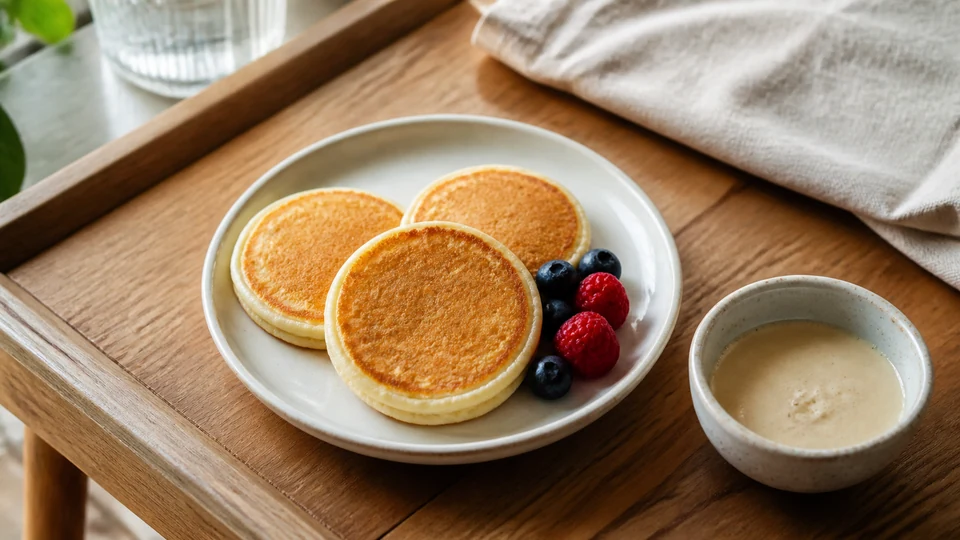
Small batch vegan pancakes
At Pancakes World, small batch vegan pancakes works best as a small-batch scaling and workflow guide, not a claimed tested yield or universal division rule. The first useful decision is to start from a complete formula that is already small or scale every ingredient consistently with suitable measuring precision. Keep that decision visible while you prepare the food, because an unrecorded ingredient change, portion change and heat change made together cannot show which adjustment helped. This page gives a controlled workflow, observable checks and recovery choices. It does not claim that the editorial platform tested a finished recipe, and it does not supply unsupported yield, timing, nutrition, health or product-performance promises.
| Guide sections |
|---|
| Direct answer |
| What this page covers |
| Plan the method before the batch |
| Method or selection guidance |
For broader context, continue with Healthy Pancake Guides.
Direct answer
What this page covers
The route answers the exact search need “small batch vegan pancakes” within the approved RECIPE_OR_IDEA intent. It focuses on decisions a cook can see and record: ingredient form, mixing or preparation order, portioning, equipment load, service timing and the condition of the finished food. It does not turn search demand into evidence and does not borrow claims from a similarly named page.
The editorial boundary matters for small-batch vegan pancakes. A complete tested recipe would need project-owned ingredients, quantities, instructions, yield and timings plus an accepted test record. None is invented here. Where a packaged ingredient is involved, its current label remains the authority for ingredients, allergens, storage and regulated nutrition language.
Plan the method before the batch
A small batch magnifies casual measuring differences. Use the same measuring system throughout, choose a bowl that still allows gentle mixing and scrape all of the small wet mixture into the dry. Plan the number and size of portions before heating the pan.
For Small batch vegan pancakes, write down the starting state in ordinary kitchen language. Record the ingredient form, the chosen preparation path, the portion method, the pan or tray, and what “ready to serve” means for this meal. A baseline can be useful without a laboratory measurement: “flows in a ribbon,” “holds a mound,” “pieces overlap,” “edges release,” or “first plate waited” are clearer than a vague verdict such as “did not work.”
Keep the small-batch vegan pancakes batch small enough to observe. The first portion is a diagnostic, not proof that every later portion will behave identically. Watch the food at more than one moment—after preparation, during cooking or reheating, and after a short consistent rest—because steam, settling, thickening and service delay can change what you see.
Method or selection guidance
Begin Small batch vegan pancakes with traceability. Use one complete formula, one product label or one clearly written preparation plan. Do not combine remembered quantities from different sources. If the plan names a specific ingredient form, keep that form; a powder, flake, purée, whole piece, chilled product and frozen product can create different handling requirements.
Next, control portion and surface for small-batch vegan pancakes. Place or pour one modest diagnostic portion in the same pan area you intend to use for comparisons. Observe spread, edge coherence, visible moisture, ease of lifting and the condition of the centre after a consistent rest. Equipment settings are not universal surface measurements, so record the setting in terms you can reproduce on your own appliance.
Finally, separate flavour from structure in small-batch vegan pancakes. Salt, sweetness, vanilla, herbs, toppings and sauces can change the eating experience while the base method still has a texture problem. Adjust the dominant issue first. A traceable batch may be imperfect, but it gives the next batch a useful starting point.
Current-batch fixes
If the first portion uses too much batter, the remaining yield becomes misleading; if a tiny egg-replacer or leavener amount is hard to measure, choose a formula designed for the target scale. Do not round several ingredients in different directions and call the result equivalent.
For a current small-batch vegan pancakes batch, prefer bounded corrections. Reduce the next portion, create more pan space, lower the holding load, or stop and record the result. Avoid repeatedly adding unmeasured flour, liquid, fat or binder to the shared bowl. That may produce edible food, but it erases the baseline and makes the next attempt harder to plan.
If safety or storage for small-batch vegan pancakes is uncertain, do not use a texture fix to justify keeping the food. Follow the applicable product label and FoodSafety.gov guidance for perishable ingredients, leftovers and cold storage. An attractive surface is not evidence that storage or handling was safe.
Prevent the same problem next time
For Small batch vegan pancakes, choose one follow-up variable tied to the strongest observation. If the mixture changed while waiting, compare waiting time or hydration. If the surface cooked unevenly, compare pan loading or portion size. If a packaged component behaved differently, compare the exact product and its directions. Preserve every other practical variable as closely as possible.
Create a one-line next-batch note for small-batch vegan pancakes: state the baseline, the single change and the sign that would count as improvement. “Use a smaller portion and look for a coherent centre before extra colour” is testable in a kitchen; “make it better” is not. Stop when several causes remain plausible and return to a complete trusted formula or method.
Ingredients, substitutions and variations
Small batches are useful for one topping comparison or one-pan breakfast. Freeze or refrigerate leftovers only under the ingredient and food-safety guidance that applies; the better control is to choose an appropriate batch before mixing.
In small-batch vegan pancakes, a substitution is a new formulation choice, not a neutral synonym. Plant drinks, flours, binders, fats, sweeteners and commercial prepared foods can differ in ingredients and behaviour. When a substitution is necessary, record the exact item and change only that item in the comparison. Do not transfer a ratio from another recipe unless the complete source explicitly supports it.
For Small batch vegan pancakes, “vegan,” “organic,” “protein,” “healthy,” and similar terms do not establish a complete nutrition, allergen or health conclusion on their own. Use current regulated label information where those details matter. For an allergy or clinical dietary need, check every package and preparation surface rather than relying on the route title.
Safety and storage boundary
For small-batch vegan pancakes, use clean utensils and follow the storage directions for the most perishable ingredient in the meal. Keep raw and ready-to-eat items separated where relevant, and refrigerate or discard leftovers according to authoritative current guidance. This page does not create a new storage time or temperature and does not override a product label.
When small-batch vegan pancakes is served to people with allergies or dietary restrictions, verify labels at the time of use. Formulations and cross-contact statements can change. A plant-based product is not automatically free from every allergen, and a wheat-based dish is not suitable for a gluten-free requirement.
Final control checklist
- Define the exact format of small-batch vegan pancakes before selecting substitutions.
- Keep one complete formula, product label or preparation plan as the baseline.
- Record ingredient form, portion method, equipment and service timing.
- Observe the first portion before changing the shared batch.
- Diagnose moisture, structure, surface and flavour as separate questions.
- Make one bounded current-batch correction when safe to do so.
- Change one variable in the next batch and preserve the rest.
- Avoid unsupported test, yield, nutrition, health, product or endorsement claims.
Frequently asked questions
Is this a tested Pancake World recipe?
No. The approved Small batch vegan pancakes brief permits practical preparation and selection guidance but requires a project-owned test record before ingredients, quantities, yield and timings can be published as a tested recipe. This article stays inside that boundary.
Can I make several substitutions at once?
You can, but the result will not explain which change mattered. For small-batch vegan pancakes, keep the baseline traceable and change one ingredient form or method variable in the next comparison. Recheck current package labels whenever a commercial ingredient changes.
What should I inspect before changing the heat?
For small-batch vegan pancakes, inspect portion size, pan loading, visible moisture, edge coherence and whether the mixture changed while waiting. A heat adjustment cannot repair every formulation or service problem, and several simultaneous changes make the result ambiguous.
Does the route title prove a nutrition or health benefit?
No. The Small batch vegan pancakes search phrase is not evidence. Nutrition statements require current reliable data, regulated terminology should follow current label guidance, and health outcomes are outside this article’s evidence boundary.
Explore related Pancakes World guidance on American Pancakes, American Breakfast: Pancakes, Diner Plates and Brunch, and Maple Syrup.
Sources and editorial references
- USDA FoodData Central —
https://fdc.nal.usda.gov/ - FoodSafety.gov food-safety charts —
https://www.foodsafety.gov/food-safety-charts - U.S. FDA Food Labeling & Nutrition —
https://www.fda.gov/food/nutrition-food-labeling-and-critical-foods