Slow cooker breakfast casserole
At Pancakes World, a slow cooker breakfast casserole is most reliable when one validated recipe controls ingredients, fill level, cooker size, and timing. Choose the structural base—potato, bread, grain, or vegetables—then keep the recipe’s binder and moisture balance intact. If advance assembly is permitted, refrigerate it safely and follow the appliance maker’s guidance about cold inserts and start-up. Do not leave egg, dairy, meat, or cut vegetables in an unpowered cooker overnight. Start at the calculated time, avoid opening the lid, verify the centre, and move to warm holding only when both recipe and appliance allow it.
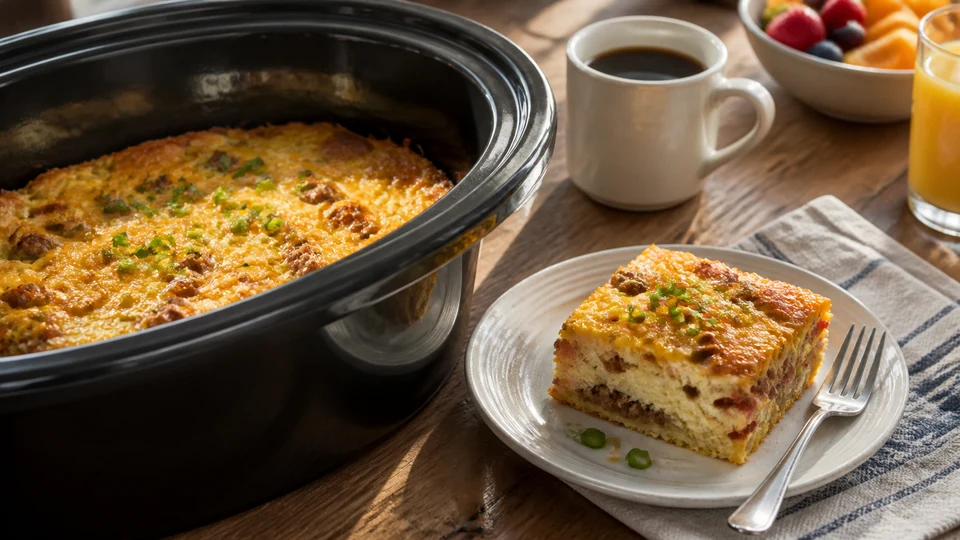
This is a focused execution and troubleshooting guide, not a recipe collection or new formula. The breakfast hub provides the parent topic, and Pancake World opens the full editorial collection.
| Guide sections |
|---|
| Lock the recipe and cooker together |
| Choose the structural base once |
| Verify every ingredient state |
| Prepare meat separately when directed |
For broader context, continue with American Breakfast: Pancakes, Diner Plates and Brunch.
Lock the recipe and cooker together
Choose one complete recipe written for the exact slow-cooker capacity available. It must name ingredient states, quantities, assembly, setting, timing range, centre test, and any holding or leftover path. Record the cooker model and retrieve its manual.
Confirm fill guidance, insert handling, lid position, warm mode, cord placement, and cleaning. Do not use the time from a recipe written for a smaller or larger vessel. Greater depth changes how the centre heats.
Without a genuine project-owned test record, this article cannot supply Recipe schema, yield, temperature, or minutes. Those claims remain attached to the selected source.
Choose the structural base once
A potato base may use shredded, diced, raw, cooked, frozen, or thawed potato. A bread base depends on absorption and rest. A grain or bean base needs its own liquid design. A vegetable base must control water release. Select one structure and keep it intact.
Do not exchange potato for bread while retaining the binder, or remove egg and assume grain will hold the mixture. These are new formulas. Choose a tested recipe already designed for the desired base.
Check whether the finished casserole should slice, spoon, or remain soft. Service expectations should match the structure rather than forcing it to behave differently.
Verify every ingredient state
Write raw, cooked, ready to eat, frozen, thawed, drained, cooled, or refrigerated beside each major component. Raw bulk sausage cannot replace cooked crumbles silently. Frozen hash browns cannot borrow the method for thawed shreds. Fresh spinach and squeezed thawed spinach bring different water.
Read packaged labels for ingredients, allergens, storage, and preparation. Keep them through service. Do not infer that smoked-looking meat is cooked or that a plant-based product is allergen-safe.
If any state differs from the source, resolve it before assembly. Do not expect longer cooking to repair an unknown substitution.
Prepare meat separately when directed
Set out dedicated raw-meat tools and a clean vessel for cooked filling. Brown sausage or another raw meat according to the recipe and package. Verify the applicable endpoint, drain as directed, and keep it away from ready-to-eat sides.
If preparing ahead, cool cooked meat under applicable guidance before refrigerated assembly. Do not seal steaming meat into a deep egg mixture. Label its container with dish and time.
Clean affected surfaces and wash hands before touching bread, cheese, vegetables, labels, or serving utensils.
Remove vegetable moisture deliberately
Follow the recipe for sautéing, draining, thawing, squeezing, or adding vegetables raw. Mushrooms, spinach, peppers, onions, tomatoes, and courgettes release different amounts of liquid.
Do not add extra vegetables simply to fill the cooker. Water can dilute the binder and leave the centre loose. Keep salsa and wet garnish for service unless the tested formula includes them.
Cool pre-cooked vegetables before advance assembly. Use the cut size specified so pieces distribute and finish as intended.
Mix the binder exactly
Egg, dairy or plant beverage, cheese or alternative, seasoning, and any thickener form a system. Measure each from the selected recipe. Plant beverages and egg substitutes are not universal one-for-one replacements.
Crack eggs into a separate bowl. Mix in the stated order and do not taste raw filling. Review every package for allergens and keep cooking fat and toppings in the complete record.
If a measured ingredient is omitted or doubled, stop before cooking. Adding a guessed correction through the layered casserole is not controlled.
Assemble at the tested depth
Use the source order for base, filling, binder, and reserved topping. Spread each layer evenly without compressing it beyond the method. Clear the insert rim so the lid seats normally.
Compare the filled level with recipe and manual expectations. If it is unexpectedly high or low, verify cooker size and measurements. Do not add leftovers to occupy empty space.
Take a private note of the assembled level and any approved variation. Appearance supports repeatability but does not become a universal fill specification.
Decide whether advance assembly is allowed
The recipe must explicitly permit refrigeration before cooking and state the relevant path. The manual must permit the insert handling that path requires. A cold ceramic insert may have manufacturer-specific thermal limits.
Cover and label the assembly. Keep it refrigerated for the source-supported period. Do not leave it sitting in the unpowered base overnight, even if cooking will start early.
If full assembly is not permitted, prepare only supported components and combine them shortly before start. Make-ahead is a set of specific tasks, not a blanket label.
Calculate the start from breakfast time
Work backward from service through the recipe’s doneness check, directed rest, cooking range, and setup. Identify the latest supported start and the person responsible for it. A timing range is not a guarantee.
Choose a recipe whose finish window overlaps a time when someone can verify the centre. An overnight method that finishes while everyone sleeps is not controlled convenience.
Add a fallback breakfast that requires no unsafe shortcut. If the casserole is late, serve the fallback and continue only under the source method.
Start without delay timing
Retrieve the cold assembly when the cooker is ready. Place the insert and lid according to the manual, select the source setting, record start, and confirm power. Keep the appliance on a stable surface with a safe cord path.
Do not use an outlet timer or appliance delay with egg, dairy, meat, or cut vegetables unless a complete authoritative method explicitly supports that exact process. Perishables should not wait in an unpowered cooker.
Do not preheat an empty cooker or cold insert unless the manufacturer and recipe direct it. Start-up belongs to the specific appliance.
Keep the lid closed
Opening changes heat and moisture. Do not stir, photograph, add garnish, or smell-check the casserole unless the source directs a step. Prepare any late topping and doneness tool before the planned opening.
Assign one person to control the lid. Several guests checking independently can invalidate the timing and create a steam hazard.
If condensation forms, leave the lid as designed. Do not insert a towel or prop it open without explicit recipe and manual support.
Verify the deepest centre
At the source’s checking point, use its visual and physical cues plus applicable official guidance. Check the centre or deepest area, not a firm edge or melted top. Avoid touching the insert with a thermometer when that can distort the reading.
If further cooking is supported, close promptly and continue on the cooking setting. Never use warm mode to finish an undercooked centre. Do not serve the outer ring while returning the middle.
Record the final check. If the method substantially exceeds its range, investigate fill, cooker size, ingredient temperature, lid, power, and substitutions rather than publishing a new time.
Move to service or supported holding
Serve after the recipe-directed rest, or switch to warm only when both recipe and appliance allow it. Record when holding begins and the supported end. Warm mode is not indefinite storage.
Place the cooker where guests cannot trip over the cord or reach across steam. Set a heat-safe lid location and suitable serving tool. Put drinks on another surface.
Label the complete dish and keep cold toppings in small portions. Replenish toppings from controlled storage.
Portion according to structure
A firm potato-and-egg casserole may cut into pieces; a bread or vegetable version may be spooned. Use the source’s portion style. Do not hold longer merely to force clean slices.
Begin with useful modest portions and allow seconds. The source yield guides planning but does not prescribe appetite. Do not invent a new yield from one household service.
Keep the serving area tidy so fallen crumbs or shared utensils do not reach a labelled alternative.
Pair the casserole with simple sides
Let the casserole carry the warm workload. Add one cold or crisp contrast, fruit or vegetables, and a drink. Avoid another egg, potato, or bread main that duplicates it.
Choose sides that can remain controlled without last-minute pans. Prepare cold foods first and return them to refrigeration until service.
Offer a clearly distinct substantial alternative when guest needs require it. Picking sausage from one corner does not create a meat-free option.
Keep labels and allergens visible
Retain packages for meat, potato, bread, cheese, plant alternatives, seasoning, cooking fat, and toppings. Build the label from all of them. Front-of-pack claims are not the full record.
Use separate serving utensils for alternatives. Explain cross-contact limits rather than certifying a home dish. If individual safety remains unresolved, provide a sealed or clearer option.
Recheck labels at every repeat because formulations can change.
Cool leftovers promptly
End service under FoodSafety.gov guidance. Divide safe leftovers into suitable containers for cooling; a deep hot insert is not automatically the right storage vessel. Record cooking and holding history.
Store toppings separately. Reheat with a supported method and verify the centre where guidance requires. Do not use warm mode to reheat unless authoritative instructions permit it.
Discard food with uncertain history. Smell cannot reconstruct missing control.
Troubleshoot a loose centre
Return to fill depth, cooker size, frozen or cold ingredient state, vegetable moisture, binder measurement, lid opening, and appliance setting. The earliest mismatch is more useful than adding time indefinitely.
Continue only within the tested method. If the edges are firm while the centre remains loose, do not serve around it. Select a better-matched recipe next time.
Do not add flour, cheese, or extra egg to the hot casserole. Those changes cannot be distributed or validated safely.
Troubleshoot wet or greasy results
Wetness can come from vegetables, thawed potato, untested sauces, or insufficient drainage. Greasiness can come from sausage, cheese, cooking fat, or a product substitution. Review the preparation record.
Correct the next batch at the source step: drain the named ingredient as directed, use the exact product state, or select a recipe designed for the desired filling. Do not scoop liquid during cooking and call the formula repaired.
If several changes seem necessary, abandon the variation and return to a complete tested recipe.
Troubleshoot dry edges
Dry or dark edges with a slow centre can indicate a shallow or mismatched cooker, too little fill, excessive time, or formula changes. Verify capacity and depth first.
Do not add liquid blindly. More liquid can worsen centre doneness. Choose a source matched to the appliance or a smaller cooker rather than using an underfilled large vessel.
Record the edge and centre separately. One word such as overcooked hides the diagnostic difference.
Clean the appliance correctly
Unplug and cool according to the manual. Remove the insert only when and how permitted. Do not immerse the electrical base or use abrasive tools on protected surfaces.
Follow instructions for soaking, dishwasher use, lid parts, seals, and storage. Sticky sweet casseroles and cooked cheese can need different attention, but the manual controls.
Inspect the cord, insert, lid, and heating base before putting them away. Damage is an appliance issue, not a reason to alter the next recipe.
Record the execution
Keep recipe source, cooker model, ingredient identities, assembly time, start, lid openings, checks, verified finish, holding, service, leftovers, and cleanup. Mark any variation explicitly.
End with repeat unchanged, select another recipe, repair one documented step, or stop using this cooker-formula pairing. A useful note identifies the next action.
One successful household result does not create public Recipe schema. A complete reviewed test record is still required.
Rehearse the overnight handoff
For an overnight recipe, the person assembling and the person checking in the morning may be different. Write a handoff with the exact cooker, setting, start time, earliest check, centre location, permitted tool, and what result counts as ready under the source. Include the warm-holding decision and its limit.
The morning person should know the stop conditions: power interruption, lid displaced, unexpected fill leakage, uncertain start, or no one able to verify the centre. “It smells cooked” is not a release criterion. The fallback breakfast should be visible and require no hurried raw cooking.
Set alarms or reminders privately where useful, but do not let a timer replace observation. A cooker reaching the nominal end of a range still needs the stated check. If the casserole finishes before everyone wakes, move only into the approved holding path.
Keep pets, children, cloth, and stored items away from the operating appliance. Overnight convenience requires a safe unattended environment within the manufacturer’s use instructions; it does not waive supervision requirements.
Run a paper capacity check
Before shopping, compare the recipe’s named cooker with the actual model and its manual. Sketch the expected ingredient layers and note which ingredients expand, release water, or form the binder. This is a planning check, not permission to fill with water or raw food as an experiment.
If the source gives only a vague cooker description, choose a clearer recipe. If the model has an unusual shape, verify that the recipe addresses comparable usable area and depth. Oval and round vessels with similar advertised capacity can still produce different layer geometry.
Do not scale by the ratio of cooker capacities alone. Egg count, potato depth, bread absorption, and centre distance do not change linearly. A validated small or large recipe is the safer choice.
Record the capacity match in the execution note so a future cook does not grab a different appliance from the cupboard.
Decide whether the slow cooker genuinely helps
The appliance earns its place when it moves active work away from the busy morning, fits the finish window, and provides a supported service path. It is less useful when raw meat still needs early browning, the recipe finishes during sleep, the group needs crisp texture, or the cooker creates unsafe buffet traffic.
Compare a tested oven casserole, a cold breakfast, and a skillet meal at the planning level. Count active tasks, equipment, supervision, refrigeration, holding, and cleanup. Do not choose the slow cooker only because the label sounds hands-off.
If another method better fits, use it. This route is an execution guide, not a claim that slow cooking is universally easier or better. The best outcome can be rejecting an unsuitable appliance-recipe pairing before ingredients are opened.
Manage a power interruption
Note when power was last confirmed and how long the interruption may have lasted. Do not guess that the retained heat completed cooking. Follow FoodSafety.gov and the appliance manufacturer’s guidance for the exact history.
If safety cannot be established, discard the casserole and use the fallback. Restarting on high, moving to an oven, or reheating later cannot erase an unknown period. Do not taste to decide.
Afterward, inspect the outlet, plug, controls, and circuit through appropriate channels before another run. Keep the incident separate from recipe troubleshooting; a power failure does not prove the binder or timing was wrong.
Coordinate one cooker with the rest of breakfast
While the casserole cooks, prepare only sides that can remain controlled and do not require the same supervision. Set tableware, wash fruit or vegetables under applicable guidance, make labels, and stage drinks. Return cold components to refrigeration.
Do not plug a toaster, kettle, coffee urn, and multiple warmers into an unassessed arrangement near the cooker. Plan electrical demand and cords. Keep steam and the hot lid away from cabinets and guest reach.
The final minutes belong to centre verification and service. Avoid starting eggs, pancakes, or another fragile hot dish then. One correctly finished casserole with simple contrasts is a complete breakfast plan.
Frequently asked questions
Can a slow cooker breakfast casserole cook overnight?
Only use a complete tested recipe explicitly written for overnight cooking and a finish window someone can supervise.
Can the insert be refrigerated?
Check the exact appliance manual and recipe. Materials and manufacturer instructions differ.
Can warm mode finish the centre?
No. Warm mode is for supported holding after verified cooking, not for completing an undercooked casserole.
Can I double the recipe?
Only with a validated scale and suitable cooker. More depth changes the centre’s cooking path.
Why should the lid stay closed?
Opening releases heat and moisture and makes the recipe’s timing less meaningful. Open only for directed steps and planned checks.
Can I substitute another sausage or plant product?
Use a tested variation that addresses cooking state, fat, moisture, seasoning, allergens, and distribution.
Explore related Pancakes World guidance on American Pancakes, Maple Syrup, and Maple Syrup Pancakes.
Sources and editorial references
- USDA FoodData Central —
https://fdc.nal.usda.gov/ - FoodSafety.gov food safety charts —
https://www.foodsafety.gov/food-safety-charts - FDA Food Labeling & Nutrition —
https://www.fda.gov/food/nutrition-food-labeling-and-critical-foods