Simon rimmer sunday brunch recipes
At Pancakes World, to find a Simon Rimmer recipe from Sunday Brunch, identify the episode date, dish name and on-screen cook, then use the matching official Channel 4 episode or recipe record for ingredients, quantities and method. Do not assume every dish shown on the programme is Simon Rimmer’s: Sunday Brunch includes guest chefs, contributors and occasional sponsored segments. Save the official URL and verify that the page names Simon before attributing the recipe to him. Cook from that complete source rather than a repost or partial clip, and follow its yield, timings and equipment. This page provides the search, attribution and preparation workflow; it does not reproduce or invent any Channel 4 recipe.
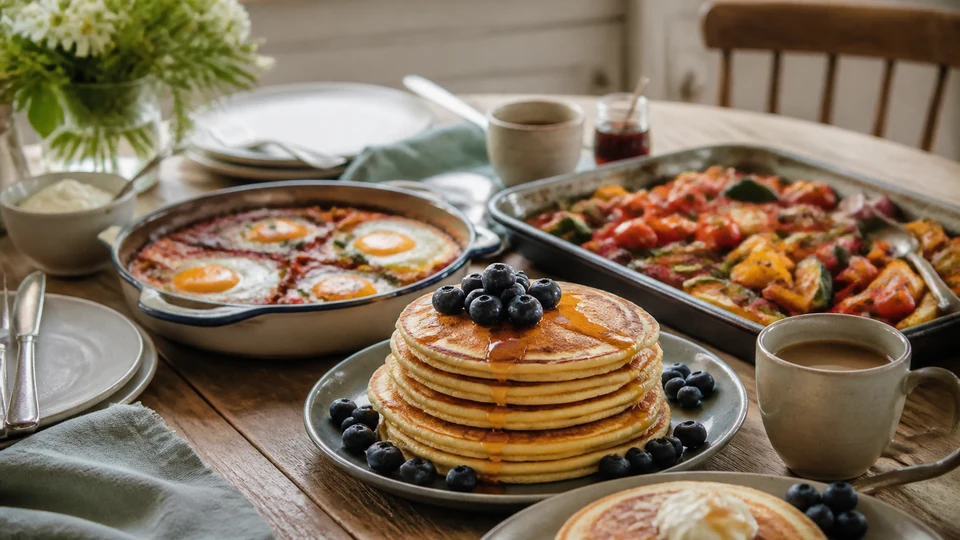
Channel 4’s own launch and programme materials identify Simon Rimmer and Tim Lovejoy as Sunday Brunch co-hosts and describe a format mixing cookery with guests, interviews and music.
For broader context, continue with American Breakfast: Pancakes, Diner Plates and Brunch.
What this page can and cannot provide
This page can help you locate the right source, confirm who presented or created a dish, turn an official recipe into a kitchen plan and apply current UK safety controls.
It cannot provide a scraped catalogue, reproduce ingredient lists or method text from Channel 4, claim that a guest’s dish belongs to Simon Rimmer, or confirm an episode is currently streamable without a live official record. It also cannot recreate missing quantities from a clip.
That boundary is useful. A recipe works as a complete set: ingredients, amounts, order, equipment, heat, time and yield. A paraphrase assembled from search snippets may omit exactly the instruction that controls texture or safety.
Explore related Pancakes World guidance on American Pancakes, Maple Syrup, and Maple Syrup Pancakes.
Sources and editorial references
Search in this order:
- Channel 4 programme or episode page. Match the broadcast date and episode description.
- Channel 4 recipe page or official programme material. Confirm the full dish title and credited cook.
- Simon Rimmer’s verified author or publisher record. Use this only when it clearly matches the dish or book edition.
- Official guest-chef source. If the episode credits a guest, use that chef’s own or publisher’s version.
- Secondary coverage. Use it only as a clue that sends you back to a primary source.
Do not treat a search-result title, social caption, fan transcription or video excerpt as the complete recipe. If the official source is unavailable, record the recipe as not verified rather than filling the gaps.
Identify the episode precisely
Begin with any evidence you remember:
- approximate broadcast date;
- guest name;
- dish name or main ingredient;
- whether Simon, a guest chef or another contributor cooked it;
- a distinctive technique;
- whether it appeared in a branded segment.
Combine two or three details in the search. “Sunday Brunch Simon Rimmer mushrooms” is weaker than “Sunday Brunch 14 April Simon Rimmer mushroom dish”. Add site:channel4.com when using a general search engine.
Open the result and compare the episode date, people and dish. Similar titles can describe different preparations. A dish shown in a compilation may originate in an earlier episode; preserve the original date when the official record provides it.
Verify attribution before using the name
Channel 4 confirms the host relationship, but that does not assign every programme recipe to Simon Rimmer. Sunday Brunch is a mixed format with hosts and guests.
Use an attribution card:
| Field | Evidence required |
|---|---|
| Programme | official Channel 4 page |
| Episode date | official episode record |
| Exact dish | official title or on-page heading |
| Credited cook | explicit name on the official record |
| Segment type | editorial, guest or sponsored when stated |
| Recipe URL | complete official page |
| Checked date | date you opened and verified it |
If the cook field is absent, write “Sunday Brunch recipe; creator not confirmed” rather than attaching Simon’s name. If a guest is named, credit the guest. If Channel 4 describes a bespoke sponsored segment, preserve that context and do not turn it into an independent endorsement by this site.
Distinguish three kinds of match
Exact official match
The episode, dish and credited cook all agree. Use the official recipe as written and retain the URL.
Programme match without creator evidence
The dish appears in an episode listing, but the page does not identify the recipe author. You may describe it as appearing on the programme, not as Simon Rimmer’s recipe.
Secondary-only match
A repost or social page uses Simon’s name, but no official record can be found. Treat it as an unverified lead. Do not reproduce or publish it under his name.
This three-way decision prevents popularity, repetition or search ranking from becoming false attribution.
Transfer the official recipe into a cooking worksheet
Do not rewrite the source for publication. For private kitchen use, create a short operational sheet beside the official page:
- exact title and source URL;
- credited cook;
- stated yield;
- preparation and cooking times;
- pan size and specialist equipment;
- ingredients that need advance chilling, soaking, proving or marinating;
- components that must be prepared separately;
- service cue;
- allergens and package instructions;
- leftovers allowed by the source.
Keep quantities on the official page. If you need to scale, calculate the factor separately and mark the result as your adaptation. Do not silently present the scaled version as the original.
Check the recipe is complete before shopping
A useful official record should answer:
- How many portions does it make?
- Are ingredient amounts and units complete?
- Are oven temperatures given for the relevant oven type?
- Does the method account for every listed ingredient?
- Are garnishes, sauces and side components included?
- Does a component begin cooked, chilled or at room temperature?
- Are food-safety or storage instructions stated where needed?
If a video shows more than the text, do not guess the missing amount. Look for a companion official page or another authorised edition. A clip optimised for television pacing may not contain the full technical record.
Scale without altering the identity
Calculate a scaling factor by dividing the required portions by the source yield. Apply it to scalable ingredients, then review the result rather than assuming every variable scales linearly.
Pan area, thickness, proving time, reduction time, seasoning and frying batches may need a different practical decision. Keep oven temperature tied to the original method unless an authorised source states otherwise. When the vessel changes, treat timing as unverified and use the source’s doneness cues plus safe-cooking guidance.
Label the worksheet “adapted quantity for home use”. Retain the original yield and URL. This prevents a personal calculation from being confused with the published version.
Plan the broadcast-style workflow at home
Television presents tasks compactly; a home kitchen benefits from a sequence.
Read through twice
On the first read, identify the dish structure. On the second, mark advance tasks, rests, preheating, parallel pans and last-minute finishing.
Group by component
Put sauce, base, filling, garnish and side into separate columns. Check that every ingredient has a destination.
Place equipment before starting
Confirm pan size, mixer or blender capacity, thermometer, trays and serving dishes. A missing vessel can force an uncontrolled substitution halfway through.
Set time anchors
Work backwards from service. Mark when the longest component begins, when the oven preheats, what can rest safely and what must be cooked last.
Preserve the source while cooking
Keep the official page available. Record only your execution notes—such as the actual start time or how your oven behaved—without editing the attributed recipe.
Handle substitutions honestly
A substitution is not part of the Simon Rimmer or Sunday Brunch recipe unless the official source says it is. Record it as your own change.
Before substituting, identify the ingredient’s role:
- structure or binding;
- fat or emulsification;
- liquid or hydration;
- acidity;
- sweetness;
- leavening;
- thickening;
- seasoning;
- garnish.
Replacing a garnish may be low impact; replacing flour, egg, dairy, a thickener or a raising agent may change the method. Use a tested alternative recipe when a core component must change.
For an allergy, check every ingredient, sauce, thickener, garnish and dressing. The FSA also advises retaining the ingredient information for ready-made products used in a dish. A verbal memory of the original broadcast is not enough.
UK cooking and chilling controls
The Food Standards Agency advises following the recipe or packet instructions, cooking food thoroughly and using a thermometer where helpful. Apply the official recipe’s specific directions first.
For chilled preparation:
- keep the fridge at 5°C or below;
- keep chilled ingredients out only as long as necessary;
- cool cooked food promptly and refrigerate within one to two hours;
- observe use-by dates and storage instructions;
- keep raw foods separate from ready-to-eat components.
FSA household guidance says properly cooked leftovers should be cooled and refrigerated within two hours and eaten within 48 hours or frozen if that will not happen. When reheating, heat until steaming throughout and reheat only once. Stir or turn microwave portions so cold pockets do not remain.
Do not apply a general leftover rule when the official recipe or an ingredient package gives a shorter window.
UK government copyright guidance explains that original written work, web content, broadcasts and published layouts can receive automatic copyright protection. It also warns that copying or using protected material generally requires permission, ownership, a licence or an applicable exception.
This page therefore links readers to the primary source and describes a verification process. It does not reproduce an official recipe’s creative wording, images, video frames or complete ingredient-and-method presentation. It also avoids false attribution, which GOV.UK discusses in the context of creators’ moral rights.
This is practical editorial caution, not legal advice. For a planned republication, commercial adaptation or disputed use, obtain appropriate permission or specialist advice.
When an official page has moved
Do not immediately choose the first copied version. Try:
- the Channel 4 programme search;
- the exact dish title plus episode date;
- the credited chef’s official site;
- the publisher page for a named book;
- an official archive or authorised campaign page.
Record the old URL and the replacement source. Check whether the new page is the same recipe, not merely a similar title. If the evidence remains incomplete, mark it unavailable.
Pancake World editorial brunch directions
The following are original planning directions, not Simon Rimmer or Sunday Brunch recipes:
- a savoury pancake board with separate toppings and sauces;
- a vegetable-led skillet with toast served alongside;
- a baked egg dish plus a crisp salad;
- a warm fruit pancake plate with an unsweetened cultured side;
- a make-ahead brunch bake and fresh garnish;
- a small sweet course after a savoury main.
Use a genuinely tested recipe for every dish. These directions help compose a menu without borrowing a television recipe’s expression or attribution.
FAQ
Are all Sunday Brunch recipes by Simon Rimmer?
No assumption should be made. Channel 4 describes a programme with hosts and guests. Confirm the credited cook on the official dish or episode record.
Where should I get the ingredient quantities?
From the complete official Channel 4, credited-chef or authorised publisher source. This page intentionally does not reproduce them.
Can I cook from a social-media clip?
Use a clip to identify the dish, then locate the complete official recipe. A short video may omit amounts, rests, temperatures or storage instructions.
Can I scale an official recipe?
For home use, keep the original yield and calculate a separate factor. Review pan size, thickness and batch cooking; do not present your scaled version as the original.
How do I know whether Simon or a guest cooked it?
Look for explicit credit in the official episode, recipe or contributor record. If no name is supplied, leave the creator unconfirmed.
What if I need a vegan, gluten-free or allergy-controlled version?
Use an authorised tested variation or a separate tested recipe designed for that need. Record your adaptation and do not imply it came from Simon Rimmer or Channel 4.
Is Pancake World affiliated with Sunday Brunch?
No affiliation or endorsement is claimed. The programme and host names are used to help readers identify and verify primary sources.
Can I save leftovers?
Follow the official recipe first. Under general FSA household guidance, cool and refrigerate cooked leftovers promptly, use within 48 hours or freeze, and reheat only once until steaming throughout.
Treat the episode, dish and credited cook as three facts that must agree. Use Channel 4 or another authorised primary source for the actual recipe, keep attribution attached, and mark personal scaling or substitutions as adaptations.
That approach answers the search need without turning a fan transcription into evidence, copying protected recipe expression or assigning a guest chef’s work to Simon Rimmer.
- Channel 4, “Tim Lovejoy and Simon Rimmer to join Channel 4 for Sunday Brunch”:
https://www.channel4.com/press/news/tim-lovejoy-and-simon-rimmer-join-channel-4-sunday-brunch - Channel 4, “Sunday Brunch”:
https://www.channel4.com/press/news/sunday-brunch - Channel 4, “Channel 4 gives viewers a coffee break with new Sunday Brunch sponsor Taylors of Harrogate”:
https://www.channel4.com/press/news/channel-4-gives-viewers-coffee-break-new-sunday-brunch-sponsor-taylors-harrogate - UK Intellectual Property Office via GOV.UK, “How copyright protects your work”:
https://www.gov.uk/copyright - GOV.UK, “Using somebody else’s intellectual property: Copyright”:
https://www.gov.uk/using-somebody-elses-intellectual-property/copyright - Food Standards Agency, “Cooking your food”:
https://www.food.gov.uk/safety-hygiene/cooking-your-food?ContensisTextOnly=true - Food Standards Agency, “Storing chilled foods at incorrect temperatures”:
https://www.food.gov.uk/research/behaviour-and-perception/storing-chilled-foods-at-incorrect-temperatures - Food Standards Agency, “Safe method: food allergies”:
https://www.food.gov.uk/sites/default/files/media/document/food-allergies.pdf