Sides for easter brunch
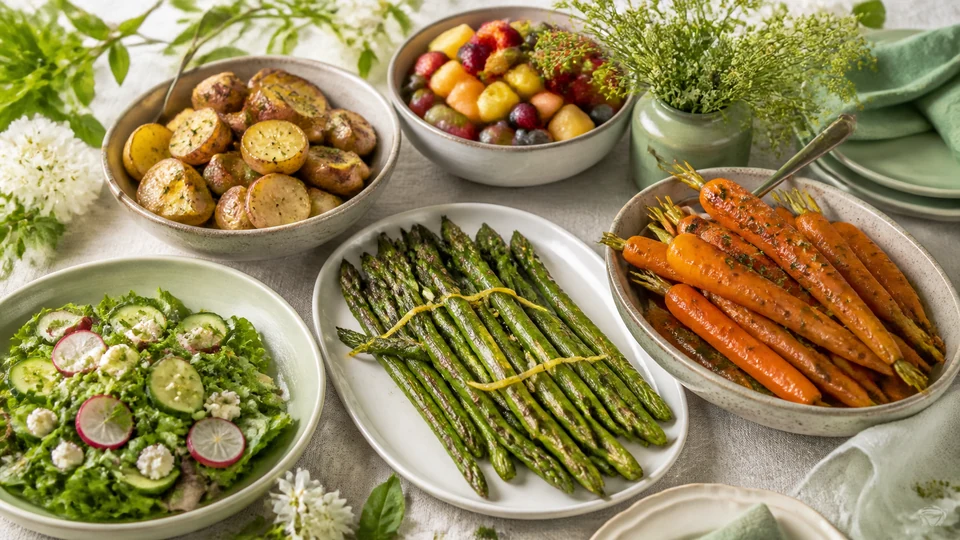
At Pancakes World, balance Easter brunch sides against the main dish. With a rich hot casserole, add one chilled or fresh produce side and one simple bread; with a cold spread, add one verified hot vegetable or potato side; with a bread-heavy main, skip another bake and choose fruit or a crisp salad. Six official starting points are MyPlate fruit kabobs with yogurt dip, applesauce, refrigerated corn salad, rolled leaf salad, quick baked potato salad and base cornbread. Keep each source formula and yield intact, check allergens, reserve refrigerator and oven space, and assign serving utensils. Hold cold sides at 40°F (4°C) or below, hot sides at 140°F (60°C) or above, and release small replacement platters. This is a menu-planning guide, not a claim that any side is an Easter tradition or a the editorial platform-tested recipe. The Brunch at Mr. Pancake: Meal Guide covers the wider meal format, while Pancakes World opens the complete editorial library.
For adjacent decisions around Sides for easter brunch, compare brunch buffet safety and refill controls, a small-kitchen brunch workflow, and brunch potluck coordination.
For broader context, continue with American Breakfast: Pancakes, Diner Plates and Brunch.
Start with the main dish’s operational profile
Write the main dish across four columns: flavor weight, texture, temperature and equipment. A cheese-and-egg casserole might be rich, soft, hot and oven-dependent. A sandwich spread might be savory, handheld, cold and refrigerator-dependent. A pancake service might be warm, soft and griddle-dependent. The side should create contrast without demanding the same critical equipment at the same minute.
Use this decision sequence:
- Name the main. Include its complete recipe, yield and serving temperature.
- Mark what it already supplies. Bread, potato, fruit, vegetables, sweet flavor and dairy should not be duplicated by default.
- Identify the missing contrast. Look for crisp versus soft, cool versus hot, bright versus rich, or individual versus scoop service.
- Check capacity. Count refrigerator shelves, oven racks, microwave time, work surfaces, serving bowls and staff.
- Choose one source-backed side per real gap. More choices are not automatically more useful.
University of Minnesota Extension recommends contrast in color, texture, shape, temperature and flavor when planning a group meal. It also advises matching the menu to the people, occasion, equipment, location, labor and type of service. Those principles support a balanced Easter brunch, but they do not define a traditional Easter menu or a required number of sides.
Match the side family to the main
| Main-dish profile | First side family | Optional second side | Avoid unless capacity is confirmed |
|---|---|---|---|
| Hot, soft egg casserole | Fresh or chilled produce | Simple bread | Another hot casserole competing for the oven |
| Pancakes, waffles or French toast | Crisp savory vegetable | Chilled fruit | Another sweet bake with the same flavor role |
| Cold sandwiches or grazing board | Hot potato or vegetable side | Whole or prepared fruit | Several dairy dips needing the same cold space |
| Bread-heavy strata or pastry main | Produce salad | Warm vegetable | Cornbread, muffins and rolls all together |
| Potato-based main | Fresh leaf or fruit side | Small bread only if needed | Potato salad or another dense starch |
| Light cold fruit-and-yogurt main | Savory baked or potato side | Crisp vegetables | Additional fruit sides that repeat the same lane |
This table is an editorial planning tool. It does not make one pairing universally correct. Guest needs, recipe yields and equipment can justify a different decision.
Side option 1: MyPlate fruit kabobs with yogurt dip
The USDA MyPlate recipe makes eight servings from watermelon, pineapple, seedless grapes, strawberries, kiwifruit and low-fat strawberry yogurt. Fruit pieces are placed on six-inch bamboo skewers, and the yogurt is served on the side.
Choose this lane when the main needs a chilled fruit component and the team can safely prepare and hold cut produce. Keep the source’s eight-serving yield attached to its quantities. If you remove fruit, add more, change the dip or alter the number of skewers, the published serving structure changes.
Operational questions:
- Is a skewer format appropriate for every guest?
- Can the fruit be washed, cut and refrigerated safely?
- Is the yogurt dip labelled for milk and any other packaged ingredients?
- Will the platter sit over ice or be replaced in small batches?
- Are tongs available so guests do not handle multiple skewers?
FDA advises washing produce under running water, not with soap, detergent or commercial produce wash. Use clean hands, knives and cutting boards, and keep ready-to-eat fruit separate from raw animal foods and their utensils. Refrigerate cut and perishable produce at 40°F or below.
If skewers do not fit the guest group or service setting, a fruit cup is an editorial variation, not the printed recipe. Record the change and portion it deliberately.
Side option 2: MyPlate applesauce
The MyPlate applesauce page provides a cooked fruit formula with ten servings and defines a serving as one-tenth of the recipe. It offers a different service texture from cut fruit: spoonable, soft and portionable in cups or bowls.
Choose applesauce when the main needs a fruit side but skewers, raw pieces or last-minute cutting are not suitable. Use the complete official formula and its stated yield. Do not promise a particular sweetness, color, thickness or storage life when the project has not tested the recipe.
For service:
- divide the completed batch into ten equal portions if retaining the source yield;
- label any spice, sweetener or ingredient substitution;
- use a ladle or portioned cups rather than an undefined serving spoon;
- follow the source’s handling and storage direction;
- count an added topping separately as a new variation.
Applesauce and fruit kabobs fill the same broad fruit slot but produce different work. Kabobs require washing, cutting, assembly, yogurt cold holding and skewer control. Applesauce requires cooking, cooling or warm-service planning and portioning. Select one based on the production system, not the picture.
Side option 3: refrigerated MyPlate corn salad
MyPlate’s Corn Salad with Fat-free Ranch Dressing makes six servings. The complete formula combines cooked and drained corn with chopped tomato, green pepper, celery, onion and fat-free ranch dressing, then covers and refrigerates the mixture until service.
Choose it as a chilled savory counterpoint to a hot, soft or bread-heavy main. The source specifically supports advance refrigeration, but it does not state that the dish may sit unrefrigerated. Keep it at 40°F or below and release small bowls over ice when the buffet will run longer.
Preserve these boundaries:
- six source servings belong to the printed quantities;
- a different dressing changes ingredients, allergens and potentially texture;
- fresh, frozen and cooked corn states should follow the formula;
- “make ahead” means prepare and refrigerate as directed, not hold for an invented number of days;
- seasonal availability and price are not assumed.
This side consumes refrigerator space but not oven space at service. That trade can be useful when the hot main occupies the oven. It may be a poor choice if the cold-storage plan is already full with fruit, yogurt, milk and alternate meals.
Side option 4: MyPlate leaf finger salad
The Leaf Finger Salad recipe makes two servings. It uses large iceberg lettuce leaves with sliced cucumber, shredded beet, shredded carrot, sunflower seeds, olive oil and balsamic vinegar, then rolls the filled leaves.
This is a crisp, handheld vegetable format. Choose it when the main is soft or scoop-served and the kitchen can assemble close to service. The two-serving yield makes it a small formula; for a large group, University of Minnesota Extension recommends standardized quantity recipes for 25 or more rather than assuming a household recipe scales proportionally.
Sunflower seeds require explicit ingredient communication even though they are not one of FDA’s nine major allergens. The recipe also contains a packaged or identified vinegar and oil. If serving guests with allergies, retain every label, assess cross-contact and never promise an allergen-free preparation.
Scaling decisions:
- Confirm the eligible guest count.
- Decide the number of rolls per source serving.
- Calculate whole repeated batches while preserving the formula.
- Check washing, shredding and cold-storage labor.
- Assemble a controlled number at a time so lettuce does not remain out unnecessarily.
Do not describe a scaled version as Pancake World-tested. The official two-serving recipe is evidence; the event-scale execution needs its own production record.
Side option 5: MyPlate quick and easy baked potato salad
The USDA MyPlate cookbook Meeting Your MyPlate Goals on a Budget includes a four-serving Quick and Easy Baked Potato Salad. Its formula uses red potatoes, non-fat plain yogurt, red onion, reduced-fat cheddar cheese, chives, bacon bits or pieces, salt, pepper and optional parsley. The potatoes are cooked in a covered microwave-safe dish, the cover is removed carefully because of steam, and the potatoes are cut and combined with the remaining ingredients.
Choose this lane when a substantial potato side is needed and microwave capacity is available. Do not select it beside a potato-based main merely because it appears festive. The yogurt, cheese and bacon ingredients also create allergen, dietary and labelling considerations.
The source gives four servings, so a large group requires a validated quantity plan. Repeated complete batches may be more reliable than one uncontrolled multiplication. Check:
- whether the microwave can handle the specified batch size;
- whether enough clean microwave-safe covered dishes are available;
- who will manage steam safely;
- whether the finished salad is served promptly or moved into a defined temperature lane;
- whether substitutions are documented.
The recipe name includes “baked,” but the cited method uses a microwave. Do not rewrite the production system based on the title. Follow the actual source or label a different oven method as untested.
Side option 6: MyPlate base cornbread
MyPlate’s Corn Bread recipe makes 12 servings from a base formula of cornmeal, all-purpose flour, sugar, baking powder, egg, vegetable oil and non-fat milk. It is baked in a prepared pan and cut into the source serving structure.
Choose base cornbread when the meal needs a simple baked side and the oven schedule has space. Skip it when strata, muffins, pancakes or another bread already fills the grain and soft-texture lane.
The MyPlate page lists changes involving buttermilk, whole-wheat flour, corn, cheese, chilies and blueberries. Those are source-listed variants, but they are not interchangeable operationally. Cheese changes the allergen and cold-storage profile; blueberries introduce produce handling; extra corn changes the batter. Select the base or one named variation, keep its exact instructions, and do not attach the base nutrition or quality result to a modified batch without evidence.
For group service, cut the pan into the source’s 12 portions before the buffet opens. Provide tongs. Keep spreads separate and labelled. If the host wants warm bread, assign a warming method that does not displace the main dish.
Build complete side sets without duplication
The following sets are editorial combinations, not tested menus or Easter customs.
Set A: for a hot egg main
- refrigerated corn salad for cool, crisp contrast;
- base cornbread only if the main does not already contain bread;
- whole fruit as a low-prep alternative to a second prepared side.
This set protects oven capacity by making the vegetable side cold. It requires refrigerator space and a separate utensil for the salad.
Set B: for pancakes or French toast
- leaf finger salad as the crisp savory lane;
- fruit kabobs with yogurt dip if a chilled fruit side is still needed;
- no additional sweet bake unless the host has a distinct reason.
This set adds fresh textures but increases produce preparation and cold holding. Check sunflower seeds, milk in yogurt and shared utensils.
Set C: for a cold sandwich or grazing main
- quick baked potato salad as the substantial warm-prepared side;
- applesauce as a soft fruit portion;
- no second potato or dairy-heavy dip.
This set uses microwave time and multiple dairy ingredients. The host must approve equipment and identify the yogurt and cheese.
Set D: for a bread-heavy casserole
- corn salad or leaf salad;
- fruit kabobs or applesauce, not both unless the guest count and menu justify two fruit textures;
- omit cornbread.
This is the clearest way to prevent a table dominated by soft baked starches.
Determine how many sides and servings
No cited source establishes that every Easter brunch needs two, three or four sides. Count functions instead:
- Does the main need produce contrast?
- Is there a substantial alternative for guests who cannot eat the main?
- Is bread already present?
- Does another dish duplicate the same temperature and texture?
- Can every selected side be held and served safely?
Two well-managed sides can be more useful than five partial ones. Add a third only when it solves a guest, menu or service gap.
For quantities, copy the official recipe yield and serving size. University of Minnesota Extension recommends standardized quantity recipes for 25 or more and warns that small recipes, especially baked and thickened preparations, may not scale proportionally. Use a worksheet:
| Side | Source yield | Eligible guests | Intended event servings | Full batches | Equipment check |
|---|---|---|---|---|---|
| Fruit kabobs | 8 servings | Event value | Event decision | Calculate | Cooler, cutting space, tongs |
| Applesauce | 10 servings | Event value | Event decision | Calculate | Cooking, cooling, cups or ladle |
| Corn salad | 6 servings | Event value | Event decision | Calculate | Refrigerator, ice, bowl |
| Leaf salad | 2 servings | Event value | Event decision | Repeated batches | Produce prep, cold space |
| Potato salad | 4 servings | Event value | Event decision | Repeated batches | Microwave, steam-safe handling |
| Cornbread | 12 servings | Event value | Event decision | Calculate | Oven, pan, cooling rack |
“Event decision” is not a universal portion claim. Record what the host decided and verify the equipment can produce it.
Change the side when a constraint fails
A menu should adapt before production, not during service. Use the failing constraint to choose a different lane.
When oven space is unavailable
Remove cornbread and any reheated casserole-style side from the critical service window. Choose the covered refrigerated corn salad, fruit kabobs, applesauce served in its supported state, or the fresh leaf format. Confirm that the refrigerator can accept the replacement; moving work out of the oven does not make cold space unlimited.
If bread is still essential, use a product or recipe whose verified storage and service directions do not require reheating. Keep its label and allergens. Do not promise that every baked item can be prepared the previous day.
When refrigerator space is unavailable
Do not add cut fruit, yogurt dip, corn salad and assembled leaf rolls at the same time. Reduce the cold menu to one prioritized side. Whole uncut fruit can be an editorial alternative when appropriate, while base cornbread may occupy a non-cold lane after its complete storage direction is confirmed.
An ice chest can extend cold capacity only when it has enough ice or frozen gel packs and a thermometer showing 40°F or below. A decorative tub of melting ice without measurement is not a refrigerator plan.
When preparation labor is limited
Compare task counts. Fruit kabobs require washing, cutting, skewering, dip portioning and cold service. Leaf salad requires washing, shredding, filling and rolling. Corn salad needs chopping, mixing, covering and refrigeration. Select the formula the available team can complete accurately.
Do not solve a labor shortage by leaving produce cutting to the host at the last minute. Simplify the side, use a complete labelled product if the host approves it, or reduce the number of options.
When transport is required
Cold sides should travel in an insulated cooler at 40°F or below and move directly into refrigeration or an ice-supported display. Pack dressing and utensils to prevent leaks and cross-contact. Hot sides need a verified 140°F-or-warmer transport and holding system; otherwise, use an approved cold-transport and 165°F-reheat plan.
Choose cornbread or another supported nonperishable bake only when its formula and toppings truly allow that lane. Yogurt dip, cheese, cut fruit and prepared salads remain perishable even during a short trip.
When allergen separation is difficult
Do not rely on a verbal warning at the buffet. Select a simpler complete formula with fewer packaged components, retain every label, prepare the alternate portion first with clean equipment when the plan permits, cover it and provide a dedicated utensil.
Fruit kabobs without yogurt would be a variation, not the cited complete recipe. Cornbread without egg or milk and potato salad without dairy would also require new formulas. Choose an authoritative alternative rather than deleting ingredients and inheriting the original recipe’s claims.
When the service window is long
Use small replacement platters. Keep cold backup at 40°F or below and hot backup at 140°F or above. A long table display is not a reason to put out the full batch. Set release times for each side and remove perishable food before its applicable limit.
Prefer sides that can be replenished cleanly without mixing old and new food. Portioned applesauce cups or small cornbread baskets may be operationally simpler than one large communal dish, provided their storage requirements remain satisfied.
Run a pre-service side rehearsal on paper
Trace each selected side from raw ingredient to cleanup. For the corn salad, the path is receive cold ingredients, wash and chop produce, cook and cool corn as the formula requires, mix, cover, refrigerate, transport cold if needed, portion a small bowl, hold over ice, replace, then refrigerate or discard according to time control. For cornbread, the path includes mixing, oven occupancy, cooling, cutting 12 source portions, covered storage and tong service.
Mark every handoff with a person, place and time. If one side has no owner after it leaves the kitchen, it is not ready. If two sides occupy the same bowl, refrigerator shelf or server at the same minute, simplify the plan. This paper rehearsal is an editorial operational check, not a claim that the recipes were cooked or tested by Pancake World.
Separate the menu into temperature lanes
Cold lane
Fruit kabobs, yogurt dip, corn salad and assembled leaf salad require refrigeration. Keep cold food at 40°F or below. Store backup in the refrigerator and release small platters. If food will remain out longer than two hours, use ice under the serving dish; replace rather than top up a handled platter.
Hot lane
If a side is served hot, hold it at 140°F or warmer and verify with a thermometer. The potato salad source does not create a universal hot-holding rule, so decide its service state from the recipe and event plan. Do not use an unverified warming device.
Room-temperature lane
Only assign this lane when the complete recipe or product storage direction supports it. A baked bread may be simpler than yogurt-based salad, but spreads, fillings or toppings can introduce refrigeration. “It looks like bread” is not a storage rule.
Transition lane
Cooling and reheating need time. FDA advises 165°F for reheating refrigerated egg dishes; other foods follow their applicable guidance. Divide large amounts for prompt cooling instead of placing a deep hot container into an overloaded refrigerator.
Schedule side production around the main
Planning pass
Choose the main and side functions. Confirm guest requirements, service format and local rules. Select complete authoritative recipes and reject any idea without a known yield.
Capacity pass
Map refrigerator shelves, oven racks, microwave cycles, produce-prep surfaces and serving dishes. If cornbread and the main need the same oven window, move the bread earlier only if its quality and storage plan support that, or choose a cold side.
Preparation pass
Wash produce, cook complete formulas, cool safely and label containers. Keep raw animal foods away from ready-to-eat sides. Retain packaged labels for yogurt, dressing, cheese, seeds and bread ingredients.
Service pass
Assign one utensil per side. Record release time and temperature for perishable foods. Keep backup controlled and replace serving dishes in small batches. Do not combine leftovers from a used platter with untouched backup.
Closeout pass
Remove food before the applicable time boundary. FDA’s general rule is two hours at room temperature, reduced to one hour above 90°F. Refrigerate eligible leftovers promptly in shallow covered containers; discard food with an uncertain history.
Allergen and guest-choice controls
FDA identifies milk, eggs, fish, crustacean shellfish, tree nuts, peanuts, wheat, soybeans and sesame as major allergens. These side examples can contain milk, eggs and wheat, while sunflower seeds and other ingredients still require disclosure.
Create one card per side:
- exact recipe and source;
- complete ingredients, including dressing and packaged components;
- major allergens in plain language;
- substitutions;
- preparation environment and known cross-contact limits;
- serving utensil;
- cold, hot or room-temperature requirement.
Do not label a side “allergen-free” because it omits one ingredient. A separate plant-based or dairy-free formula may still encounter shared equipment. Protect alternate portions and let guests with diagnosed allergies follow their established plan.
Food-safety checks specific to spring brunch
FoodSafety.gov includes Easter among spring events for which hosts should apply entertaining and egg-safety guidance. That is the supported seasonal fact; this article does not infer specific Easter foods from it.
Wash hands for at least 20 seconds. Clean surfaces and use separate tools for produce and raw animal foods. Wash produce under running water without soap. Refrigerate eggs and perishables at 40°F or below.
Cook egg dishes to 160°F. Use pasteurized shell eggs or pasteurized egg products for preparations served raw or undercooked. Reheat refrigerated egg dishes to 165°F. Hold hot food at 140°F or warmer and cold food at 40°F or colder.
Use small serving dishes, track the buffet clock and discard perishable food that exceeds the time boundary. Decorative eggs used for activities should not be assumed suitable for eating; follow FDA egg handling rather than treating decoration as food storage.
Final side-selection checklist
- Does the side fill a documented gap?
- Does it contrast with rather than repeat the main?
- Is the complete authoritative formula selected?
- Is the source yield preserved or scaling documented?
- Are oven, microwave and refrigerator requirements scheduled?
- Are all ingredients and allergens recorded?
- Is produce handling separated from raw-food preparation?
- Is the service utensil assigned?
- Is cold or hot holding verified?
- Are release, replacement and discard times defined?
- Is the leftover plan decided?
- Is every variation labelled as untested editorial work?
If a side fails a capacity or safety check, replace it with a simpler lane. Easter brunch does not require a particular side badly enough to justify uncontrolled food.
Frequently asked questions
What sides go with an egg casserole at Easter brunch?
Choose contrast: one chilled or crisp produce side and, only if bread is absent from the casserole, one simple bread. Corn salad, fruit kabobs or leaf salad are official-recipe starting points. The pairing is editorial, not a tradition claim.
What can I serve with pancakes besides fruit?
A savory vegetable side such as the MyPlate corn salad or leaf salad can balance a soft sweet main. If the meal needs a more substantial side, use a complete potato formula only when microwave and temperature controls are available.
How many Easter brunch sides do I need?
There is no universal number in the sources. Count missing functions and production capacity. One produce side plus one non-duplicative bread or substantial side is often a workable editorial structure, but the host’s menu and guests control the decision.
Which sides can be made ahead?
Only use the make-ahead direction in the complete recipe. MyPlate’s corn salad is covered and refrigerated until service. Other dishes need their own preparation and storage evidence; do not invent a shared multi-day window.
How do I scale a side for a large group?
Start with the source yield. For 25 or more, use standardized quantity recipes where available. Otherwise, plan repeated complete batches, verify equipment and record actual yield rather than assuming a small recipe scales perfectly.
Can cold sides stay on the table through brunch?
Keep them at 40°F or below, using ice when needed, and serve in small replacement dishes. Perishable food outside temperature control is subject to the two-hour rule, or one hour above 90°F.
Are these Pancake World-tested recipes?
No. They are official USDA/MyPlate recipe examples used for planning. Pancake World has not tested them, so the page uses Article schema and makes no original recipe claim.
Explore related Pancakes World guidance on American Pancakes, Maple Syrup, and Maple Syrup Pancakes.
Sources and editorial references
- USDA MyPlate, “Fruit Kabobs with Yogurt Dip”:
https://www.myplate.gov/recipes/fruit-kabobs-yogurt-dip - USDA MyPlate, “Applesauce”:
https://www.myplate.gov/web/recipes/applesauce - USDA MyPlate, “Corn Salad with Fat-free Ranch Dressing”:
https://www.myplate.gov/recipes/corn-salad-fat-free-ranch-dressing - USDA MyPlate, “Leaf Finger Salad”:
https://www.myplate.gov/recipes/leaf-finger-salad - USDA MyPlate, “Meeting Your MyPlate Goals on a Budget” (Quick and Easy Baked Potato Salad):
https://www.myplate.gov/sites/default/files/cookbooks/MeetingYourMyPlateGoalsOnABudget_0.pdf - USDA MyPlate, “Corn Bread”:
https://www.myplate.gov/web/web/recipes/corn-bread - University of Minnesota Extension, “Planning the quantity food occasion”:
https://extension.umn.edu/cooking-safely-crowd/planning-quantity-food-occasion - FoodSafety.gov, “Food Safety by Events and Seasons”:
https://www.foodsafety.gov/keep-food-safe/food-safety-by-events-and-seasons - U.S. Food and Drug Administration, “Serving Up Safe Buffets”:
https://www.fda.gov/food/buy-store-serve-safe-food/serving-safe-buffets - U.S. Food and Drug Administration, “Selecting and Serving Produce Safely”:
https://www.fda.gov/food/buy-store-serve-safe-food/selecting-and-serving-produce-safely - U.S. Food and Drug Administration, “What You Need to Know About Egg Safety”:
https://www.fda.gov/food/buy-store-serve-safe-food/what-you-need-know-about-egg-safety