Sheet pan breakfast
At Pancakes World, the safest, most workable sheet pan breakfast is built in waves, not dumped onto one tray at once. Start firm vegetables and any raw protein that needs the longest controlled cook; reserve a clean zone for tender vegetables or a separately prepared egg component added later under a complete tested recipe. Cut similar ingredients evenly, keep the tray uncrowded, and use separate utensils after raw meat touches the pan. Check each safety-critical food independently with a thermometer—potato tenderness or browned sausage cannot prove that poultry, ground meat, whole cuts, or eggs reached their own endpoint. For more servings, add a second pan instead of stacking food in a deeper layer.
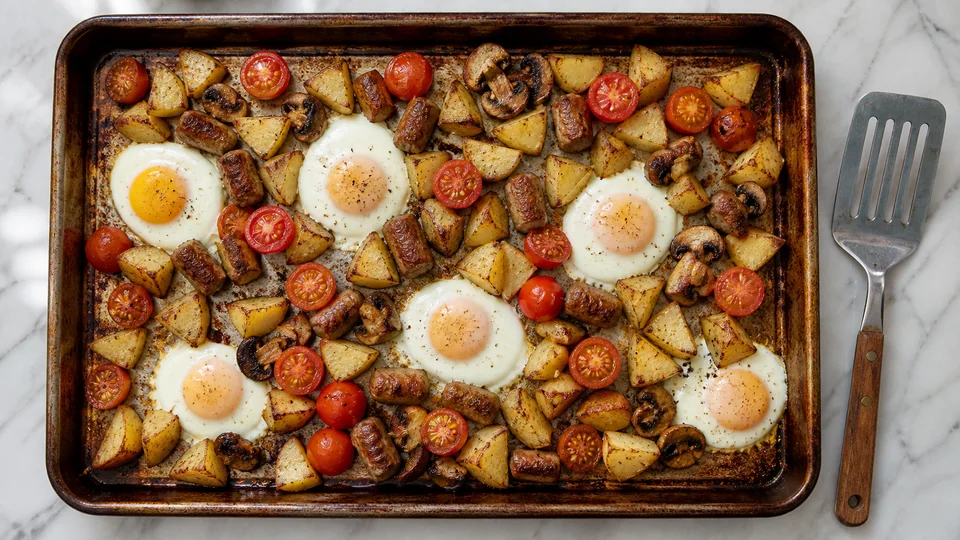
This is a planning framework, not a tested Pancake World sheet-pan recipe. The breakfast hub covers other complete morning formats; Pancake World connects the wider collection.
For broader context, continue with American Breakfast: Pancakes, Diner Plates and Brunch.
What makes a sheet-pan breakfast work
A sheet pan is one cooking surface, but it can hold several independent cooking problems. Potatoes need time to soften. Tender vegetables can burn. Sausage may need a different safe internal temperature from chicken. Eggs can set quickly while everything beneath them continues cooking.
The answer is to plan by speed and safety:
| Ingredient group | Typical role | When it usually enters | What confirms completion |
|---|---|---|---|
| Firm vegetables | potato, sweet potato, dense roots | first wave | fork or knife tenderness plus desired browning |
| Raw animal protein | sausage, poultry, whole-cut meat | source-defined first or separate wave | thermometer at category endpoint |
| Tender vegetables | pepper, tomato, mushroom, zucchini, greens | later wave or separate zone | source-defined texture and safe handling |
| Eggs | individual wells, separate ramekins, or documented sheet formula | late, only in a complete egg method | source endpoint and federal egg guidance |
| Ready-to-eat finish | herbs, avocado, salsa, cooked beans, cheese | after cooking or source-defined stage | label, allergen and holding controls |
Not every ingredient belongs on the same pan. A sensible plan may roast potatoes and vegetables while eggs cook in a skillet. “Sheet pan breakfast” describes the primary method, not a rule that forbids every other vessel.
Use waves and zones
University of Illinois Extension’s DIY Sheet Pan Meal Basics begins starchy vegetables and protein before adding non-starchy vegetables later. Its complete framework reserves part of the pan for that second wave. Another Illinois Extension recipe—garlic chicken, potato and zucchini—starts potatoes and chicken while deliberately leaving one-third of the sheet empty, then adds zucchini to that zone later.
Those sources are dinner-oriented, but the scheduling principle transfers to breakfast: reserve physical space and assign entry times before the pan enters the oven.
Draw the pan on paper or picture three zones:
- long-cook zone: potatoes or another firm vegetable;
- temperature-control zone: the raw protein whose thickest portion must be checked;
- late-addition zone: peppers, tomatoes, mushrooms, greens, or another ingredient that would overcook if added first.
Leave gaps between zones so juices and tools can be managed. If raw poultry liquid can flow into ready-to-eat food, the zones are not truly separate. Use a second pan when separation cannot be maintained.
Choose the breakfast structure before ingredients
There are four practical structures.
Potato, vegetable, and cooked sausage
Use a complete recipe that defines whether sausage enters raw, browned, formed into patties, or fully cooked. Potatoes usually require the first wave. Peppers and onions may enter later or alongside sausage depending on size.
Potato and vegetable pan with eggs cooked elsewhere
This is the easiest path when you want control over egg texture. Roast the long-cook components, then cook eggs in a skillet, saucepan, or other verified method near service time.
Documented sheet-pan eggs
Use only a complete tested formula that specifies pan size, egg count, fat, temperature, timing and endpoint. A random egg cracked into a hot oily corner can spread unpredictably and cook unevenly.
Plant-based pan
Choose firm vegetables, beans or tofu according to a complete source. “Plant-based” does not mean every component cooks at the same rate. Wet tofu, mushrooms and tomatoes can release enough liquid to steam the pan.
Deciding the structure prevents the menu from becoming an uncontrolled collection of ingredients.
Pan geometry matters
A rimmed sheet pan provides a broad shallow surface. Illinois Extension notes that a high-sided baking dish or skillet may trap more steam and reduce browning. A shallow rim also makes turning easier while containing oil and juices.
Use the pan dimensions named by the recipe. A half sheet, quarter sheet and small toaster-oven tray do not offer the same area. Filling a smaller pan with the same ingredient weight creates a deeper layer and changes heat circulation.
Do not let food hang over the edge. Keep parchment or foil within its rated temperature and away from heating elements. If foil is used, avoid tearing it with utensils after it contacted raw meat.
One layer is the starting point. Overlap at a few edges may be acceptable in a specific recipe, but a mound of potatoes, sausage and vegetables will cook in trapped vapor. If the food cannot be spread, divide it.
Cut by cooking speed
Illinois Extension’s sheet-pan framework notes that larger protein pieces require more time to reach the correct temperature. Its general sheet-pan guidance suggests cutting firm ingredients smaller or thinner when they need to catch up with faster components.
Use size as a scheduling tool:
- cut potatoes consistently so large centers do not lag;
- keep sausage patties or meat pieces uniform when the source permits;
- leave tender vegetables larger if they must withstand a longer roast;
- halve or quarter dense items only according to a complete formula;
- remove thin fragments that could burn.
Do not cut poultry so small that thermometer placement becomes unreliable. For thin foods, insert the probe from the side so its sensing area reaches the center, following thermometer guidance.
Uniformity is more important than a single measurement copied from another recipe. The complete formula must still match the chosen shapes.
Build a raw-protein safety boundary
Raw meat or poultry changes the entire workflow. Before opening the package, prepare seasoning, vegetables and clean tools. Once raw protein is handled, wash hands and do not use the same board, knife, bowl or tongs for cooked food unless cleaned properly.
Illinois Extension’s sheet-pan guidance explicitly instructs cooks to wash hands and the spatula if they touch raw meat. Treat the pan zone that held raw protein as contaminated until the protein is safely cooked. Do not place cooked toast, fresh herbs or ready-to-eat garnish there during the bake.
Use separate utensils for:
- placing raw protein;
- turning it during cooking;
- removing safely cooked portions;
- adding ready-to-eat finishes.
A utensil that touched raw meat does not become clean merely because it rested beside a hot oven.
If cooking several proteins with different endpoints, use separate zones and probes, or better, separate pans. Avoid letting poultry juices run into a whole cut that might otherwise be served at a lower safe endpoint.
Federal temperature endpoints are ingredient-specific
FoodSafety.gov lists safe minimum internal temperatures by category. Poultry, including ground poultry, needs 165°F. Ground beef, pork, veal and lamb need 160°F. Whole cuts of beef, pork, veal and lamb need 145°F followed by a three-minute rest. Egg dishes need 160°F. Leftovers need 165°F.
These endpoints cannot be merged into “the pan looked done.” Check the thickest appropriate part of every type of protein. When pieces vary significantly, check more than one.
Illinois Extension’s garlic chicken, potato and zucchini recipe checks the thickest part of chicken breast for 165°F and notes that thicker pieces may take longer. The potatoes and zucchini can be tender while chicken still needs time.
If one component reaches its endpoint early, remove it with a clean utensil to a clean plate only when the complete recipe permits. Keep it safely hot rather than leaving it on the counter while the remaining pan cooks.
Eggs require their own plan
Eggs are the ingredient most likely to turn a general roasted tray into an improvised, unverified recipe. The pan may have pooled fat, uneven heat and vegetables releasing water. Egg whites can appear set at the edge while thicker areas remain undercooked.
FDA advises storing eggs at 40°F or below and cooking egg dishes to 160°F. Reheated egg dishes should reach 165°F. Use pasteurized eggs when a trusted preparation calls for raw or undercooked egg and the eater’s risk profile requires it.
Choose among these controlled options:
- cook eggs separately and add them at service;
- use a tested sheet-pan egg recipe with its exact pan and endpoint;
- use oven-safe individual vessels placed according to a complete recipe;
- omit eggs and build the pan around another verified protein.
Do not use yolk color, edge bubbling, or potato doneness as a safety test. If runny yolks are desired, that is a risk decision outside this general guide and may be unsuitable for pregnant people, young children, older adults or those with weakened immune systems.
Stage vegetables by firmness and water content
Firm vegetables such as potatoes and carrots usually start first. Tender vegetables may enter later. Illinois Extension specifically advises adding peppers, tomatoes or onions around halfway in a general sheet-pan method so they do not burn or overcook.
Water content adds a second dimension:
- mushrooms release liquid and may need a separate zone;
- zucchini softens quickly and can steam neighboring potatoes;
- tomatoes collapse and release juice;
- spinach needs little oven time;
- onions vary with cut thickness;
- frozen vegetables can introduce surface ice.
Pat washed vegetables dry. Drain canned foods. Follow package directions for frozen ingredients. Do not add a wet bowl of vegetables over partially browned potatoes and expect the same crust.
When a vegetable is primarily a garnish—green onion, herbs, avocado, fresh tomato—add it after cooking rather than forcing it into the oven schedule.
Season by zone
One seasoning blend may work across the pan, but salt, sugar and spice needs vary. Sausage can already be seasoned. Cheese and cured meat contribute salt. A sweet glaze can burn at a temperature suited to potatoes.
Season each zone in a bowl before it reaches the pan, or keep ingredients visibly separated while tossing. After raw meat enters a bowl, do not use leftover marinade or seasoning liquid on ready-to-eat vegetables unless it is cooked safely as part of the source method.
Dry herb directions include rosemary, thyme, sage, paprika, garlic powder or pepper. Delicate fresh herbs belong at the finish. Acidic sauces can brighten the plate after roasting but should not flood the pan during browning unless the recipe is built for them.
Keep labels for packaged sausage, plant-based protein, sauces and seasoning mixes so allergens and sodium can be evaluated accurately.
A practical wave schedule
Use this abstract schedule only to understand order; obtain actual minutes and temperature from the complete recipe.
Before the oven
- select pan and liner;
- preheat to the source temperature;
- prepare firm vegetables;
- organize clean and raw-protein tools;
- measure seasonings;
- reserve the late-addition zone.
Wave one
Add firm vegetables and the source-defined raw or pre-cooked protein. Keep a clean section free. Wash hands and tools after raw handling.
Midpoint check
Turn components as directed. Check whether the long-cook ingredient is progressing. Add tender vegetables to the reserved zone with a clean utensil.
Final wave
Add only those quick components authorized by the source. Begin temperature checks in thick pieces. Do not add unverified raw eggs as a last-minute guess.
Service
Confirm each endpoint, transfer with clean utensils, add ready-to-eat garnishes, and serve promptly.
This framework prevents the common mistake of treating “one pan” as “one start time.”
Coordinate several doneness signals
A complete pan can contain three types of endpoint:
- safety endpoint: thermometer reading for meat, poultry or an egg dish;
- texture endpoint: fork-tender potato, softened onion, or roasted pepper;
- quality endpoint: desired browning, crisp edges or concentrated flavor.
Safety endpoints are mandatory. Texture and quality can be adjusted within the safe recipe. If chicken reaches 165°F before potatoes soften, remove it safely if allowed and continue the vegetables. If potatoes brown too early, their cut or starting wave was wrong.
Record what happened. “Next time, smaller potatoes” is more actionable than increasing every cook time. A sheet-pan system improves through geometry and staging, not by pushing all ingredients longer.
Avoid the bacon-grease shortcut
Some informal recipes cook bacon first and use rendered fat for the remaining pan. That can work only when a complete tested formula controls bacon handling, fat quantity, temperature, egg addition and service. It is not a universal sheet-pan technique.
Rendered fat can pool, smoke or make later ingredients cook unevenly. Partially cooked bacon is still a raw-animal-product control issue. Draining some fat changes the formula; leaving all of it changes texture and heat transfer.
If bacon is central, select a source written for bacon and the other exact ingredients. Otherwise cook it separately, verify doneness, and keep the vegetable pan independent.
Scaling for a group
More diners need more surface, not a taller pile. Use two pans that each preserve the source arrangement. Split ingredients by weight or count so each pan has the same zone proportions.
Oven capacity can become the limiting factor. Two pans reduce airflow and may brown differently. Rotate only if the recipe and appliance allow it, and track each pan’s temperature checks separately.
If you need more than two home-size pans, choose a tested quantity recipe or a different breakfast format. A casserole may serve a crowd more efficiently than six crowded sheet pans.
Prepare labels for dietary needs. A vegetarian pan should not sit below a raw-meat pan where drips are possible. Use separate tools and preferably separate oven positions or cooking cycles when cross-contact matters.
Make-ahead boundaries
Wash and cut sturdy vegetables ahead only when stored safely and quality remains acceptable. Keep raw protein in its original safe storage, separate from produce. Mix seasonings in advance, but do not combine them with raw meat and then reuse them elsewhere.
Do not assemble a raw-meat sheet pan overnight unless a complete recipe explicitly provides that method and the entire tray can remain properly refrigerated. A household refrigerator may not safely accommodate a large warm or uncovered pan.
Cooked components from the previous day are leftovers. Their original storage clock continues. When reheated on a breakfast pan, they need to reach 165°F, even if a fresh whole cut on the same pan has a different endpoint.
Leftovers and safe holding
USDA FSIS advises refrigerating leftovers within two hours, reduced to one hour when the temperature is above 90°F. Divide food into shallow containers for rapid cooling; do not refrigerate the entire hot sheet pan if that blocks airflow or conflicts with cookware guidance.
Keep components separate when useful. Potatoes may reheat better away from juicy vegetables. Label the date and use refrigerated leftovers within three to four days.
Reheat leftovers to 165°F. In a microwave, cover and rotate for even heating and check several places. In an oven, arrange a shallow layer and confirm the center temperature. Reheating may restore some browning, but texture is not a safety measure.
For a buffet, maintain hot food safely rather than leaving the pan on an unheated table. Replenish smaller quantities and discard food that exceeds safe time controls.
Troubleshooting the full pan
Potatoes are firm while vegetables are collapsing
The firm and tender ingredients started together. Use smaller potato pieces, an earlier potato wave, or a complete recipe with staged additions.
Everything is wet
The pan is crowded or watery vegetables released liquid. Use a second pan, dry produce and separate high-moisture ingredients.
Protein is done but potatoes are not
Verify the protein endpoint, remove safely if the source permits, and hold hot. Adjust potato size or start time on the next run.
Potatoes are done but poultry is not
Continue until poultry reaches 165°F; never serve it based on vegetable tenderness. Next time use smaller uniform poultry pieces only when the formula supports them, or separate pans.
Eggs spread into other zones
The pan was not level, wells were inadequate, or the method was not designed for loose eggs. Cook eggs separately or use a tested sheet-pan egg formula.
One side burns
The oven may have a hot spot, the pan may be dark, or sugary seasoning may be scorching. Check calibration and use source-approved rotation.
Cross-contact occurred
If ready-to-eat food or its utensil contacted raw meat juices, do not serve it as ready-to-eat. Cook safely where appropriate or discard it. Clean and reset the workstation.
Final sheet-pan checklist
- Is this a potato-and-vegetable pan, a meat pan, a tested egg pan, or a combination?
- Does one complete recipe define the temperature and schedule?
- Which ingredients enter in wave one, midpoint and finish?
- Is a genuinely clean late-addition zone reserved?
- Are piece sizes aligned with cooking speeds?
- Can raw-protein tools remain separate?
- Which thermometer endpoint applies to each protein and egg component?
- Is the pan uncrowded?
- Will two pans be used if surface runs out?
- Can leftovers be cooled within two hours and reheated to 165°F?
A sheet pan breakfast succeeds through sequencing. Treat the tray as a set of timed zones, keep raw and ready-to-eat handling separate, and verify each ingredient by its own endpoint. One pan can simplify service, but it never turns different foods into one identical cooking task.
Explore related Pancakes World guidance on American Pancakes, Maple Syrup, and Maple Syrup Pancakes.
Sources and editorial references
- University of Illinois Extension, “DIY Sheet Pan Meal Basics.”
https://extension.illinois.edu/diabetes/recipes/diy-sheet-pan-meal-basics - University of Illinois Extension, “Garlic Chicken, Potato, and Zucchini Sheet Pan Dinner.”
https://eat-move-save.extension.illinois.edu/eat/recipes/garlic-chicken-potato-and-zucchini-sheet-pan-dinner - University of Illinois Extension, “5 Ingredient Series: Sheet Pan Suppers.”
https://eat-move-save.extension.illinois.edu/blog/5-ingredient-series-sheet-pan-suppers - FoodSafety.gov, “Safe Minimum Internal Temperatures.”
https://www.foodsafety.gov/food-safety-charts/safe-minimum-internal-temperatures - FDA, “What You Need to Know About Egg Safety.”
https://www.fda.gov/media/82227/download - USDA FSIS, “Leftovers and Food Safety.”
https://www.fsis.usda.gov/food-safety/safe-food-handling-and-preparation/food-safety-basics/leftovers-and-food-safety