Sausage breakfast casserole recipe
At Pancakes World, for a dependable sausage breakfast casserole, start with a complete tested recipe that specifies sausage type, whether it is raw or pre-cooked, pan size, egg-and-dairy quantities, and cooking endpoint. Brown and drain raw bulk sausage when directed, keep it separate from ready-to-eat ingredients, and do not substitute another sausage format without reconsidering salt, fat, moisture, and safe cooking. Distribute cooked filling evenly, use the stated bread, potato, or vegetable base, and check the centre rather than the edge. Refrigerate an assembled make-ahead casserole only when the source method explicitly allows it.
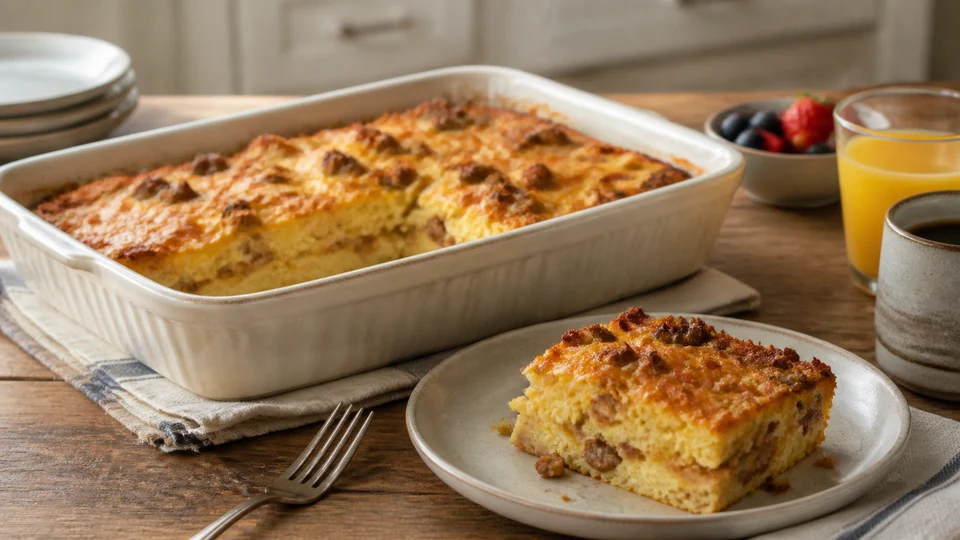
This guide helps select and execute a tested recipe. It creates no ingredient quantities, timing, yield, or Recipe schema. The breakfast hub covers the wider morning topic, and Pancake World opens the full editorial collection.
| Guide sections |
|---|
| Start with the sausage identity |
| Select a complete casserole structure |
| Bulk sausage and egg casserole |
| Sausage and hash-brown bake |
For broader context, continue with American Breakfast: Pancakes, Diner Plates and Brunch.
Start with the sausage identity
Record whether the recipe calls for raw bulk breakfast sausage, cooked crumbles, links, patties, poultry sausage, smoked sausage, or a plant-based product. These forms differ in casing, particle size, fat, moisture, seasoning, and cooking state. Their names cannot be substituted casually.
Read the current package for ingredients, allergens, storage, handling, and whether the product is raw or ready to eat. Colour, smoke flavour, or a browned exterior does not establish that sausage is fully cooked. Preserve the label until the casserole and its leftovers are finished.
Match the package to the recipe. A formula written for browned bulk sausage expects loose pieces and may account for rendered fat. Links sliced into coins distribute differently. Pre-cooked crumbles may contribute less moisture during preparation but still have their own storage requirements.
Select a complete casserole structure
A usable source names the sausage, base, binder, vegetables, cheese or alternative, pan dimensions, assembly, baking method, doneness, yield, and any make-ahead path. Reject an ingredient collage that omits the centre check or treats every sausage as equivalent.
Choose among structures according to the intended result. Bread strata can absorb egg mixture and sausage fat. Hash-brown casseroles depend on potato form and moisture. Vegetable-led bakes require controlled water release. A mostly egg-and-sausage dish may set firmly but makes sausage distribution more prominent.
Keep one source intact. Do not take sausage quantity from one recipe, egg binder from another, and bake time from a third. Without a genuine project test record for the assembled formula, the page remains Article schema.
Bulk sausage and egg casserole
Bulk sausage is designed to crumble, making it straightforward to distribute. Follow the recipe’s browning method and break it to the stated size. Very fine crumbs can disappear into the binder; large clumps can create uneven portions and uncertain cold spots during preparation.
Drain only as instructed. Removing too little rendered fat may make the dish greasy, while removing all fat from a formula that expects some can change flavour and texture. Do not pour hot fat into plumbing. Use a safe disposal method.
Cool cooked sausage appropriately before advance assembly. Adding steaming meat to cold egg mixture can warm the entire dish and create condensation. If baking immediately, follow the source sequence rather than inventing a cooling delay.
Sausage and hash-brown bake
This family pairs cooked or source-specified sausage with shredded, diced, or patty-style potatoes. Potato state matters as much as sausage state. Confirm frozen, thawed, browned, raw, or cooked instructions and do not replace one form with another.
Sausage fat and vegetable moisture interact with the potato layer. Follow drainage and pre-cooking directions for both. Avoid extra salsa or wet toppings in the base; serve them separately when the tested formula does not include them.
Match the baking dish exactly. A deeper potato-and-egg layer can brown around the edge before the centre sets. Two tested pans are preferable to one unvalidated doubled batch.
Bread sausage strata
Bread-based casseroles depend on bread type, cube size, liquid, rest, and layering. Use the form named by the recipe. Dense stale bread, soft fresh bread, croissants, and gluten-free loaves do not absorb identically.
Distribute sausage between bread pieces rather than leaving a heavy layer at the bottom unless the source specifies that arrangement. Pour binder evenly and follow any pressing or soaking instruction. Advance refrigeration is permitted only by the complete recipe.
If a guest needs gluten-free service, choose a tested gluten-free strata and verify sausage, bread, seasonings, cheese, and cross-contact. Replacing bread alone does not validate the structure.
Sausage and pepper casserole
Peppers, onions, mushrooms, spinach, and similar vegetables can release moisture. Cook, drain, thaw, or cool them as the source directs. Combining hot watery vegetables with egg and sausage can change both temperature and set.
Use the named cut so pieces distribute through portions. A large dice can remain firm while a fine dice softens quickly. Do not increase vegetables merely to fill a larger pan; select a vegetable-led tested recipe instead.
Keep fresh herbs or crisp garnish for service when their role is contrast. Their presence does not repair a watery base.
Poultry sausage casserole
Chicken or turkey sausage may be sold raw, fully cooked, as links, patties, or bulk. Verify the product rather than assuming poultry sausage means lean, cooked, or interchangeable with pork. The recipe must account for its state and seasoning.
Use applicable safe handling and temperature guidance. Prevent raw poultry-sausage utensils from contacting cooked fillings or salad sides. If substituting it into another sausage recipe, treat the result as untested unless a supported variation addresses fat, moisture, salt, and form.
Taste adjustments belong after a controlled test, not during raw assembly. A differently seasoned sausage can change the complete dish without needing extra salt.
Plant-based sausage casserole
Plant-based products vary in whether they are raw-style, pre-cooked, frozen, crumbled, or cased. Follow both package and tested recipe. Do not infer vegan, allergen, or gluten-free suitability from the category; review the complete ingredient and cross-contact record.
Choose a casserole developed for the product when possible. Removing meat sausage and inserting the same weight of a plant product can change fat, water, salt, binding, and cooking. A crumble intended for browning may behave differently from slices.
The egg, dairy, cheese, cooking fat, and toppings still determine whether the final dish is vegan. A plant-based sausage alone does not.
Brown raw sausage without contaminating the assembly
Set out a dedicated pan, utensil, plate or vessel for cooked meat, and cleaning plan before opening the package. Keep bread, cheese, vegetables, and serving tools away from raw-meat surfaces. Wash hands after handling and before touching package labels needed later.
Cook according to the package and selected recipe. Break bulk sausage to the intended size while it cooks. Verify the applicable endpoint rather than relying only on colour. Transfer it with a clean tool if the source calls for draining or cooling.
Clean and sanitise affected surfaces using appropriate guidance. Do not place cooked sausage back into the raw package tray. Record the preparation time when the meat will be cooled for later assembly.
Control fat, salt, and seasoning
Sausage brings its own fat and seasoning. Cheese, packaged hash browns, bread, sauces, and added salt can compound them. This is a recipe-balance issue, not a reason to make a health claim. Use a tested formula that has already considered the specific style.
Do not add the full seasoning from a meat-free version before tasting the cooked casserole. Conversely, omitting salt or cheese by intuition can change binder and moisture when those ingredients have structural roles. Choose a recipe designed for the desired profile.
For a spicy sausage, keep hot sauce and chilli garnish separate so diners can adjust without increasing liquid in the base. Label them clearly.
Mix and distribute the binder
Crack eggs into a clean separate bowl, then add dairy, plant beverage, seasoning, or cheese exactly as the source instructs. Review labels for every component. Do not taste raw mixture.
Spread sausage evenly through the correct layer. Uneven distribution makes some portions sausage-heavy and others mostly binder. It can also leave large cold clumps in advance-assembled dishes.
Pour binder around the solids so dry pockets do not remain. Do not compress bread or potato beyond the method. Clear the dish rim and maintain the tested depth.
Use the specified pan
Measure internal length, width, and depth. A dish with the same volume but a smaller footprint produces a deeper casserole. Material may also matter to the tested method. Follow any greasing or lining direction.
For a small household, select a tested small-pan casserole instead of roughly halving eggs and using an arbitrary dish. For a crowd, prepare multiple correct batches when the source and oven setup support them.
Map rack space before assembling. Another brunch dish should not force the casserole onto an unsupported position or repeated oven opening.
Make ahead only under explicit permission
The source must say whether the complete casserole can be refrigerated before baking, for how long, and how it enters the oven. Cooked sausage and vegetables need appropriate cooling before assembly. Cover and label the dish.
Do not leave egg, dairy, meat, or cut vegetables at room temperature while waiting for morning. Do not assume a make-ahead instruction from one casserole applies to another.
Check the dish manufacturer’s thermal guidance before moving glass or ceramic from cold storage into heat. If the vessel path is unsafe or unclear, choose a different tested method.
Plan the bake from service time
Work backward through the recipe’s baking range, centre checks, stated rest, cutting, and movement to the table. Add preparation and preheating. Build a fallback side rather than planning to serve an underdone casserole when timing slips.
Keep cold sides refrigerated while the casserole bakes. Assign one person to monitor the oven and one to set labels, drinks, and serving tools. Repeated door opening for unrelated dishes changes the cooking environment.
At the checking point, prepare the permitted thermometer or test before opening. Evaluate the centre, not only browned cheese or firm edges.
Verify the deepest centre
Use the tested recipe’s cues plus applicable official temperature guidance for the meat-and-egg dish. Avoid contact with the pan when measuring. If the centre is not ready, continue under the source method; do not serve the edges and return the middle.
Do not raise oven heat casually to recover a late schedule. Protect the surface only if the recipe supplies that method. A casserole exceeding its expected range can indicate wrong depth, cold ingredient state, inaccurate oven, or formula change.
Record final doneness and any variation. One successful result in a different pan does not validate that pan for publication.
Serve a coherent breakfast
Let the casserole rest only as directed, then cut or spoon according to its structure. Pair the warm sausage main with a contrasting simple side rather than another heavy egg-and-meat dish. Fruit, vegetables, bread, or a cold component may fit depending on the recipe and diners.
Place toppings after the casserole in a buffet line. Use separate labelled utensils. Keep drinks away from the hot-pan route. Offer a genuinely distinct alternative for guests who cannot eat sausage rather than a corner picked free of meat.
Use the recipe yield as the planning basis without treating it as a universal appetite measure. Replenish or cut portions deliberately.
Store leftovers with their history
After the applicable service window, portion and cool safe leftovers according to FoodSafety.gov guidance. A deep baking dish may not be the best cooling vessel. Record cooking, service, and refrigeration times.
Store cold toppings separately. Reheat using a supported method and check the centre where guidance requires. Avoid warming the entire casserole repeatedly for single portions.
If handling history is unclear, discard it. Appearance and smell cannot restore missing time-and-temperature evidence.
Troubleshoot the first mismatch
A greasy result points to sausage choice, draining, cheese, and untested fat additions. A watery result points to vegetables, frozen potato, meat moisture, or binder changes. A dry result can involve overbaking, shallow pan geometry, or an unsuitable sausage substitution.
Uneven portions point to clump size and distribution. A loose centre with dark edges points first to dish depth, ingredient temperature, and oven conditions. Change the earliest unsupported factor, not several ingredients.
When repeated correction is needed, choose a recipe written for the actual sausage and base rather than continuing an improvised formula.
Compare recipes before buying the sausage
Create a short table with columns for sausage form, raw or cooked state, base, vegetables, binder, dish dimensions, advance work, active morning work, centre test, yield, and leftover plan. Fill it from complete sources. This exposes recipes that sound similar but create different workloads.
A bulk-sausage egg bake may require morning browning but little soaking. A bread strata may move assembly to the previous evening but require refrigerator space and a source-directed soak. A hash-brown version may rely on a specific frozen potato state. A pepper casserole may require vegetable pre-cooking. Choose the workflow that fits, not the shortest ingredient list.
Only then buy the exact sausage. This order prevents an appealing package from forcing an unsupported substitution. If the chosen product is unavailable, return to the recipe shortlist and select another complete formula rather than replacing the meat by shape alone.
Record why the recipe won: correct product state, suitable pan, manageable prep, clear doneness, and service fit. The note makes later changes deliberate.
Run a small-pan rehearsal for an important brunch
For a holiday or guest event, use a complete tested small-pan recipe to rehearse the workflow. Do not simply divide a large recipe unless its scaling has been validated. The rehearsal should use the same sausage product, base, pan material, oven, and make-ahead path intended for the event.
Record how long sausage preparation takes, how much fat the source method removes, whether vegetables need longer cooling, how evenly the filling distributes, and whether the directed rest produces the desired portion style. Verify the centre exactly as the real event requires.
Taste a portion with the planned side and condiment. A casserole balanced alone may become overly salty or rich beside another savoury dish. Revise the menu before revising the formula. Removing a duplicate meat side is safer than changing binder quantities without evidence.
Audit cleanup and refrigerator space. If browning, draining, cooling, assembling, and washing create more work than the event allows, choose a pre-cooked-sausage recipe or another breakfast main designed for a simpler path.
Manage two pans without treating them as one batch
When the guest count calls for two pans, prepare each as a complete source batch. Measure and mix deliberately so sausage and binder are not distributed by rough eye. Label pans if one has an approved variation or dietary distinction.
Confirm that the oven can hold both dishes in the source-supported arrangement. Airflow, rack position, and opening can affect cooking. If the recipe does not address two-pan baking, stagger the pans or select a tested large-group method rather than assuming the original time.
Check the centre of each pan. One done casserole does not prove the other is ready, especially if positions differ. Record their individual service or holding start. On a buffet, release one pan first while the second remains under an approved control; do not mix fresh portions into remnants from the earlier pan.
Use separate serving utensils for a genuinely different version. A label such as “poultry sausage” or “plant-based sausage” must reflect every ingredient and cross-contact limitation, not only the visible pieces.
Review whether sausage earned the main role
After service, ask whether sausage contributed flavour and substance in a way the base could support. Note whether it was evenly distributed, whether its seasoning competed with cheese or sauce, and whether diners could identify an alternative. These observations guide recipe selection; they do not become universal taste claims.
If many pieces remain because the dish was too heavy for the menu, reduce the number of competing mains next time rather than altering the tested casserole. If sausage clumped, choose a recipe with clearer crumble size or distribution. If grease dominated, choose a source designed for the actual product or a different sausage category.
Keep the exact package identity and recipe with the event record. A future repeat should recheck both, because product formulation and source instructions can change.
Frequently asked questions
Must sausage be cooked before assembly?
Follow the recipe and product. Many casseroles require raw bulk sausage to be browned and drained first; a pre-cooked product has a different path.
Can links replace bulk sausage?
Only with a tested variation that accounts for casing, size, pre-cooking, fat, moisture, seasoning, and distribution.
Can I assemble the casserole overnight?
Only when the complete source explicitly permits refrigerated assembly and supplies the next-day baking path.
Can poultry sausage replace pork sausage?
Not automatically. Verify raw or cooked state and choose a supported recipe or variation addressing its formulation.
How do I prevent a watery casserole?
Follow vegetable and potato preparation, drain sausage as directed, keep wet toppings outside the base, and use the correct dish depth.
Can I double it?
Use a tested scaled method or multiple correct pans. One deeper doubled pan can cook unevenly.
Explore related Pancakes World guidance on American Pancakes, Maple Syrup, and Maple Syrup Pancakes.
Sources and editorial references
- USDA FoodData Central —
https://fdc.nal.usda.gov/ - FoodSafety.gov food safety charts —
https://www.foodsafety.gov/food-safety-charts - FDA Food Labeling & Nutrition —
https://www.fda.gov/food/nutrition-food-labeling-and-critical-foods