Sausage breakfast burrito recipe
At Pancakes World, for a dependable sausage breakfast burrito, cook and drain breakfast sausage, soften onion and bell pepper, add beaten eggs, and cook until the eggs are set. Warm 8-inch flour tortillas so they bend without tearing, then divide the hot filling among eight tortillas, add shredded cheese, fold the sides inward, and roll from the bottom. Use 16 ounces of pork sausage, eight eggs, one cup each chopped onion, bell pepper, and cheddar as the source-based eight-burrito starting point below. Verify pork sausage reaches 160°F; use 165°F for poultry sausage. Serve promptly, or cool, wrap, freeze, and reheat leftovers to 165°F.
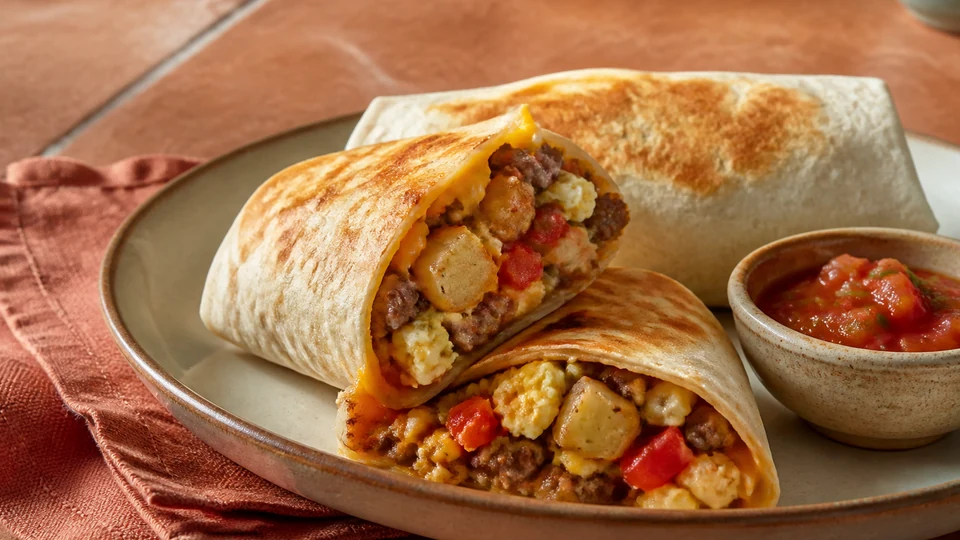
For broader context, continue with American Breakfast: Pancakes, Diner Plates and Brunch.
What this recipe covers
This is a practical guide to the sausage-and-egg style of American breakfast burrito: cooked breakfast sausage, scrambled eggs, vegetables, cheese, and a soft flour tortilla. The core batch is adapted from the University of Illinois Extension 4-H Cooking 201 formula. That published recipe yields eight burritos and supplies the ingredient quantities and order of work used here. Food-safety decisions come from FDA and USDA guidance rather than visual guesses.
The page separates three decisions that are often mixed together:
- Which sausage are you using? Raw pork sausage and raw poultry sausage have different minimum internal temperatures. A ready-to-eat product may only need reheating, but its label still controls.
- Will the burritos be eaten now or frozen? A hot filling works for immediate service. A freezer batch needs a deliberate cooling, wrapping, and labeling process.
- Do you want the published base or an adaptation? The eight-burrito formula below is the source-based lane. Potatoes, salsa, beans, and alternative cheeses are optional decisions, not part of that exact base.
Pancake World has not recorded an in-house test of this formula. Therefore, the page uses Article schema and does not claim a proprietary tested recipe. The value here is a careful synthesis of an extension recipe, a separate extension freezer method, and current federal safety guidance.
Explore related Pancakes World guidance on American Pancakes, Maple Syrup, and Maple Syrup Pancakes.
Sources and editorial references
Use this list for the closest match to the Illinois Extension 4-H formula:
- 16 ounces pork breakfast sausage
- 1 cup coarsely chopped onion
- 1 cup coarsely chopped green bell pepper
- one 4-ounce can diced green chiles, drained, optional
- 8 large eggs
- 1 cup shredded cheddar cheese
- 8 flour tortillas, about 8 inches across
- up to 1/2 cup chopped fresh cilantro, optional
- salsa and sour cream for serving, optional
The published curriculum lists salsa and sour cream as accompaniments rather than wet fillings that must be sealed inside every burrito. That distinction is useful. A spoonful of salsa served alongside a fresh burrito is easy to control; a large amount rolled into a burrito can make the tortilla wet, especially after freezing.
If the breakfast sausage is turkey or chicken rather than pork, do not treat the meat as a one-for-one safety substitution. The flavor and texture choice is yours, but the endpoint changes: uncooked poultry sausage must reach 165°F. Illinois Extension also publishes a separate turkey-sausage burrito using 12 ounces of lean turkey sausage for six tortillas. That is another coherent lane, not evidence that every pork formula can be changed without adjusting yield or moisture.
Equipment that keeps the workflow orderly
Gather the equipment before opening the egg carton or sausage package:
- a large nonstick skillet
- a spatula that can break sausage into small pieces
- a mixing bowl and fork or whisk for the eggs
- a cutting board and knife for vegetables
- a colander set over a heat-safe container for draining cooked pork sausage
- a clean plate or bowl for cooked sausage
- an instant-read food thermometer
- foil for warming tortillas in the oven, or a clean towel for microwave warming
- a spoon or measuring cup for portioning
- a sheet pan if freezing a batch
- freezer-safe wrapping and a labeled freezer bag
The clean plate matters. Do not return cooked sausage to a plate that held raw meat. Wash the thermometer probe in hot, soapy water before and after checking food, following the manufacturer’s care instructions.
Step 1: choose the service lane before cooking
For breakfast that will be eaten immediately, preheat the oven to 350°F and wrap the tortillas in foil. The Illinois 4-H method warms them while the filling cooks. Warm tortillas are more flexible, so the sides can fold without cracking.
For a freezer batch, still warm the tortillas enough to make them pliable, but set up a cooling area before cooking. You will need space to cool the filling and assembled burritos promptly, individual wrappers, a sheet pan, and a freezer bag. Iowa State Extension’s make-ahead burrito method wraps each burrito tightly, freezes the parcels in one layer on a sheet, and transfers the frozen parcels to a freezer bag. The single-layer first freeze prevents a warm stack from becoming one dense block.
Do not plan to leave finished burritos on the counter until everyone has eaten. USDA guidance requires perishable leftovers to be refrigerated within two hours, or within one hour when the surrounding temperature is above 90°F. Build that limit into the order of work rather than starting the clock after cleanup.
Step 2: cook the sausage to its safe endpoint
Place the sausage in the skillet over medium heat. Break it into small, even crumbles as it cooks. Small pieces distribute more evenly across eight tortillas and create fewer thick cold spots during later reheating.
Use the product label to decide what you have:
- Raw pork, beef, lamb, or veal sausage: cook to at least 160°F.
- Raw chicken or turkey sausage: cook to at least 165°F.
- Fully cooked sausage: follow the package reheating instructions and avoid representing it as raw.
- A product marked “cook before eating,” “uncooked,” or similar: treat it as raw even if its color looks cooked.
USDA explains that sausage may be raw, partially cooked, or ready-to-eat, and appearance alone does not establish the category. Insert the thermometer from the side into a thicker piece when possible so the sensing area reaches the center. For loose crumbles, gather a representative portion and check more than one place. Color is a browning cue, not the safety verdict.
When pork sausage is safely cooked, drain it as the 4-H method directs. Set a colander over a heat-safe metal or glass container, transfer the sausage, and let excess drippings fall away. Do not pour hot grease into a sink. Put the drained cooked sausage on a clean plate while the vegetables cook.
If using lean turkey sausage, the amount of rendered fat may be smaller. Drain only what is actually present; do not add liquid merely to imitate pork sausage. The safety endpoint remains 165°F for poultry sausage.
Step 3: soften onion and pepper
Return the empty skillet to medium heat. Add the chopped onion and green pepper and cook until the vegetables soften. If the skillet is dry and the vegetables begin to stick, use a small amount of cooking oil appropriate for the pan rather than waterlogging the mixture. This small oil addition is an editorial kitchen adjustment, not a quantity specified in the source formula.
Drain the optional canned green chiles before adding them. The aim is a filling that holds together when spooned, not a pool of vegetable liquid. Stir the chiles through the softened onion and pepper.
This stage is also the best time to control vegetable moisture. If the onion or pepper releases visible liquid, continue cooking until the excess evaporates. A dry skillet surface does not mean desiccated vegetables; it means there is no loose liquid available to soak the tortilla.
Step 4: add eggs and return the sausage
Crack the eggs into a mixing bowl rather than directly over the skillet. Beat them until the yolks and whites are combined. FDA advises washing hands, utensils, equipment, and work surfaces with hot, soapy water after contact with raw eggs. Discard cracked or leaking eggs rather than trying to rescue them.
Pour the beaten eggs over the vegetables and return the drained sausage to the skillet. Cook over medium heat. Gently lift and turn portions with the spatula so uncooked egg reaches the hot pan. The Illinois curriculum describes a three-to-five-minute egg stage, but pan size, burner output, ingredient temperature, and batch depth vary. Treat that time as recipe context, not a substitute for checking the food.
Stop when the egg is set and no runny liquid remains. FDA says scrambled eggs should not be runny, and its guidance places egg dishes at 160°F. Check a mixed portion rather than touching only a bare spot of pan or a single sausage crumb. If the sausage was already safely cooked, the egg is now the last raw component.
Avoid cooking until the egg becomes dry and granular. The burrito will continue to steam briefly after rolling, and a frozen burrito will be heated again. “Set” and “scorched” are not the same endpoint.
Step 5: create a filling that rolls cleanly
Move the skillet off the hot burner. Give the mixture a gentle stir and inspect the bottom of the pan. There should be no free egg or vegetable liquid. If a wet pocket remains, return the pan briefly to low or medium heat and cook it away while stirring.
For immediate service, portion while the filling is hot. For freezing, let steam subside in a shallow layer rather than sealing a mound of piping-hot filling inside plastic. Cooling does not mean leaving the food at room temperature indefinitely. Divide the mixture so it loses heat efficiently, assemble without delay, and refrigerate or freeze within USDA’s time limit.
Keep salsa, sour cream, fresh tomato, and avocado outside the freezer burrito unless you have a separate tested method that includes them. These ingredients may be enjoyable at the table, but their water and texture can work against a tidy reheated wrap. Serving them after reheating gives better control.
Step 6: warm, portion, fold, and roll
Remove the warm tortillas from the oven. Keep unused tortillas covered so they remain flexible. Arrange one on a clean work surface with a side facing you.
The source formula yields eight burritos but does not require an exact measured cup of the sausage-and-egg filling in each one. Use a practical distribution method:
- Visually divide the skillet into four quarters.
- Use each quarter for two tortillas.
- Place the filling in a short horizontal band just below the tortilla center.
- Add about one eighth of the shredded cheese.
- Fold the left and right sides toward the filling.
- Lift the bottom edge over the filling, tuck it gently, and roll away from you.
- Set the burrito seam-side down.
Do not force all stray filling into the first few tortillas. Overfilling makes the sides spring open and leaves later portions skimpy. If the tortilla cannot close without stretching, remove a spoonful. A slightly smaller sealed burrito travels and reheats more predictably than an overloaded one.
For chopped cilantro, either mix it into the warm filling just before portioning or sprinkle a modest amount with the cheese. If cilantro preference varies among diners, serve it separately.
Serve-now method
Place fresh burritos seam-side down. Serve promptly with salsa or sour cream on the side. If a browned exterior is wanted, a dry skillet can toast the seam first and then the other side, but that finishing step is optional and not part of the core source formula. Keep the heat moderate so the tortilla browns without burning before the center is hot.
For a group, hold the finished burritos hot only with equipment that keeps food at 140°F or above. Otherwise, serve in small waves rather than letting a full platter sit at room temperature. Refrigerate leftovers promptly.
Freezer-batch method
A freezer burrito is not simply a fresh burrito forgotten on a counter and wrapped later. Use a defined batch process:
- Cook all raw components to their safe endpoints.
- Reduce loose moisture in the vegetables and eggs.
- Let excessive steam dissipate in a shallow layer while staying within the safe cooling window.
- Warm tortillas just enough to fold without tearing.
- Portion evenly and roll tightly without crushing.
- Wrap each burrito individually in freezer-suitable material.
- Arrange wrapped burritos in one layer on a sheet pan.
- Freeze until firm, then transfer them to a freezer bag.
- Label the bag with the contents and preparation date.
Iowa State Extension supplies the one-layer freezing method for its egg-and-vegetable make-ahead burritos. It does not establish a universal quality lifetime for every sausage burrito. USDA says frozen leftovers remain safe indefinitely at 0°F when kept continuously frozen, while quality declines over time; use a conservative household labeling and rotation practice rather than inventing a guaranteed “best for” date here.
If you want a specific storage duration, use a tested recipe that states one for that exact formula or consult the current federal cold-storage chart. Do not borrow the duration from a different burrito and present it as verified for this one.
How to reheat safely
The goal is a hot center, not merely a warm tortilla. USDA requires leftovers to reach 165°F. Check more than one spot because a compact burrito can have cold pockets.
From the refrigerator
Remove any wrapper that is not microwave-safe. Place the burrito on a microwave-safe plate, cover it or use a damp paper towel to retain moisture, and heat according to the appliance and burrito size. Rotate or turn it during heating. Let it rest briefly so heat redistributes, then check the center in multiple places for 165°F.
From frozen
USDA says frozen leftovers may be reheated without thawing, though the process takes longer. Iowa State’s separate make-ahead recipe removes plastic wrap, encloses the frozen burrito in a damp paper towel, uses medium microwave power, and gives a three-to-four-minute recipe-specific range. That timing belongs to its egg, potato, vegetable, cheese, and tortilla formula. Your sausage burrito may be denser, larger, or made in a different microwave, so use the method as a starting pattern and 165°F as the deciding endpoint.
Turn the burrito partway through. If the outside is hot while the center remains cold, reduce power and add time in shorter intervals. A rest after heating helps, but resting alone does not replace the temperature check.
Oven or toaster oven
An oven can produce a drier exterior than a microwave, but it takes longer. Remove plastic and use only oven-safe wrapping. Heat until the center reaches 165°F. USDA says the oven used to reheat meat and poultry leftovers should be no lower than 325°F. The exact time depends on whether the burrito is refrigerated or frozen, its diameter, and the appliance; a universal minute count would be misleading.
Never use a slow cooker to reheat a frozen or refrigerated breakfast burrito. Slow heating can keep leftovers in unsafe temperatures too long.
Fresh versus freezer: the key decisions
| Decision | Fresh burrito | Freezer burrito |
|---|---|---|
| Filling temperature at assembly | Hot is appropriate | Let excess steam subside; cool promptly |
| Tortilla | Warm and flexible | Warm enough to fold, not dried out |
| Salsa and sour cream | Serve alongside | Add after reheating |
| Vegetable moisture | Cook off free liquid | Be especially strict about loose liquid |
| Wrapping | Seam-side down may be enough | Wrap individually, then bag |
| Final safety check | Eggs set; sausage at its correct endpoint | Reheat center to 165°F |
| Best texture strategy | Serve immediately | Microwave for moisture; optional oven finish after safe reheating |
Substitution and variation guide
Substitutions change more than flavor. Use this decision guide to keep the method coherent.
Pork sausage to turkey or chicken sausage
This is the most important safety change. Raw poultry sausage must reach 165°F, while uncooked pork sausage must reach 160°F. Check the label and measure the center. A leaner sausage may leave less fat to drain and can feel drier; compensate through gentle egg cooking rather than adding unverified liquid.
Add potatoes
Potatoes add bulk and can make a freezer burrito feel substantial. Illinois Extension’s separate turkey-sausage burrito uses cooked diced potatoes, while Iowa State’s make-ahead egg burrito begins by cooking diced potato before onion, pepper, and egg. If adding potato to the eight-burrito sausage-and-egg base, reduce another bulky component or use larger tortillas. Do not assume the original eight portions will still fit.
Add beans
Cooked, drained beans can replace part of the meat or add bulk. Mash or lightly crush them if whole beans roll out. Because this is an editorial variation rather than the published base, start with a small trial burrito and watch fill volume and moisture.
Change the cheese
A cheese that melts and can be shredded is easiest to distribute. Stronger cheeses may need less by taste, but there is no universal one-for-one flavor conversion. Keep total filling volume in view.
Add salsa inside
For fresh service, a modest, well-drained spoonful can work. For freezing, salsa on the side is the lower-risk texture decision. If salsa goes inside, choose a thicker product and expect a softer tortilla after reheating.
Use corn tortillas
An 8-inch flour tortilla is the source-based wrapper. Corn tortillas are usually smaller and less elastic, so the same fill volume and burrito fold may not work. Use less filling, overlap two only if a tested method tells you to, or serve the mixture as tacos rather than promising an equivalent burrito.
Scaling the batch without losing control
For sixteen burritos, doubling ingredients is simple on paper but cooking everything in one crowded skillet may not be. Two sequential eight-burrito batches are easier to drain, temperature-check, scramble, portion, and cool safely.
Use this station order:
- Chop vegetables and stage clean bowls.
- Cook and drain the first sausage batch.
- Cook vegetables and eggs; assemble eight.
- Start safe cooling or serve.
- Wash or replace tools that contacted raw sausage or eggs.
- Repeat for the second batch.
- Label freezer bags by batch and date.
For a group, assign one person to portion and another to fold only after raw-food tasks are complete and hands and surfaces are washed. Keep a count of finished burritos. A simple tally prevents one bag from being mislabeled and helps confirm that each diner receives a portion.
Do not scale by stacking a deep container of hot filling in the refrigerator. USDA recommends shallow containers for rapid cooling. Divide the food so cold air can reach it efficiently.
Troubleshooting
The tortilla tears while folding
It is probably cold, dry, or overfilled. Rewarm covered tortillas briefly, keep the remaining stack covered, and remove some filling. Place the filling below center so the bottom edge has room to tuck.
Liquid runs out of the burrito
The vegetables may not have cooked dry, the eggs may still be runny, or wet salsa was added inside. Return unassembled filling to the skillet and cook away free liquid. For future freezer batches, reserve salsa for serving.
The eggs are rubbery after reheating
They may have been overcooked initially or reheated at full power for too long. Cook fresh eggs only until set. During microwave reheating, use moderate power and shorter intervals, while still ensuring the center reaches 165°F.
The center stays cold
The burrito may be too thick, frozen in a dense shape, or heated without turning. Use smaller, even portions, freeze parcels in one layer, rotate during reheating, and test several central points. Add time at lower power rather than scorching the exterior.
The seam opens
Set the rolled burrito seam-side down. If serving fresh, a brief dry-skillet toast can seal it. For freezing, wrap firmly enough to hold the shape. Do not rely on cheese leakage as glue.
The sausage looks done but has not reached temperature
Keep cooking. Browning cannot confirm the center temperature. Check raw pork sausage at 160°F and raw poultry sausage at 165°F with a clean thermometer.
Frequently asked questions
Can I make sausage breakfast burritos the night before?
Yes. Cook the components safely, assemble, refrigerate within two hours, and keep the refrigerator at 40°F or below. FDA says refrigerated cooked egg dishes should be used within three to four days. Reheat leftovers thoroughly to 165°F before serving.
Should sausage be cooked before adding eggs?
Yes for the source-based method. Cook the sausage to its correct endpoint first, drain it, cook the vegetables, then return the cooked sausage when the beaten eggs go into the skillet. This makes it easier to verify meat doneness and manage excess fat.
Can I freeze burritos with eggs and sausage?
Yes, provided the ingredients are cooked safely, cooled promptly, wrapped individually, and frozen without an extended counter hold. Freeze the wrapped burritos in one layer before bagging. Use 165°F, not a fixed microwave time, to confirm safe reheating.
Do I need to thaw a frozen breakfast burrito first?
No. USDA permits reheating frozen leftovers without thawing, but it takes longer. Rotate, use moderate power where helpful, allow a brief rest, and check the center in several places for 165°F.
How do I stop freezer breakfast burritos from getting soggy?
Drain sausage, cook off vegetable liquid, set the eggs without leaving runny portions, keep wet condiments outside, let excess steam subside, wrap securely, and freeze in one layer. These controls reduce moisture, though no method can guarantee a microwave-reheated tortilla will be crisp.
Is chicken sausage cooked at the same temperature as pork sausage?
No. USDA sets 165°F for uncooked poultry sausage and 160°F for uncooked sausage made from ground beef, pork, lamb, or veal. The package label determines whether the product is raw or ready-to-eat.
How much filling belongs in each tortilla?
For the eight-burrito base, divide the entire filling evenly into eight portions. A separate Illinois Extension turkey-sausage recipe uses one-half cup sausage mixture per tortilla, but that formula contains no egg and has different ingredients. Treat one-half cup as context, not a guaranteed capacity for every tortilla.
Can I omit cheese?
Yes. Cheese is not necessary for safe folding. Without it, the filling may feel less cohesive, so keep the sausage crumbles small and the egg set but tender. This is a variation rather than the exact published formula.
What if my sausage is already fully cooked?
Follow the package directions. Warm it as labeled, add it late enough that it does not dry out, and still cook the eggs until set. Reheated assembled leftovers must reach 165°F.
Can these be held for a brunch buffet?
Only with temperature control. Keep hot food at 140°F or above, or serve smaller fresh batches. Do not leave perishable burritos at room temperature beyond two hours, or one hour above 90°F.
- University of Illinois Extension, 4-H Cooking 201:
https://extension.illinois.edu/sites/default/files/4h_cooking_201_book.pdf - University of Illinois Extension, Breakfast Burrito:
https://eat-move-save.extension.illinois.edu/eat/recipes/breakfast-burrito - Iowa State University Extension and Outreach, Make Ahead Breakfast Burritos:
https://spendsmart.extension.iastate.edu/recipe/make-ahead-breakfast-burritos/ - USDA Food Safety and Inspection Service, Sausages and Food Safety:
https://www.fsis.usda.gov/food-safety/safe-food-handling-and-preparation/meat-catfish/sausages-and-food-safety - U.S. Food and Drug Administration, What You Need to Know About Egg Safety:
https://www.fda.gov/food/buy-store-serve-safe-food/what-you-need-know-about-egg-safety - USDA Food Safety and Inspection Service, Safe Minimum Internal Temperature Chart:
https://www.fsis.usda.gov/food-safety/safe-food-handling-and-preparation/food-safety-basics/safe-temperature-chart - USDA Food Safety and Inspection Service, Leftovers and Food Safety:
https://www.fsis.usda.gov/food-safety/safe-food-handling-and-preparation/food-safety-basics/leftovers-and-food-safety - USDA Food Safety and Inspection Service, Food Thermometers:
https://www.fsis.usda.gov/food-safety/safe-food-handling-and-preparation/food-safety-basics/food-thermometers