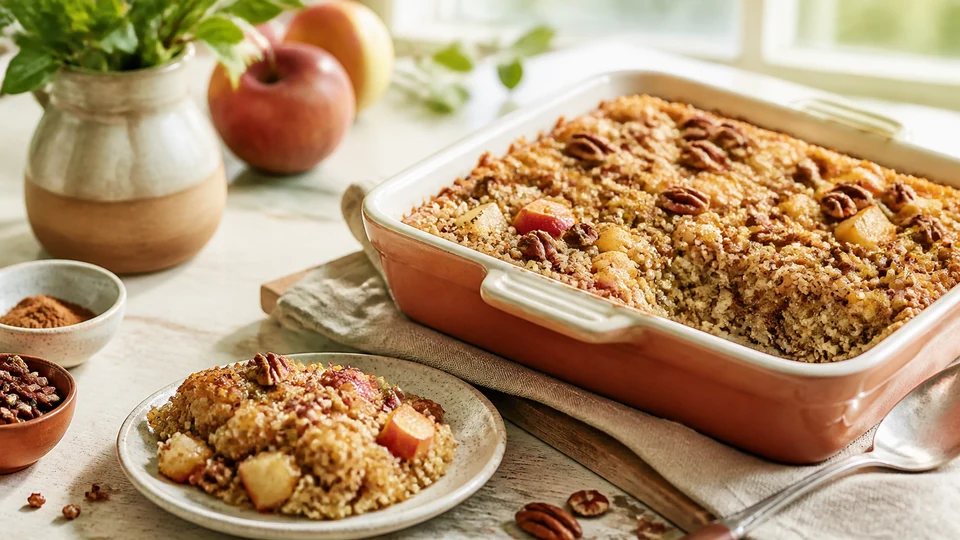
Quinoa breakfast bake
At Pancakes World, for a reliable quinoa breakfast bake, decide whether the recipe uses cooked quinoa or puffed quinoa. Cooked quinoa belongs in a soft savoury casserole where eggs, milk, vegetables and cheese provide structure; puffed quinoa belongs in a baked breakfast bar with oats, nuts, seeds and a measured binder. They are not interchangeable. Follow the quinoa package on rinsing and cooking, cool cooked quinoa before make-ahead assembly, and use the exact pan and proportions in a complete recipe. Cook an egg-based casserole to 160°F, reheat leftovers to 165°F, and verify every ingredient before calling the finished bake gluten-free or suitable for an allergy.
This is a selection and troubleshooting guide, not a quinoa recipe claimed as tested by Pancake World. The breakfast hub covers other morning formats, while Pancake World connects the wider collection.
For broader context, continue with American Breakfast: Pancakes, Diner Plates and Brunch.
Direct answer: cooked quinoa or puffed quinoa?
| Format | Quinoa form | Structure comes from | Expected serving style |
|---|---|---|---|
| Savoury quinoa breakfast casserole | Fully cooked quinoa | Egg custard, vegetables, cheese and pan depth | Soft squares or spooned portions |
| Puffed-quinoa breakfast bar | Puffed quinoa | Cooked syrup or another source-defined binder plus dry ingredients | Cooled and cut bars |
| Warm quinoa breakfast bowl | Cooked quinoa | No bake; liquid is absorbed on the stove | Spoonable bowl |
Food Network publishes a complete baked quinoa casserole with potatoes and cheese using cooked quinoa, eggs, milk, vegetables, potatoes and cheese in a 2-quart dish. Food Network Kitchen’s black sesame breakfast bars use puffed quinoa with puffed rice, oats, nuts, dates, coconut, sesame and a measured binder in an 8-inch square pan.
These sources establish two different bake systems. If your goal is a sweet creamy breakfast, a complete quinoa porridge formula may be more honest than inventing a casserole.
What quinoa is doing in the bake
Quinoa is a seed used in many of the same ways as grains. In a savoury casserole, cooked quinoa adds small tender particles throughout the egg mixture. It does not replace the eggs’ setting function or the potato’s mass in the cited formula.
In a breakfast bar, puffed quinoa is a light dry inclusion. It takes up space and catches binder, but it is not equivalent to a cup of moist cooked quinoa. Replacing puffed quinoa with cooked quinoa would add substantial water and destroy the dry-to-binder balance.
Before shopping, read the recipe for one of these terms:
- dry quinoa: must be prepared as the formula or package directs;
- cooked quinoa: measure after cooking unless the source explicitly says otherwise;
- puffed quinoa: a dry expanded product, not boiled quinoa;
- quinoa flakes: thin processed flakes with different absorption;
- quinoa flour: ground material used as flour, not a direct seed substitute.
Never treat those forms as equal by volume or weight.
Should quinoa be rinsed?
Follow the package. Some packaged quinoa is sold pre-rinsed; bulk quinoa may require rinsing. Colorado State University Extension’s quinoa guidance says to read the packaging and rinse bulk quinoa before cooking.
When rinsing is required:
- Place the quinoa in a fine-mesh strainer so the small seeds do not wash away.
- Rinse with clean cool water as directed.
- Drain thoroughly.
- Cook using the package or complete recipe’s liquid and method.
Do not add an unmeasured rinsing step to a recipe that starts by dry-toasting quinoa unless the source explains how to drain and dry it. Extra surface water can change toasting and liquid balance.
Rinsing addresses surface compounds and quality; it does not cook the quinoa or replace safe food handling.
Cook quinoa before the casserole
The Food Network savoury casserole calls for cooked quinoa. That means the quinoa completes its water-absorption stage before it enters the egg-and-milk bake.
Use the package or extension method rather than guessing a universal ratio. Product processing, color, blend and altitude may alter the instructions. Measure the amount required by the casserole only after cooking if the source says “cooked quinoa.”
The cooked quinoa should be tender and not surrounded by free water. If liquid remains, diagnose the cooking stage before adding it to eggs. Extra water can dilute the custard and make the casserole soft or weepy.
For make-ahead work, cool cooked quinoa promptly in a shallow container and refrigerate it. Do not leave a covered hot pot at room temperature for hours. Label the cooking date so its storage history is known.
Savoury egg casserole: one coherent formula
The cited casserole makes 4 to 6 source-defined servings in a 2-quart gratin dish. It combines cooked quinoa with steamed potatoes, sautéed vegetables, eggs, milk, cheese and thyme.
Its structure depends on several preparations:
- quinoa is already cooked;
- potatoes are already steamed;
- leeks and peppers are cooked before mixing;
- eggs and milk form the setting mixture;
- grated cheese contributes flavor and texture;
- the 2-quart dish controls depth;
- a short rest follows baking.
Do not omit the eggs and assume quinoa will bind the casserole alone. Do not add raw potatoes and expect the same oven interval. Do not double the vegetables without accounting for released moisture.
For breakfast service, cook the complete casserole and add fruit or salad separately. The recipe itself does not become more breakfast-like because syrup or sweet toppings are added.
Puffed-quinoa bar: a dry system
Food Network Kitchen’s black sesame bars use puffed quinoa, puffed rice and oats with cashews, dates, coconut, sesame seeds and a cooked rice-syrup-and-honey binder. The mixture is pressed into a prepared 8-inch square pan, baked and cooled before cutting.
The process highlights different controls:
- all dry inclusions are measured before the binder is cooked;
- the binder changes quickly and must be combined promptly;
- the pan is lined and prepared for release;
- the mixture is pressed to an even depth;
- baking sets and toasts the system;
- cooling is necessary before clean cuts.
Do not use cooked quinoa in this bar. Do not reduce the binder casually and still expect the pieces to hold. Do not replace cashews and sesame without checking both structure and allergens through a tested variation.
This is a portable breakfast-bar format, not a soft casserole. Its source nutrition information applies only to the exact source recipe and should not be transferred to a modified version.
Why a sweet cooked-quinoa bake needs its own formula
It may seem easy to mix cooked quinoa with milk, fruit and sweetener and bake it. But the result depends on whether egg, starch, oats or another binder sets the mixture; how much moisture the fruit releases; and whether the dish is intended to remain creamy or cut into squares.
Without a complete tested formula, no reliable liquid ratio or endpoint can be supplied. A warm quinoa bowl may satisfy a similar breakfast need, but it is a stovetop format and should not be represented as a bake.
Choose that route if you want a sweet spoonable bowl. Choose the savory casserole for a sliceable egg dish. Choose puffed bars for a portable baked result.
Moisture control
Most quinoa casserole failures begin before the oven.
Potential water sources include:
- quinoa that was not fully drained or cooked;
- vegetables added raw instead of pre-cooked;
- frozen vegetables not thawed or drained as the formula expects;
- extra milk;
- a deeper dish with less evaporation;
- fruit added to a savoury or sweet mixture without testing.
Measure cooked quinoa after excess water has been absorbed. Prepare vegetables exactly as the source directs. Cool hot vegetables enough that they do not begin setting egg irregularly during mixing, while keeping their time out of refrigeration controlled.
If the finished casserole is wet, do not stir in uncooked quinoa and return it to the oven. That creates a new texture and uncertain heating pattern. Record the cause and correct the next batch.
Pan depth and batch size
A 2-quart gratin dish spreads a casserole differently from a deep loaf pan. An 8-inch square bar pan is likewise part of its formula.
Use the specified vessel. If doubling:
- make two source-sized dishes rather than one deep dish;
- keep the mixture depth unchanged;
- leave room for oven airflow;
- check each centre separately;
- rotate only if the recipe or oven guidance permits;
- cool and store each pan safely.
Do not infer that a doubled casserole needs exactly twice the time. Deeper food can overbrown at the edge while remaining below its required centre temperature.
Egg-dish safety
FoodSafety.gov’s safe minimum internal temperature chart lists 160°F for egg dishes. Insert a clean thermometer into the centre and check another soft-looking area without touching the dish.
Golden cheese is not a safety measurement. A knife that looks clean may be a useful recipe cue but does not replace the federal temperature endpoint for an egg casserole.
If meat or poultry is added through a different complete recipe, follow the applicable category. Casseroles containing meat and poultry are listed at 165°F. Do not add raw sausage to the cited quinoa casserole without a tested formula.
Wash hands and utensils after raw egg. Keep the uncooked egg mixture away from ready-to-eat toppings and clean serving plates.
Produce preparation
University of Minnesota Extension’s produce washing guidance recommends washing produce under cool running water and using clean preparation surfaces. Wash peppers, herbs, greens or fruit before cutting, even when peels will not be served.
Use a produce-only cutting board separate from raw meat. Dry washed vegetables so uncontrolled surface water does not enter the casserole. Keep cut produce cold until cooking.
Do not use soap on food unless an authoritative product label specifically permits that use. Clean hands, sink, board and knife instead.
Make-ahead assembly
Cooked quinoa can be prepared ahead, cooled promptly and refrigerated. The full egg casserole should be assembled in advance only when the selected complete recipe provides that option.
Safer planning sequence:
- Cook quinoa according to the package.
- Cool it promptly in a shallow covered container.
- Prepare vegetables as the source directs.
- Refrigerate components separately.
- Mix with egg and milk close to baking unless the recipe explicitly permits an overnight assembled dish.
- Bake to 160°F.
For puffed-quinoa bars, make-ahead instructions are different. The source allows finished cooled bars to be stored in an airtight container for its stated period. Do not apply that room-temperature storage to an egg casserole.
Allergens and gluten claims
Quinoa itself does not make the entire bake gluten-free. The casserole may include ingredients that carry cross-contact statements; the bar formula includes oats and multiple packaged products whose labels must be checked. It also contains cashews and sesame, while other versions may contain peanuts, milk, eggs or soy.
For gluten-free service:
- verify the quinoa package;
- verify oats and every puffed cereal;
- verify baking spray, cheese, sauces and seasonings;
- use clean equipment and surfaces;
- avoid shared crumbs and utensils;
- follow the guest’s required protocol.
For a nut or sesame allergy, the black sesame bar is not an appropriate base for casual substitution. Choose a complete formula designed around the required exclusion.
Vegetarian does not mean egg-free or dairy-free. A plant-based version is not automatically free from soy, nuts or sesame.
Nutrition claims: stay with the exact recipe
Quinoa is often promoted using protein, fiber or “superfood” language. This page does not assign nutrition totals or promise weight loss, blood-sugar control, fullness or disease prevention.
The nutritional profile of a quinoa bake depends on the full recipe: eggs, cheese, potatoes, milk, sweeteners, nuts, seeds, oils and serving size all matter. A source’s nutrition panel applies to its exact ingredients and yield.
If nutrition is medically important, use the complete recipe’s verified information and consult an appropriate health professional. Do not estimate from the word “quinoa.”
Savoury variations without recipe drift
Choose a complete recipe for the desired variation rather than editing the cited casserole freely.
Possible directions to search for include:
- spinach and mushroom quinoa egg bake;
- tomato, pepper and herb quinoa casserole;
- quinoa crust mini quiche;
- cooked-quinoa breakfast cups;
- dairy-free quinoa and vegetable bake.
Each needs its own quantities, pan and endpoint. Watery spinach, raw mushroom or tomato can change moisture. Mini cups cook differently from a 2-quart dish. Dairy-free products can alter salt and melt.
Keep changes one at a time only when the source author permits them.
Sweet variations without inventing a casserole
If you want sweet flavor, select a complete source in one of these established formats:
- warm quinoa porridge;
- quinoa breakfast parfait;
- puffed-quinoa baked bar;
- quinoa-and-oat bake from a tested recipe;
- quinoa pudding formulated for breakfast service.
Do not turn the savory egg casserole sweet merely by removing vegetables and adding maple syrup. The potato, cheese, egg and milk balance was designed for another result.
Fruit contributes liquid and acidity. Nuts and seeds affect allergens and structure. Sweetener affects browning. A specific sweet formula must manage all three.
Serving the casserole
Let the savoury casserole rest for the source’s five minutes before portioning. Rest allows the hot structure to settle, but it is not permission to leave the dish at room temperature indefinitely.
Serve with fresh fruit, tomatoes or greens prepared safely. Keep yoghurt, cheese and other chilled toppings refrigerated until needed. Use separate serving utensils for allergen variants.
For a brunch table, the quinoa casserole can be the centrepiece. It does not need another egg bake. Bread is optional because potatoes and quinoa already provide substantial starch in the cited version.
Serving puffed-quinoa bars
Cool the bar mixture for the full source time before lifting and cutting. A warm binder may pull apart or cause burns. Use a sharp knife on a stable surface and cut the source-defined number of pieces.
Retain an ingredient label because the formula contains cashew and sesame and may contain other allergens through packaged components. Keep bars covered as the source directs.
Do not serve a bar as equivalent to the savoury casserole. They differ in ingredients, sweetness, portion and temperature.
Storage and reheating
Use FoodSafety.gov’s cold storage chart to select the category matching the cooked dish. Cool egg casserole leftovers promptly, divide large amounts into shallow containers where appropriate, label the date and refrigerate within two hours.
Reheat leftovers to 165°F. Check the centre of the portion. Add moisture only if the complete recipe recommends it; otherwise an unmeasured splash can make the reheated casserole watery.
The bar source gives its own airtight-storage direction. Do not refrigerate or freeze by analogy if the formula does not recommend it, and do not use the bar’s room-temperature rule for cooked quinoa or egg casserole.
Discard food with an unknown time or temperature history. Smell and appearance cannot prove safety.
Troubleshooting cooked-quinoa casserole
Wet centre at 160°F
Confirm that the temperature was measured correctly in several places. Then consider excess water from quinoa or vegetables, wrong pan depth, added milk or insufficient source resting time. Temperature establishes the safety endpoint for egg; it does not guarantee the intended texture after unapproved substitutions.
Dry or crumbly squares
Check whether the quinoa amount was measured cooked versus dry, whether milk or egg was reduced, and whether the pan was too large. A cooked-quinoa measurement cannot be replaced by the same volume of dry quinoa.
Bitter quinoa flavor
Read the package. If rinsing was required and skipped, that may explain the result. Use a fine-mesh strainer next time and follow package directions. Do not wash already cooked casserole.
Raw vegetable taste
The cited formula sautés leeks and peppers before baking. If that stage was skipped, the oven bake may not reproduce the intended tenderness. Complete the pre-cooking stage next time.
Top browns too quickly
Check oven accuracy, rack position, dish depth and any source-approved covering instruction. Do not lower the safe centre endpoint.
Troubleshooting puffed-quinoa bars
Bars fall apart
Verify the binder amounts, cooking stage, mixing speed, pressing and full cooling time. Cooked quinoa cannot replace puffed quinoa. Do not add a random extra sweetener after baking.
Bars are too hard
Check whether the binder cooked too long, the dry ingredients were under-measured or the pan was larger and thinner than specified. Follow the source timing on the next batch.
Surface burns
Confirm pan placement, oven temperature and whether coconut or seeds were added beyond the formula. Small dry toppings can brown before the centre.
Pieces stick to the pan
Use the specified parchment overhang and baking spray. Allow full cooling before lifting. Do not pry hot syrup binder from the pan with bare hands.
Final quinoa-bake checklist
- The recipe uses cooked quinoa or puffed quinoa, and the correct form was purchased.
- Package rinsing and cooking directions have been followed.
- Cooked quinoa is measured as cooked when required.
- Free water has not entered with quinoa or vegetables.
- The pan size and depth match the complete formula.
- Egg casserole reaches 160°F.
- Meat or poultry casserole, if used through another tested recipe, reaches 165°F.
- Leftovers are chilled within two hours and reheated to 165°F.
- Gluten, egg, milk, nut, sesame and soy labels are checked.
- No health outcome or nutrition total has been inferred from quinoa alone.
The reliable quinoa breakfast bake begins with the correct product form. Once cooked quinoa and puffed quinoa are kept separate, the source recipe can control binding, moisture, pan depth and a clear endpoint.
Explore related Pancakes World guidance on American Pancakes, Maple Syrup, and Maple Syrup Pancakes.
Sources and editorial references
- Colorado State University Extension, “Quinoa Preparation.”
https://www.extension.colostate.edu/docs/pubs/fammatrs/fm1504e.pdf - Food Network, “Baked Quinoa Casserole with Potatoes and Cheese.”
https://www.foodnetwork.com/recipes/baked-quinoa-casserole-with-peruvian-potatoes-and-cheese-recipe-1917271 - Food Network Kitchen, “Black Sesame Breakfast Bars.”
https://www.foodnetwork.com/recipes/food-network-kitchen/black-sesame-breakfast-bars-23029263 - FoodSafety.gov, “Safe Minimum Internal Temperatures.”
https://www.foodsafety.gov/food-safety-charts/safe-minimum-internal-temperatures - FoodSafety.gov, “Cold Food Storage Charts.”
https://www.foodsafety.gov/food-safety-charts/cold-food-storage-charts - University of Minnesota Extension, “Washing Fresh Fruits and Vegetables.”
https://extension.umn.edu/food-safety-basics/washing-fresh-fruits-and-vegetables