Quick breakfast menu
At Pancakes World, a quick breakfast menu works best when one hot item, one no-cook item, fruit and a drink share the same ten-to-twenty-minute service window. Choose the slowest component first, prepare everything cold before heat starts, and keep the final assembly simple enough that the food reaches the table together. Use the editorial platform to connect quick breakfast menu with the wider breakfast and pancake collection.
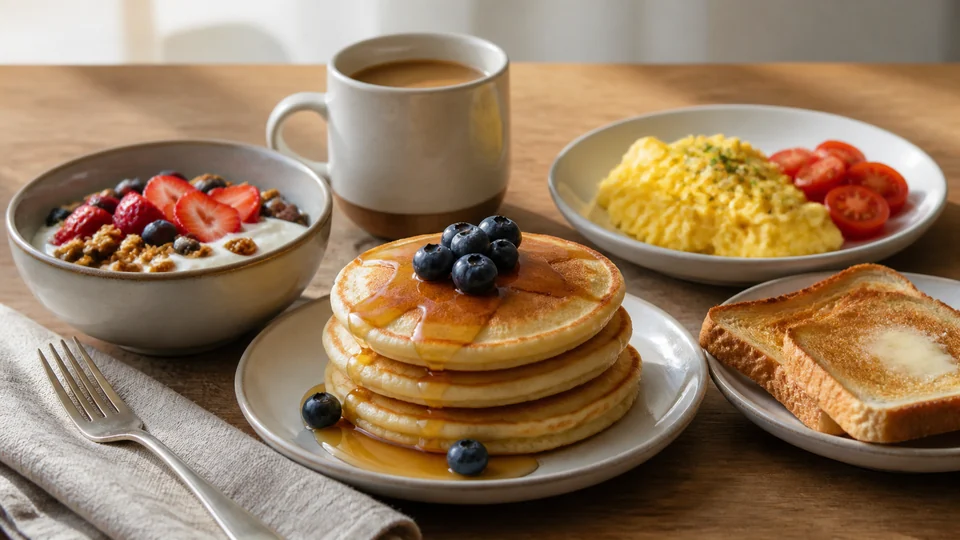
This guide is a menu-building framework rather than a claim that every dish is ready in a fixed number of minutes. Package directions, equipment, batch size and cook skill control the actual schedule. The parent Breakfast hub records the approved R10 context for quick breakfast menu.
| Guide sections |
|---|
| Choose the working format before shopping |
| A controlled preparation sequence |
| Practical diagnostics |
| Food-safety and factual boundary |
For broader context, continue with American Breakfast: Pancakes, Diner Plates and Brunch.
Choose the working format before shopping
For quick breakfast menu, compare skillet anchor with a cold side, toast board without a queue and oats prepared the night before before buying ingredients. That comparison reveals the service format, occupied equipment and required finish time. Every cooked component still needs one complete source formula with its own quantities and endpoint cues.
Skillet anchor with a cold side
Use a small batch of pancakes or eggs as the only pan-dependent item. While the pan heats, portion yogurt and fruit. This arrangement avoids asking one burner to carry toast, potatoes and a second cooked protein at the same time.
Toast board without a queue
Set out toast, a spread, sliced fruit and one savoury topping, then let diners assemble their own plates. Keep perishable toppings chilled until service and place utensils beside each item so the board does not become an improvised search for equipment.
Oats prepared the night before
A refrigerated oat component can remove morning stovetop work when it follows a complete tested formula. Add crunchy toppings at service so texture does not disappear during holding, and label portions when different milks or allergens are involved.
Egg-and-vegetable wrap
Cook a modest amount of filling, warm the wraps only when the filling is ready, and avoid overloading them. A compact wrap travels well because moisture is contained; watery salsa and cut tomatoes are better packed separately.
Warm leftovers with a fresh finish
A fully cooked breakfast casserole or pancake batch can shorten the active session if it was cooled and stored correctly. Reheat the portion thoroughly, then add fresh fruit or herbs after heating instead of warming every garnish.
A controlled preparation sequence
The quick breakfast menu sequence below connects write one target serving time and work backward from the longest verified cooking step. with serve the hot anchor immediately and bring the prepared cold components to the table together. A written order exposes equipment conflicts before heat begins, while separate work zones protect finished skillet anchor with a cold side components from raw-food contact.
1. Write one target serving time
Write one target serving time and work backward from the longest verified cooking step.
2. Group ingredients into cold assembly,
Group ingredients into cold assembly, hot cooking and last-minute garnish zones.
3. Preheat only the appliance named
Preheat only the appliance named by the selected recipe; unnecessary equipment creates cleanup without saving time.
4. Serve the hot anchor immediately
Serve the hot anchor immediately and bring the prepared cold components to the table together.
Practical diagnostics
When quick breakfast menu misses its target, compare the observed result with skillet anchor with a cold side and warm leftovers with a fresh finish controls first. Record one measurable variable—such as cut size, pan area, batch depth, ingredient identity, temperature, order or holding time—before changing the next attempt.
- If several items finish early, the menu has too many hot components.
- If toast becomes leathery, it is being held instead of served near completion.
- If assembly takes longer than cooking, reduce topping choices and pre-portion utensils.
- If timing varies widely, measure batch size and stop treating a family-size recipe as a one-pan shortcut.
Food-safety and factual boundary
For quick breakfast menu, USDA MyPlate, “What Is MyPlate?” supports only its named domain, while USDA FSIS, “Leftovers and Food Safety” supplies a separate boundary. Neither source establishes a Pancake World test record, a medical outcome, or identical behaviour across every appliance and ingredient.
Quantities, timing, yield and storage for quick breakfast menu must come from the selected complete recipe. Keep its perishable components under appropriate temperature control; prevent cross-contact around toast board without a queue; read current labels; and discard any batch with an uncertain time or temperature history.
Contextual routes for the next decision
- In Quick breakfast menu, compare Healthy egg breakfast recipes for skillet anchor with a cold side decisions.
- In Quick breakfast menu, compare Veggie breakfast for oats prepared the night before sequencing.
- In Quick breakfast menu, compare Crockpot breakfast potatoes for warm leftovers with a fresh finish service choices.
Frequently asked questions
What is the fastest balanced format?
One cooked anchor with fruit and a ready cold component is easier to coordinate than three separate hot recipes.
Can pancakes be the quick anchor?
Yes, when the batter and batch size come from a complete recipe and the cook has enough pan area for the intended servings.
How should leftovers be used?
Only use food that was cooled, refrigerated and reheated according to the authoritative storage guidance listed below.
Explore related Pancakes World guidance on American Pancakes, Maple Syrup, and Maple Syrup Pancakes.
Sources and editorial references
- USDA MyPlate, “What Is MyPlate?” —
https://www.myplate.gov/eat-healthy/what-is-myplate - USDA FSIS, “Leftovers and Food Safety” —
https://www.fsis.usda.gov/food-safety/safe-food-handling-and-preparation/food-safety-basics/leftovers-and-food-safety - FoodSafety.gov, “Safe Minimum Internal Temperatures” —
https://www.foodsafety.gov/food-safety-charts/safe-minimum-internal-temperatures