Pumpkin breakfast cookies
At Pancakes World, for a complete, authoritative pumpkin breakfast cookie recipe, use Oregon State University Extension’s Food Hero formula. It combines canned pumpkin, brown sugar, eggs, vegetable oil, all-purpose and whole-wheat flours, baking powder, cinnamon, nutmeg, ginger, raisins, and chopped nuts; the source yields 48 soft cookies baked at 400°F. Follow its page for exact quantities and the 10-to-12-minute bake. The cookies are designed to be flattened before baking, so do not expect ordinary drop-cookie spread. For an oat-and-seed alternative, use University of Illinois Extension’s separate pumpkin trail-cookie formula rather than combining the two.
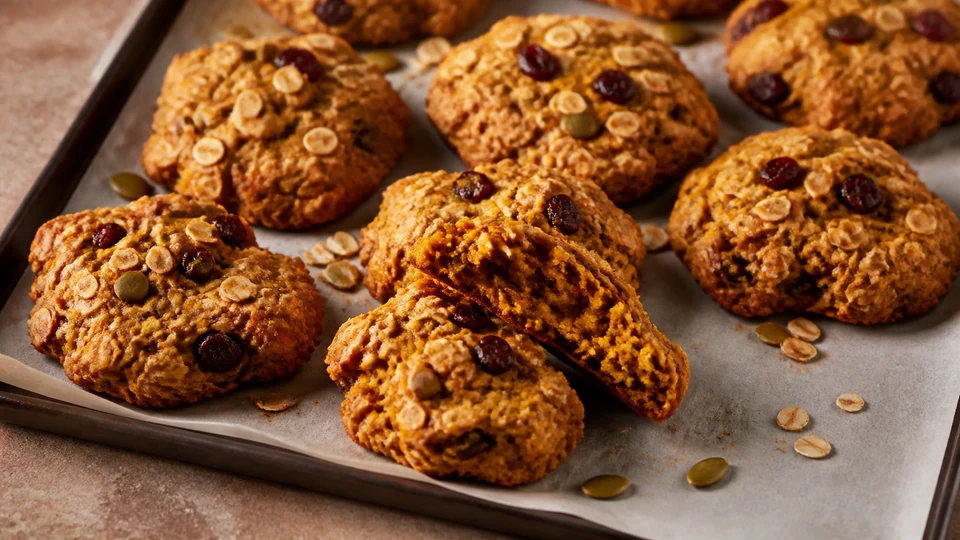
This guide helps you choose, prepare, modify, portion, and store either source recipe without inventing a third formula. The breakfast hub covers other morning choices, while Pancake World connects the wider collection.
For broader context, continue with American Breakfast: Pancakes, Diner Plates and Brunch.
Direct answer: start with the OSU recipe
Choose the OSU Extension pumpkin breakfast cookies when you want a soft, wheat-based cookie with raisins and optional nuts and need a large batch. The source uses one standard 15-ounce can of pumpkin purée and makes 48 cookies. It also publishes tested preference notes for egg-free, gluten-free, soy-free, tree-nut-free, and peanut-free versions.
Choose the Illinois Extension pumpkin trail cookies when you want an oat-forward architecture built from rolled oats, quick oats, cranberries, pumpkin seeds, and flax. That source makes 18 larger cookies and bakes at a different temperature and time. Its ratios cannot be imported into the OSU dough.
“Breakfast cookie” describes a portable baked format and the way a source presents it. It does not prove that one cookie is a complete breakfast, lower in sugar than every cereal, suitable for a medical diet, or nutritionally interchangeable with oatmeal. Evaluate the complete formula, portion, accompaniments, and individual needs.
Compare the two authoritative recipes
| Decision | OSU pumpkin breakfast cookies | Illinois pumpkin trail cookies |
|---|---|---|
| Main structure | All-purpose and whole-wheat flour | Rolled and quick-cooking oats with flax |
| Pumpkin | Cooked purée or a 15-ounce can | Canned pure pumpkin in the source amount |
| Sweetener | Brown sugar | Honey |
| Fat | Vegetable oil | Margarine or coconut oil |
| Egg | Two eggs, with OSU aquafaba option | Two eggs in the published formula |
| Fruit | Raisins or another source-supported dried fruit | Dried unsweetened cranberries |
| Crunch | Chopped nuts, optional under source guidance | Pumpkin seeds |
| Yield | 48 smaller cookies | 18 larger trail cookies |
| Source oven setting | 400°F | 350°F |
The comparison is for selection. Once you choose, keep that recipe’s quantities, scoop size, flattening method, pan treatment, temperature, and endpoint together.
What makes the OSU cookie work
Pumpkin purée
Pumpkin brings water and solids to the dough. The OSU formula uses cooked, puréed pumpkin and identifies a 15-ounce can as the convenient amount. Buy pure pumpkin, not pumpkin pie filling. Pie filling is a sweetened and seasoned product with a different composition.
Read the can label before opening. If using home-cooked pumpkin, follow the source description and understand that homemade purée can vary in moisture. Do not add extra pumpkin because a partial can is available; more water can alter spread, set, and baking time.
Once opened, transfer unused pumpkin to a clean covered container if the can is not fully used by another recipe. Refrigerate or freeze it promptly according to reliable storage guidance and the product label. Do not leave purée at room temperature throughout a long baking session.
Two-flour system
OSU uses both all-purpose flour and whole-wheat flour. The blend supports structure while incorporating a whole-grain ingredient. USDA MyPlate encourages making at least half of grain choices whole grains, but that general guidance does not turn any cookie into a universal health food.
Measure flour using the method intended by the source. Scooping and compressing flour into a cup can add more than expected and dry the cookies. Do not replace all flour with oats, almond flour, or coconut flour; those ingredients absorb and bind differently.
OSU publishes a wheat-free and gluten-free suggestion using an all-purpose gluten-free flour mix. That is a source-supported option, but the texture will differ. Check every component, not only the flour, when gluten-free food is required.
Eggs and oil
Eggs help bind and set the cookies. Vegetable oil supplies fat throughout the dough. Deleting either changes structure. OSU’s egg-free note uses six tablespoons of aquafaba for the eggs; that is more reliable than inventing a banana or flax replacement for this particular formula.
Aquafaba is the liquid drained from canned white beans such as chickpeas. Its package may contain sodium or other ingredients, and it introduces a legume-derived component. The source advises freezing extra aquafaba. Label it clearly so it is not mistaken for stock or discarded liquid.
For soy-free cookies, OSU directs readers to avoid soybean oil. A generic bottle labeled “vegetable oil” can contain soybean oil, so read the ingredient statement. For peanut-free service, avoid peanut oil. These changes address ingredients, but home cross-contact still needs attention.
Brown sugar
Brown sugar is an added sugar. FDA explains that added sugars appear on Nutrition Facts labels and can be compared using grams and Percent Daily Value. The presence of pumpkin, whole-wheat flour, raisins, or nuts does not erase the brown sugar in the recipe.
Measure it as written. Reducing sugar can change more than sweetness: moisture retention, tenderness, spread, and browning may change. If a lower-added-sugar target is important, choose a tested formula developed for it rather than altering this dough and retaining the source’s claims or nutrition panel.
Baking powder and spices
Baking powder provides leavening. Cinnamon, nutmeg, and ginger create the warm-spice profile. Measure baking powder carefully; a tablespoon is materially different from a teaspoon. Use clean, dry measuring spoons and avoid dipping a utensil that touched raw egg into spice jars.
Pumpkin pie spice is not listed as a one-for-one substitute in the OSU formula. Blends vary. Use the individual spices named by the source unless it publishes a conversion.
Raisins and nuts
OSU permits another dried fruit when raisins are unavailable. Dried cranberries, chopped apricots, dates, and other products differ in size, sweetness, oil, preservatives, and added sugar. Use a source-supported type and keep the stated volume rather than adding several varieties at once.
Chopped nuts add texture and are optional under OSU’s tree-nut-free guidance. If nuts are omitted, do not automatically replace them with the same volume of seeds; that is a new structural and allergen decision. A nut-free label also depends on the packages and kitchen environment.
Preparation workflow for the OSU formula
1. Read the complete source first
Confirm yield, equipment, pan capacity, ingredient quantities, and supported substitutions. A 48-cookie batch may require several sheets or baking rounds. Decide before mixing how unbaked dough will remain cool and how finished cookies will cool.
2. Prepare the workspace
Wash hands and clean the counter. Set out two mixing bowls, measuring tools, a sturdy spoon, baking sheets, a tablespoon measure or scoop, and cooling racks. Preheat to the source’s 400°F and lightly grease sheets as directed.
If an oven thermometer shows a consistent offset, account for it carefully. Do not alter the source temperature based on surface colour from a single prior bake.
3. Mix the wet ingredients
Stir pumpkin, brown sugar, eggs, and oil until smooth, following OSU’s sequence. Scrape the bowl so concentrated sugar or egg does not remain at the bottom.
Do not taste raw dough. It contains raw egg and flour. Raw flour is not a ready-to-eat food, and tasting is not a valid way to adjust spice or sweetness.
4. Combine dry ingredients separately
Distribute both flours, baking powder, cinnamon, nutmeg, ginger, and salt before they meet the wet mixture. This reduces concentrated pockets of leavener or spice.
Add dry to wet and mix until incorporated. Prolonged aggressive mixing can change a wheat-based cookie’s texture. Stop when no dry flour pockets remain, then fold in raisins and nuts.
5. Portion consistently
OSU directs dropping dough by tablespoon and spacing cookies one inch apart. Use the same measure for each portion so pieces finish at similar times. A heaping serving spoon can double the intended size and invalidate the bake estimate.
Gently flatten each portion with the back of a spoon. Pumpkin dough may hold its shape rather than spreading like a high-butter cookie. Flattening is part of the recipe, not a decorative option.
6. Bake to the source endpoint
OSU gives 10 to 12 minutes at 400°F, until tops are dry and begin to brown. Start checking at the lower end. Pan colour, cookie size, oven zones, and multiple sheets can change timing.
Use the source’s visual endpoint as a quality cue within its tested formula. Do not move that clock to the Illinois oat cookie, which uses a different dough, portion, temperature, and schedule.
7. Cool completely
Let cookies set briefly as appropriate, then move them to a rack so steam can escape. A soft cookie may feel delicate while hot. Packing warm cookies traps condensation and can shorten quality life.
Use a clean spatula and cooling rack. Keep raw-dough utensils away from finished cookies.
The Illinois oat-and-seed alternative
Illinois Extension’s pumpkin trail cookies use canned pure pumpkin, eggs, honey, rolled oats, quick-cooking oats, dried unsweetened cranberries, pumpkin seeds, ground flaxseed, pumpkin pie spice, salt, and margarine or coconut oil. The source portions three tablespoons for each of 18 cookies, flattens them, and bakes at 350°F.
Choose this architecture when visible oats, cranberries, seeds, and flax are the intended result. It is not simply the OSU cookie with flour removed. Rolled and quick oats perform different jobs: rolled oats retain more distinct texture, while quick oats integrate more closely. Flax and pumpkin seeds add their own absorption and structure.
Honey counts as added sugar in FDA labeling context. Calling the Illinois cookie “naturally sweetened” would not make its sweetener nutritionally invisible. Use the source quantity and evaluate the full serving.
The Illinois PDF publishes nutrition information for its exact formula and serving. Do not copy those numbers onto a version made with different oil, fruit, seed quantity, cookie size, or sweetener.
Which cookie fits your breakfast plan?
Choose OSU when:
- you want a soft wheat-based cookie;
- a 48-cookie batch is useful;
- raisins and optional chopped nuts fit the group;
- you need one of OSU’s explicitly supported substitutions;
- the 400°F short bake works with the rest of the meal.
Choose Illinois when:
- you want an oat-forward cookie with two oat textures;
- pumpkin seeds and cranberries are desired;
- 18 larger portions fit better;
- honey is the chosen sweetener;
- a 350°F bake can share the schedule with other food.
Do not choose by a single ingredient such as whole-wheat flour, oats, honey, or pumpkin. Read the complete formula, serving size, allergen profile, and source directions.
Are pumpkin breakfast cookies healthy?
There is no responsible universal yes-or-no answer. A cookie can contain pumpkin, whole grains, fruit, nuts, seeds, sugar, oil, eggs, and flour in the same formula. The amount eaten and foods served alongside it affect the meal.
For general comparison:
- look at the actual serving size;
- identify added sugars rather than judging sweeteners by name;
- check saturated fat and sodium on packaged ingredients when relevant;
- note whole-grain ingredients without assuming they cancel everything else;
- consider allergens and dietary restrictions;
- distinguish a portable snack from a complete meal.
FDA’s general Percent Daily Value guide considers 5% DV or less low and 20% DV or more high for an individual nutrient on a labeled serving. That tool helps compare packaged foods. A homemade cookie without validated analysis should not be assigned precise nutrition claims from an informal calculator.
Someone managing diabetes, celiac disease, food allergy, kidney disease, or another medical condition may need individualized professional guidance. This article does not prescribe a therapeutic breakfast.
Gluten-free and allergen decisions
Gluten-free
FDA defines “gluten-free” for voluntarily labeled US foods, including a requirement that unavoidable gluten be below 20 parts per million. For OSU’s supported gluten-free variation, choose an all-purpose flour mix bearing suitable labeling and check baking powder, spices, dried fruit, oil, and every other packaged ingredient.
For the Illinois oat recipe, oats themselves require label attention when gluten-free food is needed. An oat product is not guaranteed appropriate merely because oats do not inherently belong to wheat, rye, or barley. Cross-contact matters.
Egg
OSU’s aquafaba option is explicitly source-supported. Illinois does not publish that same replacement in its trail-cookie PDF, so do not transfer it and expect identical results. Choose the OSU recipe when that tested egg-free path fits.
Tree nuts and peanuts
OSU permits omitting nuts for a tree-nut-free cookie and avoiding peanut oil for a peanut-free version. Check flour mixes, dried fruit, oils, and shared equipment. “No nuts added” is not an allergen guarantee if packages or surfaces have cross-contact.
Illinois uses pumpkin seeds, which are not tree nuts, but an individual can still have a seed allergy. Read labels and avoid presenting a substitution as universally safe.
Soy
Avoid soybean oil for OSU’s soy-free variation and inspect all packaged ingredients. A generic vegetable oil blend may contain soy. Margarine in the Illinois recipe can also contain soy, milk, or other ingredients depending on the product.
Batch planning
Forty-eight cookies require space. Count sheets and rack positions before mixing. If only one pan fits without crowding, keep remaining dough covered and cool between rounds according to safe practice.
Do not place dough on a hot sheet unless the source expects it. A hot pan can begin setting or spreading the next batch before it reaches the oven. Cool, clean, and regrease sheets as required.
For consistent portions, use one tablespoon for OSU and the source’s three-tablespoon portion for Illinois. Count cookies as they are scooped; do not rely on memory after several sheets.
If baking two sheets at once, oven airflow and upper/lower heat can produce uneven colour. Rotate only if the source and oven allow it. Check both sheets independently and remove finished cookies rather than extending all pieces for the palest corner.
Serving pumpkin cookies at breakfast
Decide whether the cookie is the main item, one component, or a portable snack. A smaller OSU cookie and a larger Illinois trail cookie are not equal portions. State which recipe and size are being served.
Possible accompaniments include plain milk, an appropriate fortified alternative, yogurt, fruit, or another food that fits the diner. These additions change nutrition and allergens. A sweetened yogurt or beverage may add more sugar than expected, so labels remain relevant.
For a group, label nuts, eggs, wheat, soy, and seed ingredients accurately. Keep allergen-managed cookies on a separate clean platter with separate tongs. Do not stack them under ordinary cookies and call the upper layer safe.
Pack cookies only after complete cooling. For transport, use a clean rigid container so soft cookies are not crushed. Keep any perishable accompaniments cold.
Storage and make-ahead decisions
Buying and managing canned pumpkin
Read the statement of identity and ingredient list. A can labeled pure pumpkin or pumpkin purée is the intended type; pumpkin pie filling normally contains sweetener and spices and would duplicate ingredients already measured in the dough. Can sizes also vary, so match the source’s 15-ounce reference rather than assuming every can is equivalent.
Inspect the package before purchase and opening. Do not use a can that is leaking, bulging, or badly damaged around a seam. Clean the lid before opening so debris does not fall into the food. Use a clean opener and spatula, and avoid letting the lid’s exterior contact the purée.
If weighing purée, tare the bowl before adding it. If measuring by volume under a source that permits volume, level the measure consistently. Do not pour off liquid from one can or add water to another unless the recipe directs it; those changes alter hydration.
Transfer leftover pumpkin out of the opened can into a clean, covered food-storage container. Label the date and intended use. Freeze a measured amount when it will not be used promptly, then thaw it under refrigeration. After thawing, stir separated liquid back only when the next source recipe expects ordinary purée; otherwise follow that recipe’s directions.
Scaling the batch responsibly
The OSU yield of 48 may be more than a small household needs. The safest option is often to bake the documented batch and freeze finished portions rather than dividing tiny quantities of baking powder, spice, or egg by eye. If you scale, use exact arithmetic and weight where practical, retain the ingredient proportions, and keep the original tablespoon portion.
Halving two eggs is straightforward because the source uses two, but other divisions can create partial eggs. Beat an egg uniformly before weighing a required fraction; do not choose “the yolk half” or “the white half.” A fractional can of pumpkin must also be measured accurately.
Doubling requires more than a larger bowl. Confirm mixer or spoon capacity, count the required pans, and avoid holding a large mass of egg-containing dough at room temperature while several rounds bake. Mix separate source-size batches when equipment or timing cannot manage a double batch evenly.
Do not double the scoop size to reduce the number of trays. A two-tablespoon OSU cookie has a deeper centre than the source’s tablespoon cookie and needs a separately tested bake. Preserve portion size and add baking rounds instead.
Packing and transport
Cool cookies completely before packing. Put soft cookies in a rigid container rather than a flexible bag that allows crushing. Separate layers with food-safe paper, and avoid stacking so high that lower cookies compress.
For school, work, or a shared event, attach an ingredient and allergen note based on the exact batch. State whether the cookies contain wheat, egg, tree nuts, soy, sesame, or other relevant ingredients. Do not reuse the standard recipe’s label for an aquafaba, gluten-free, or nut-free variation.
If cookies are served with milk, yogurt, or another perishable item, keep that accompaniment at a safe cold temperature during transport. The cookie container does not function as refrigeration. Keep allergen-managed cookies sealed and physically separated from ordinary cookies until service, with their own utensil.
The source pages should guide recipe-specific storage. Because these soft cookies contain pumpkin and egg and retain moisture, avoid assuming they have the shelf life of a crisp commercial biscuit.
Cool fully, then place in a clean covered container. If the source recommends refrigeration, follow it. In a warm or humid kitchen, refrigeration is the more cautious choice for a moist homemade cookie when no validated room-temperature shelf life is provided.
Separate layers with food-safe paper if sticking is likely. Label the recipe, allergens, and bake date. Keep nut-free and nut-containing batches in separate containers.
For freezing, use the source’s supported guidance where available. Package cooled cookies in meal-size portions, remove excess air, and label. Thaw under clean, controlled conditions. Freezing preserves quality; it does not make a batch safe if ingredients were mishandled before freezing.
Do not store raw dough for an assumed period unless the recipe says it can be refrigerated or frozen. Baking powder activity, flour hydration, and food safety can change during a long hold.
Common problems and decisions
Cookies stay in round mounds
Both sources direct flattening before baking. The dough is not expected to flow like a butter-rich drop cookie. Use the back of a spoon or the source tool and match the stated thickness.
OSU cookies are dry
Check flour measurement, pumpkin amount, scoop size, oven accuracy, and bake time. Packed flour or small portions baked for the full maximum can dry quickly. Do not add unmeasured pumpkin to the next batch; correct the identified measurement first.
Cookies are wet in the centre
Confirm portion size, flattening, pan spacing, and oven temperature. A heaping scoop creates a deeper centre. Extra pumpkin, fruit, or liquid sweetener changes the formula. Continue only until the source endpoint is reached, then cool as directed.
Spices taste uneven
Whisk or stir dry ingredients thoroughly before adding them to the pumpkin mixture. Break up baking-powder and cinnamon clumps. Do not sprinkle extra spice over raw dough after one tray is already baking.
Fruit burns at the edge
Keep dried fruit inside the dough rather than leaving pieces exposed on a dark pan. Measure the source quantity and use consistent portions. If a replacement fruit is larger, chop it only when the source permits a different dried fruit and maintain the intended scale.
Cookies stick
Use the pan preparation specified by the source. Let cookies set enough to lift without tearing, but do not leave them steaming on the sheet indefinitely. A thin spatula helps with soft cookies.
Egg-free cookies differ in texture
OSU explicitly warns that free-from changes can alter texture and nutrient content. Treat the aquafaba version as a supported variation, not an identical clone. Measure six tablespoons accurately and retain the rest of the formula.
Gluten-free cookies crumble
All-purpose gluten-free flour mixes vary in starches, gums, and protein. Use a mix designed as a cup-for-cup style substitute when that matches OSU’s note, and expect texture differences. Do not add random binders without a tested direction.
What not to claim
Do not call these cookies sugar-free: OSU uses brown sugar and Illinois uses honey. Do not call them automatically vegan: the standard formulas use eggs, and other ingredients require checks. Do not call them gluten-free without compliant ingredients and cross-contact controls.
Do not advertise them as high-protein, low-calorie, diabetic-friendly, weight-loss, heart-healthy, or performance-enhancing without evidence that meets the claim and the exact finished recipe. Do not copy a source nutrition panel after changing ingredients or portion size.
Do not say the recipe has been tested by Pancake World. The evidence comes from OSU Extension and Illinois Extension, and the complete source formula remains on those pages.
Final recommendation
For a soft, wheat-based pumpkin breakfast cookie, follow OSU’s 48-cookie formula and its exact mixing, tablespoon portion, flattening, 400°F oven, and 10-to-12-minute endpoint. Use only the substitutions OSU specifically supports.
For an oat, cranberry, pumpkin-seed, and flax version, follow Illinois Extension’s separate 18-cookie trail formula at its own 350°F process. Do not merge the flour ratios, fats, sweeteners, or times.
Whichever you choose, buy pure pumpkin rather than pie filling, measure added sweetener, identify allergens, cool completely, store cautiously, and describe the cookie honestly as one possible breakfast component—not a universal nutrition solution.
Explore related Pancakes World guidance on American Pancakes, Maple Syrup, and Maple Syrup Pancakes.
Sources and editorial references
- Oregon State University Extension: Pumpkin Breakfast Cookies —
https://extension.oregonstate.edu/imported-publication/pumpkin-breakfast-cookies - University of Illinois Extension: Pumpkin Trail Cookies —
https://extension.illinois.edu/sites/default/files/pumpkin_trail_cookies.pdf - FDA: Added Sugars on the Nutrition Facts Label —
https://www.fda.gov/food/nutrition-facts-label/added-sugars-nutrition-facts-label - FDA: Questions and Answers on Gluten-Free Food Labeling —
https://www.fda.gov/food/nutrition-food-labeling-and-critical-foods/questions-and-answers-gluten-free-food-labeling-final-rule - FDA: Food Allergies —
https://www.fda.gov/food/nutrition-food-labeling-and-critical-foods/food-allergies - FoodSafety.gov: Cold Food Storage Chart —
https://www.foodsafety.gov/food-safety-charts/cold-food-storage-charts - USDA MyPlate: Make Half Your Grains Whole Grains —
https://www.myplate.gov/sites/default/files/2024-06/TipSheet-4-Make-Half-Your-Grains.pdf