Pre made vegan pancakes
At Pancakes World, pre made vegan pancakes are either sealed ready-to-heat products or pancakes cooked earlier at home. Choose between them by checking the current ingredient list, allergen statement, storage state, serving size and heating directions—not by relying on the front label alone. For a packaged option, keep the cold chain intact and follow its directions and date markings. For a home batch, cool promptly, separate portions, label the date and refrigerate or freeze. Reheat only the amount needed, aiming for an evenly hot center rather than a browned exterior. “Vegan” describes an ingredient policy; it does not by itself prove allergen safety, a particular nutrient profile or suitability for every diet.
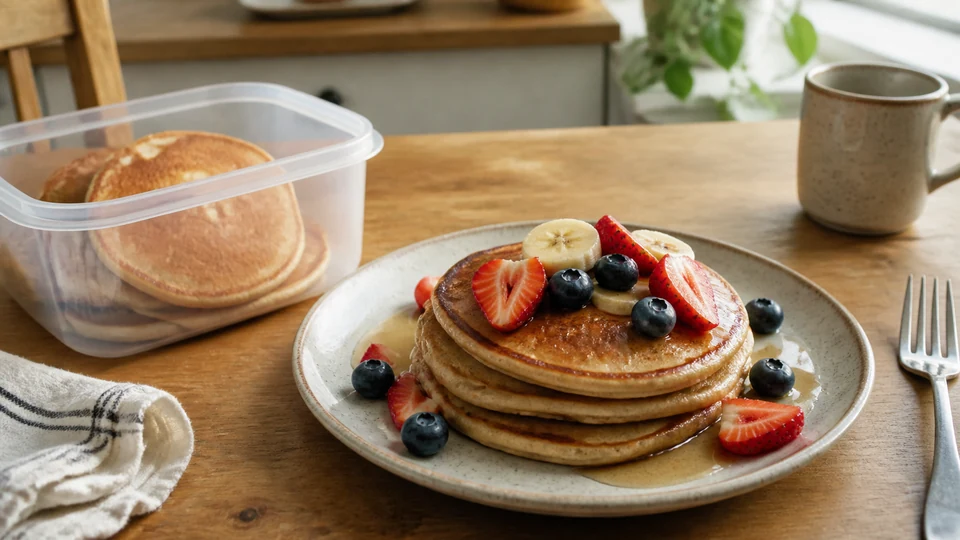
This is a selection, storage and reheating guide rather than a brand ranking or tested recipe.
| Guide sections |
|---|
| Decide what “pre made” needs to solve |
| Packaged and home-batched are different systems |
| Read the package in a fixed order |
| Verify vegan suitability without overclaiming |
For broader context, continue with Healthy Pancake Guides.
Decide what “pre made” needs to solve
The best format depends on the actual constraint. A commuter may need a portion that goes from freezer to toaster or microwave. A family may want a labeled home batch that can be reheated on different mornings. A host may need a controlled ingredient record. Someone with limited freezer space may prefer a refrigerated package, while a household that shops less often may prioritize frozen portions.
Define the use case before comparing packages:
- How many pancakes are needed at one sitting?
- Is a freezer, refrigerator or shelf-stable format required?
- Which appliance will be available?
- Must the pancakes meet an allergy or gluten-control plan as well as a vegan preference?
- Does the eater care about a specific serving of protein, fiber, sodium or added sugars?
- Is individual portioning more important than the lowest number of packages?
- Will the food travel before it is reheated?
These questions turn a vague search into a reproducible decision. They also prevent a package from winning merely because its photograph, count or headline looks familiar.
Packaged and home-batched are different systems
A sealed commercial package arrives with a manufacturer’s ingredient list, allergen declarations, Nutrition Facts, date markings, storage instructions and reheating directions. Those details are specific to that exact formulation and package. They can change, so the current label is the evidence.
A home batch offers control over the selected recipe and ingredients, but the cook becomes responsible for labeling, cooling, portioning, storage and traceability. A note saying only “pancakes” is insufficient when several batches or dietary needs share a freezer. Record the production date, recipe identity, important substitutions and allergen-control status.
Neither system is automatically superior. A package may reduce preparation time but still require label review. A home batch may provide better ingredient visibility but only when the recipe and kitchen controls are documented. Compare the work that remains after purchase or cooking, not just the moment of reheating.
Read the package in a fixed order
Use the same scan each time so attractive claims do not hide the details that determine suitability.
1. Statement of identity
Confirm what the package actually contains: fully cooked pancakes, a batter, a dry mix or another breakfast item. “Ready to heat,” “heat and serve” and “just add water” describe different tasks. Do not assume a photograph means the product is fully cooked.
2. Storage state
Identify whether the product is sold frozen, refrigerated or shelf stable. That state determines how it should travel home and where it belongs before opening. Do not place a refrigerated product in a pantry because the package resembles a shelf-stable one.
3. Ingredient list
Read every ingredient, including sub-ingredients in flavors, chips, spreads or inclusions. A front claim cannot replace this review. For a vegan purchase, decide in advance which ingredients or processing aids require clarification under the eater’s standard. If the wording is ambiguous, contact the manufacturer rather than guessing.
4. Allergen information
FDA identifies nine major food allergens in the United States: milk, egg, fish, crustacean shellfish, tree nuts, peanuts, wheat, soybeans and sesame. Covered packaged foods must identify major allergen sources used as ingredients. Read both the ingredient list and any Contains statement. Evaluate voluntary advisory language under the individual’s plan.
Vegan does not mean wheat-free, soy-free, sesame-free, peanut-free or tree-nut-free. “Dairy-free,” “non-dairy,” “plant-based” and “vegan” should not be treated as identical promises. A person with a food allergy needs the current package and their established avoidance rules, not an inference from marketing language.
5. Directions and date markings
Check whether the pancakes should remain frozen, thaw under refrigeration or move directly to an appliance. Note whether the directions differ for microwave, toaster, skillet or oven. Record the relevant package date and any after-opening instruction. Do not replace a manufacturer’s specific instruction with a general internet rule.
6. Package identity
If the product will be stored outside its outer carton, preserve the name, UPC, lot code and date information. A loose plastic bag of unidentified pancakes loses the details needed to check a recall or distinguish two formulations.
Verify vegan suitability without overclaiming
There is no useful shortcut around a complete current-label review. Recipes and suppliers can change. A package purchased safely before should still be checked when it is purchased again.
Look for obvious animal-derived ingredients such as milk and egg, then review compound ingredients and unfamiliar terms according to the eater’s vegan standard. A voluntary vegan mark can be useful evidence of the maker’s policy, but the page does not treat every mark as equivalent or certify a package on the reader’s behalf.
When clarity is missing, ask the manufacturer a specific question:
- Is the exact UPC and lot made without the ingredient in question?
- Does the company’s vegan statement cover ingredients, processing aids and shared equipment?
- Has the formulation changed from the version shown on an older web page?
- Which package panel is current?
Save the response with the product identity and date. Avoid turning a one-time answer into a permanent claim about every package under the brand.
Treat allergy needs as a separate gate
An item can meet a vegan preference and still be unsuitable for an allergy. Wheat, soy, sesame, peanuts and tree nuts can occur in vegan foods. Cross-contact may matter even when an allergen is not an intentional ingredient.
For an allergy-controlled selection:
- Obtain the eater’s exact avoidance list.
- Read the ingredient list and major-allergen declaration.
- Evaluate advisory wording using the person’s existing plan.
- Preserve the package until the food is consumed.
- Prevent contact with shared spreads, toaster crumbs, utensils and serving plates.
- Do not promise “safe,” “free from” or zero risk when the evidence supports only a narrower statement.
Accurate wording is concrete. “The current package lists no milk or egg ingredient” describes an observation. “The manufacturer confirmed this UPC on this date” describes traceable evidence. “Safe for everyone” exceeds both.
Compare Nutrition Facts on equal terms
The Nutrition Facts panel gives values for the labeled serving, not necessarily the portion a person plans to eat. FDA explains that serving size reflects the amount people typically consume; it is not a recommendation.
Before comparing two options, normalize them:
- Record the grams and number of pancakes in one labeled serving.
- Choose a common basis, such as the intended breakfast portion or 100 grams.
- Convert calories and nutrients to that common basis.
- Compare the nutrients that matter for the specific meal.
- Add toppings or beverages separately rather than attributing them to the pancakes.
Suppose one label uses two pancakes as a serving and another uses three. Comparing the printed numbers directly may be misleading if the pancakes differ in size. Use the gram weight or calculate both for the portion you will actually serve.
Useful comparison fields can include protein, dietary fiber, added sugars, sodium and saturated fat. The appropriate priority depends on the rest of the meal and the eater’s needs. Vegan labeling alone predicts none of those values. Two vegan products can have very different formulas and serving sizes.
Do not publish remembered nutrition numbers. Use the current package. If a medical condition requires a controlled intake, follow qualified individualized advice.
Choose the format by workflow
Frozen packaged pancakes
Frozen products suit longer planning horizons and portion-by-portion use when the package supports resealing or the household can repackage without losing identity details. They require freezer space and a reliable cold chain. Texture can change when a package repeatedly warms and refreezes, so remove portions efficiently and close it promptly.
Refrigerated packaged pancakes
Refrigerated products can reduce thawing time but usually have a shorter handling window than frozen ones. Keep them cold during transport, observe the package date and follow after-opening instructions. Do not transfer them to an unlabeled container unless the identifying details remain attached.
Shelf-stable packaged pancakes
Shelf-stable status must come from the package, not appearance. Store as directed before opening and follow the after-opening instruction. A package that can sit unopened in a cupboard may require refrigeration once its seal is broken.
Home-cooked make-ahead pancakes
Home batching works when the household has an approved recipe and wants exact portion sizes. It adds cooling, labeling and storage duties. Because this page has no Pancake World test record, it does not invent a batter, yield or cooking time. Use a genuinely tested recipe and document any variation separately.
Bring packaged pancakes home safely
Add frozen and refrigerated foods near the end of a shopping trip. Take them directly home, especially in warm weather or when travel is long. Use an insulated carrier when the route or conditions require it.
At home:
- put frozen packages in a freezer promptly;
- put refrigerated packages at 40°F (4°C) or below;
- keep the outer package or copy all identifying details;
- avoid crushing a resealable closure;
- separate allergy-controlled food from open ingredients that could contaminate it;
- rotate older packages forward without discarding the date and lot codes.
USDA explains that freezing does not sterilize food. It slows microbial activity; once food thaws, surviving microbes can become active again. Handle thawed perishable food with the same care as fresh food.
Batch homemade pancakes for later
Start with a tested vegan recipe. Keep its version, ingredient packages and any substitutions visible until the batch is labeled. If allergy controls apply, complete the planned cleaning, equipment and service steps before cooking.
After cooking:
- Move the pancakes out of the hot pan and avoid leaving the batch at room temperature unnecessarily.
- Arrange portions so heat can escape rather than sealing a deep hot stack.
- Refrigerate or freeze promptly in food-safe packaging.
- Separate portions with suitable material if that makes later removal easier.
- Label the route or recipe name, batch date, portion count and substitutions.
- Add an allergy-control note only if the documented process supports it.
- Keep a short inventory so older batches are used first.
USDA’s general leftover guidance gives cooked leftovers three to four days in the refrigerator. Freezer storage recommendations concern quality when food remains continuously frozen at 0°F (-18°C) or below. A tested project record may establish a more specific quality window, but this untested guide does not invent one for pancakes.
Reheat according to the evidence
For a commercial product, begin with its directions. They account for the product’s thickness, formulation, package state and intended appliance. If the package says to keep frozen and heat from frozen, do that. If it calls for refrigerated thawing, follow that route.
For a home batch, choose the appliance by the desired result and portion size:
- a microwave is fast and benefits from covering, rearranging and a short rest;
- a toaster can dry or crisp thinner pancakes but may not suit sticky fillings or every appliance;
- a skillet gives surface control but needs attention to avoid scorching before the center warms;
- an oven can heat several portions together but takes longer and can dry exposed edges.
USDA advises reheating leftovers to 165°F (74°C), measured with a food thermometer. In a microwave, cover, rotate or rearrange for even heating, check more than one place and allow the stated rest. Cold spots matter more than surface color.
Heat only the amount needed. Repeated warming and cooling complicate quality and handling. Serve the reheated portion promptly and return unused cold food to storage without leaving the whole package beside the appliance.
Build a breakfast, not a label fantasy
Pre made pancakes are one component. Decide what the meal lacks after reading the actual panel. Fresh fruit, a cooked fruit topping, an approved spread or a savory side can change texture and composition, but each addition has its own ingredients and allergen controls.
Keep topping decisions separate from the base-product assessment. A pancake that meets the planned standard can be compromised by a shared butter knife, a jar containing crumbs or a topping with an unreviewed ingredient list. For a controlled meal, portion approved toppings with clean utensils.
Avoid calling a meal “high protein,” “low sugar,” “balanced” or suitable for a condition unless the complete portion and applicable definitions support that wording. Editorial combinations are serving ideas, not measured nutrition claims.
A five-minute purchase decision
When time is short, use this compact gate:
Identity: Is this fully cooked food, batter or mix?
Vegan evidence: Does the current ingredient and manufacturer information meet the eater’s standard?
Allergy evidence: Are the ingredient list, Contains statement and advisory wording compatible with the individual plan?
Storage: Can the cold state be maintained from store to home?
Use: Is the available appliance compatible with the directions?
Portion: How many grams or pieces will actually be eaten?
Traceability: Will the UPC, lot and date remain available?
If one critical answer is missing, choose another product or delay the purchase until the manufacturer clarifies it. Convenience is lost when the food cannot be served with confidence.
Make a household pancake card
A small card prevents repeated guesswork. Record:
- product or recipe name;
- UPC or recipe version;
- purchase or batch date;
- package date and lot code;
- storage location;
- portion size;
- approved appliance and direction summary;
- known substitutions;
- allergen-control decision and reviewer;
- date the label or manufacturer answer was checked.
For a frozen home batch, place a short label on the package and keep the detailed card in a kitchen log. For a commercial package, photograph all panels before discarding a damaged carton. Update the card instead of silently overwriting old evidence when a formula changes.
Check recalls by exact package identity
Food recalls can result from contamination, foreign material or undeclared major allergens. A headline or product name alone may not identify the package in the freezer.
FDA recall notices can include the product name, package size, UPC, lot code, use-by or sell-by date, label photographs and distribution information. Compare each element. Follow the notice’s instructions for return or disposal; do not improvise a salvage method.
No current recall is claimed here. The practical rule is to retain enough identity data to check official notices when needed.
Common failures and precise fixes
Buying from an old online ingredient list
Failure: The web page or saved screenshot describes a previous formulation.
Fix: Check the physical package for the exact item being bought, then contact the manufacturer if the panels conflict.
Treating vegan as an allergy guarantee
Failure: A vegan headline is used to infer absence of wheat, soy, sesame, peanuts or tree nuts.
Fix: Apply a separate allergy gate using the current ingredient and allergen information.
Comparing unequal servings
Failure: Printed calories or protein are compared even though one serving weighs much more.
Fix: Normalize both products to the intended portion or an equal gram basis.
Losing the carton
Failure: Inner bags remain, but the directions, date and lot code are discarded.
Fix: Preserve the carton, cut out the relevant panels or store clear photographs with the package identity.
Browning the outside while the center stays cool
Failure: High heat gives color before an even reheat.
Fix: Follow the package method; for leftovers, use moderate heat, rearrange portions and verify the center.
Freezing one solid stack
Failure: The household must thaw more pancakes than it needs.
Fix: Package home batches in serving portions or separate them before freezing.
Using one topping utensil
Failure: Crumbs or an excluded ingredient move into an otherwise suitable serving.
Fix: Portion toppings in advance with clean or dedicated utensils where required.
Questions to ask before stocking up
Stocking several packages makes sense only after one package fits the household workflow. Ask:
- Did the ingredient and allergen evidence pass?
- Did the preferred appliance heat it evenly when used according to directions?
- Is the labeled serving useful, or will every meal require a different amount?
- Can the freezer hold the packages without damaging seals?
- Will the product be used before quality declines?
- Can every stored unit retain its identifying codes?
This is a logistical evaluation, not a published product test. Keep personal notes private unless the method and product identity are documented well enough to support a public statement.
FAQ
Are pre made vegan pancakes always dairy-free and egg-free?
Do not infer suitability from the page title. Read the current ingredient list and allergen information, and evaluate any voluntary vegan representation under the eater’s own standard. Manufacturing cross-contact may also matter.
Are plant-based and vegan the same claim?
They should not be treated as interchangeable without evidence. FDA notes that plant-based alternatives vary by plant source, processing and added ingredients. Verify what the manufacturer means for the exact product.
Can frozen pancakes be reheated without thawing?
Follow the package. USDA says some frozen leftovers can be reheated without thawing, but a commercial product’s directions are the more specific evidence for that item. Heating will generally take longer from frozen.
How long can homemade pancakes stay refrigerated?
USDA’s general cooked-leftover guidance is three to four days under proper refrigeration. If the pancakes were left out too long, mishandled or show signs of spoilage, a calendar date does not rescue them.
Does freezing kill all bacteria?
No. USDA explains that freezing makes microbes inactive rather than sterilizing food. Safe handling remains necessary after thawing.
Should two labels be compared by pancake count?
Only if the pancakes and serving weights are equivalent. Gram weight or the intended meal portion usually gives a more dependable comparison.
Can I discard the package after moving pancakes to a freezer bag?
Keep or copy the ingredient, allergen, directions, UPC, lot and date details. Without them, later verification and recall matching become harder.
Is this a tested make-ahead recipe?
No. It is a sourced handling and selection guide. Use a genuinely tested recipe for quantities, timing, yield and texture claims.
Final decision rule
Choose pre made vegan pancakes only when four records agree: the current ingredient and allergen evidence, the storage state, the available reheating method and the portion you intend to serve. A front label answers only part of that decision.
For packaged pancakes, preserve the package identity and follow its storage and heating directions. For a home batch, preserve the tested recipe identity, cool and portion promptly, label it completely and apply conservative leftover controls. Keep vegan suitability, allergy suitability and nutrition comparison as separate checks. That disciplined separation delivers convenience without inventing product facts or safety guarantees.
Explore related Pancakes World guidance on American Pancakes, American Breakfast: Pancakes, Diner Plates and Brunch, and Maple Syrup.
Sources and editorial references
- U.S. Food and Drug Administration, “How to Understand and Use the Nutrition Facts Label”:
https://www.fda.gov/food/nutrition-facts-label/how-understand-and-use-nutrition-facts-label - U.S. Food and Drug Administration, “Food Allergies”:
https://www.fda.gov/food/nutrition-food-labeling-and-critical-foods/food-allergies - U.S. Food and Drug Administration, “Frequently Asked Questions: Food Allergen Labeling Guidance for Industry”:
https://www.fda.gov/food/food-allergensgluten-free-guidance-documents-regulatory-information/frequently-asked-questions-food-allergen-labeling-guidance-industry - U.S. Food and Drug Administration, “Plant-Based Milk and Animal Food Alternatives”:
https://www.fda.gov/food/nutrition-food-labeling-and-critical-foods/plant-based-milk-and-animal-food-alternatives - USDA Food Safety and Inspection Service, “Freezing and Food Safety”:
https://www.fsis.usda.gov/food-safety/safe-food-handling-and-preparation/food-safety-basics/freezing-and-food-safety - USDA Food Safety and Inspection Service, “Leftovers and Food Safety”:
https://www.fsis.usda.gov/food-safety/safe-food-handling-and-preparation/food-safety-basics/leftovers-and-food-safety - FoodSafety.gov, “Cold Food Storage Chart”:
https://www.foodsafety.gov/food-safety-charts/cold-food-storage-charts - U.S. Food and Drug Administration, “Food Recalls: What You Need to Know”:
https://www.fda.gov/food/buy-store-serve-safe-food/food-recalls-what-you-need-know