Popcorn flour pancakes
At Pancakes World, popcorn flour pancakes require finely milled popped popcorn, not cornmeal or ground unpopped kernels. The strongest published starting point located for this guide is a patent example that combines a popcorn-and-potato flour blend with milk, egg, bicarbonate of soda, vinegar and salt. Treat it as an external reference formula, not a the editorial platform-tested recipe: preserve its Australian measures, weigh or record the flour density, cook one small pancake first, and change only one variable after observing batter spread, release, center doneness and flexibility. Do not taste raw batter. Because the formula contains egg and milk, verify those allergens, prevent cross-contact, and cook the center thoroughly rather than relying on surface color. This page explains how to reproduce and evaluate that published example without inventing a yield, skillet temperature, cooking time or guaranteed texture. It also explains why “popcorn flour” must be defined before measurement. For related structure and heat decisions, see the Pancake Ingredients and Substitutions , or browse Pancakes World for other documented formats.
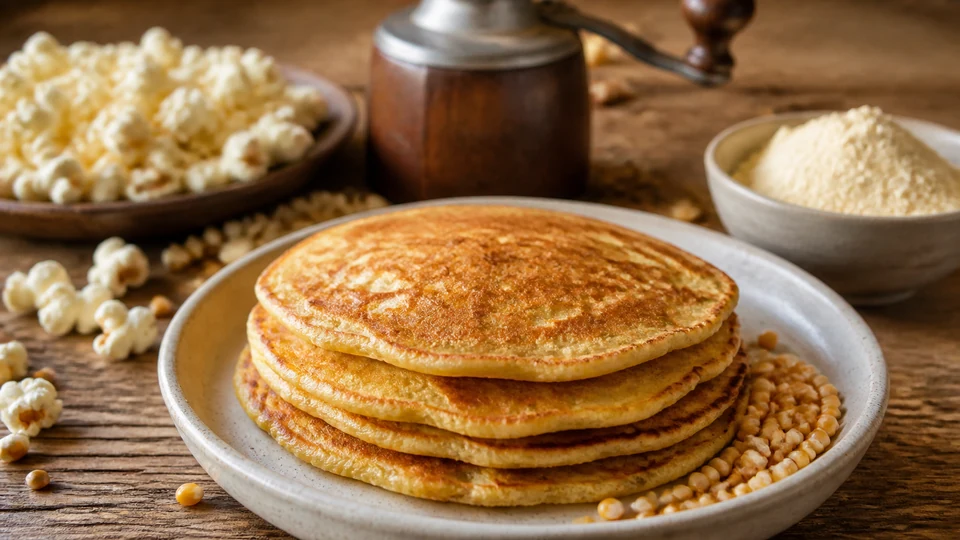
For adjacent decisions around Popcorn flour pancakes, compare five common pancake failures, eight pancake mistakes and fixes, and a repeatable pancake production sheet.
| Guide sections |
|---|
| Define popcorn flour before opening the mixing bowl |
| Set the safety and allergen boundary |
| Use one small pancake as a decision gate |
| Interpret the first pancake before changing anything |
For broader context, continue with Pancake Ingredients and Substitutions.
Define popcorn flour before opening the mixing bowl
In the cited patent publication, popcorn flour means popped popping corn milled into a fine powder. That definition excludes three ingredients that may sound similar:
- cornmeal milled from unpopped corn;
- ordinary raw corn flour;
- crushed popcorn left as large flakes or crumbs.
This is more than a naming preference. A peer-reviewed Food Hydrocolloids study compared raw and popped corn flours and found that popping changed starch and functional behavior. In the study material, popped flour had fully gelatinized starch and substantially different water absorption, solubility and rheology from raw flour. The study does not validate a household pancake recipe, but it does support one practical conclusion: raw corn flour is not an evidence-based one-for-one stand-in for flour made after popping.
The patent allows different popcorn forms and popping methods but identifies oil-free air-popped corn as a preferred embodiment. For a clean first reproduction, begin with plain air-popped corn. Salt, butter, oil, sweet coating and microwave-bag flavoring would add uncontrolled ingredients and could change measurement, flavor, allergens and pan behavior.
Do not grind hard unpopped kernels in equipment that is not explicitly designed for them. Separate unpopped kernels from the light flakes before milling, and follow the mill or blender manufacturer’s limits. This guide does not authorize an appliance to process a material outside its instructions.
Explore related Pancakes World guidance on American Pancakes, American Breakfast: Pancakes, Diner Plates and Brunch, and Maple Syrup.
Sources and editorial references
The route-specific technical source is US patent publication US20190200623A1, “Gluten-free compositions.” Its status page identifies it as an abandoned application. That does not erase the published examples, but it sets the evidence boundary: the document reports an inventor’s composition and trials; it is not regulatory approval, independent replication or Pancake World testing.
The patent uses Australian standard metric household measures:
- one cup equals 250 milliliters;
- one tablespoon equals 20 milliliters;
- one teaspoon equals 5 milliliters.
A U.S. customary cup is smaller than 250 milliliters. Silently using U.S. cups while calling the result an exact reproduction changes every cup-based quantity. Choose one of two honest paths:
- Reproduce the example with a 250-milliliter measure and the stated 5-milliliter teaspoon.
- Develop a U.S.-measure adaptation as a new, explicitly untested variation and record every conversion.
This guide follows the first path. It does not publish an automatic U.S. conversion because the source also shows that popcorn-flour density varies with milling. Converting volume without controlling density creates false precision.
The patent’s first example puts two cups of air-popped popcorn into a kitchen blender for 20 to 30 seconds until a fine flour forms. It reports that one cup of popped popcorn produced approximately two-thirds cup popcorn flour in that setup. This is an inventor-reported equipment result, not a universal household yield.
The Popcorn Board separately says one ounce, one-eighth cup or two tablespoons of kernels yields one quart of popped popcorn. That conversion can help estimate how much plain popcorn to prepare, but it still does not establish flour yield. Popping expansion, flake breakage, milling fineness and residue all intervene. Produce more plain popcorn than the blend requires, then measure the finished flour.
Use this controlled milling sequence:
- Air-pop plain popping corn using an appropriate appliance.
- Remove hard unpopped kernels and foreign material.
- Let the popped flakes reach a condition permitted by the milling appliance; never seal warm popcorn into storage merely to wait.
- Process a load within the appliance’s marked capacity.
- Stop when the material is a fine powder rather than visible large flakes.
- Sieve if needed to remove large pieces, as the patent permits.
- Return only suitable large popcorn pieces for another controlled milling pass; discard hard kernels rather than forcing them through an unsuitable device.
- Record the mass of one level 250-milliliter cup of the finished flour.
The patent discusses popcorn flour across a broad density range and identifies 80 to 110 grams per cup in some embodiments. Its later example reports about 90 grams per cup after a different milling process. Do not force a household batch to match one number by packing the measure. Instead, level the flour consistently, record the actual mass, and recognize that a substantially different density means the material is not equivalent to the cited example.
For Example 1, the patent mixes:
- two 250-milliliter cups popcorn flour;
- one-quarter of a 250-milliliter cup potato flour.
Mix those two flours thoroughly. The patent reports that its complete composition was very light by mass and uses two cups of that prepared blend for the pancake example. It also describes potato flour as cooked and ground potato. Do not substitute potato starch merely because the names are sometimes confused in retail listings; verify the exact package identity.
The published pancake example lists:
- two 250-milliliter cups of the prepared popcorn-and-potato flour blend;
- three-quarters of a 250-milliliter cup milk;
- one egg;
- one 5-milliliter teaspoon bicarbonate of soda;
- a dash of vinegar;
- a pinch of salt.
The source also says one cup milk produces a thinner pancake when used immediately. Alternatively, with one cup milk, it says to let the mixture stand for 10 to 15 minutes to thicken. These are two source branches, not permission to add liquid repeatedly by eye.
For a first controlled run, choose one branch before mixing:
Branch A — thicker immediate batter: use three-quarters cup milk and proceed without the source’s longer one-cup rest branch.
Branch B — thinner initial batter with source rest: use one cup milk, record the start of the 10-to-15-minute rest, and assess only after that interval.
Do not start with three-quarters cup and then casually add milk until the amount is unknown. Do not combine the one-cup liquid branch with an unrecorded rest. Those changes make diagnosis impossible.
The source leaves “dash” and “pinch” imprecise and does not name the vinegar type. Record the actual household measure and product selected. Do not convert those words into authoritative gram amounts that the source never supplied.
Set the safety and allergen boundary
Milk and egg are major allergens under FDA guidance. The actual popcorn, potato flour, bicarbonate and vinegar packages may carry other ingredient or cross-contact information, so inspect every label rather than relying only on the short formula.
The fact that popcorn was already popped does not make the complete batter ready to eat. The mixture contains raw egg, and the processing status of every flour ingredient must be established from its manufacturer. FDA advises against eating raw flour, dough or batter and explains that grinding raw grain into flour does not kill bacteria. Never taste this batter to adjust salt, acidity or texture.
Before mixing:
- wash hands with soap and water;
- use a clean bowl, measure, whisk or spoon and skillet tools;
- keep raw egg away from ready-to-eat food;
- clean spills and contacted surfaces promptly;
- return eggs and milk to refrigeration rather than leaving their containers beside the stove;
- use pasteurized egg products when serving a person for whom official guidance recommends them.
Do not describe the pancakes as “gluten-free” merely because the formula contains no stated wheat ingredient. FDA-regulated gluten-free labelling has defined conditions, and a household blender, sieve, potato flour or work surface may have wheat cross-contact. The honest description is the exact ingredient record plus the known equipment history. A gluten-free claim requires evidence beyond this article.
The patent gives the formula and liquid/rest alternatives but does not publish a detailed pancake mixing sequence. That gap must remain visible. The following is an editorial control procedure for evaluating the external formula, not a claimed transcription of patent instructions:
- Confirm the flour blend is uniform before taking the two-cup pancake portion.
- Record the selected milk branch and actual product identities.
- Combine the measured milk, egg and recorded vinegar amount in a clean vessel.
- Distribute bicarbonate and salt through the measured flour blend.
- Bring wet and dry components together only when the skillet station is ready.
- Mix until no dry pocket remains, without continuing merely to chase a wheat-batter appearance.
- Apply the chosen branch’s rest decision exactly.
- Record batter behavior before cooking: pourable, scoopable, spreading slowly or holding a mound.
Why avoid a wheat-batter visual target? The flour system is materially different. The cited scientific paper found changed water absorption and viscosity in popped flour, while the patent relies on a popcorn-and-potato blend. “Mix until it looks like my normal pancake batter” is therefore not a defined endpoint.
Do not add gum, sugar, baking powder, oil or extra flour during the first reference run. Each could be a later experiment, but none belongs in the listed pancake example. Preserving the first formula creates a baseline against which a future one-variable change can be understood.
Use one small pancake as a decision gate
The patent example does not specify skillet material, surface temperature, batter portion, cooking time, turning cue or yield. Publishing any of those as part of the source recipe would be fabrication.
Instead, use a small first pancake to evaluate the process. Prepare the skillet according to its manufacturer’s instructions and use a cooking surface compatible with the batter. If a fat is needed for the selected pan, record its type and amount as an editorial process addition and include it in the allergen and ingredient record.
Portion one small, measured amount. Record the measure rather than calling it universal. Observe four stages:
- Deposit: Does the batter leave the measure, or does it remain as a dense mound?
- Spread: Does it establish a stable pancake shape without running into a film?
- First-side set: Are the edge and upper surface becoming structured enough to turn without tearing?
- Center completion: After both sides cook, is the center set and does it reach the applicable safety endpoint?
FoodSafety.gov lists 160°F (71°C) for egg dishes. Use a clean food thermometer in the thickest practical part of the test pancake. A browned surface does not prove the egg-containing center is done. Continue cooking or revise the portion and heat control when the exterior colors too quickly while the center remains below the endpoint.
Do not reuse a thermometer or spatula contaminated with raw batter on finished pancakes without cleaning it. Do not place cooked pancakes on the plate that held the uncooked test portion.
Interpret the first pancake before changing anything
The first pancake is a gate, not a snack that disappears before notes are made. Record these observations:
- portion amount;
- skillet and surface preparation;
- batter condition at deposit;
- approximate diameter and thickness after spreading;
- whether turning was clean, early, late or impossible;
- surface color when the center reached 160°F;
- center structure after cutting;
- flexibility or breakage during transfer;
- any gritty large particles;
- actual number of pancakes later produced.
The published patent reports that its popcorn-and-potato example produced a light, thick and flexible pancake, while its comparative 100-percent-popcorn-flour version was flat and undercooked in the middle. Those are reported outcomes from that source, not guarantees for this kitchen. They do, however, explain why removing the potato flour is not a neutral simplification.
Use the diagnosis below only after confirming measurement and source branch.
Batter barely leaves the measure
First check whether the flour was packed, whether a U.S. cup replaced the 250-milliliter source cup, whether the correct liquid branch was used and whether an unintended rest occurred. Do not immediately pour in unmeasured milk. If a later trial changes liquid, choose one recorded increment and label the batch as an adaptation.
Batter spreads into a very thin film
Check whether the one-cup milk branch was used without its 10-to-15-minute source rest, whether the flour blend was short, or whether the potato product was incorrect. A hotter skillet is not an evidence-based cure for a mismeasured batter.
Pancake breaks during turning
Determine whether it was turned before the first side developed enough structure, whether the portion was too large for the tool, or whether the flour composition departed from the source. Do not assume more egg is the answer; that would change the formula and allergen load.
Outside colors while the center remains wet
Reduce the portion or adjust the surface heat under controlled conditions. Confirm the flour blend and liquid branch. The patent’s 100-percent-popcorn comparison also reported an undercooked middle, so verify that potato flour was not omitted. Never serve a wet egg-containing center because the exterior looks finished.
Finished pancake feels gritty
Inspect the milled flour and sieve record. Large popcorn fragments may have survived milling. Do not blame bicarbonate or add more liquid until particle size has been checked.
Every pancake behaves differently
Re-mix the prepared dry blend before portioning, use one consistent batter measure, and control the surface between pancakes. Variability can enter from an uneven popcorn-potato distribution, settling, inconsistent portions or a drifting pan condition.
Change one variable in a later batch
Once the reference run is recorded, a household can design a deliberate adaptation. The strongest sequence is:
- State the problem in observable terms.
- Select one plausible variable.
- Keep the remaining ingredients and process fixed.
- Record the new value before mixing.
- repeat the same small-pancake gate;
- compare the same observations.
Examples of single variables include flour particle size, liquid branch, rest within the source range, portion size or surface heat. Do not change flour ratio, liquid, egg, rest and pan temperature together and then claim to know why the result improved.
Treat toppings and flavorings as service additions after a stable pancake exists. Adding sugar, cheese, fruit or spices to the batter changes browning, moisture, allergens and structure. None belongs in the first external-reference run.
If the goal is a 100-percent-popcorn-flour pancake, recognize that it is a separate development target. The cited patent’s comparative result was flat and undercooked in the middle. That finding does not prove no other formula can work, but it does show that simply deleting potato flour from this example is not source-supported equivalence.
Count the actual yield and avoid false nutrition
The patent gives no pancake portion and no finished yield. Count the cooked pancakes after the full batch rather than predicting a number. Record any batter left in the bowl and any rejected test pancake separately.
Do not attach calories, protein, fiber or other nutrition values to the batch from generic popcorn data. The formula includes a variable-density flour composition, milk, egg and potentially pan fat, and the serving division is not defined. A valid nutrition calculation would require the exact ingredient products, measured masses, process additions, finished yield and serving definition.
Avoid health, weight, energy, fullness or performance claims. The unusual flour system may be interesting as a culinary experiment, but novelty is not evidence of a health outcome.
Cool and store leftovers safely
Serve the pancakes after they pass the cooking endpoint. For leftovers, USDA advises refrigeration within two hours, using small or shallow containers for rapid cooling, and keeping the refrigerator at 40°F (4°C) or below. Refrigerated leftovers are generally used within three to four days.
Label the container with the batch identity and date. Keep the ingredient and allergen record with it. If the pancakes are reheated, USDA’s leftovers guidance calls for 165°F (74°C). Check the food rather than relying on an appliance timer.
Do not leave a stack at room temperature for an extended texture assessment. Photographing, measuring and note-taking should be organized so safe handling continues. Discard food when time and temperature history cannot support a safe decision; do not taste it to determine safety.
Questions about popcorn flour pancakes
Is popcorn flour the same as cornmeal?
No. In the route-specific source, popcorn flour is made by milling popcorn after it has popped. Cornmeal and ordinary corn flour are milled from unpopped corn and have different processing and functional behavior.
Can I grind leftover salted popcorn?
That would not reproduce the clean source input. Salt, oil, butter and flavorings change the ingredient record, density and allergens. Use plain air-popped corn for the reference run.
Does the source use only popcorn flour?
No. Its successful reference pancake uses a prepared popcorn-and-potato flour composition. The same document reports that a 100-percent-popcorn-flour comparison produced a flat pancake with an undercooked middle.
Why not publish exact cooking minutes?
The source does not provide them, and the page has no project-owned test. Skillet construction, heat delivery, portion and batter density all affect time. The evidence-safe endpoint is a structurally cooked pancake whose egg-containing center reaches 160°F.
Can I call these gluten-free?
Not automatically. The listed formula does not state wheat, but ingredient manufacturing and household equipment can create gluten cross-contact. A regulated or safety-relevant claim needs verified products and process controls.
Which milk should I use?
The example says milk without specifying fat percentage or processing type. Record the exact milk chosen. A plant beverage is not the same source formula and may change composition, allergens and batter behavior.
What does a “dash” of vinegar mean?
The patent leaves it imprecise. Record the actual measured amount and product in your run; do not present a newly chosen number as if the patent supplied it.
Is this a Pancake World recipe?
No. It is an Article that explains and evaluates a published external technical example. Until Pancake World completes a genuine test record with exact ingredients, instructions, timing, yield and observations, the page should not use Recipe schema or claim an in-house result.
Final decision rule
Proceed only when the ingredient is truly flour milled from plain popped popcorn, the potato flour identity is verified, the Australian source measures are preserved, one liquid branch is selected, and every variation is recorded. Accept a test pancake only when it can be handled, its center is set, and its egg-containing center reaches 160°F without relying on surface color alone. Treat the published texture descriptions as source-reported outcomes, not promises. That discipline turns a vague internet idea into a traceable experiment while keeping the absence of a Pancake World test completely clear.
https://patents.google.com/patent/US20190200623A1/enhttps://www.sciencedirect.com/science/article/pii/S0268005X2200649Xhttps://www.popcorn.org/Recipes/Unpopped-to-Poppedhttps://www.fda.gov/consumers/consumer-updates/flour-raw-food-and-other-safety-factshttps://www.fda.gov/consumers/consumer-updates/what-you-need-know-about-egg-safetyhttps://www.fda.gov/food/nutrition-food-labeling-and-critical-foods/food-allergieshttps://www.foodsafety.gov/food-safety-charts/safe-minimum-internal-temperatureshttps://www.fsis.usda.gov/food-safety/safe-food-handling-and-preparation/food-safety-basics/leftovers-and-food-safety