Pancakes using buttermilk
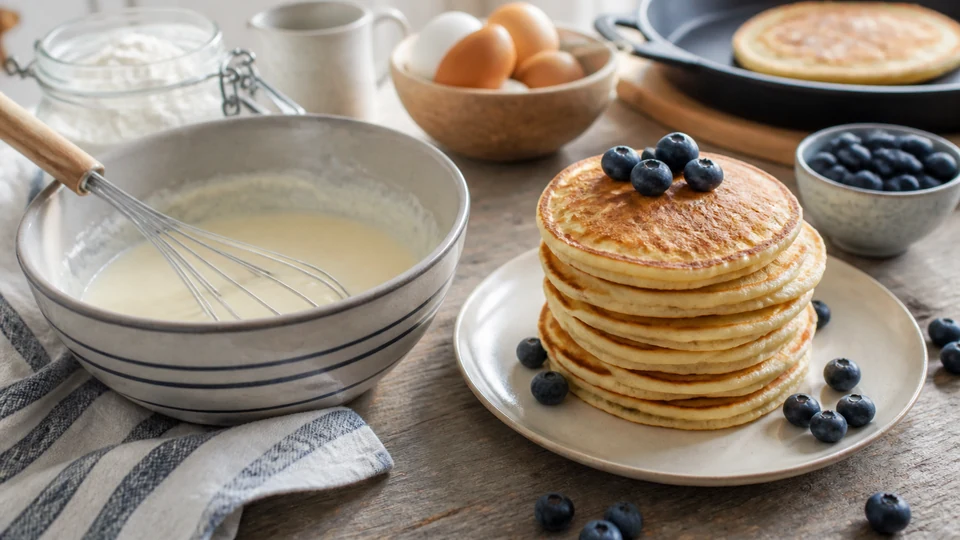
At Pancakes World, to make pancakes using buttermilk, choose a recipe written for cultured buttermilk and keep its flour, liquid, baking soda, baking powder, egg, and fat in balance. Mix dry and wet ingredients separately, combine gently, rest for the specified time, and cook one measured pancake over moderate heat. Buttermilk is thicker and more acidic than ordinary milk, so replacing milk with it in an unrelated recipe while leaving the leaveners unchanged is not a dependable conversion. Use the carton across several tested recipes rather than improvising a universal milk swap.
For broader context, continue with American Breakfast: Pancakes, Diner Plates and Brunch.
Direct answer for pancakes using buttermilk
The simplest method is a documented buttermilk-pancake formula. King Arthur Baking’s version uses cultured buttermilk with both baking powder and baking soda, then gives a defined rest and griddle method. Utah State University Extension also lists buttermilk among pancake uses and publishes a formula pairing it with both leaveners. These sources support using buttermilk inside a balanced recipe, not adding arbitrary acid or soda.
If the question is how to finish leftover buttermilk, select additional tested recipes—biscuits, cornbread, dressing, or another documented use—based on the amount and date remaining. Do not keep batter merely to consume the carton. Freshly mixed dry and wet components are easier to manage unless the recipe specifically approves longer storage.
What the reader needs to know
The carton and the recipe must match
Liquid cultured buttermilk, powdered buttermilk, homemade cultured buttermilk, and milk mixed with an acid are not automatically equivalent. The package may have its own reconstitution directions, while a scratch formula may depend on the viscosity of refrigerated cultured buttermilk. Read both sources.
When baking soda meets an acid in wet batter, gas production begins. Baking powder may contribute additional lift according to its formulation. This is why a batter should usually be cooked after its directed rest, not held through the day. More soda is not a repair for an old leavener, an underheated pan, or a batter that was spread too thin.
Decide what problem you are solving
| Goal | Best starting point | Avoid |
|---|---|---|
| Classic buttermilk flavor | Complete scratch formula | Swapping buttermilk into any milk recipe |
| Use a boxed mix | Package directions | Adding cultured liquid to a water-only mix without guidance |
| Finish a partial carton | Several separate tested recipes | Enlarging one unfamiliar pancake batch excessively |
| No cultured buttermilk available | Source-approved substitute | Treating every acidic dairy product as equal |
| Dairy-free pancakes | Purpose-built non-dairy formula | Calling acidified plant drink cultured dairy buttermilk |
The word “using” should not become an instruction to pour in more than the formula needs. Measure the liquid and store the remainder according to its label.
Practical options and examples
A plain first batch
Make the source formula without berries, chocolate, or spices. The plain pancake reveals whether the batter spreads, releases, and cooks through. Some small lumps after mixing can be acceptable; vigorous whisking is not required to make the bowl look polished.
After the directed rest, portion one pancake. If it darkens before the upper edge begins to set, lower the heat. If it spreads much farther than the documented size, confirm the flour and liquid measurements before adding anything. Correct only one variable.
A carton-use plan
Write the carton’s amount and use-by information, then allocate exact quantities to recipes. Pancakes might use one portion, a dressing another, and biscuits or cornbread the rest. Utah State University Extension identifies these as established culinary uses. Follow individual recipes and storage instructions rather than mixing a large unverified “use-it-up” batter.
A substitute plan
King Arthur compared actual buttermilk with several alternatives in pancakes and reported that plain Greek yoghurt thinned with milk performed particularly well in its tested context. Use its specified proportion only with the associated formula or a recipe that endorses it. Milk plus vinegar may supply acidity but does not reproduce all dairy solids or viscosity.
For a distinct no-flour direction, vegan protein powder pancakes no flour needs a different binder system. Gluten-free vegan potato pancakes is savory and dairy-free, while high-fiber breakfast is a menu-building guide.
Choosing the right approach
Use a scratch formula when you have liquid cultured buttermilk and want the ingredient to shape flavor and texture. Use a mix only according to its current package. Use a supported substitute when access, not dairy avoidance, is the problem. For vegan or dairy-free needs, move to a purpose-built recipe instead of preserving the buttermilk name.
The pancake science hub explains why liquid, acid, and leavener decisions interact. Pancake World keeps this page focused on using buttermilk accurately, without claiming a homemade batch was tested here.
Common mistakes
- Replacing milk with buttermilk while ignoring baking soda and baking powder.
- Using self-rising flour in a formula designed for all-purpose flour and separate leaveners.
- Packing flour into a cup and then thinning the overmeasured batter repeatedly.
- Adding extra soda to make pancakes “fluffier.”
- Holding mixed batter overnight without source approval.
- Pouring all remaining buttermilk into the bowl to avoid waste.
- Confusing a powdered ingredient with ready-to-use liquid.
- Pressing pancakes after the turn.
- Describing a dairy recipe as vegan because vegetable oil replaced butter.
Step-by-step checklist
Select and measure
- Read the buttermilk label and date.
- Select a recipe explicitly calling for that product type.
- Confirm flour and leavener types.
- Measure flour by weight if possible.
- Measure baking soda, baking powder, and salt level.
- Melt fat and allow it to cool slightly.
- Measure only the required buttermilk.
Build the batter
- Whisk dry ingredients evenly.
- Combine buttermilk, egg, fat, and flavoring separately.
- Add wet mixture to dry.
- Stir until no dry flour pocket remains.
- Stop before the batter becomes overworked.
- Rest for the exact source interval.
- Do not keep adding liquid while flour continues hydrating.
Cook and assess
- Heat a lightly greased pan moderately.
- Portion the source’s stated amount.
- Watch edge setting, bubbles, base color, and release together.
- Turn once with a broad spatula.
- Leave the pancake unpressed.
- Confirm the center is set.
- Adjust pan heat before changing the whole bowl.
Use the remainder
- Return the carton to refrigeration immediately.
- Record how much remains.
- Choose another tested recipe that fits that amount.
- Do not use a product past its stated safe date or contrary to storage directions.
- Keep raw batter separate from cooked food and do not taste it raw.
Variations or substitutions when relevant
For a yoghurt substitution, use the cited test-kitchen method and preserve the rest of the recipe. For milk acidified with lemon juice or vinegar, use it only where a trusted formula gives the quantity and acknowledges the texture difference. For powdered buttermilk, follow manufacturer reconstitution and recipe directions.
For sweeter pancakes, add fruit or chocolate through a documented variation. Scattering pieces over individual portions reduces the risk of crushing fruit through the bowl. For savory pancakes, use an appropriate formula with controlled sugar and drain wet additions.
For gluten-free requirements, use a tested buttermilk recipe based on an identified gluten-free blend and check every ingredient. For dairy-free requirements, do not use cultured dairy buttermilk; choose a complete non-dairy method and label it accurately.
The related guides fiber-rich breakfast and gluten-free vegan pumpkin pancakes offer different ingredient systems and should not inherit the acid/leavener assumptions on this page.
Diagnose the ingredient before changing it
If a newly opened carton is much thinner or thicker than expected, confirm that it is the same product type the recipe names. Shake or handle it only as the label directs. Do not thicken thin buttermilk with flour before seeing how the complete batter behaves; flour also changes the dry-to-liquid balance. Do not dilute thick buttermilk automatically, because the formula may have been developed for that viscosity.
If the finished pancakes taste alkaline, review the baking-soda measurement and whether the correct acidic liquid was used. If they taste unusually sharp, confirm that extra acid was not added and that the buttermilk was suitable for use. Taste alone is not a food-safety test, so follow the product date and storage label.
If pancakes are flat, examine several causes in order: correct leavener, correct flour and liquid measurements, mixing intensity, rest, pan heat, and portion. Adding soda to the remaining bowl can leave uneven pockets and an unpleasant flavor. If the first batch is beyond repair, make notes and start the next attempt from the verified formula.
If batter is lumpy, distinguish small hydrated lumps from dry flour pockets. Scrape the bowl and fold gently. Forcing the batter through prolonged whisking can develop more wheat structure. A few small lumps in the cited King Arthur method are acceptable.
A measured use-up schedule
Suppose a carton remains after one batch. First record its actual volume and date. Search authoritative recipes for the precise remaining amount; do not assume a dressing, biscuit, cake, and pancake formula use interchangeable quantities. Assign each planned use to a day when it can be prepared and stored correctly.
Dry ingredients for a second pancake batch can be measured ahead in a labelled container. Keep the buttermilk, egg, and fat separate until cooking time. This preserves flexibility and avoids relying on batter whose leaveners have already been wetted.
If the remaining quantity is too small for another full recipe, choose a documented partial use or scale a formula mathematically by weight when the source and equipment allow it. Scaling down is clearer than topping the carton up with milk and pretending the composition is unchanged. Record the new yield and keep portion size consistent.
Waste reduction should never override a use-by date, an off-label storage condition, or a guest’s allergy requirement. Discarding an unsuitable remainder is safer than concealing it in a mixed batter. This page does not provide sensory criteria for determining microbial safety.
Buttermilk versus neighboring ingredients
Plain yoghurt is thicker and may need thinning in a supported substitute. Kefir has its own acidity and consistency. Soured milk created with vinegar or lemon supplies a different set of solids and flavor. Powdered buttermilk requires reconstitution or formula-specific dry handling. Plant drink plus acid can serve a buttermilk-style vegan recipe but is not cultured dairy buttermilk.
Name the ingredient accurately in notes and when serving others. That prevents a substitution from turning into an unverified allergy or nutrition claim. If the meal must be vegan, move to a vegan recipe at the start rather than describing dairy buttermilk as optional after mixing.
Explore related Pancakes World guidance on American Pancakes, Maple Syrup, and Maple Syrup Pancakes.
Sources and editorial references
- King Arthur Baking: Buttermilk Pancakes —
https://www.kingarthurbaking.com/recipes/buttermilk-pancakes-recipe— recognized culinary formula with measured buttermilk, leaveners, rest, portion, and cooking cues. - Utah State University Extension: Buttermilk —
https://extension.usu.edu/preserve-the-harvest/buttermilk— extension documentation of cultured buttermilk and its pancake and wider culinary uses. - Utah State University Extension: Ingredient substitutions —
https://extension.usu.edu/archive/list-of-ingredient-substitutions-for-cooking-and-baking— acid and baking-soda substitution context, used only within formula-specific guidance. - King Arthur Baking: Buttermilk substitute—what to use —
https://www.kingarthurbaking.com/blog/2019/01/28/how-to-substitute-for-buttermilk— direct pancake comparison of buttermilk and stated alternatives.
Evidence checked 16 August 2026. Product instructions and recipes can change; verify current labels and sources.