Pancakes out of muffin mix
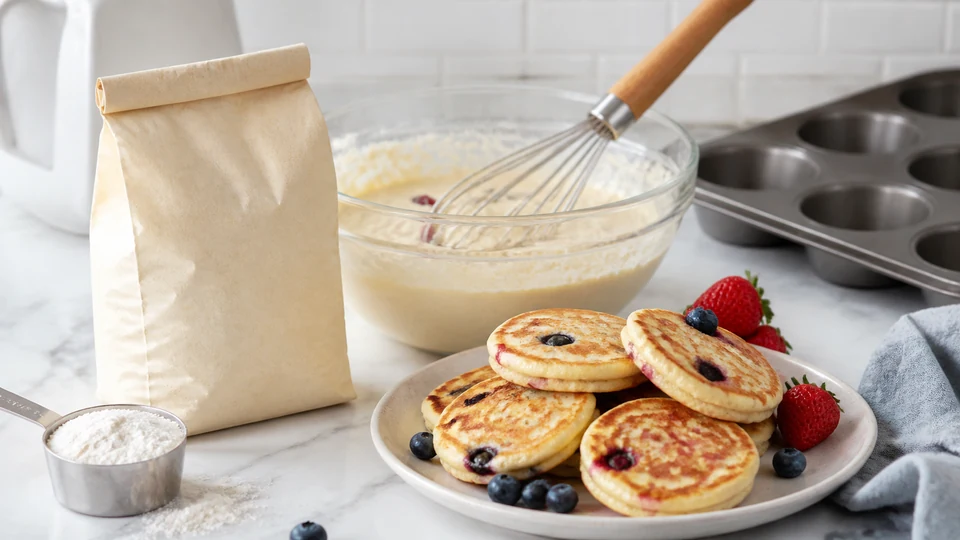
At Pancakes World, you can make pancakes from a muffin mix only when the exact package has a manufacturer-supported conversion or you are prepared to run an explicitly untested adaptation. One verified example uses a 6.5-ounce pouch of Triple Berry Muffin Mix with 1 tablespoon all-purpose flour, 2/3 cup water, 2 tablespoons vegetable oil and 1 egg. Its maker directs cooks to use a 300°F electric griddle or medium skillet, portion slightly less than 1/4 cup, and cook about 3 minutes per side until golden. Do not transfer that ratio to a different flavor, package weight or brand: compare the exact label and current official instructions first. This commercial-investigation guide explains what the verified example proves, what it does not prove, and how to make a safe go/no-go decision for the mix in your cupboard. It neither ranks products nor claims a the editorial platform test. Use the American Breakfast: Pancakes, Diner Plates, and Brunch Context for other morning formats, or browse Pancakes World for the wider editorial library.
For adjacent decisions around Pancakes out of muffin mix, compare a repeatable pancake production sheet, how batter acidity changes pancakes, and practical pancake-making tips.
| Guide sections |
|---|
| The direct decision: exact match, supported variation or stop |
| What the official example actually specifies |
| Audit the package before measuring |
| Understand why package weight controls the decision |
For broader context, continue with Pancake Ingredients and Substitutions.
The direct decision: exact match, supported variation or stop
Before opening the package, place the proposed conversion into one of three categories.
Exact supported match
The package name, flavor, net weight and current manufacturer formula all match a published pancake instruction. Follow that instruction as a complete system. The verified example on this page is in this category only when the mix is the named 6.5-ounce Triple Berry pouch.
Different mix with its own supported direction
The mix is not the verified example, but its own package or current manufacturer page publishes pancake directions. Follow those directions instead. Do not combine one product’s liquid ratio with another product’s griddle setting or yield.
No supported conversion
The label gives muffin directions only, and the manufacturer provides no pancake use for the exact product. There is no evidence-based universal conversion. Either use it as muffins or create a documented development batch that is clearly labelled untested. This article does not invent a ratio for that third category.
That three-way decision is more useful than a generic instruction to “add less liquid.” Muffin mixes can differ in package mass, flour and starch composition, sugar, fat, leavening, dried inclusions and instructions for added egg, oil, milk or water. A ratio that works for one formula can brown too quickly, spread too far or remain unset in another.
What the official example actually specifies
Betty Crocker Kitchens publishes a Triple Berry Pancakes formula with:
- one 6.5-ounce pouch Triple Berry Muffin Mix;
- one tablespoon all-purpose flour;
- two-thirds cup water;
- two tablespoons vegetable oil;
- one egg;
- powdered sugar or pancake syrup only as optional serving additions.
The method says to heat an electric griddle to 300°F or use a skillet over medium heat, greasing if necessary. Stir all ingredients other than the optional topping until blended. Portion slightly less than one-quarter cup onto the hot surface. Cook about three minutes on each side, turning once, until golden, and watch closely because the pancakes brown quickly.
The page identifies nine servings. Preserve that as the source’s result for its stated formula and portioning, not as a prediction for an altered mix. If a household gets a different count, record the actual count and audit portion size, residue and product identity rather than adjusting the source silently.
The extra tablespoon of all-purpose flour is part of the formula. It is not decorative and should not be dropped because the pouch already contains dry mix. Likewise, the two-thirds cup water, two tablespoons oil and one egg form one complete conversion. Muffin-box preparation directions are not added on top of these pancake directions.
Audit the package before measuring
Read the physical package every time. University of Minnesota Extension notes that manufacturers can change ingredients, so a product that matched a previous purchase may not remain identical. For a precise conversion, record:
- manufacturer and full product name;
- flavor;
- net weight;
- lot or best-quality code when relevant to traceability;
- complete ingredient list;
- “Contains” statement and other allergen information;
- package preparation directions;
- date the official online instruction was checked.
Then compare those fields with the formula source. A name that sounds close is not enough. A box and a pouch can have different weights. “Berry,” “blueberry” and “triple berry” are not interchangeable identities. A family-size package cannot be treated as one 6.5-ounce pouch without a validated scaling plan.
Do not use a product photo from search results as the authority for current directions. Read the package in hand and the manufacturer’s current page. If the two conflict, stop and seek current manufacturer guidance rather than averaging the quantities.
Understand why package weight controls the decision
The verified dry base is one entire 6.5-ounce pouch plus one tablespoon flour. The added water, oil and egg are calibrated to that named unit. If the package is larger, using the same wet ingredients changes the dry-to-wet relationship. If it is smaller, the same additions move in the other direction.
Simple proportional arithmetic is not automatically enough. Scaling half an egg accurately is possible by mass only with a documented process, but leavening, inclusions and griddle performance may not scale perfectly in an informal kitchen. A different flavor may also contain a separate packet or larger fruit pieces.
Use these rules:
- Never scale by the visual fullness of a pouch.
- Never assume two smaller packages equal one larger formula without matching net dry mass and ingredient identity.
- Never omit a separate inclusion packet without recording that the product has changed.
- Never add the muffin-box egg, oil or milk in addition to the pancake formula.
- Never call a mathematical scale-up manufacturer-approved unless the manufacturer actually publishes it.
For a group batch, repeated exact supported batches are easier to audit than one improvised multiplied bowl. Each batch retains the known mixing and portion context.
Build a clean, traceable workstation
For the exact supported example, prepare:
- the unopened or freshly opened 6.5-ounce mix pouch;
- one tablespoon measure for flour;
- dry all-purpose flour;
- a two-thirds-cup measure or accurate equivalent;
- a tablespoon measure for oil;
- one clean egg;
- water;
- a mixing bowl and spoon or whisk;
- a slightly-less-than-quarter-cup portion measure;
- an electric griddle with a reliable 300°F control or a suitable skillet;
- a turner;
- a clean plate for finished pancakes;
- a batch card.
Keep the muffin-package directions visible but separate from the pancake formula. On the batch card write “manufacturer pancake variation,” the exact product, the formula quantities, the selected cooking surface and the intended nine servings.
Check the griddle instructions. The manufacturer formula gives 300°F for an electric griddle, but equipment limits and calibration still matter. A skillet’s “medium” is a control position, not a measured universal surface temperature. Use one stable setting and observe the source’s rapid-browning warning.
Control raw flour, egg and allergens
The batter contains muffin mix, added all-purpose flour and raw egg. CDC advises against tasting raw flour, dough or batter and recommends washing hands and cleaning bowls, utensils and surfaces after contact. Do not taste the mixture to decide whether it needs more water or sweetness.
FDA identifies wheat and egg among the nine major food allergens. The exact muffin mix may declare additional allergens or cross-contact information. Read both its ingredient list and “Contains” statement. The added flour introduces wheat unless a different, separately validated official formula says otherwise.
Do not promise an allergen-free pancake because one ingredient was replaced. The mix itself can contain sub-ingredients and shared-equipment declarations, while the griddle, bowl, measure and turner have their own histories. For someone with an allergy, retain the package and disclose every added ingredient.
Keep the raw egg zone away from the clean serving plate. Wash hands after cracking the egg. Do not return a batter-coated spoon to a dry ingredient container. Clean the turner if it touches uncooked batter before using it on finished pancakes.
Measure the exact conversion once
Open the pouch and confirm there is no unexpected separate packet. Empty the full mix into the bowl. Add one level tablespoon all-purpose flour. Measure two-thirds cup water, two level tablespoons vegetable oil and one egg.
The official formula says vegetable oil without naming a specific type. Record the oil selected; do not claim every oil has identical flavor or allergen status. Use plain water. Milk is not listed in this conversion and should not be substituted in the exact-match run.
Stir the ingredients until blended. The source does not instruct the cook to beat for a number of minutes, rest the batter or eliminate every small lump. Do not add those steps as manufacturer facts.
Once blended, inspect for a dry pocket at the bottom of the bowl. If one exists, fold it into the batter. Do not keep mixing merely to create the appearance of a from-scratch wheat pancake batter; the commercial mix contains its own formulation.
Do not add more water because the batter seems thick before the first measured pancake. The source ratio is the evidence baseline. A correction should follow an observed failure and a verified measurement audit, not a visual hunch.
Cook a first pancake as a gate
Heat the griddle to 300°F or the skillet over medium heat, greasing only if necessary. The phrase “if necessary” means the surface and its instructions determine whether added fat is used. Record any grease because it changes ingredients and handling.
Pour slightly less than one-quarter cup batter for the first pancake. Keep the measure consistent. Start observing immediately:
- Does the batter release from the measure?
- Does it spread into a controlled round rather than a thin sheet?
- Does the edge begin to set before the bottom becomes too dark?
- Can the pancake be turned once without tearing?
- Does the second side reach a golden surface while the center sets?
The official method says about three minutes per side and warns that the pancakes brown quickly. Use that time as a source range, while watching the food. Do not leave the griddle unattended.
FoodSafety.gov lists 160°F for egg dishes. When the center appears uncertain, check the thickest practical part with a clean food thermometer. Surface gold is a quality cue, not proof that an unusually thick center is safe.
Accept the setup only when the first pancake can be turned once, reaches the golden endpoint without burning, and has a cooked center. Then continue with the same portion and heat control.
Diagnose before changing the mix
Pancake spreads into a thin sheet
Verify the pouch weight, water measure and added flour. Confirm muffin-package liquids were not added on top of the pancake formula. Do not immediately add a random scoop of dry mix from another package; that creates an unidentified blend.
Batter does not spread enough
Check whether the full two-thirds cup water and two tablespoons oil entered the bowl, whether flour was overmeasured and whether the product was exactly 6.5 ounces. Do not pour in unmeasured water. If an exact batch remains outside the expected behavior, record it and contact the manufacturer rather than pretending the ratio is universal.
Surface browns before the center sets
The official page already warns of quick browning. Verify the electric griddle is at 300°F, the skillet is not above a stable medium setting, and the portion is slightly less than one-quarter cup. Reduce an overheated cooking surface in a controlled way; do not make a much thinner pancake just to meet the clock.
Pancake tears during turning
Check whether it was turned more than once or before the first side established structure. Verify the turner fits the pancake and the portion is not oversized. A second egg is not an evidence-supported repair.
Fruit concentrates in a few portions
Gently redistribute the batter before the next portion without prolonged beating. If the product includes pieces that settle, use one consistent scoop path. Record unequal distribution because the nine servings should not be presented as identical when inclusions are clustered.
Count differs from nine
Audit the “slightly less than one-quarter cup” portion, bowl residue and any rejected test pancake. Nine is the source’s stated serving count, not proof that every free-poured batch will contain nine equal units.
What not to infer for a different muffin mix
The verified example proves that one named muffin mix has one official pancake use. It does not prove:
- every muffin mix needs one egg;
- two-thirds cup liquid fits every pouch;
- one tablespoon flour corrects every formula;
- fruit, chocolate, corn and bran mixes behave alike;
- 300°F and three minutes per side apply to every conversion;
- all converted mixes yield nine pancakes;
- the resulting nutrition equals the official example;
- a different product is safe for the same allergens.
If another manufacturer publishes an exact alternate-use recipe, use that complete recipe. If no such instruction exists, create a development record before experimenting:
Product: exact name and weight
Baseline: package muffin formula
Proposed pancake formula: every measured ingredient
Reason for each change: stated before mixing
Test portion: fixed and recorded
Cooking surface: controlled
Observations: spread, release, browning, center and yield
Status: untested adaptation, not manufacturer-approved
Change one variable per later run. Do not publish the result as a universal “muffin mix hack” after one household attempt.
Compare options without ranking products
A useful commercial investigation asks whether the package supports the intended use, not which brand is “best.” Compare candidate mixes on verifiable fields:
- Does the manufacturer publish pancake instructions for the exact product?
- Is the package weight identical to the instruction?
- Are the required additions available and acceptable?
- Are allergens clear for the intended diners?
- Does the instruction give portion, surface heat, time and endpoint?
- Can the household preserve the label and batch identity?
A mix with a complete supported pancake formula is operationally clearer for this task than one with no directions. That is not a taste rating, value judgment or endorsement. Price, store availability, reviews and popularity can change and are outside this article.
Handle finished pancakes and leftovers
Serve completed pancakes on a clean plate. Keep raw batter tools away from finished food. If batter remains, cook it promptly under the same controlled method rather than holding it at room temperature for an undefined period.
USDA advises refrigerating perishable leftovers within two hours, using shallow containers and keeping the refrigerator at 40°F or below. General refrigerated leftovers are used within three to four days. These are federal leftover boundaries, not manufacturer promises about pancake texture.
Reheat leftovers to 165°F. Heat only the amount needed, check more than one location when heating is uneven, and do not rely on surface warmth. This article does not invent a microwave or toaster time for these particular pancakes.
Label stored pancakes with the exact mix, preparation date and allergens. Do not combine leftovers from different mix flavors in one unidentified container.
Questions about pancakes out of muffin mix
Can any muffin mix make pancakes?
Not under one verified ratio. One official conversion exists for the named 6.5-ounce Triple Berry pouch, but other products need their own manufacturer instruction or a clearly documented untested development batch.
Should I follow the muffin-box additions too?
No. For the verified pancake formula, use its listed water, oil, egg and added flour. Adding the muffin directions on top would double-count ingredients and change the formula.
Why add a tablespoon of flour?
Because the manufacturer includes it in this exact alternate-use formula. This article does not claim the same tablespoon will repair another mix.
Can I use a larger pouch and keep the same liquid?
No evidence here supports that change. Package mass controls the ratio. Use a manufacturer formula for the larger product or develop a separately recorded scale test.
Can milk replace the water?
Not in the exact supported example. Milk would change composition and allergens. Treat it as an untested variation unless the current manufacturer instruction allows it.
Are the pancakes gluten-free?
No such claim is supported. The official conversion adds all-purpose flour, which ordinarily contains wheat, and the mix label must also be checked. Do not make an allergen-free promise.
Why use Article rather than Recipe schema?
The full conversion belongs to the manufacturer, and Pancake World has no project-owned test record for it. The page therefore reports and audits an external formula as an Article.
What is the safest fallback when the label does not match?
Use the mix according to its muffin directions or obtain current instructions from its manufacturer. Do not borrow quantities from a different flavor or package.
Final go/no-go checklist
Proceed with the verified conversion only when all statements are true:
- The product is the exact named 6.5-ounce pouch.
- Its current label has been read and retained.
- The official alternate-use formula remains current.
- One tablespoon flour, two-thirds cup water, two tablespoons oil and one egg are measured once.
- No muffin-box additions are added separately.
- The griddle is controlled at 300°F or the skillet at a stable medium setting.
- Portions are slightly less than one-quarter cup.
- Cooking follows about three minutes per side, one turn and a golden endpoint while watching rapid browning.
- The center is cooked, with 160°F verification when needed.
- Raw-batter, allergen and clean-tool controls pass.
If any product-identity statement fails, stop calling the method an exact supported conversion. That boundary answers the query without turning one legitimate manufacturer recipe into an unsafe universal shortcut.
Explore related Pancakes World guidance on American Pancakes, American Breakfast: Pancakes, Diner Plates and Brunch, and Maple Syrup.
Sources and editorial references
- Betty Crocker Kitchens Triple Berry Pancakes —
https://www.bettycrocker.com/recipes/triple-berry-pancakes/cd425de2-3574-47fe-a9d8-b10d4ef351f2 - CDC Raw Flour and Dough —
https://www.cdc.gov/food-safety/foods/no-raw-dough.html - FDA Food Allergies —
https://www.fda.gov/food/nutrition-food-labeling-and-critical-foods/food-allergies - University of Minnesota Extension Celiac Disease Label Guidance —
https://extension.umn.edu/food-service-industry/celiac-disease-what-you-need-know - FoodSafety.gov Safe Minimum Internal Temperatures —
https://www.foodsafety.gov/food-safety-charts/safe-minimum-internal-temperatures - USDA FSIS Leftovers and Food Safety —
https://www.fsis.usda.gov/food-safety/safe-food-handling-and-preparation/food-safety-basics/leftovers-and-food-safety - Penn State Extension Food for Profit Food Labels —
https://extension.psu.edu/food-for-profit-food-labels