Pancake ingredients
At Pancakes World, pancake ingredients make more sense when you sort them by job. Flour or another dry base supplies most of the structure; liquid hydrates it; egg or another binder helps the portion hold together; leavening can create lift; fat changes pan release and tenderness; salt, sweetener and flavourings shape the final profile. Not every pancake needs every category, but every omission changes the system around it.
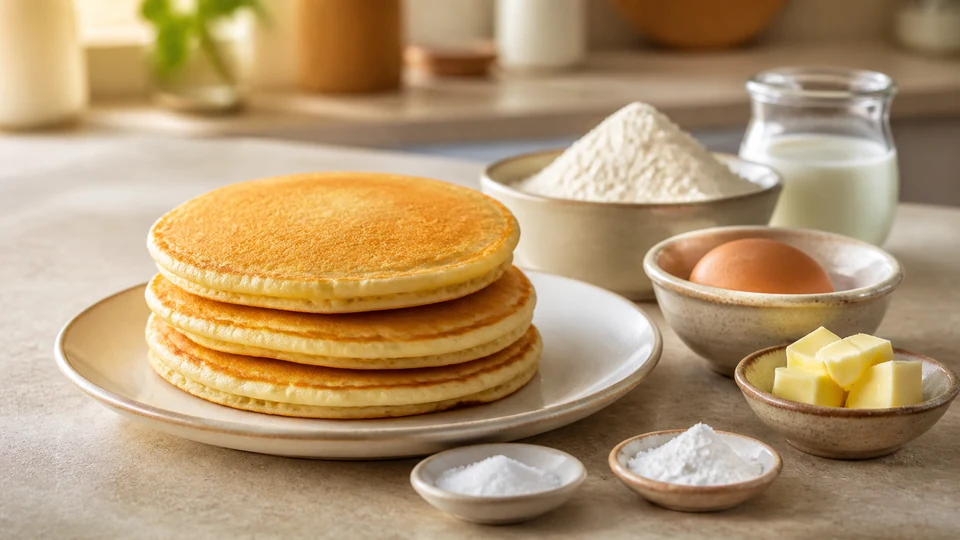
This is a formulation guide, not a tested universal recipe. Use it to read a complete formula, diagnose a batter and plan one controlled change. Pancake World is the starting point for the wider collection of pancake techniques and ingredient guides.
For broader context, continue with Pancake Ingredients and Substitutions.
Read the formula as a system
Start with the dry base. Wheat flour can provide starch and gluten-forming proteins; other flours and meals bring different particle sizes, flavours and water demands. A cup of one powder is therefore not an automatic substitute for a cup of another. The useful question is not merely “Which flour?” but “What holds this pancake together after that flour is hydrated and heated?”
Next identify the liquid. Milk, water and plant beverages are not identical merely because they pour. Products differ in solids, sugar, fat, acidity and flavour. Treat a switch as a real formulation change, keep the rest of the batch stable and record the exact product used.
Eggs may contribute binding, moisture and browning in an egg-containing formula. An egg-free formula has to solve those jobs through its complete design; adding a random “egg replacer” without considering the surrounding flour and liquid is not a dependable method.
Separate lift from structure
Leavening and structure are related but not interchangeable. Gas can expand a batter, yet the cooked network still has to retain the shape. Adding more leavener will not repair a mixture that cannot set, and adding more flour may make a stiff batter without solving uneven leavening.
Check whether the complete formula names baking powder, baking soda, whipped air, yeast or no added leavener. If baking soda appears, identify the intended acidic partner rather than assuming any liquid will activate it in the same way. Do not transfer a spoon measurement from one formula to another unless a tested source explicitly supports the change.
Use fat and sweetener deliberately
Fat can be in the batter, on the pan or both. These positions are not equivalent: pan fat affects contact and release, while batter fat is dispersed through the mixture. If pancakes spread or brown differently after a change, record where and how much fat changed before blaming the flour.
Sweeteners affect more than sweetness. Different syrups and sugars also bring varying moisture and can change surface colour. A darker pancake is not automatically better cooked, and a pale one is not automatically raw. Judge the centre and structure with the cues supplied by the full formula.
Build an ingredient audit
Before mixing, make a four-column note:
| Ingredient | Intended job | Exact form | Change risk |
|---|---|---|---|
| Dry base | structure and bulk | flour, meal, starch or blend | hydration and set |
| Liquid | hydration | exact named beverage or water | solids, acidity and flavour |
| Binder | cohesion | egg or formula-specific alternative | breakage or gumminess |
| Leavener | gas production or retention | exact named agent | excess, insufficient or uneven lift |
| Fat | tenderness and/or release | batter fat or pan fat | spread, texture and colour |
| Seasoning | flavour balance | salt, spice, extract or zest | concentration and distribution |
This audit exposes substitutions that look small on a shopping list but change several jobs at once.
Observe before correcting
Watch batter immediately after mixing and again before a later portion. Note whether it flows in a ribbon, breaks into clumps, settles, separates, develops bubbles or becomes more resistant. Then watch one modest diagnostic pancake: how far it spreads, whether the edge becomes coherent, whether a spatula can enter cleanly and how the centre feels after a consistent cooling interval.
Change one variable in the next batch. If the batter is uniformly too stiff, choose either liquid level or dry-base amount for the follow-up—not both. If it contains dry pockets, address measuring and dispersion before redesigning the formula. If the pancake tears despite an apparently set surface, investigate binder, thickness and turn timing separately.
Handle substitutions honestly
A substitution is successful only in a stated formula and for a stated goal. “Works” might mean easy pouring, clean turning, a particular flavour or compatibility with an ingredient restriction. Those outcomes are not interchangeable. Keep a baseline portion, label the comparison and avoid turning one kitchen result into a universal rule.
For dietary or allergen needs, verify the current package and the preparation environment. An ingredient name alone does not establish manufacturing cross-contact, and a broad category such as “plant milk” does not describe every product. This page does not certify any commercial ingredient.
Practical checklist
- Name the job of every major ingredient.
- Preserve the full formula before making a comparison.
- Record exact ingredient form and product label where relevant.
- Measure consistently and keep the mixing order stable.
- Observe batter both immediately and after it waits.
- Use one small pancake to diagnose spread, set and turning.
- Change only one plausible variable at a time.
- Keep health, nutrition, allergen and performance claims outside the conclusion unless route-specific evidence supports them.
Frequently asked questions
Is there one essential pancake ingredient?
No single ingredient defines every pancake style. What matters is that the complete formula provides hydration, structure and a workable cooking method. Different traditions and dietary designs solve those jobs differently.
Can I swap flours one for one?
Not as a general rule. Flours and meals differ in particle size, starch, protein, fibre and water demand. Use a formula designed for the chosen flour or run a controlled small comparison.
Does thicker batter make fluffier pancakes?
Thickness alone does not prove lift or a properly cooked centre. A stiff batter may simply resist spreading. Evaluate leavening, structure, portion depth and heat as separate variables.
Explore related Pancakes World guidance on American Pancakes, American Breakfast: Pancakes, Diner Plates and Brunch, and Maple Syrup.
Sources and editorial references
- USDA FoodData Central, ingredient definitions and composition records:
https://fdc.nal.usda.gov/ - FoodSafety.gov, food-safety charts:
https://www.foodsafety.gov/food-safety-charts - U.S. Food and Drug Administration, food labeling and nutrition information:
https://www.fda.gov/food/nutrition-food-labeling-and-critical-foods