Overnight breakfast casserole with hash browns
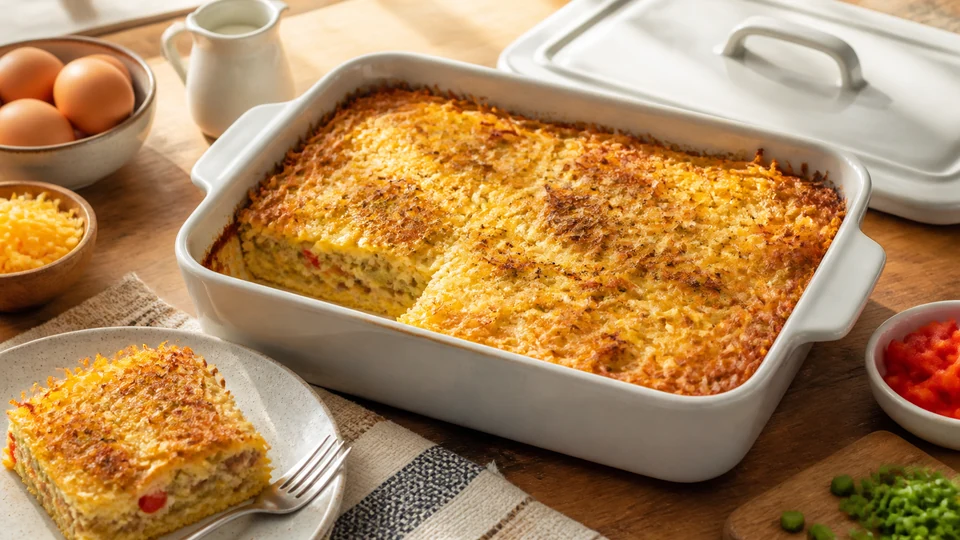
At Pancakes World, for one tested overnight breakfast casserole with hash browns, use Pillsbury Kitchens’ eight-serving formula: cooked hot pork sausage, 10 eggs, milk, Dijon mustard, pepper, refrigerated O’Brien hash browns and sharp cheddar in a sprayed 13-by-9-inch, 3-quart dish. Cook and drain the sausage, combine it with the egg mixture, potatoes and part of the cheese, then cover and refrigerate for at least 8 but no more than 12 hours. The next morning, top with the remaining cheese and bake at 350°F (177°C) for 45 to 55 minutes, until the center is just set. Rest 10 minutes before dividing into eight equal pieces. This guide preserves that exact make-ahead method and adds food-safety, timing and diagnosis controls. It does not treat frozen hash browns, same-day assembly or another sausage as tested equivalents, and it does not claim a the editorial platform test. Browse the American Breakfast: Pancakes, Diner Plates, and Brunch Context for other morning formats, or explore Pancakes World for the larger editorial library.
For adjacent decisions around Overnight breakfast casserole with hash browns, compare the croissant breakfast casserole, an eggs Benedict casserole format, and small-kitchen brunch scheduling.
| Guide sections |
|---|
| Keep the seven-ingredient formula intact |
| Plan backward from breakfast time |
| Prepare the correct vessel and cold space |
| Cook the sausage before assembly |
For broader context, continue with American Breakfast: Pancakes, Diner Plates and Brunch.
Keep the seven-ingredient formula intact
The tested Pillsbury recipe uses:
- one 16-ounce package bulk hot pork sausage;
- 10 eggs;
- 1 1/2 cups milk;
- 2 teaspoons Dijon mustard;
- 1/4 teaspoon ground pepper;
- one 20-ounce bag refrigerated O’Brien hash browns, about 4 1/2 cups;
- 1 1/2 cups shredded sharp cheddar cheese, 6 ounces.
Each descriptor matters. “Bulk hot pork sausage” is not a cooked link or a plant-based crumble. Refrigerated O’Brien hash browns are shredded fresh potatoes with onion and bell pepper, not a frozen plain potato bag. Sharp cheddar is divided between the mixture and the topping.
Do not add separate salt without first reviewing the sausage, potato and cheese labels. The published formula does not list it. Do not add another egg, extra milk or a can of soup because another breakfast casserole uses one. Those changes create a different custard and moisture system.
The source publishes eight servings. Preserve that division rather than cutting the dish into an arbitrary buffet count and transferring the source nutrition panel.
Plan backward from breakfast time
The recipe requires covered refrigeration for at least 8 hours but no longer than 12. That is a controlled window, not simply “overnight.”
If breakfast is planned for 9:00 a.m., work backward:
- Allow 10 minutes for the baked casserole to stand.
- Allow the source’s 45-to-55-minute bake window plus oven preheating.
- Remove, uncover and top only when the oven is being prepared.
- Count 8 to 12 hours backward from the moment the covered raw casserole entered refrigeration.
Record the refrigerator-in time on the cover. A dish assembled at 5:00 p.m. and baked at 10:00 a.m. would exceed the source’s 12-hour maximum. A dish assembled only four hours before baking would not satisfy its minimum.
Do not extend the window because the refrigerator “feels cold.” Use a refrigerator thermometer and maintain 40°F (4°C) or below under USDA guidance.
Prepare the correct vessel and cold space
Use a 13-by-9-inch baking dish with a 3-quart capacity. Pillsbury links the vessel to correct setting; a smaller, deeper dish can leave the center liquid within the stated time.
Before cooking sausage:
- confirm the dish fits level in the refrigerator;
- reserve a shelf where raw egg mixture cannot drip onto ready-to-eat food;
- confirm a food-safe cover fits securely;
- check the refrigerator thermometer;
- set out a skillet, whisk, large bowl and clean utensils;
- reserve one-half cup cheese separately for the morning topping;
- write the assembly time and latest permitted bake-start decision on a label.
Spray the bottom and sides of the dish with cooking spray as the source directs. Record the spray ingredients because they may add allergens or other ingredients not visible in the seven-line formula.
Do not assemble in a decorative vessel whose volume is unknown. Surface area and depth affect heat movement and the set-center endpoint.
Cook the sausage before assembly
Place the bulk hot pork sausage in an 8-inch skillet over medium heat. Break clumps apart and cook for 5 to 7 minutes, or until no longer pink, then drain as directed.
Color is the recipe’s cue, but federal guidance provides a stronger safety check: ground pork sausage should reach 160°F (71°C). Check representative thick pieces with a clean food thermometer. Do not place the thermometer back into cooked sausage after it has touched raw meat without cleaning it.
Drain the cooked sausage. Excess rendered fat would alter the casserole’s liquid balance. Do not rinse it or press in an unrecorded way. Keep the cooked meat away from the raw sausage package and tools.
Wash hands with soap and water after handling raw sausage. Clean and sanitize the contacted board, skillet handle area, utensils and counter. The clean assembly spoon must not be the raw-meat spoon unless it has been properly washed.
Do not use a fully cooked sausage product under the same timing without an explicit variation record. Its moisture, fat, seasoning and required preparation can differ.
Build the egg mixture accurately
In a large bowl, beat 10 eggs with 1 1/2 cups milk, 2 teaspoons Dijon mustard and 1/4 teaspoon ground pepper until mixed well.
Use refrigerated eggs and return the carton promptly. Crack each egg into a small clean cup first if shell fragments or spoilage need to be checked, then transfer it to the bowl. Never taste the raw mixture.
Measure the milk rather than pouring to a visual line in the bowl. Level the mustard measure. Dijon is the source identity; yellow, honey or whole-grain mustard is a variation and may change sugar, salt, texture or allergens.
Whisk until yolks and whites are distributed, but do not invent a beating time or foam target. The source says mixed well, not aerated to a specified volume.
Review the milk, mustard and egg labels for allergens. FDA recognizes milk and egg as major allergens, and prepared mustard or spray may have additional statements.
Add potatoes, cheese and sausage in the stated proportions
Stir into the egg mixture:
- the complete 20-ounce bag refrigerated O’Brien hash browns;
- one cup of the shredded sharp cheddar;
- all cooked, drained sausage.
Reserve the remaining one-half cup cheese. Put it in a labelled covered container in the refrigerator for the morning.
Separate potato clumps so they distribute through the eggs. Fold from the bottom to prevent a sausage-heavy zone. Do not mash the potatoes or beat until the shreds disappear.
Pour the mixture into the prepared dish and spread solids evenly. Check all corners. Uneven potato and sausage distribution produces servings with different composition and can create shallow and deep egg zones.
Cover immediately and place the dish on its reserved refrigerator shelf. Write the exact time. Do not leave it on the counter while cleaning the kitchen.
Why refrigerated O’Brien hash browns are not a detail
The source explicitly uses refrigerated potatoes and says no frozen-potato thawing is needed. It also warns that frozen hash browns can introduce more moisture and contribute to a soggy casserole.
Therefore:
- do not add frozen hash browns directly;
- do not thaw a frozen bag and call it equivalent;
- do not substitute hash brown patties;
- do not replace O’Brien potatoes with plain shreds without noting the missing onion and peppers;
- do not use a package weight other than 20 ounces without a separate scale plan.
A frozen-potato version may be developable, but it is not this tested method. It needs its own thawing, drainage, weight, bake and center-setting record.
Manage the 8-to-12-hour refrigerator gate
During refrigeration, keep the casserole covered and at 40°F or below. Do not open it repeatedly to stir. The source describes the overnight rest as part of the tested process.
Before baking, verify:
Elapsed time: at least 8 and no more than 12 hours
Refrigerator: 40°F or below
Cover: remained secure
Cross-contact: no leak or raw-food contamination
Reserved cheese: still labelled and refrigerated
Dish: intact and oven-safe
If time or temperature history is unknown, do not guess. A raw egg-and-meat casserole is not a suitable food for a taste test.
The recipe does not instruct a 30-minute counter warm-up. Move from controlled refrigeration into the published morning sequence.
Bake to time, center set and temperature
Heat the oven to 350°F. Remove the dish from refrigeration, uncover it and distribute the reserved one-half cup cheese across the top.
Bake for 45 to 55 minutes until the center is just set. Begin observing within the source window. A set center should not flow like raw egg when the dish is moved gently. Surface browning alone is not enough.
FoodSafety.gov lists 160°F for egg dishes. Check the center with a clean thermometer, avoiding contact with the bottom of the dish. Test another central location when potato or sausage distribution creates thick areas.
Do not raise the oven temperature to shorten the morning. That can brown the cheese and edges before the cold center sets. Do not cover an underdone center with more cheese and serve it as finished.
When the center is just set and the safety endpoint passes, remove the casserole. Let it stand 10 minutes. The source uses that rest before cutting; do not skip it to meet a rushed serving time.
Divide into eight equal portions
After the 10-minute stand, cut once lengthwise through the center. Cut crosswise in half, then make two additional evenly spaced crosswise cuts. This produces eight pieces.
Use a clean small spatula to lift each serving. Inspect the first central cut:
- egg structure is set rather than liquid;
- potatoes are distributed through the piece;
- sausage is cooked;
- no cold pocket remains;
- the bottom releases without a pool of raw custard.
If the center is underdone, return the casserole to cooking promptly and recheck temperature. Do not serve edge pieces while leaving an unsafe center for later.
The eight-piece division preserves the source serving basis. If smaller buffet pieces are needed, record the new count and do not attach the source’s per-serving nutrition values.
Diagnose common failures from evidence
Center is liquid after 55 minutes
Check dish size, oven accuracy, refrigerator starting temperature, ingredient quantities and potato type. A dish smaller or deeper than 13 by 9 inches changes the heat path. Continue cooking under control until the center sets and reaches 160°F; do not rely on the maximum clock alone.
Top browns too early
Verify rack position and actual oven temperature. The cheese may color before the center is ready. Use an appliance-appropriate protective cover only as an editorial corrective action and keep monitoring the center; do not present it as part of the original method.
Casserole is watery
Audit whether frozen potatoes replaced refrigerated O’Brien hash browns, whether sausage was drained, whether milk was overmeasured or whether the 10-minute stand was skipped. Identify the actual divergence before changing eggs or bake temperature.
Portions vary dramatically
The solids were likely not evenly distributed or the dish was cut unevenly. Next time spread potatoes and sausage to all corners before refrigeration and map eight cuts after the rest.
Egg layer is rubbery at the edges
Review vessel size, oven accuracy and total bake beyond the just-set endpoint. More time is not automatically better once the center is safe and set.
Reserved cheese was left out overnight
Do not use it. The topping is perishable and must remain refrigerated. Replace it only with an identical safely stored ingredient whose label is recorded, or stop the exact batch.
Variation decisions that require a new record
Pillsbury discusses possible cheese and sausage variations, but the exact seven-ingredient formula is the strongest baseline. Treat each of these as a new batch:
- mild instead of hot sausage;
- turkey, chicken, plant-based or fully cooked sausage;
- another melting cheese;
- plain refrigerated hash browns;
- frozen potatoes;
- added vegetables or herbs;
- nondairy milk;
- egg substitute;
- same-day baking.
Change one variable at a time. Update ingredients, allergens, cooking endpoint and observations. Do not transfer the published eight-serving nutrition panel to a changed formula.
The source explicitly says its same-day version was not tested in the same way and suggests different milk and checking time. That makes same-day preparation a separate pathway, not a shortcut inside this overnight guide.
Cool and store leftovers safely
Pillsbury instructs refrigerating leftovers within two hours and for no longer than four days. USDA likewise recommends prompt cooling, shallow containers and refrigeration at 40°F or below.
Do not leave the full deep casserole at room temperature for a long buffet. Return uneaten portions to controlled refrigeration within the two-hour boundary. Divide large leftovers into smaller shallow containers when faster cooling is needed.
Label containers with recipe identity, bake date, portion count and allergens. Keep toppings or sauces separate unless their own storage evidence supports combination.
Reheat leftovers to 165°F (74°C). Check the center with a thermometer. The source provides a microwave method for a single serving, but appliance wattage and portion geometry vary; follow appliance-safe serviceware and verify the endpoint instead of relying only on time.
The source does not recommend freezing because egg and potato quality can become watery. Preserve that as a quality recommendation, not a claim that freezing makes the food unsafe.
Create a morning handoff that another cook can follow
An overnight casserole often crosses responsibility: one person assembles it, while another turns on the oven. The cover label should therefore carry decisions, not merely the dish name.
Write:
Assembled and refrigerated: exact date and time
Earliest bake preparation: eight hours later
Twelve-hour limit: exact date and time
Oven: 350°F
Reserved topping: one-half cup sharp cheddar in the labelled container
Bake range: 45 to 55 minutes
Finish: center just set and 160°F
Rest: 10 minutes
Cut: eight equal pieces
The morning cook should confirm the refrigerator stayed at 40°F or below and that the cover remained secure. If the dish has been moved, left out or opened, the handoff must report that event. Do not erase an uncertain temperature history because guests are waiting.
Keep the baking dish out of a direct hot-to-cold thermal shock situation prohibited by its manufacturer. This article cannot certify every glass, ceramic or metal vessel. Follow the dish maker’s handling instructions as well as the recipe dimensions.
Set a timer for the first check inside the source window, but assign a person to examine the center. A timer cannot see an unset custard. Record the actual removal time and center temperature so a future batch can be compared without pretending the result is universal.
Coordinate buffet service without losing the safety clock
Cut only after the 10-minute stand, then move portions with clean tools. If all eight servings will not be eaten immediately, keep the unserved food under appropriate temperature control rather than leaving the dish on a table indefinitely.
Use one serving utensil for the casserole and separate utensils for fruit, bread or sauces. This reduces cross-contact and keeps the egg, milk, pork and any package-declared allergens traceable. Display a short ingredient card when serving people outside the household.
Start the two-hour leftover clock when the baked casserole leaves controlled hot or cold holding, not when the last guest arrives. Record that time. At the boundary, refrigerate eligible leftovers promptly in shallow containers or discard food whose exposure cannot be verified.
When packing portions, label them “fully cooked casserole,” not “raw overnight mix.” Include the bake date and use-by decision. Never mix a newly baked portion with an older refrigerated portion in one container, because their storage clocks differ.
Questions about overnight hash-brown casserole
Can frozen hash browns replace refrigerated O’Brien potatoes?
Not as an exact substitution. The tested recipe uses a 20-ounce refrigerated O’Brien product, and the source warns frozen potatoes can add moisture. A frozen version needs separate testing.
How long should the assembled casserole refrigerate?
At least 8 hours but no longer than 12, covered at 40°F or below. Record the in and out times.
Can it be baked immediately?
That is not the same tested pathway. The source discusses a separate same-day suggestion with changed milk and checking time. This guide preserves the overnight formula.
How do I know the center is done?
It should be just set, not liquid, after the 45-to-55-minute window, and an egg-dish temperature check should reach 160°F.
Can I use cooked sausage?
Not without treating it as a variation. The formula starts with 16 ounces bulk hot pork sausage cooked and drained in the process.
What allergens matter?
Egg and milk are inherent in the formula. Sausage, potatoes, mustard, cheese and cooking spray labels may identify additional allergens or cross-contact. Read every package.
Why rest 10 minutes?
The source includes the rest before serving and cutting. It supports cleaner division and a stable center; do not invent a shorter time.
Why is this an Article rather than Recipe schema?
The tested recipe belongs to Pillsbury Kitchens. Pancake World has no project-owned test record for this casserole, so the page reports and audits the external formula as an Article.
Final acceptance checklist
Accept the casserole only when:
- All seven exact ingredient lines are verified.
- Bulk hot pork sausage was cooked, reached 160°F and was drained.
- The dish is 13 by 9 inches and 3 quarts.
- Refrigerated O’Brien hash browns, not frozen potatoes, were used.
- One cup cheese entered the mixture and one-half cup stayed refrigerated for topping.
- Covered refrigeration lasted 8 to 12 hours at 40°F or below.
- Baking occurred at 350°F for 45 to 55 minutes as the source range.
- The center was just set and reached 160°F.
- The casserole stood 10 minutes.
- It was divided into eight equal portions.
- Leftovers entered refrigeration within two hours and are limited to four days.
- Reheated portions reach 165°F.
That sequence delivers the real value of an overnight casserole: the morning work is predictable because the night-before formula, cold chain, vessel and endpoints are all controlled.
Explore related Pancakes World guidance on American Pancakes, Maple Syrup, and Maple Syrup Pancakes.
Sources and editorial references
- Pillsbury Kitchens Overnight Country Sausage-Hash Brown Casserole —
https://www.pillsbury.com/recipes/overnight-country-sausage-hash-brown-casserole/e6b3ef2a-3e5f-4db5-9684-c5b199f3482f - FoodSafety.gov Safe Minimum Internal Temperatures —
https://www.foodsafety.gov/food-safety-charts/safe-minimum-internal-temperatures - USDA FSIS Refrigeration and Food Safety —
https://www.fsis.usda.gov/food-safety/safe-food-handling-and-preparation/food-safety-basics/refrigeration-food-safety - USDA FSIS Leftovers and Food Safety —
https://www.fsis.usda.gov/food-safety/safe-food-handling-and-preparation/food-safety-basics/leftovers-and-food-safety - FDA What You Need to Know About Egg Safety —
https://www.fda.gov/consumers/consumer-updates/what-you-need-know-about-egg-safety - FDA Food Allergies —
https://www.fda.gov/food/nutrition-food-labeling-and-critical-foods/food-allergies - USDA FSIS Sausages and Food Safety —
https://www.fsis.usda.gov/food-safety/safe-food-handling-and-preparation/meat/sausages-and-food-safety