Oven roasted breakfast potatoes
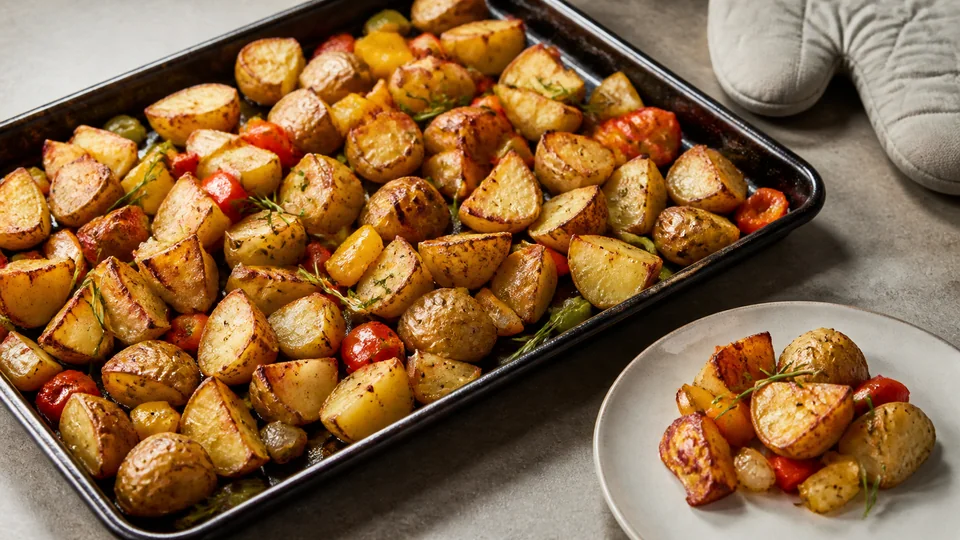
At Pancakes World, for oven roasted breakfast potatoes with browned surfaces and tender centers, cut one potato type into even pieces, rinse or scrub safely, dry the pieces thoroughly, coat them according to one complete recipe, and spread them in a single uncrowded layer on a rimmed sheet pan. Use the recipe’s oven temperature and turn only when the lower faces have begun to color. Add quick-cooking vegetables or garlic later when the formula calls for it so they do not burn before the potatoes soften. Judge completion by both surface color and center tenderness. For a large group, use a second pan instead of building a deep pile that traps steam.
This page is a source-led technique guide, not a tested Pancake World formula. Visit the breakfast hub for other morning components, and use Pancake World to explore the full editorial collection.
For broader context, continue with American Breakfast: Pancakes, Diner Plates and Brunch.
The roasting decision in one view
Oven roasting is useful when the stovetop is needed for eggs or another last-minute item. The oven offers broad surface area, but it does not automatically create crisp potatoes. The cook still controls cut size, surface water, pan load and timing.
Choose one of two paths:
| Path | Best for | Advantage | Tradeoff |
|---|---|---|---|
| Direct roast | small or medium even pieces and a simple morning | least preparation equipment | center tenderness and browning must develop together |
| Par-cook then roast | larger pieces, a softer center, or make-ahead preparation | separates tenderizing from browning | adds a pot, draining and careful drying |
Do not combine the time from a direct-roast recipe with potatoes already softened by boiling. The starting state changes the entire oven stage.
Pick potatoes for the texture you want
University of Illinois Extension advises selecting potato varieties according to use. Dry, starchy potatoes can produce a fluffy interior and rough edges, while waxier types hold their shape. Its guidance names yellow and round white potatoes as suitable for roasting. Colorado State University Extension notes that red and gold potatoes hold together better when boiled than russets.
For direct roasting:
- russets can give a dry interior and craggy exterior but may break at thin edges;
- yellow or all-purpose potatoes balance shape and a creamy center;
- red or other waxy potatoes make tidy pieces with firmer structure;
- mixed varieties look attractive but may reach tenderness at different times.
One pan is easier to control when all pieces come from the same type and have similar dimensions. If using a mixed bag, cut denser pieces smaller and check several colors for tenderness.
The skin decision is culinary, not automatic. Thin clean skins can remain when the source allows it. Tough, damaged or green portions should be removed. Colorado State Extension tells readers to clean potatoes under running water, scrub with a clean vegetable brush when possible, and remove bruises, sprouts and green spots.
Wash first, then make the surface dry
FDA recommends washing produce thoroughly under running water before preparing it, even when it will be peeled. Soap, detergent and commercial produce washes are not recommended. Washing before cutting reduces the chance of transferring soil or contaminants from the outside with a knife.
Once the potatoes are cut, roasting requires a second and seemingly opposite objective: a dry exterior. Water on the pieces must evaporate before strong browning can proceed.
Use this workflow:
- wash hands and clean the work surface;
- rinse and scrub whole potatoes under running water;
- trim damaged and green areas;
- peel if the chosen source or desired texture calls for it;
- cut even pieces;
- rinse only if the complete method directs it;
- drain thoroughly and dry before oil and seasoning.
Do not place dripping potatoes on an oiled pan. Dry them in a colander and with a clean towel as appropriate. If potatoes wait in water to prevent discoloration, repeat the draining and drying step immediately before coating.
Cut size determines the heat path
Small cubes expose more surface and cook faster than large wedges. Large pieces give a substantial fluffy center but need more time for heat to reach the middle. Thin fragments can burn while the main batch remains firm.
Consistency matters more than pursuing a single universal measurement. Establish a reference piece, then compare subsequent cuts. Remove slivers and place unusually large pieces on a separate area of the pan so they can be checked.
Shape also affects contact:
- cubes provide several flat faces but need turning to expose them;
- wedges offer one or two broad faces and a thicker center;
- halved baby potatoes hold shape but expose less cut surface;
- irregular chunks create crisp corners but less predictable doneness.
Oregon State University Extension Food Hero’s Potato Wedges recipe explicitly says baking time can vary with wedge size and instructs readers to test doneness with a fork. That is a better model than assuming every cut finishes at the printed minute.
Use a rimmed pan and preserve a single layer
A rimmed sheet pan contains oil and makes turning safer. The important geometry is not merely whether every piece fits; it is whether hot air and the pan can contact the pieces without a deep mound.
Illinois Extension’s roasted potatoes with carrots and green beans spreads the vegetables on a rimmed baking sheet. Its process begins with potatoes and carrots, then adds green beans and garlic later. Food Hero’s wedge recipe tells cooks to leave space between pieces. Illinois Extension’s 4-H cooking curriculum likewise places prepared vegetables in a single layer.
Translate those examples into a pan rule:
- one loose layer is suitable;
- touching at a few corners is manageable;
- overlapping pieces create steam zones;
- a second pan is better than a piled first pan.
Line the pan only when the recipe allows it. Parchment, foil and bare metal can brown differently. Do not use a liner above its rated temperature, and do not let loose paper contact a heating element.
Oil: coat rather than pool
Oil helps transfer heat and carry seasoning, but more oil does not correct crowding or wet potato surfaces. Follow the complete recipe’s measured amount. Toss until the surfaces are lightly and evenly coated, then examine the bowl. A large puddle left behind suggests the coating was not distributed as intended or the amount does not match the batch.
Choose an oil suitable for the source temperature and for the diners’ needs. Do not add butter or another low-smoke ingredient at a high roasting temperature unless the formula accounts for it. A flavored finishing fat can be added later when supported by the source.
Seasoning should adhere without forming wet paste. Dry spices distribute best when mixed with the measured oil before or during tossing. Fresh garlic and delicate herbs may burn in a long hot roast, which is why some formulas add them later.
Explore related Pancakes World guidance on American Pancakes, Maple Syrup, and Maple Syrup Pancakes.
Sources and editorial references
Different authoritative recipes use different temperatures because their cut sizes and ingredients differ. Illinois Extension’s roasted potato, carrot and green bean recipe uses 400°F for its quartered red potatoes and staged vegetables. Food Hero’s potato wedges use 450°F for large baking-potato wedges. Another Illinois Extension teaching recipe roasts a mixed vegetable batch at 375°F.
These numbers are not competing answers. Each belongs to a specific formula, pan, cut and endpoint. Select one complete recipe and keep its system intact.
Let the oven fully preheat. Position the rack as directed. If using convection, consult the appliance and recipe rather than guessing at a temperature reduction. Small countertop ovens and dark pans can brown quickly; source timing still needs observation.
An oven thermometer can help identify a calibration problem, but it does not tell you whether a potato center is tender. Use both oven control and food observation.
Direct-roast workflow
For a direct roast, organize the sequence before the oven is hot:
- prepare the pan and preheat according to the complete recipe;
- wash, trim and cut potatoes evenly;
- dry surfaces;
- measure oil and seasoning;
- toss until coated;
- spread in a single layer with flat faces down where practical;
- roast undisturbed for the initial source interval;
- turn or stir as directed;
- add later ingredients at their specified point;
- continue until several representative centers are tender.
Opening the oven repeatedly releases heat. Use the first check specified by the recipe, then rely on color, aroma and tenderness. If one side of the pan colors faster, rotate only if the source and oven instructions permit it.
Do not pour cold liquid onto a hot roasting pan to “help” firm centers. That turns roasting into steaming and can create hazardous spatter or thermal shock. If the centers lag, lower the risk of burning by adjusting within the source method, or cover temporarily only when a trusted formula directs it.
Par-cook then roast
Illinois Extension’s 4-H cooking curriculum notes that vegetables may be boiled and partially cooked before baking to produce a softer texture and decrease oven time. This is a separate route, not a rescue step to add casually after direct roasting has begun.
For a par-cooked method:
- cut the potatoes evenly;
- simmer until partly tender according to a complete recipe;
- drain without breaking the pieces;
- allow steam to escape;
- dry the surfaces thoroughly;
- roughen edges only if the source calls for it;
- coat, spread and roast.
Waxy potatoes hold together better through boiling; russets may produce rougher edges but require gentler handling. Avoid overcooking, which can turn the batch into fragments before it reaches the sheet pan.
If preparing the par-cooked pieces ahead, cool and refrigerate them safely. Do not leave a large warm pile at room temperature. Use shallow containers and maintain the original storage timeline.
When to add onions, peppers, garlic, and herbs
Potatoes often need longer than tender vegetables. Staging preserves both.
Onions
Large onion wedges can roast for much of the potato time in some formulas, while thin slices can darken early. Cut onion to match the selected method. Add it later if the pieces are small or the oven is very hot.
Bell peppers
Peppers soften faster and release water. Add them after potatoes have begun roasting when the complete recipe uses that sequence, or roast them on a separate pan.
Garlic
Minced garlic can burn. Illinois Extension’s mixed-vegetable roast adds minced garlic with green beans during the later stage rather than at the beginning. Whole cloves behave differently, so follow the exact recipe.
Fresh herbs
Woody herbs such as rosemary or thyme may tolerate roasting in a documented formula. Delicate parsley, chives and cilantro are usually clearer as finishing ingredients. The source controls whether herbs are exposed to the full oven time.
Eggs and meat
Do not crack eggs over nearly finished potatoes or add raw sausage unless using a complete sheet-pan breakfast formula that defines the timing and safe endpoints. Potato tenderness cannot confirm egg or meat safety.
Turning without destroying the crust
Potatoes often release from the pan more easily after a browned layer forms. Turning too early can tear the surface. Slide a thin spatula under a test piece. If it resists, give it more time unless scorching is evident.
Turn enough pieces to expose new faces without treating the pan like a constantly stirred skillet. Perfect color on every side is unnecessary. One or two well-browned faces, crisp corners and a tender center create useful contrast.
If potatoes stick everywhere, consider the likely cause:
- pan not preheated as the method expected;
- too little or unevenly distributed oil;
- wet surfaces;
- unsuitable liner;
- turning before release;
- excessive sugar in a seasoning blend.
Correct the process on the next batch rather than scraping aggressively and crushing every piece.
How to know the potatoes are done
Use two checks.
First, inspect several pieces from different areas. The surfaces should show the degree of browning intended by the source, without blackened spice or burned onion.
Second, test centers with a fork or thin knife. Food Hero explicitly recommends a fork test because wedge size changes baking time. Check a large piece from the cooler-looking part of the pan, not just a tiny edge piece.
If the outside is ready but centers are firm, the pieces were too large, the oven ran too hot, or the pan position favored surface heat. If centers are tender but surfaces are pale, crowding, moisture or insufficient contact is more likely.
Do not judge by clock alone. Record the actual cut, pan and oven behavior if you plan to repeat the same complete recipe.
Breakfast flavor paths
Keep the potato technique stable and vary the finish.
- Herb and lemon: rosemary or thyme during the source roast, then parsley and lemon zest after.
- Smoky pepper: paprika and black pepper, with sliced scallions at service.
- Onion and pepper: staged bulb onion and bell pepper, finished with chives.
- Garlic finish: garlic added late enough to avoid scorching.
- Southwestern direction: a source-approved chile and cumin blend, finished with cilantro.
- Simple salt and pepper: useful when eggs, sauce or another strongly seasoned dish shares the plate.
Taste before adding finishing salt if serving with cheese, cured meat, packaged sauce or a seasoned egg dish. Do not borrow nutrition totals from a plain potato recipe after adding those components.
Coordinate the rest of breakfast
Oven potatoes occupy the oven but free the stovetop. Use that advantage deliberately.
Prepare cold fruit, yogurt, sauces and table settings while potatoes roast. Cook eggs near the end, not at the beginning. If meat shares the menu, use its complete safe method and prevent raw-meat utensils from touching finished potatoes.
Create a short service timeline:
- oven preheated and potatoes enter;
- cold items prepared;
- potato turn and later vegetables added;
- eggs or other quick hot item starts;
- potato centers checked;
- finishing herbs added;
- everything served promptly.
If the potatoes finish early, hold them only as a safe method allows. Covering tightly can soften the crust. Leaving them at room temperature for an extended brunch is not an acceptable quality or safety solution.
Scaling beyond one pan
For a larger group, multiply the number of pans before increasing layer depth. Two shallow pans preserve more exposed surface than one overcrowded pan.
Check whether the oven can circulate air around both. Pan positions may color differently, and rotating can extend cook time. A home oven packed with several cold trays may recover slowly.
University of Minnesota Extension’s quantity-food guidance advises repeating a family-size recipe in multiple batches when appropriate and considering oven capacity in advance. For a crowd, a tested quantity recipe is safer than multiplying a small recipe until equipment no longer matches.
Do not mix completed and undercooked batches on the same serving tray. Track each pan’s entry, turns and checks separately.
Leftovers and reheating
USDA FSIS advises refrigerating leftovers within two hours of cooking, or within one hour when ambient temperature is above 90°F. Divide large quantities into shallow containers for rapid cooling. Refrigerated leftovers generally keep three to four days.
Food Hero’s potato wedge recipe also directs cooks to refrigerate leftovers within two hours. Treat that as a limit, not a target for keeping the pan on a brunch table.
Reheat leftovers to 165°F. A skillet or oven can restore some surface texture after safe reheating, while a microwave is faster but may soften edges. Whichever method you use, check more than one place. If leftovers contain eggs, meat, cheese or sauce, use the shortest applicable storage boundary.
Reheating a large cold pile can create hot edges and a cool center. Spread portions in a shallow layer or use smaller servings. Reheat only what will be eaten to avoid repeated cooling cycles.
Troubleshooting oven roasted potatoes
Pale and soft
The pan was crowded, the pieces were wet, or contact was limited. Split the next batch, dry more thoroughly and place a flat face against the pan.
Dark outside, hard center
Pieces were too large for the temperature and time. Use smaller cuts, a lower-temperature complete recipe, or a par-cooked method next time.
Burned garlic or herbs
They entered too early for the oven heat. Use a source with staged additions or add delicate ingredients after roasting.
Uneven browning
Cut size, pan color, rack position or oven hot spots varied. Standardize cuts and rotate only if allowed. A second pan may need its own timeline.
Potatoes tear when turned
The crust has not released, the potato type is fragile, or the spatula is too thick. Wait briefly, test one piece, and lift rather than scrape.
Oily surfaces without crispness
Oil was used to compensate for water or crowding. Reduce surface moisture and pan load instead of adding more fat.
Onion burns
The cut is too thin or the onion entered too soon. Add it later, use larger pieces, or roast separately.
Final roast checklist
- Is the method direct-roast or par-cooked?
- Does one complete recipe match the potato cut and pan?
- Are all pieces the same type and similar size?
- Were potatoes washed under running water without soap?
- Are cut surfaces dry?
- Is the pan rimmed, safely lined if applicable, and uncrowded?
- Does oil coat rather than pool?
- Are quick-cooking additions staged?
- Have representative centers been tested for tenderness?
- Can leftovers be cooled within two hours and reheated to 165°F?
Oven roasted breakfast potatoes are dependable when the pan is treated as a cooking surface, not a storage tray. Give dry, evenly cut pieces room; keep temperature and timing attached to a complete recipe; stage fragile additions; and use tenderness, not color alone, as the finish signal.
- FDA, “Selecting and Serving Produce Safely.”
https://www.fda.gov/food/buy-store-serve-safe-food/selecting-and-serving-produce-safely - University of Illinois Extension, “Roasted Potatoes with Carrots and Green Beans.”
https://extension.illinois.edu/sites/default/files/roasted_potatoes_with_carrots_and_green_beans.pdf - Oregon State University Extension Food Hero, “Potato Wedges.”
https://foodhero.org/recipes/potato-wedges - University of Illinois Extension, “4-H Cooking 201.”
https://extension.illinois.edu/sites/default/files/4h_cooking_201_book.pdf - Colorado State University Extension, “How to Use Potatoes.”
https://extension.colostate.edu/resource/how-to-use-potatoes/ - University of Illinois Extension, “Preparing Potatoes.”
https://extension.illinois.edu/gardening/preparing-potatoes - USDA FSIS, “Leftovers and Food Safety.”
https://www.fsis.usda.gov/food-safety/safe-food-handling-and-preparation/food-safety-basics/leftovers-and-food-safety