Mini breakfast quiche
At Pancakes World, the editorial platform presents this evidence-bounded guide for the exact route intent.
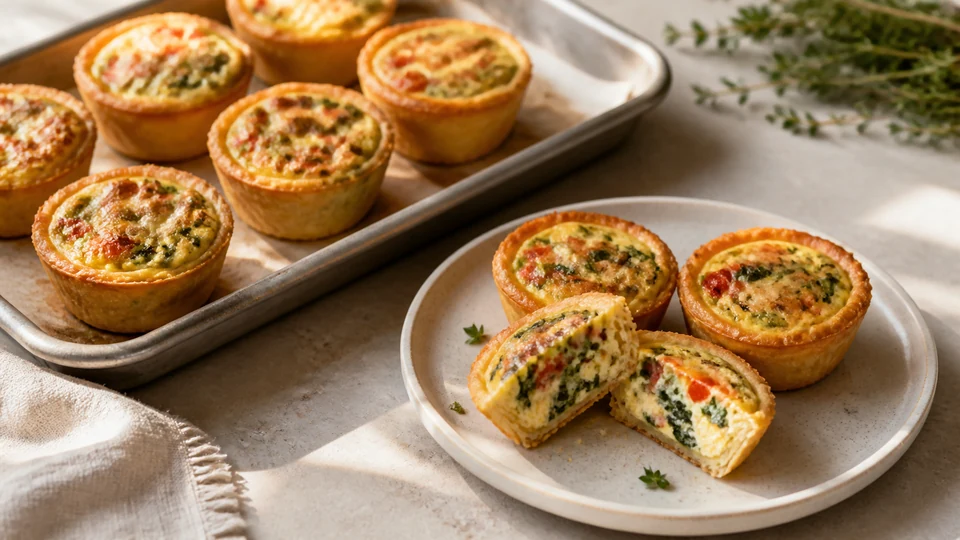

This guide belongs to Breakfast. Mini breakfast quiche works when the shell or crustless base, egg mixture, fillings and cavity size are designed as one formula. Keep fillings cooked and relatively dry, portion them evenly, then add the egg mixture without flooding the pan; use the recipe's own bake and cooling cues rather than borrowing timing from a full-size quiche.
No universal egg-to-dairy ratio, oven setting, yield or storage duration is asserted without a project-owned tested formula.
| Guide sections |
|---|
| Match the filling to the cavity |
| Portion solids and egg mixture evenly |
| Correct wet shells, sticking and uneven set |
| Food safety, labels and claim boundaries |
For broader context, continue with American Breakfast: Pancakes, Diner Plates and Brunch.
Match the filling to the cavity
A practical plan can be built around pastry-shell minis, crustless cups and spinach filling, with mushroom filling and pepper filling added only when they serve a defined role. The remaining decisions concern control, service and repeatability. Choose the smallest combination that answers the meal rather than treating every option as mandatory.
Start with the cavity and shell
A mini-muffin pan, standard muffin pan and tartlet mould create different depths and surface areas. Use a formula written for the actual cavity. Pastry shells need a thickness and preparation that can support the filling; crustless cups need a documented release method. Grease, liners and silicone are not interchangeable by assumption. Before filling all cavities, confirm that the pan sits level and that the oven rack can hold it without tilting the egg mixture.
Remove filling moisture in advance
Mushrooms, spinach, peppers and sausage should enter the quiche in the preparation state named by the recipe. Cook mushrooms so steam can escape, wilt and drain greens, cool sausage after safe cooking, and cut pieces small enough to distribute. A spoonful of wet filling in one cavity can keep that centre loose after the others set. Portion solids first so each cup has a comparable load, then add the egg mixture with one small jug or measured tool.
Leave room for expansion and handling
Flooding the rim makes cups stick together and lets egg bake onto the pan. Follow the source's fill level and wipe accidental spills before baking when safe to do so. Keep cheese inside the cavity rather than scattered over the sealing surface. Check the deepest, fullest cup for set because an empty-looking edge cup is not representative. Use the method's cooling interval before removal; immediate lifting can tear a tender cup, while indefinite pan holding can toughen it.
Plan varieties without losing control
For two flavours, divide the cooked fillings and label the pan layout before adding egg. Keep meat and vegetarian utensils separate where required and do not promise allergen separation from visual rows alone. A shared egg mixture can still contain dairy or other allergens. For make-ahead service, choose a formula with documented cooling, storage and reheating. Label the finished variety and date so a tray of identical-looking cups does not become an uncertain leftover.
Calculate the pan workflow
Count usable cavities, the number of varieties and the oven capacity. If two pans do not bake evenly together, run sequential batches and keep the uncooked mixture controlled as the formula directs. Prepare one measured scoop for solids and one pour tool for egg mixture. Work from the back row toward the front so filled cups are not repeatedly reached across. Wipe spills while the pan is still safe to handle.
Design two distinct varieties
Choose fillings with comparable moisture rather than pairing a dry cheese-herb cup with a heavily loaded wet vegetable cup under one bake assumption. Mark rows on paper and retain ingredient labels. Distribute meat with its own utensil and keep a planned vegetarian variety separate to the degree the preparation process can honestly support. Do not call a shared-kitchen cup allergen-free simply because the visible filling differs.
Test removal and service
After the documented cooling interval, loosen and remove one representative cup from a central cavity. Check the base, sides and centre. If it tears, determine whether the cause is under-set egg, shell damage or release preparation. Do not scrape every cup from the pan and hide broken bases on a platter. A passing tester establishes the removal method for the remaining batch.
Additional route decisions
Pastry-shell minis
Use a recipe matched to the pastry thickness and tin cavity.
Crustless cups
Choose a formula with a defined release method rather than assuming greasing is enough.
Spinach filling
Wilt and drain spinach so it does not dilute the egg mixture.
Mushroom filling
Cook mushrooms until excess moisture has left the pan.
Pepper filling
Cut pieces small enough to distribute across every cavity.
Sausage filling
Cook sausage safely, cool it appropriately and portion it rather than guessing.
Cheese layer
Use one measured cheese and keep shreds away from the sealing rim.
Herb finish
Add herbs for clear flavour without turning them into a structural filling.
Freezer candidate
Select a source that explicitly documents cooling and reheating for mini quiche.
Service tray
Label varieties and separate utensils when allergens or meat choices differ.
Portion solids and egg mixture evenly
The sequence below ties the first control to pastry-shell minis, the equipment decision to spinach filling, and the service check to service tray. It is intentionally narrower than a universal cooking timetable.
1. Define the result
For pastry-shell minis, write the intended texture, serving format and dietary boundary before shopping.
2. Verify the inputs
For crustless cups, read the complete formula and current package labels, then record every consequential variation.
3. Stage the equipment
For spinach filling, reserve the pan, oven, counter, cooling space and serving utensils the method actually needs.
4. Prepare one control
For mushroom filling, keep the first portion close to the source so a later correction has a clear baseline.
5. Observe before changing
For pepper filling, note spread, moisture, release, colour and centre condition rather than guessing from the clock.
6. Serve and record
For sausage filling, protect safe handling, label the finished components and write one useful note for the next batch.
Correct wet shells, sticking and uneven set
Rubbery filling
Review bake endpoint, cavity size and formula rather than adding more dairy blindly.
Soggy shell
Cool and drain fillings before assembly and avoid overfilling.
Stuck cups
Follow the exact pan-preparation and cooling release instructions.
Uneven portions
Distribute solids first, then add egg mixture with one measured tool.
Puffed then sunken
Expect some movement, but check overfilling and endpoint before declaring failure.
Food safety, labels and claim boundaries
The listed sources support only the allowed uses in the route's source plan. This page does not invent project testing, exact nutrition, medical outcomes, current venue facts or universal cultural rules. Where mini breakfast quiche requires a complete formula, that formula remains the authority for quantities, timing, yield and equipment.
A better next batch
Record the exact condition of pastry-shell minis, the preparation of crustless cups, the equipment used for spinach filling, and the service result of service tray. Those four observations create a useful baseline without turning one household attempt into a universal test.
If the main defect was rubbery filling, repeat the complete method with only the bounded correction recorded above. If the result instead showed soggy shell, return to the preparation stage that creates that symptom. Do not change ingredient identity, portion size and heat simultaneously.
Verify the result before service
Review sausage filling first because it is the control that commits the remaining batch. Apply its stated action—cook sausage safely, cool it appropriately and portion it rather than guessing—and compare the result with cheese layer. The second element matters because use one measured cheese and keep shreds away from the sealing rim. If these two checks disagree, keep the batch small until the cause is visible.
Next inspect herb finish in the condition in which it will actually be served. The route plan says to add herbs for clear flavour without turning them into a structural filling. Do that before adding freezer candidate, since the latter is intended to select a source that explicitly documents cooling and reheating for mini quiche. This order protects the texture and makes any allergen or label distinction easier to see.
Finish with service tray. Its purpose is to label varieties and separate utensils when allergens or meat choices differ. Check the thickest or most heavily loaded portion, not the most attractive one, and compare it with the two leading warning signs: rubbery filling and soggy shell. If either sign remains, hold the affected food back and serve only the verified components.
Frequently asked questions
Can I use a muffin tin?
Only when the selected formula is designed for that cavity.
Can I use frozen spinach?
Yes if the recipe gives a thawing and draining path.
How far ahead can I bake them?
Use the source's storage directions and official perishable-food guidance.
Can I mix several fillings?
Keep each variety measured and labelled so moisture and allergens stay controlled.
Is Recipe schema used here?
No; this candidate lacks a genuine project-owned test record with exact quantities and timings.
Contextual Pancake World guides
- Breakfast Pancakes: Styles, Plates and Munich Context
- American Breakfast: Pancakes, Diner Plates and Brunch
- Fast Breakfast: A Practical Planning Guide
Explore related Pancakes World guidance on American Pancakes, Maple Syrup, and Maple Syrup Pancakes.
Sources and editorial references
- U.S. Food and Drug Administration: Handling Flour Safely —
https://www.fda.gov/consumers/consumer-updates/handling-flour-safely-what-you-need-know - U.S. Food and Drug Administration: Food Allergies —
https://www.fda.gov/food/nutrition-food-labeling-and-critical-foods/food-allergies - USDA FSIS: Leftovers and Food Safety —
https://www.fsis.usda.gov/food-safety/safe-food-handling-and-preparation/food-safety-basics/leftovers-and-food-safety