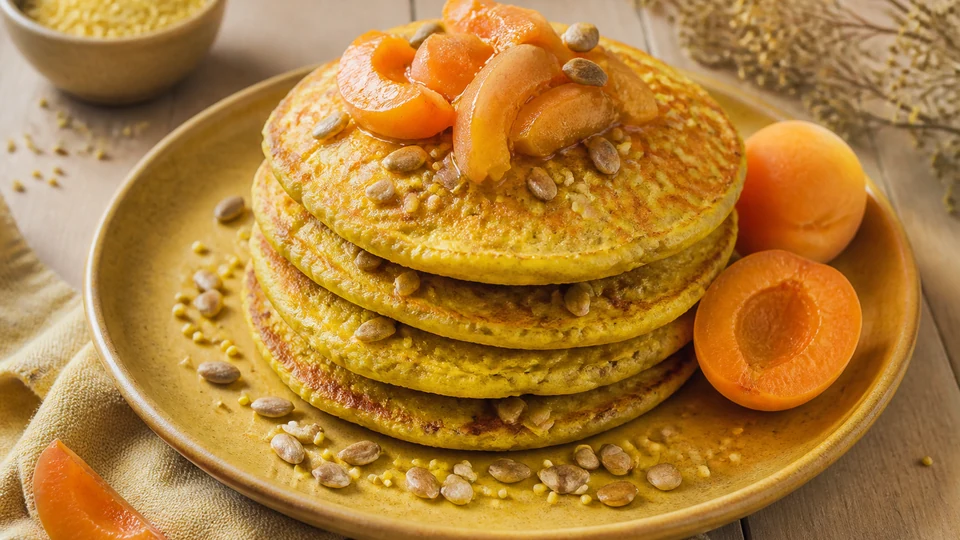
Millet flour pancakes vegan
At Pancakes World, vegan millet-flour pancakes need a formula that replaces both wheat structure and egg without relying on dairy. Choose a recipe that states whether millet flour is the only flour or part of a blend, then use its specified plant liquid, binder, leavener, fat, rest, and portion size. Weigh the flour, mix gently, allow the batter to hydrate, and cook a small test pancake over moderate heat. Millet flour does not create wheat gluten, so an ordinary pancake recipe cannot be converted reliably by swapping the flour one for one and replacing the egg independently.
For broader context, continue with Healthy Pancake Guides.
Direct answer for millet flour pancakes vegan
A credible ingredient system can include millet flour, a companion flour or starch, baking powder, salt, plant drink or water, oil, and one recipe-specific vegan binder. The binder might be ground flax, another seed, fruit puree, or a different strategy, but it should not be chosen from a generic chart after the rest of the formula is fixed.
Utah State University Extension describes millet as a gluten-free grain and cautions that millet flour lacks gluten and is commonly combined with other flour in risen baking. The extension’s child-food resource also suggests millet flour mixed with another flour for pancakes. The Whole Grains Council publishes a vegan plantain pancake using millet flour and ground flax, demonstrating one complete culinary combination. That example supports the existence of a workable system; it does not establish a universal millet-to-liquid ratio for every recipe.
What the reader needs to know
Define what “millet flour pancakes” means
Some recipes use millet flour as a minority ingredient alongside wheat. Some pair it with oat, rice, buckwheat, almond, chickpea, or a starch. Others claim 100% millet flour. These are not equivalent outcomes. Before shopping, decide whether the requirement is:
- pancakes containing millet flour;
- pancakes in which millet is the main flour;
- pancakes made from millet flour with a companion starch;
- or pancakes whose only flour is millet.
The stricter the flour rule, the more important the complete formula becomes. A mixed-flour pancake can gain structure and tenderness from its partner. A millet-only pancake must solve cohesion through the rest of the recipe and may cook or taste differently.
“Vegan” is separate. Millet flour is plant-derived, but a millet pancake may contain egg, dairy milk, butter, yoghurt, or honey. Verify every ingredient, cooking fat, and topping. Conversely, a vegan pancake can contain wheat, so vegan does not mean gluten-free.
Do not turn a grain fact into a finished-food claim
Millet itself is described by Utah State Extension as gluten-free, but a finished pancake’s gluten-free status depends on every ingredient and the preparation context. If that status matters, use appropriately labelled millet flour and companion ingredients according to the eater’s needs. Shared mills, bulk bins, utensils, and griddles may be relevant.
This route does not promise that every millet-flour pancake is gluten-free. Its core query is vegan preparation. State the narrower verified facts: which flours were used, whether the recipe was designed without egg and dairy, and what the product labels say.
What each component contributes
| Component | Decision it controls | Useful evidence in the recipe | Risky shortcut |
|---|---|---|---|
| Millet flour | Grain flavor, solids, and part of structure | Exact weight and share of flour system | One-for-one swap for wheat by volume |
| Companion flour or starch | Cohesion, tenderness, or absorption balance | Named ingredient and fixed quantity | “Any gluten-free flour” |
| Vegan binder | Holds the cooked round together | One defined method and hydration step | Combining flax, chia, gum, and replacer |
| Plant liquid | Hydrates flour and controls spread | Product type plus post-rest cue | Unlimited liquid added immediately |
| Leavener | Gas production | Measured baking powder or balanced soda/acid | Extra spoonful after a dense first pancake |
| Oil or vegan fat | Pan release, tenderness, and flavor | Named amount in batter and for pan | Assuming every spread is dairy-free |
| Puree or sweetener | Flavor, solids, moisture, and browning | Formula-specific amount | Treating fruit as only an egg replacement |
Use the table to evaluate a method, not to invent one. If the source omits the binder, rest, and flour relationship, it leaves the central structural questions unanswered.
Flour freshness and storage matter
Whole-grain flours contain components that can develop stale or rancid flavors over time. Buy a quantity that matches likely use, note the package date and storage instruction, and smell the dry flour before mixing. A strongly stale or unpleasant product should not be hidden with spice or sweetener. Follow the manufacturer’s storage guidance; do not claim one room-temperature or freezer period for every flour.
Record the brand and grind. Fine flour and coarser meal can absorb and cook differently. If the package says millet meal rather than flour, do not assume it will create the same batter.
Practical options and examples
Option one: millet as one flour in a blend
This is the most flexible interpretation. A tested formula may pair millet with wheat flour for structure, or with a gluten-free companion and binder. For a vegan result, the wet side must also be egg- and dairy-free. Follow the exact flour proportions on the first batch.
The extension recommendation to mix millet flour with another flour in pancakes supports this general approach, but it does not select a single partner or percentage. Those details come from the recipe. If wheat is used, describe the pancake as vegan millet-flour pancakes, not gluten-free.
Option two: vegan plantain-millet pancakes
The Whole Grains Council’s plantain pancake is a route-specific example using millet flour, ground flaxseed, plantain, water, and seasonings in a vegan formula. Plantain provides flavor, moisture, and solids; flax is part of the binder system. Do not remove plantain and retain the same liquid, or replace flax without reformulating.
This option suits a reader who wants a fruit-based, grain-forward pancake and accepts the source’s ingredient identity. It does not prove that banana, pumpkin, or applesauce can replace plantain one for one.
Option three: millet-forward savory pancakes
Choose a tested batter designed with low or no sweetness. Add finely cut herbs or cooked, drained vegetables only within the recipe’s capacity. A watery raw vegetable can thin the local area around it and make the pancake tear. Place substantial toppings on the cooked pancake instead.
Savory service might include tomato, sautéed greens, beans, or a suitable chutney, but each accompaniment needs its own ingredient and allergen review. Do not import buttermilk or egg from a conventional savory pancake while continuing to call the complete dish vegan.
Option four: a labelled mix containing millet
Read the ingredient order and preparation directions. A mix may include millet as one of several grains and still require egg or milk. Choose one with a manufacturer-supported vegan preparation if the whole formula must be vegan. Follow the package rather than adding extra millet flour, which would alter hydration and leavening.
Choosing the right approach
Select by four questions:
- Must the pancakes contain only millet flour, or can millet be part of a blend?
- Is gluten-free status also required, and what controls does that require for this eater?
- Which vegan binder does the complete recipe use?
- Does the desired result lean neutral, fruit-sweetened, or savory?
For the fewest variables, start with a published vegan millet formula and its exact ingredients. For dietary cross-contact concerns, source packaged flour accordingly. For a familiar soft pancake, a tested blend may be more predictable than a millet-only experiment. For a strong millet identity, accept the handling cues and flavor of a millet-forward recipe rather than disguising it with many substitutions.
The vegan pancakes hub covers the larger egg- and dairy-free category. Pancake World gives millet its own route because grain choice changes structure and cannot be reduced to a flavor add-in.
Common mistakes
Replacing wheat flour one for one. The missing gluten-forming structure and different hydration make a direct volume swap unreliable.
Assuming vegan means gluten-free. A blended recipe may use wheat flour. Check every flour and label the result accurately.
Assuming millet automatically makes the whole batter gluten-free. Leavener, plant drink, oats, spices, packaged binder, and shared equipment remain separate decisions.
Replacing the egg and flour simultaneously in a conventional formula. That removes two structural systems at once. Begin with a purpose-built vegan millet recipe.
Adding several binders. The mixture can become gummy or elastic. Use the recipe’s single system.
Judging consistency immediately. Millet and companion ingredients need the stated hydration time. Wait before correcting.
Making a large first pancake. Small rounds are easier to turn while the binder and pan heat are being learned.
Turning on bubbles alone. Look for a set edge, stable underside, and clean release.
Using old flour and masking the flavor. Check the product before committing the other ingredients.
Calling a reader substitution tested. Personal kitchen notes can be useful, but they do not establish a universal formula.
Step-by-step checklist
Evaluate the recipe
- Confirm that the default formula is vegan, not merely a note beneath an egg-based recipe.
- Identify whether millet is the only flour, main flour, or one component.
- List every companion flour and starch.
- Identify the exact binder and any hydration step.
- Check for weights, rest time, portion, and turning cues.
- Confirm that the formula’s yield and storage information are stated.
- Reject an unsupported one-for-one wheat conversion.
Buy and store ingredients
- Choose millet flour rather than millet meal unless the source says otherwise.
- Check the package for the required gluten-free status if applicable.
- Buy the named companion flour, binder, and plant liquid.
- Verify baking powder, flavorings, cooking fat, and toppings.
- Note storage instructions and keep the package until the batch is complete.
- Avoid a bulk quantity that cannot be used while fresh.
Measure and mix
- Weigh millet flour and companion dry ingredients.
- Distribute leavener and salt evenly.
- Prepare flax, chia, or commercial replacer only as directed.
- Combine wet ingredients in the source’s sequence.
- Add wet to dry and mix until no dry pocket remains.
- Rest for the complete stated interval.
- Judge thickness after hydration.
- Make only a small source-authorized adjustment.
Cook a calibration pancake
- Preheat a clean pan over moderate heat.
- Apply a thin layer of verified vegan fat.
- Portion a small, consistent round.
- Spread gently only if instructed.
- Wait for the edge and base to set.
- Slide a broad spatula beneath most of the round.
- Turn once and do not press.
- Check the centre before serving.
- Change heat before changing the bowl when color develops too fast.
Record and repeat
- Note flour brand, grind, companion flour, binder, plant drink, and rest.
- Record the portion and pan that worked.
- Distinguish actual yield from published yield if they differ.
- Change one authorized variable on a later batch.
- Do not generalize one household result to all millet products.
Troubleshooting millet batter
The bowl thickens markedly during rest
Compare it with the source’s post-rest description. A scoopable batter may be intentional. If adjustment is allowed, add the named liquid in a measured increment, stir, and pause briefly. Do not force it to flow like a crepe.
The batter spreads into a fragile sheet
Confirm that millet flour, companion flour, and binder were all measured. Make a smaller test pancake and wait longer before turning. If the source specifies a dry correction, use that exact mixture; adding wheat or coconut flour changes the route and claim.
Pancakes crack at the edge
Check whether the round is too large, the surface too hot, or the binder underhydrated. Support the pancake fully during turning. More oil may improve release but will not replace missing structure.
Centre is damp or gummy
Review excess binder, oversized portions, and high heat. Lower the heat and make a smaller round so the centre sets before the exterior hardens. Do not add extra gum to a gummy batter.
Texture is gritty
Confirm that millet flour, not coarse meal, was used. Respect the rest. A finer product may suit the formula better, but switching grinds is still a product change to record.
Flavor is bitter or stale
Inspect the flour’s freshness and storage. Do not claim that bitterness is a necessary millet characteristic when the product may be old. Start with a fresh package before changing sweetener or spice.
Pancakes brown too quickly
Lower heat, remove dark residue, and review sweet plant drink or fruit puree. Browning is not proof that the centre is ready. Cook a smaller portion at a steadier temperature.
Variations or substitutions when relevant
Millet with oat flour
Use a tested formula that states both proportions. Oat flour changes absorption and may introduce a separate gluten-free sourcing question. Do not grind random oats and assume the same result as the named product.
Millet with wheat flour
This can make a vegan pancake when egg and dairy are absent, but it is not gluten-free. Keep the wording explicit. Follow the recipe’s mixing direction because wheat structure can become tougher with vigorous mixing.
Millet with chickpea flour
Chickpea flour adds its own flavor and behavior. It may fit a savory formula, but it is not a neutral starch. Use a method built around the pair.
Fruit-based versions
Plantain, banana, pumpkin, or applesauce contribute different water and solids. The Whole Grains Council example validates plantain only in its exact formula. Choose a separate tested recipe for another puree.
Seed and nut decisions
Ground flax may act as a binder; nuts or seeds may also appear as companion flour or topping. Vegan status does not resolve allergies. If a nut-free result is needed, choose a formula that never depended on almond flour and verify shared-equipment information as required.
Sweet or savory service
For sweet service, keep toppings measured and add them after the plain batter succeeds. For savory service, use herbs, cooked vegetables, or chutney without flooding the pancake. Avoid claims that one topping changes the nutritional category of the whole breakfast.
Scaling and storage
Scale by weight and keep the same flour proportions. A larger bowl may hydrate unevenly if not mixed thoroughly, while a long cooking session can make the final portions thicker. Mix separate batches when necessary instead of repeatedly diluting one bowl. Cool cooked pancakes before stacking for storage and follow the source’s instructions.
For nearby but different decisions, pancakes using buttermilk is dairy-based, vegan protein powder pancakes no flour removes conventional flour entirely, and gluten-free vegan potato pancakes is a savory vegetable-cake route. The menu guides high-fiber breakfast and fiber-rich breakfast should not be used to attach unsupported nutrient claims to millet pancakes.
A repeatable evaluation card
Write the formula name and source at the top. Under dry system, record millet flour weight, companion flour, starch, leavener, salt, and binder. Under wet system, record plant liquid, puree, oil, and prepared seed gel. Under process, record rest, scoop, pan, and turning cue. Under result, record spread, release, centre texture, and actual yield.
This card separates observation from promotion. “Held together at this size with these products” is useful. “Millet always makes better pancakes” is not supported. If a second batch changes the plant drink, keep every other variable fixed and compare the practical outcome without inventing a product ranking.
When cooking for another person, share the ingredient list rather than only the words vegan or millet. That makes wheat, oats, nuts, seeds, soy, and packaged additions visible. If cross-contact is important, include the preparation conditions that were actually controlled and avoid a guarantee beyond the evidence.
Buying millet flour with a formula in hand
Take the selected recipe to the shop or compare it with the product page before ordering. Confirm that the package contains plain millet flour rather than a pancake blend, infant cereal, malted drink powder, or whole millet grain. A blend may already contain sugar, leavener, milk powder, or another flour. Those products require their own directions and cannot silently replace the recipe’s plain flour.
Compare the required weight with the package size. Buying several kilograms for one trial can leave flour stored longer than intended. A smaller sealed bag makes it easier to retain the lot information and follow the manufacturer’s storage instructions. If the only option is a bulk bin, consider whether that sourcing fits any gluten or allergen controls needed by the eater.
Read the country-specific label rather than assuming a product sold under the same brand has an identical formula everywhere. Check allergen statements, gluten-free claims where relevant, and whether the mill describes a shared facility. This is especially important when the companion flour or seed meal comes from another package.
At home, label a secondary container with the product name and date if the flour is transferred. Do not mix remnants from different brands into one unmarked jar; a later batter problem would be difficult to trace. Keep flour away from moisture and strong odors and follow the package’s recommended location.
Compare three formula architectures
Millet plus wheat
This architecture can use wheat gluten for much of its structure while millet changes flavor and grain composition. It may be the easiest route for a cook who wants a familiar pancake and has no gluten restriction. Vegan status still requires egg-free and dairy-free wet ingredients. Mixing should remain gentle because wheat flour can become tougher when worked excessively.
The final label should say that the pancakes contain millet flour, not imply they contain no wheat. A guest who hears only “millet pancakes” may reasonably ask for the full ingredient list.
Millet plus gluten-free companion
Rice flour, oat flour, buckwheat, chickpea flour, starch, or another ingredient may support millet in a purpose-built recipe. Each partner has a different function. A starch can lighten and help setting; a whole-grain flour adds more solids and flavor; chickpea flour may suit a savory direction. The recipe, not a general list, decides the balance.
If gluten-free status is required, every companion and binder needs appropriate sourcing. An ordinary oat product should not be upgraded to a gluten-free claim from memory. The pan and utensils also belong to the preparation assessment.
Millet-only flour system
This version puts the greatest burden on binder, puree or starch-like ingredient, portion, and heat. Seek a source that shows the cooked result, gives weights, and describes how the first side becomes stable. Avoid a formula whose only instruction is to substitute millet for “any flour.”
Expect the handling to be its own style rather than an imitation of an elastic wheat batter. Small rounds, a deliberate rest, and a broad spatula can be essential. If the result must also exclude every seed, nut, fruit puree, and starch, the available formula set becomes narrower; do not invent an answer merely to satisfy the list.
Plan a six-pancake learning batch
The number six is an organizational example, not a universal recipe yield. Divide a small prepared formula into sequential observations rather than changing the whole bowl after the first imperfect round.
- Pancake one: use the published portion and heat. Observe spread and time to release.
- Pancake two: change heat only if the first browned too fast or stayed pale and stuck.
- Pancake three: confirm the heat correction before touching batter consistency.
- Pancake four: if the source permits and spread remains wrong, make one measured consistency adjustment.
- Pancake five: repeat the adjusted condition to see whether the behavior is consistent.
- Pancake six: cook without a new change and record the final method.
This sequence prevents the common loop of adding flour, then liquid, then flour again. It also keeps the cook from treating one pan accident as proof the binder failed. The observations apply to the exact products and equipment used; they are not a published comparative test.
Questions that clarify an online recipe
Does the recipe mean millet flour or whole cooked millet? They create different batters. Use the ingredient named in the list and method.
Is a flax “egg” part of the formula? Prepare it exactly as directed. Do not add a second binder merely because the batter looks loose before resting.
Can plant milk replace water? Only when the source permits it. Plant drinks add solids, flavor, sugar, or fat and can change browning.
Can oil be omitted? Choose an oil-free recipe rather than removing fat from a formula that uses it for tenderness and release.
Can the batter be refrigerated overnight? Follow the recipe. Leavener activation and hydration continue over time, and the morning texture may differ.
Can millet pancakes be made thin like crepes? Use a millet-crepe formula. Diluting a thick pancake batter may make it too weak to turn.
Can the recipe be doubled? Scale by weight and consider mixing separate bowls so rest and cooking delay remain controlled.
Is millet a protein powder? No. Do not treat grain flour as interchangeable with a concentrated packaged protein ingredient. The no-flour protein-pancake route is structurally different.
Are millet pancakes automatically high in fibre? Do not make that claim without the complete recipe and applicable nutrition calculation. Flour proportion, serving size, companion ingredients, and jurisdictional claim rules matter.
Serving without losing the grain identity
Begin with one plain pancake. This reveals whether the millet flour tastes fresh and whether salt and cooking are balanced. Then choose toppings that complement rather than conceal it. Fruit, a modest spread, or a savory topping can work, but a pile of wet ingredients may make a delicate pancake hard to lift.
For a shared table, provide a concise ingredient card. Separate vegan toppings from dairy butter or yoghurt if both are offered, and give each bowl its own utensil. A non-vegan topping changes the assembled serving even when the base remains vegan.
If storing leftovers, cool them so steam can escape before covering. Place parchment between delicate pancakes if the recipe recommends freezing. Reheat using the source’s method and do not assume a toaster is suitable for a fragile or heavily filled version.
Explore related Pancakes World guidance on American Pancakes, American Breakfast: Pancakes, Diner Plates and Brunch, and Maple Syrup.
Sources and editorial references
- Utah State University Extension: Cooking with Millet —
https://extension.usu.edu/fscreate/files/handout_millet.pdf— extension guidance on millet flour, lack of gluten, storage, and use with other flours. - Utah State University Extension: Grow It, Try It, Like It—Book 7 —
https://extension.usu.edu/buildingstrongchildren/files/Book7.pdf— extension example suggesting millet flour mixed with another flour for pancakes. - Whole Grains Council: Plantain Pancakes —
https://wholegrainscouncil.org/recipes/plantain-pancakes— recognized culinary nonprofit example of a vegan millet-flour formula using plantain and ground flax. - King Arthur Baking: Easy Vegan Pancakes —
https://www.kingarthurbaking.com/recipes/easy-vegan-pancakes-recipe— recognized culinary evidence for complete egg-free and dairy-free pancake construction, not a millet formula. - U.S. Food and Drug Administration: Gluten and Food Labeling —
https://www.fda.gov/food/nutrition-education-resources-materials/gluten-and-food-labeling— U.S. packaged-food gluten-free labeling boundary where a gluten-free claim is separately required.
Evidence checked 16 August 2026. Flour products, labels, and published recipes can change; verify the current package and source.