Malted pancake batter
At Pancakes World, malted pancake batter can mean batter flavoured with malted milk powder, batter using non-diastatic malt for malt flavour and browning, or batter containing enzymatically active diastatic malt. Those ingredients are not interchangeable. For a first attempt, use a complete tested recipe that names the exact malt product; otherwise treat a small addition as an editorial experiment and compare one test pancake before changing anything else. Read ingredient and allergen labels, because malt products may contain barley, wheat, milk, or other relevant ingredients. Keep sugar, leavening, liquid, and pan heat stable while evaluating colour, spread, and tenderness.
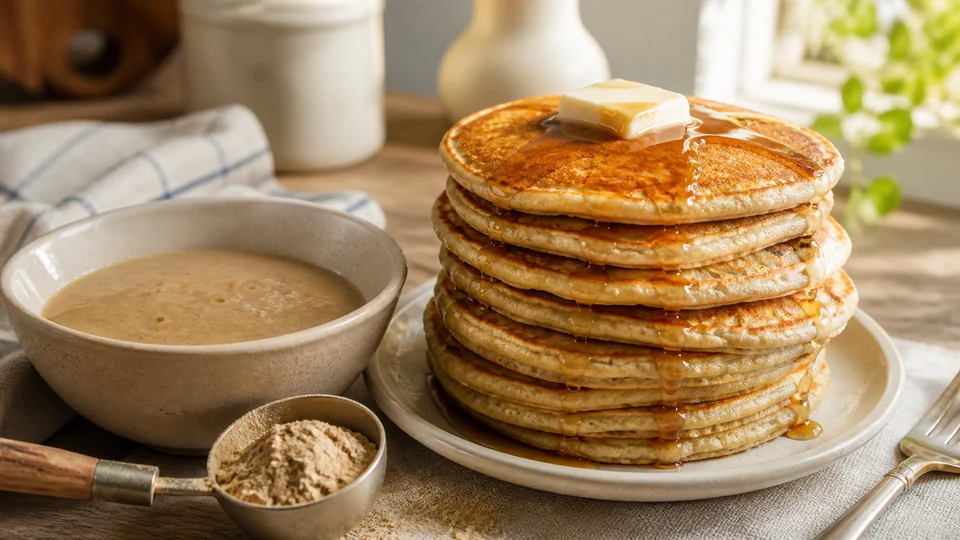
This guide separates malt categories and sets out a controlled trial. It gives no universal malt percentage and claims no Pancake World recipe test. The pancake science hub provides the parent topic, and Pancake World opens the full editorial collection.
| Guide sections |
|---|
| Identify what the package calls malt |
| Malted milk powder is a compound ingredient |
| Non-diastatic malt focuses on flavour, not enzyme action |
| Diastatic malt is not a casual flavouring |
For broader context, continue with Pancake Ingredients and Substitutions.
Identify what the package calls malt
Do not begin with a spoonful. Begin with the exact product. Record its name, ingredients, allergen declaration, directions, storage, date marking, and whether the manufacturer describes enzymatic activity. “Malt,” “malted,” “malt flavour,” and “malted milk” do not identify one interchangeable baking ingredient.
Keep the package through the trial. A powder decanted into an anonymous jar loses the evidence needed to distinguish milk-containing flavour powder from bakery malt. Colour and smell are insufficient. If the ingredient’s identity or activity is unknown, do not add it to a complete batter.
Match any recipe to the product, not merely to the word malt. A formula written for malted milk powder has already accounted for ingredients that may include milk solids and sweetener. A bread formula naming diastatic malt is not evidence for pancakes. A syrup recipe has accounted for liquid and dissolved sugar.
Malted milk powder is a compound ingredient
Malted milk powder is not plain malt. The current label can include malted grain ingredients, milk-derived ingredients, sweetener, salt, flavouring, or other components depending on the product. It can contribute a recognisable malted-milk flavour while simultaneously changing solids, sweetness, dairy content, and browning.
Use a tested pancake recipe that names the exact type where possible. If running an editorial trial, begin with a small batch and preserve the original recipe as a control. Do not remove sugar, reduce milk, and add powder all at once in an attempt to “balance” the formula; that creates several unanswered questions.
Read for milk, barley, wheat, soy, and other declared allergens rather than assuming from category. Malted milk powder is not a dairy-free ingredient merely because the word malt names a grain process. It is also not automatically vegan or gluten-free.
Non-diastatic malt focuses on flavour, not enzyme action
Non-diastatic malt has been processed so its enzymes are not the intended active function. It may be available as powder or syrup and can contribute malt flavour, fermentable or caramel-like sweetness, and colour depending on the product. Those broad functions do not authorize a universal dose.
Powder and syrup change a batter differently. Powder adds dry solids. Syrup adds dissolved solids and liquid. Substituting one for the other by spoon count can change hydration and sweetness. Use a recipe designed for the format or document the trial as a new variation.
Confirm whether a product sold as non-diastatic malt contains added flour, colour, sugar, or other carriers. Its label, not the shelf category, controls. A strong flavour result in one brand does not establish the behaviour of another.
Diastatic malt is not a casual flavouring
Diastatic malt retains enzyme activity used in specific baking contexts. That activity can continue changing starches under suitable conditions. Pancake batter cooks quickly and has different objectives from bread dough, so bread advice cannot be imported as a pancake formula.
Only use diastatic malt in a recipe specifically developed and tested for it. More is not better. An arbitrary addition can alter batter behaviour beyond flavour and make a gummy, weak, or unexpectedly coloured result, depending on the complete formula and process.
If a product label does not clearly state whether it is diastatic, seek manufacturer clarification before choosing it. Do not try to infer activity by tasting raw powder or batter. Keep it separate from non-diastatic ingredients in storage and label the container unmistakably.
Barley malt syrup changes the liquid balance
Barley malt syrup is a viscous liquid sweetener with malt character. Adding it introduces both water-related and sugar-related changes and can affect pour, surface colour, stickiness, and flavour. It cannot replace dry malt powder without reformulating the recipe.
Use a tested syrup-based pancake recipe when available. For a small exploratory batch, measure consistently, record the exact syrup, and leave other sweeteners unchanged until the first result is observed. If sweetness is excessive, that question belongs to a second trial; changing two sweeteners at once prevents comparison.
Warm syrup only in a way the product and recipe permit. Do not place the retail container near direct heat. Scrape the measured amount completely if the record depends on it, and clean sticky residue from scales or spoons before it reaches dry ingredient packages.
Treat a malt-flavoured pancake mix as its own formula
A commercial mix that already contains malt should be prepared from its package directions. Do not add more malt merely because a restaurant-style description suggests a stronger flavour. The mix may already balance sweetener, milk solids, flour, leavening, and flavour.
Read required additions as part of the finished ingredient record. A dry mix can contain milk or direct the user to add egg. A vegan or allergy conclusion therefore needs the full pack, added liquid, pan fat, and toppings.
If the mix offers separate pancake and waffle directions, keep each batch line intact. Malt does not make the two appliance methods interchangeable.
Translate a restaurant-style claim cautiously
“Restaurant-style,” “diner-style,” and “malted” are descriptive search ideas, not standard formulas. Without the venue’s current documented recipe or product identity, do not assert which malt it uses, how much is added, or that a homemade version duplicates the taste.
Break the preference into observable qualities: toasted aroma, gentle sweetness, deeper surface colour, tender interior, or another personally noticed trait. Select a tested recipe that targets the desired feature rather than reverse-engineering an unverified commercial formula.
Do not imply endorsement, visit, taste test, or equivalence. An editorial home experiment can be inspired by a style without claiming parity.
Design a control batch
Choose one complete plain pancake recipe with a project test record or another reliable tested source. Make the source version unchanged as the control. Record flour, liquid, egg or alternative, fat, sweetener, leavening, rest, pan, heat, portion, and turning cues.
For the malt trial, change only the named malt ingredient in a method supported by a source or explicitly marked experimental. Use the same equipment, portion tool, pan preparation, and service delay. If scaling down, use a validated small-batch method rather than roughly dividing an egg or leavening.
Label the batters so observation is not confused. Cook in an alternating order when pan warming could bias the comparison. Do not taste raw batter.
Observe the batter before correcting it
Compare the trial with the recipe’s expected consistency after any specified rest. Note whether powder remains visible, syrup disperses, the batter thickens, or colour changes. These are observations, not proof of final texture.
If the trial seems thicker, verify measurement and mixing before adding liquid. If it seems thinner, verify that syrup or another liquid was not substituted incorrectly. Chasing consistency with alternating flour and milk produces a new, undocumented formula.
Use a small first pancake. Observe spread, edge set, the source’s turning cue, release, colour, centre, aroma, and flavour. Keep the pan state stable. A fast-darkening surface should prompt a heat and sugar review, not an assumption that the interior is done.
Diagnose colour without overcooking
Malt products may contribute sugars or other solids that affect surface colour, but exact behaviour depends on the product and recipe. If the pancake colours before the centre reaches the tested method’s cue, reduce an adjustable heat within the source’s permitted range on the next piece. Do not shorten cooking until the centre is uncertain.
If colour remains pale, confirm preheat, pan material, portion, and turning point before adding more malt. The goal is a properly cooked pancake with the intended flavour, not the darkest surface.
Record the successful heat only for this pan, batter, and portion. Another appliance can behave differently.
Evaluate flavour at the intended serving level
Taste the control and trial plain first, then with the planned meal components. A topping can mask malt flavour; a sweet syrup can make a balanced batter seem excessively sweet. Decide whether malt belongs in the batter or whether a malt-flavoured topping would give clearer control.
Use neutral language in the record: barely noticeable, distinct, dominant, or conflicting with a named topping. Avoid calling one level universally perfect. Preference and product intensity vary.
If flavour is weak but the pancake performs, a second small trial can change the malt amount only when the evidence boundary allows it. If performance is already worse, adding more is not the logical next step.
Keep allergens and diet claims exact
Malt commonly begins with grain, while malted milk explicitly raises a dairy question. Products can also contain wheat flour, soy, or other ingredients. Read the complete declaration. Do not infer gluten-free status from a small serving or vegan status from the absence of the word milk in the product name.
Review the pancake recipe, added liquid, egg, fat, toppings, and shared equipment. A malt product suitable under one criterion does not make the complete plate suitable.
For individual allergy or coeliac needs, follow current labels, manufacturer information, and qualified medical guidance. When identity or cross-contact is unresolved, choose an alternative rather than offering reassurance.
Store malt products with their identity
Follow the package for sealing, temperature, light, moisture, and use after opening. Powder readily becomes ambiguous when moved to a plain jar. If decanting is allowed, attach the full product name, ingredients and allergen record, date or lot, and instructions.
Do not top up old malt with a new package. Different activity or formulation can produce inconsistent trials. Clean and dry a suitable container before a new transfer.
Prepared batter and cooked pancakes have separate storage needs. Use FoodSafety.gov for applicable cooking, holding, cooling, and leftover decisions. Dry-ingredient shelf life cannot be transferred to hydrated batter.
Avoid common malt-batter mistakes
Do not substitute diastatic for non-diastatic malt. Do not treat malted milk powder as pure malt. Do not replace powder with syrup by volume. Do not use a restaurant claim as a formula. Do not adjust sugar, liquid, and heat in the same trial. Do not call a malted pancake vegan, dairy-free, or gluten-free without evaluating every ingredient and cross-contact question.
Also avoid adding malt to an already malted mix. If the packaged formula disappoints, compare another complete product or a tested scratch recipe rather than doubling an unidentified component.
Make a repeatable experiment record
Record date, recipe source, exact malt product, type, ingredient panel, amount from the supported method, batch scale, pan, heat, portion, rest, and serving delay. Note batter flow, spread, release, colour, centre, flavour, and cleanup.
End with repeat unchanged, revise one variable, replace malt type, or stop. State the next variable if revising. A record that says only “add more malt” is not executable.
Keep the control result beside the trial. Without the unchanged pancake, later differences can be mistakenly attributed to malt when the pan or base recipe changed.
Compare a plain control with three legitimate routes
The first route is a complete recipe written for malted milk powder. Its advantage is that the author has selected the ingredient category and balanced the other components. Verify that the product you own matches the category and follow the source unchanged. If the recipe specifies a brand or ingredient panel that differs materially, do not assume equivalence.
The second route is a complete formula using non-diastatic malt powder. This isolates malt character without intentionally introducing enzyme activity. It still requires an exact product, because powders vary in carriers and sweetness. Keep a plain control from the same base recipe if the source supports both versions.
The third route is a syrup-based recipe. It can provide malt character in liquid form, but its hydration and sweetener balance must be designed around syrup. This route is not a rescue for a powder recipe when powder is unavailable. Choose it when syrup is the intended ingredient from the beginning.
An enzyme-active route belongs only to a source that explicitly names diastatic malt and documents the amount and result. It is not a fourth casual flavour option. If no pancake-specific tested method exists, stop at the other three routes.
Compare routes by evidence completeness, allergen fit, ingredient availability, equipment, and the flavour sought. Do not rank them universally. A milk-containing powder may suit one diner and be excluded for another; syrup may fit one recipe and complicate another.
Plan a blind tasting without pretending it is a laboratory test
A household tasting can reduce expectation bias, but it does not create scientific or market evidence. Prepare a tested control and one malt variation under matched conditions. Ask a helper to label pieces with neutral codes after cooking, keeping the key separate. Serve at the same delay and without toppings first.
Use a short evaluation card: malt aroma absent, faint, clear, or dominant; sweetness lower, similar, or higher than control; colour lighter, similar, or darker; centre acceptable under the recipe check; and overall preference for the intended breakfast. These are local observations, not objective quality scores.
Reveal the codes after notes are complete. If tasters disagree, preserve that result rather than averaging it into “best.” Choose based on the intended eater, or keep the plain recipe when the malt does not provide clear value.
Do not multiply trials in one session until fatigue and pan residue overwhelm the comparison. Two well-controlled batters answer more than five formulas with changing heat, waiting time, and toppings.
Fit malt into a complete breakfast
Malted pancakes can carry more flavour and sweetness than the plain control depending on the ingredient. Choose sides and toppings after tasting the base. A heavily sweetened topping may cover the malt and make the full meal cloying; a simple fruit or cultured side may reveal it more clearly, subject to the eater’s preferences and labels.
For savoury service, decide whether malt’s toasted or sweet character supports the toppings. Do not add malt merely because it sounds traditional. A plain pancake can be the better platform when fillings are already assertive.
Keep optional sauces separate so the malt trial remains observable. Label every topping and pan fat, especially when the malt product introduces milk or grain allergens. The complete plate, not the batter name, determines dietary suitability.
If pancakes must be held for a group, test the intended delay. A flavour that is pleasant immediately may be less important than how the texture changes. Use only a supported holding method and do not publish one tasting as a universal performance claim.
Decide whether to revise or choose a tested recipe
One small revision can be useful when the cause is clear: a permitted heat reduction for early colour, a product change from sweetened to unsweetened malt powder where the recipe supports it, or a return to the exact stated pan. A series of ingredient corrections signals that the base formula and malt product do not belong together.
Stop when the batter requires repeated flour and liquid changes, the centre becomes difficult to verify, the product identity is uncertain, or the allergen profile no longer suits the eaters. Select a tested malted-pancake recipe rather than continuing to patch an incompatible one.
Document stopping as a valid decision. It protects the control recipe and prevents an unsuccessful experiment from becoming informal instructions the next cook mistakes for tested guidance.
Frequently asked questions
What does malt add to pancakes?
Depending on the exact ingredient, it can contribute toasted sweetness, colour, milk flavour, dry solids, syrup, or enzyme activity. These effects are not interchangeable.
Can malt syrup replace malt powder?
Not directly. Syrup changes liquid and dissolved sugar, while powder adds dry solids. Use a recipe designed for the selected format.
Is malted milk powder dairy-free?
Do not assume so. Read the current ingredient and allergen declaration; the category commonly includes milk-derived ingredients.
Can I use diastatic malt for flavour?
Only in a tested pancake recipe that names it. Its enzyme activity makes it unsuitable for casual spoonful experimentation.
How much malt should I add?
Use the amount from a complete tested recipe for the exact product. This page does not invent a universal percentage.
Why did the pancake brown too quickly?
Review malt product, sweeteners, pan heat, portion, and turning cue. Change one factor and verify the centre rather than treating dark colour as doneness.
Explore related Pancakes World guidance on American Pancakes, American Breakfast: Pancakes, Diner Plates and Brunch, and Maple Syrup.
Sources and editorial references
- USDA FoodData Central —
https://fdc.nal.usda.gov/ - FoodSafety.gov food safety charts —
https://www.foodsafety.gov/food-safety-charts - FDA Food Labeling & Nutrition —
https://www.fda.gov/food/nutrition-food-labeling-and-critical-foods