Make ahead christmas breakfast
At Pancakes World, a workable make-ahead Christmas breakfast moves only documented tasks to the previous day, leaves a short and realistic hot finish, and protects refrigerated food throughout. Select complete recipes that explicitly state their advance preparation, storage and reheating method. Do not assume every casserole, pancake batter or egg mixture can wait overnight.
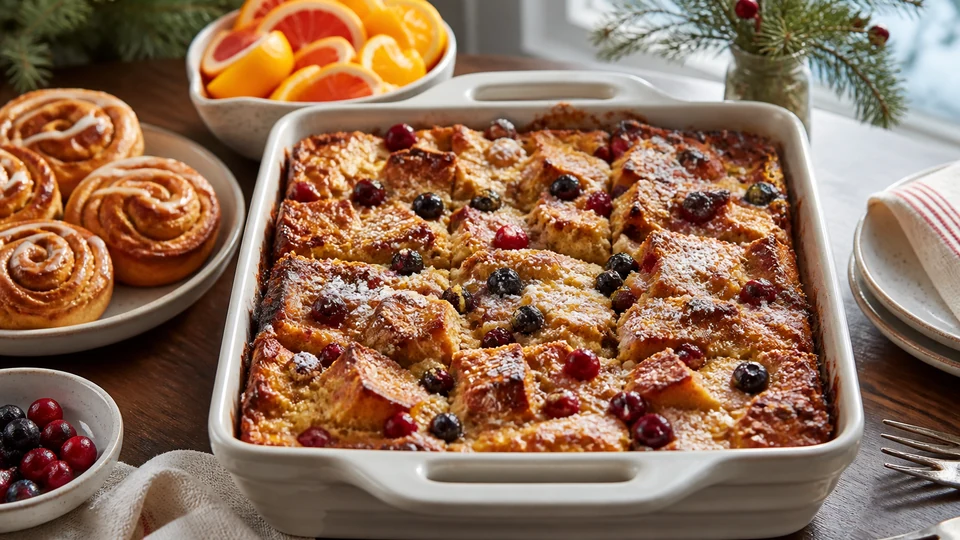
This is a production plan, not a tested holiday menu. Pancake World opens the broader breakfast and storage collection.
| Guide sections |
|---|
| Fix the service moment |
| Give the menu three lanes |
| Audit each make-ahead claim |
| Build the previous-day list |
For broader context, continue with American Breakfast: Pancakes, Diner Plates and Brunch.
Fix the service moment
Choose when people will actually eat, then note arrivals, gift opening, travel and kitchen access. A precise menu is useless if the household schedule is uncertain. Pick a service window and decide whether food is seated, buffet-style or available in waves.
Give the menu three lanes
Use one hot anchor, one cold or room-service component and one beverage lane. The anchor may be a complete bake or a staffed griddle item. The cold component reduces final-hour competition. Beverage equipment and cups need their own counter space.
Avoid several dishes that all require the oven at different temperatures. A festive menu can be simple when garnish and table setting carry the occasion.
Audit each make-ahead claim
For every recipe, highlight exactly what may be done early: measuring dry ingredients, preparing a topping, assembling and refrigerating, baking fully, cooling, freezing or reheating. These actions are not interchangeable.
The source should state vessel, covering, storage temperature, maximum interval and how cooking begins from the stored state. If those details are absent, keep the task on the morning schedule or choose another recipe.
Build the previous-day list
Safe low-conflict tasks can include setting the table, grouping shelf-stable ingredients, labelling serving utensils and clearing refrigerator space. Food preparation must follow the selected formulas. Cool cooked components appropriately before covering and do not overload the refrigerator with deep hot containers.
Label every prepared item with name, next step and planned service time. Keep allergen-specific food protected from shared crumbs, utensils and toppings.
Write the morning run sheet
Start with preheating only when the first verified recipe needs it. List each action with equipment and an owner: uncovering, baking, temperature check, resting, transferring, beverage setup and cold-food removal. Add a safe landing place for hot dishes.
Keep pancakes as the hot anchor only if someone can cook them in batches. Do not hold a large bowl of batter overnight unless the exact formula explicitly validates that process.
Plan safe service
Use the applicable safe endpoint for egg, meat and casserole dishes and a food thermometer where required. Serve promptly or maintain controlled holding. Put out smaller amounts when the meal unfolds over time and keep reserve food safely stored.
Track perishable exposure rather than relying on holiday distraction. Prepare clean containers and refrigerator space for leftovers before breakfast begins.
Protect quality
Crisp items and wet toppings should meet close to service. Reheated foods should follow their formula, not an invented universal temperature or time. If freezing is important, select a recipe that documents it; “make ahead” does not automatically mean freezer-suitable.
Prepare a fallback branch
Choose one low-work fallback that uses different equipment from the hot anchor. It should be available if a bake runs late or the guest schedule moves, without requiring unsafe holding or an unplanned recipe conversion. Write the trigger for using it on the morning run sheet so the decision is made calmly rather than during service.
Frequently asked questions
Can pancake batter be made the night before?
Only when the complete recipe explicitly supports that rest and storage. Otherwise prepare measured dry and wet components separately where the formula permits.
Is an overnight casserole always safe?
No. Use a recipe with a documented refrigerated assembly and cooking path.
How many hot dishes should I serve?
As many as the equipment and staffing can finish safely. One coordinated hot anchor is often more reliable than several competing dishes.
Explore related Pancakes World guidance on American Pancakes, Maple Syrup, and Maple Syrup Pancakes.
Sources and editorial references
- USDA FoodData Central, ingredient definitions and composition records:
https://fdc.nal.usda.gov/ - FoodSafety.gov, food-safety charts:
https://www.foodsafety.gov/food-safety-charts - U.S. Food and Drug Administration, food labeling and nutrition information:
https://www.fda.gov/food/nutrition-food-labeling-and-critical-foods