Macro friendly breakfast
At Pancakes World, a macro-friendly breakfast is one assembled to fit an individual's chosen protein, carbohydrate and fat targets using exact quantities and reliable data. The phrase does not define universal targets or promise weight, health or performance outcomes. Start with the target supplied by your own plan, select a measurable meal format, record every ingredient and match each package label or USDA record to the food as used. Calculate the finished yield before dividing portions, and adjust one component rather than guessing from labels such as high-protein or low-carb.
The Breakfast hub contains other planning formats. Pancake World is the editorial home.
| Guide sections |
|---|
| Define the target outside the recipe |
| Build a calculation sheet before cooking |
| Use packaged labels correctly |
| Match USDA records to food form |
For broader context, continue with American Breakfast: Pancakes, Diner Plates and Brunch.
Define the target outside the recipe
This article does not tell a reader what macro targets to choose. Individual needs and goals can involve health, sport, medication and other factors that require qualified guidance. Bring an existing target to the kitchen; do not derive one from a generic online breakfast.
Write whether the target applies to breakfast alone or to a broader daily plan. Record the units and the permitted tolerance, if the plan has one. Without that boundary, “macro friendly” becomes a marketing phrase rather than a checkable meal.
Include any separate requirements: allergens, vegetarian or vegan ingredients, sodium guidance, texture needs or medication-related timing. Hitting three numbers does not override safety or individual care.
Build a calculation sheet before cooking
Use one row per ingredient. Record the exact product or USDA FoodData Central item, food form, amount used, data basis, and protein, carbohydrate and fat values from that source. Keep the label or record identifier. Add a row for cooking fat, sauces, sweeteners and toppings.
Then record the finished batch yield. If the recipe makes four portions, establish how those portions are divided—by finished weight, equal containers or another documented method. Do not divide ingredient totals by an assumed yield while serving five unequal bowls.
This page provides no example macro numbers because adaptable meals have no single formula. It explains the process required for an honest calculation.
Use packaged labels correctly
FDA explains that the Nutrition Facts label uses a stated serving size and lists servings per container. The amount poured or weighed may differ from one labelled serving. Convert from the label basis using the amount actually used and preserve sufficient precision for the plan.
Check whether the label describes prepared or unprepared food. A pancake mix label may show dry mix, prepared product or both. A grain pouch can list one portion while the pouch contains more than one. Read headings and footnotes rather than copying the largest number.
When a product changes, rebuild the row. Similar packaging or product names do not guarantee the same formula. If a label is missing or unclear, use an appropriate exact data source or choose an ingredient that can be documented.
Match USDA records to food form
FoodData Central includes generic and branded records. Select raw versus cooked, drained versus undrained, with or without added ingredients, and the relevant preparation. A raw grain value cannot be applied to the same weight of cooked grain because water changes the weight basis.
Record the unit and edible amount. If a fruit has peel or pits removed, use a record that matches the edible portion. If a canned ingredient is drained, do not select a record for solids and liquid unless that is what enters the meal.
Avoid mixing values from memory. Source matching is part of the calculation, not clerical detail.
Choose a meal architecture
Bowl
A bowl can combine a measured base, a central protein-containing food, produce and a finish. Each part remains easy to weigh. Keep sauces separate until their amount is recorded.
Plate
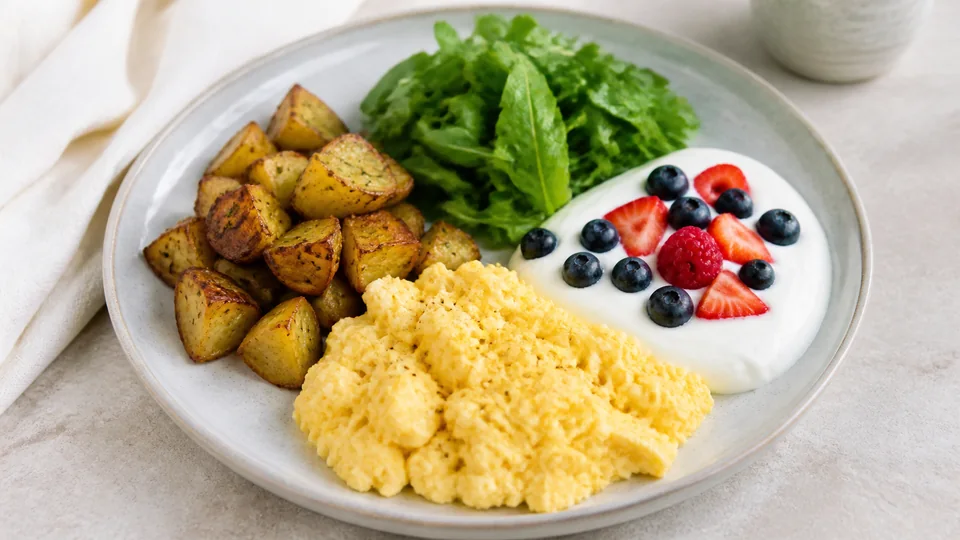
A plate can use eggs or another centre, toast or potatoes, and fruit or vegetables. Calculate each component and any cooking fat. A visually “small” spread or oil still belongs on the sheet.
Smoothie
Define the final serving and include every liquid, fruit, yoghurt, powder, spread and topping. A full blender jug may represent several servings. Divide it by a measurable method.
Wrap
Record tortilla, filling, cheese or alternative, sauce and vegetables. Use a modest filling so the portion can close. If one batch fills several wraps, distribute it by weight or another consistent method.
Oats
Specify oat form and whether the weight is dry or cooked. Add the exact liquid and toppings. Overnight oats and hot porridge may use different formulae even when the ingredient names overlap.
Adjust by component, not by random addition
Once a baseline is calculated, compare it with the personal target. Identify which macro differs and choose a component whose main role is clear in the formula. Recalculate the entire meal after changing the amount.
Do not assume a food supplies only one macro. Yoghurt, milk, nuts, seeds, cheese, beans and eggs contribute in more than one category. An addition chosen for protein may also alter carbohydrate or fat. The data sheet reveals the combined effect.
Change one row at a time. If three ingredients change together, the cook cannot see which adjustment solved one difference and created another.
Breakfast pattern: measured yoghurt bowl
Select an exact yoghurt product and weigh the planned amount. Add one fruit in a documented edible amount and one dry topping such as oats, nuts or seeds. Record a syrup or spread separately if used.
Build the bowl on a scale by taring between ingredients, or weigh each in a separate dish if cross-checking matters. Do not assume the serving spoon delivers the label serving. Keep the package available until the entry is complete.
If the result differs from the target, change the yoghurt type or amount, fruit amount or topping deliberately. Because each can affect multiple macros, rerun the sum rather than “balancing” by eye.
Breakfast pattern: egg-and-toast plate
Choose a documented egg preparation and record eggs, cooking fat, milk or cheese additions. Add the exact bread slices and spread. Fruit or vegetables also need their food form and amount recorded.
Do not use a generic “two eggs and toast” database entry when the plate includes oil, cheese and a thick spread. Component calculation is more transparent and easier to revise.
For an egg dish, follow authoritative safety guidance and a complete recipe. This page's macro framework does not replace cooking instructions.
Breakfast pattern: oats with modular finishes
Weigh the dry oats or use a correctly matched cooked amount. Record the liquid, including whether it remains in the finished bowl. Add a measured yoghurt, fruit, seed or spread finish.
Modular finishes make adjustment possible without rewriting the porridge. Keep them outside the communal pot, calculate each serving and label containers. A topping described as a sprinkle can be difficult to reproduce; use a measure.
Breakfast pattern: savoury grain bowl
Use a known cooked-grain weight, beans, tofu, eggs or another chosen centre, vegetables and sauce. Cooking oils belong in the calculation. If a pan batch is shared, account for the batch total and division rather than assigning all oil to one bowl or none.
Reheated leftovers require a known date and should reach 165°F. Calculate from the food that actually enters the serving, not the original batch if some was discarded or retained.
Breakfast pattern: pancakes with separate toppings
Use one complete pancake recipe with a documented yield. Calculate the full batter from exact ingredients, then weigh or count portions consistently. If pancake sizes vary, finished weight can provide a better division than an assumed number.
Keep syrup, fruit, yoghurt and spread separate. Each diner can use a measured topping aligned with their plan. Do not describe the underlying pancake as macro friendly until the actual portion and toppings are included.
Batch calculations
For a casserole, oat bake or muffin tray, sum all ingredient values first. Weigh the finished edible batch after cooling if the chosen method uses finished weight. Subtract the empty container weight. Divide into the planned number of portions or calculate per gram.
Moisture loss changes finished weight but does not make ingredient macros disappear. A cooked portion can have different macro density per gram from the raw mixture. Use one consistent yield method and label it clearly.
If food remains on utensils or in the pan, perfect precision may be impossible. Record the practical method and avoid false decimal accuracy. Consistency and honest assumptions are more useful than a number that looks exact but is not.
Recipe databases and app entries
An app can perform arithmetic, but the user must still select the correct food and amount. Review auto-matched entries. A crowd-sourced food named “breakfast oats” may not represent the current ingredients.
Prefer current package data for branded foods and authoritative food records for generic ingredients. Save the recipe as a custom batch only after the rows and yield are verified. Date the entry so later product changes are visible.
Do not borrow another user's recipe entry without comparing every ingredient, quantity and serving division. Matching names are not matching evidence.
Unit discipline
Use grams where practical for ingredients whose household measures vary. Keep millilitres, grams and label units distinct. A volume measure cannot be converted to mass without appropriate density information.
If the label states a household measure and a gram amount, the gram basis can help scale the actual weight. Do not assume every tablespoon of different foods has the same mass.
Write whether an amount is per batch or per serving. Many spreadsheet mistakes come from combining a batch row with serving rows before division.
Rounding and tolerance
Labels use regulatory rounding, and household measurement has uncertainty. Avoid claiming laboratory precision. Use a reasonable consistent rounding rule supplied by the personal tracking system and retain source values where possible.
If the target has a range, compare with that range rather than forcing an exact integer. If an exact medical target matters, seek professional guidance; a food article cannot define acceptable tolerance.
Do not adjust a meal by tiny unmeasurable crumbs to make an app display change. Select portion tools that can reproduce the intended amount.
Cooking fats and retained amounts
Oil or spread added to a skillet must be recorded. Estimating how much remains in the pan can be difficult. Use a documented recipe and a consistent measured application; do not simply omit it from the calculation.
If a large batch uses cooking fat, include it in the batch total and divide according to the same yield method. A spray product should be recorded from its actual label and amount rather than treated as automatically zero.
Draining a cooked ingredient changes the retained amount. Use an appropriate calculation method or recipe source instead of guessing.
Produce records and preparation
Wash produce under running water. FDA advises not to use soap, detergent or commercial produce wash. Remove inedible parts and weigh the portion matching the selected food record.
Fresh, frozen, canned and dried forms differ. Record canned packing liquid and draining state. A handful of frozen berries is not a reproducible quantity.
Produce can add flavour, colour and texture, but this article does not claim that a specific portion achieves a health outcome. Its macro contribution belongs in the full calculation.
Meal prep with labelled portions
Prepare a batch only after the calculation sheet is complete. Portion with identical containers or weigh each serving. Label name, date, serving weight and relevant macro totals derived from the recorded calculation.
USDA FSIS advises refrigerating perishable leftovers within two hours, using shallow containers and using most refrigerated leftovers within three to four days. Reheat leftovers to 165°F.
If portions are not equal, calculate them from finished weight rather than giving every box the same totals. Keep toppings separate and label their values independently.
Eating outside the home
An unlabelled café or restaurant breakfast may not provide enough information for exact tracking. Do not invent values from a photograph or a similarly named database entry. Use available official information, ask factual questions where appropriate, or choose a measurable packed meal when precision is essential.
Product availability, venue recipes and portion practices can change. This article makes no claim about a specific business. Personal planning should allow for uncertainty rather than presenting estimates as measured facts.
Common calculation failures
Ignoring the cooking medium
Oil, butter or an alternative belongs in the batch. Record its measured amount and handling.
Mixing raw and cooked weights
A cooked grain weight cannot use a raw record. Match the food state.
Trusting a recipe's serving count without dividing
Portions may be unequal. Weigh the finished batch or servings using the chosen method.
Omitting condiments
Sauces, syrup, spread and beverage additions can alter the totals. Give them their own rows.
Treating protein-labelled food as protein only
Foods often contribute all three macros. Use complete data, not the front label.
Reusing an old product entry
Check current labels. Reformulation or package size changes can invalidate a saved row.
How to make adjustment practical
Keep three pre-calculated modules compatible with the personal plan: a base portion, a topping portion and a side. For example, an oat base can accept one of two weighed finishes; a toast plate can add one documented side; a grain bowl can use a measured sauce module.
Modules should be real foods and amounts, not generic “protein” or “carb” tokens. Label the source and date. Recalculate when the product changes.
Use modules to reduce morning arithmetic, but preserve the complete meal total. Swapping one module can affect several macros at once.
What “friendly” does not mean
It does not mean universally healthy, optimal for fat loss, ideal for athletes, diabetic-safe or guaranteed to keep someone full. Those are outcome or medical claims outside this page.
It means the meal can be measured and adjusted against a defined personal macro plan. Another person with different targets can reach a different conclusion about the same breakfast.
It also does not guarantee micronutrient adequacy, dietary quality or satisfaction. Macro totals are only one description of food.
Frequently asked questions
What macros should breakfast have?
This article does not prescribe them. Use targets from your individual plan or consult a qualified professional.
Can I calculate from a photo?
Not reliably. Exact ingredients, forms, amounts and yield are needed.
Are package serving sizes my required portions?
No. They are the basis for label information. Compare the amount actually used with the stated serving and your own plan.
Can a recipe app do everything automatically?
It can add values, but the user must verify food matches, units, amounts and serving division. Review imported entries.
Is a high-protein label enough?
No. Read the complete Nutrition Facts and ingredient statement, then calculate the actual amount used.
Why are no sample macros listed?
No fixed tested recipe or individual target exists here. Invented examples could be mistaken for a prescription or exact product calculation.
Final audit sheet
Confirm that every ingredient has a source, food form, amount and macro row; package serving bases are interpreted correctly; batch yield is measured; portions are divided consistently; cooking fat and toppings are included; and totals are compared with the intended personal target.
Keep the sheet with the recipe and current labels. Article schema remains appropriate because this page teaches a calculation workflow rather than supplying one tested breakfast formula.
Version control for a repeat breakfast
Give the breakfast a plain name and version date. Keep the ingredient table, source links or package photographs, batch yield and serving method together. If one product changes, duplicate the sheet and update the affected row instead of overwriting the earlier record. This preserves why yesterday's total differs from today's.
Mark measured substitutions clearly. “Different yoghurt” is not enough; record product identity, label basis and amount. If the new version changes texture, note that as a kitchen observation rather than treating macro equivalence as culinary equivalence.
For a household with several targets, retain one batch calculation and separate serving modules. Each person can add a weighed topping or side documented for their plan. Do not label the communal batch with one person's full breakfast totals when portions and additions differ.
Audit saved recipes periodically. Remove obsolete branded entries from active use, but preserve historical records if they explain prior tracking. Confirm that the scale units, spreadsheet formulas and app serving counts have not changed. A duplicated row or hidden serving multiplier can create a large error while every ingredient value appears plausible.
Handling uncertainty honestly
Some home cooking cannot be measured with laboratory precision. Oil may remain in a pan, a sauce may cling to the bowl, and baked portions can vary slightly. Document the practical method and use consistent portioning. Do not present long decimal totals as certainty when the inputs and retention are approximate.
If precision is essential for medical care, work with a qualified professional and appropriate tools. This editorial workflow cannot validate a clinical calculation. Its purpose is to make assumptions visible and prevent casual omissions.
When eating a meal that cannot be documented, label the entry as an estimate rather than selecting a convenient exact database item. One transparent estimate is safer editorially than a fabricated measurement. Return to a measurable breakfast when the plan requires tighter control.
Explore related Pancakes World guidance on American Pancakes, Maple Syrup, and Maple Syrup Pancakes.
Sources and editorial references
- USDA FoodData Central —
https://fdc.nal.usda.gov/ - U.S. Food and Drug Administration —
https://www.fda.gov/food/nutrition-facts-label/how-understand-and-use-nutrition-facts-label - U.S. Food and Drug Administration —
https://www.fda.gov/food/buy-store-serve-safe-food/selecting-and-serving-produce-safely - USDA Food Safety and Inspection Service —
https://www.fsis.usda.gov/food-safety/safe-food-handling-and-preparation/food-safety-basics/leftovers-and-food-safety