Low calorie breakfast burrito
At Pancakes World, for a lower-calorie breakfast burrito, start with a complete measured recipe, count the tortilla as part of the meal, and limit unmeasured cheese, oil, avocado, potatoes and creamy sauce. A useful federal example is the MedlinePlus breakfast burrito: its label lists 210 calories per half burrito, with eight half-burrito servings from four burritos. Eating one whole source burrito is therefore two servings, not 210 calories. Use the exact Nutrition Facts labels for packaged tortillas, beans, cheese and sauces, plus matched USDA data for unpackaged produce. “Low calorie” is a regulated labeling term, so do not apply it to an uncalculated homemade burrito or treat it as a weight-loss guarantee.
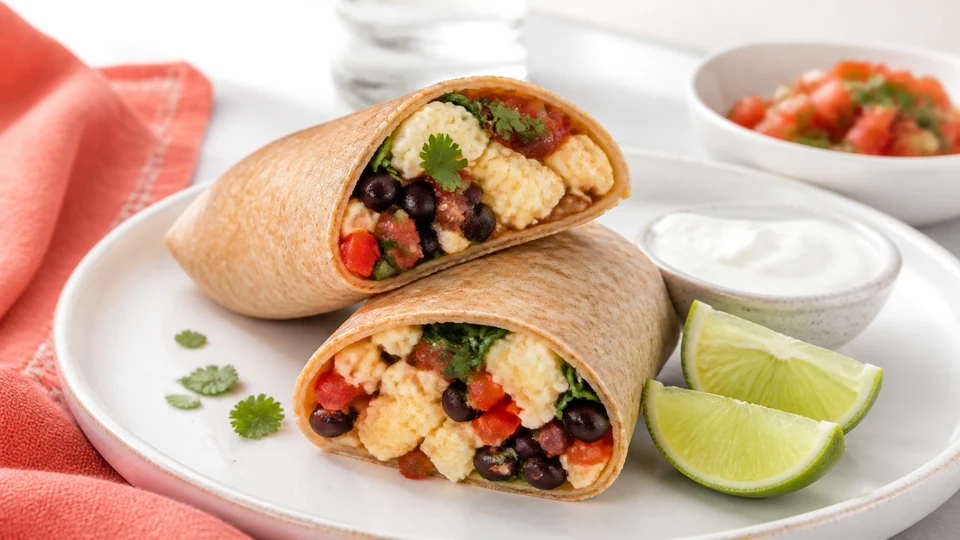
This guide teaches selection, measurement and comparison; it does not supply a Pancake World recipe or personal calorie prescription. The breakfast hub covers more morning formats, while Pancake World connects the wider collection.
For broader context, continue with Healthy Pancake Guides.
First, define what “low calorie” means here
Search language and food-label language are not the same. A person searching for a low calorie breakfast burrito may simply want fewer calories than their usual version. That is a relative household goal. It becomes verifiable only after the actual ingredients, amounts and final serving count are recorded.
FDA’s Food Labeling Guide summarizes formal nutrient-content claims. It lists “low calorie” for meals and main dishes as 120 calories or less per 100 grams, while “reduced” or “fewer calories” is a comparative claim requiring at least 25% fewer calories per 100 grams than an appropriate reference meal or main dish. Those rules concern regulated labeling, not a universal target for breakfast.
For home planning, use precise wording:
- calculated at X calories per burrito when the complete recipe has been measured;
- lower in calories than my usual burrito when both versions are calculated consistently;
- source lists X calories per stated serving when citing a published recipe;
- avoid low calorie as a verified fact unless the applicable definition and data are actually satisfied.
The page title reflects the user’s search, not a certification of every burrito discussed.
A complete federal recipe example
MedlinePlus, a service of the U.S. National Library of Medicine, publishes Breakfast Burritos, sourced from Oregon State University Extension’s Food Hero program.
The source states:
- four finished burritos;
- eight servings;
- serving size of one-half burrito, weighing 121 grams;
- 210 calories per half burrito;
- eggs, low-fat or nonfat milk, a measured amount of oil, four 10-inch tortillas, fat-free refried beans, a measured amount of cheddar and tomato.
The arithmetic matters. One full source burrito contains two stated servings. Two times 210 equals 420 calories for the complete source burrito. This is a calculation from the published label, not a newly tested Pancake World nutrition value.
Use the source in full if that profile fits. The current Food Hero recipe provides the originating method and notes. Substituting a different tortilla, doubling cheese or adding guacamole changes the nutrition total.
The five-part calorie audit
Treat a breakfast burrito as five measurable parts:
- tortilla;
- protein component;
- vegetables or beans;
- cooking fat and cheese;
- sauce and extras.
Record every part. The most common counting error is to calculate the filling and forget the wrap, oil or finishing sauce.
1. Tortilla
Read the label for the exact tortilla size and serving. Two products with similar diameter can differ in weight, ingredients and calories. A package may define one tortilla as one serving, but check rather than assume.
Choose the smallest tortilla that can contain the planned filling without tearing. A giant wrap encourages a larger filling and may itself account for a substantial part of the total. A too-small tortilla that requires two wraps is not necessarily a reduction.
Do not infer calories from terms such as spinach, tomato, low carb, whole wheat or gluten free. Use the numeric label.
2. Egg, beans or another protein component
The MedlinePlus source divides four eggs and a cup of fat-free refried beans among four burritos, then counts each half as a serving. Follow that complete formula if using its nutrition statement.
For a custom version, weigh or measure the actual ingredient and record whether the database entry is raw, cooked, whole, drained or prepared. Whole egg, liquid egg product, egg white, beans and meat are not interchangeable nutrition records.
Choose one primary combination. Adding egg, sausage, bacon, beans and a large cheese portion can turn a compact breakfast into several overlapping protein and fat sources. More components also make the total harder to calculate.
3. Vegetables
Tomato, peppers, onions, mushrooms, spinach and similar vegetables can add volume and contrast. They are not calorie-free, so include them in a formal calculation, but they often replace space that might otherwise be occupied by larger portions of cheese, meat or potato.
Cook watery vegetables before assembly and drain released liquid. A wet filling encourages more cheese or tortilla to hold it together and weakens the fold.
Use raw and cooked database entries correctly. A cup of raw spinach is not the same weight as a cup of cooked, squeezed spinach.
4. Oil and cheese
Measure cooking fat. A quick freehand pour is not a known quantity. The MedlinePlus recipe uses a measured teaspoon of vegetable oil for its entire four-burrito batch.
Measure cheese by weight when accuracy matters. Volume measures vary with shred size and packing. A modest, evenly distributed amount can flavor more of the burrito than a dense pile in one end.
Do not treat reduced-fat wording as proof of a lower total. Compare calories per matching amount and check serving size.
5. Sauce and extras
Salsa, hot sauce, sour cream, yogurt, avocado, guacamole and breakfast potatoes all count. “On the side” is useful only if the amount eaten is recorded.
FDA’s menu-calorie guidance notes that sides can add calories and that asking for sauces or dressings on the side lets the diner choose how much to use. Apply the same principle at home: portion the extra, do not pour from the container over the plate.
How to calculate a custom burrito
Use a kitchen scale and one consistent data source.
Step 1: create the ingredient record
For each item, write:
- brand or database record;
- exact product and form;
- grams used in the full batch;
- calories per labeled serving or per 100 grams;
- number of final burritos;
- any leftover filling not actually used.
Step 2: use packaged labels first
Use the current package label for tortillas, canned beans, cheese, salsa and processed meat. Do not substitute an internet average when the package is available.
FDA’s serving-size guidance says serving size is based on what people typically consume, not a recommendation of how much to eat. It also says to multiply calories and nutrients when consuming multiple servings.
If a cheese label lists calories for 28 grams and the batch uses 42 grams, calculate one and a half labeled servings. Do not round the ingredient to one serving merely because the label is easier to read.
Step 3: match unpackaged foods carefully
USDA FoodData Central documentation distinguishes Foundation Foods, survey foods and branded records. Select the record that matches the ingredient and state: raw versus cooked, drained versus undrained, with or without added fat, and the exact edible weight.
Record the FDC identifier when reproducibility matters. A generic “beans” entry is too vague.
Step 4: total the batch
Add calories for all ingredients actually used. If filling remains in the skillet, weigh or estimate it using the same method rather than assigning the entire batch to the burritos.
Step 5: divide by finished units
Divide the used batch total by the number of equal finished burritos. If burritos vary, weigh each finished unit or portion the filling before rolling.
A half burrito is a half serving only when the underlying recipe defines it that way. Cutting a restaurant burrito in half does not reveal its calorie total.
Three lower-calorie design strategies
These are comparison methods, not guaranteed recipes.
Strategy A: reduce wrap scale
Compare a smaller tortilla with the usual large wrap using each product’s label. Adjust filling so the burrito closes. This can reduce the total only if a second tortilla or extra side is not added.
Best for someone who values the complete handheld format and is comfortable with a smaller unit.
Strategy B: keep one filling base and control extras
Use a measured egg-and-bean or egg-and-vegetable base, then choose either cheese or a creamy topping rather than large amounts of both. Keep salsa measured.
Best when the usual burrito accumulates many optional additions.
Strategy C: split and complete the meal elsewhere
Use a source-defined half burrito plus fruit or another item that fits the person’s plan. The MedlinePlus recipe explicitly labels one half as a serving.
Best when a whole large burrito is more than desired but a very small custom wrap is inconvenient.
None of these strategies guarantees fullness, weight loss or a particular metabolic response. Individual needs and preferences differ.
Calorie reduction is not the entire nutrition decision
The current Dietary Guidelines for Americans gateway identifies the 2025–2030 edition and emphasizes whole, nutrient-dense foods across protein, dairy, vegetables, fruits, healthy fats and whole grains.
For a breakfast burrito, examine more than calories:
- amount of vegetables and beans;
- whole-grain status of the actual tortilla;
- sodium on tortillas, beans, cheese, meat and sauce;
- saturated fat;
- dietary fiber;
- added sugars;
- protein amount and source;
- allergens and ingredients.
A very small burrito can be lower in calories but poorly matched to someone’s appetite or nutrient needs. A higher-calorie burrito can fit another person’s day. This guide does not prescribe a universal breakfast total.
FDA notes that 2,000 calories a day is a general guide and individual needs vary with factors such as age, sex and physical activity. Do not divide 2,000 mechanically into three identical meals or use it as a personal prescription.
A practical comparison worksheet
Compare the usual burrito with the proposed version using the same columns:
| Component | Usual product and grams | Proposed product and grams | Usual calories | Proposed calories | Verified source |
|---|---|---|---|---|---|
| Tortilla | Record | Record | Calculate | Calculate | Package label |
| Egg or egg product | Record | Record | Calculate | Calculate | Label or USDA record |
| Beans or meat | Record | Record | Calculate | Calculate | Label or USDA record |
| Vegetables | Record | Record | Calculate | Calculate | USDA record |
| Cheese | Record | Record | Calculate | Calculate | Package label |
| Oil | Record | Record | Calculate | Calculate | Package label |
| Sauce | Record | Record | Calculate | Calculate | Package label |
| Extras | Record | Record | Calculate | Calculate | Matching source |
| Total | — | — | Sum | Sum | — |
Only after both totals exist can you say how many fewer calories the proposed version contains. For a formal reduced-calorie claim, the appropriate regulatory comparison is more specific than a personal worksheet.
Keep the filling rollable
A lower calculated total is not useful if half the filling falls out and is replaced with extra sides. Build for structure:
- Warm the tortilla only as its package or complete recipe directs.
- Keep filling away from the outer edge.
- Use cooked, drained vegetables.
- Portion filling before rolling.
- Fold sides inward, then roll firmly without tearing.
- Serve immediately or follow a tested make-ahead method.
Do not overfill a small tortilla. Reduce the batch per unit rather than forcing a large filling into a smaller wrapper.
Divide a batch so the calculation matches the food
A correct batch total can still produce incorrect per-burrito numbers when the filling is divided by eye. The first wrap may receive more beans and cheese than the fourth, yet all four are recorded as equal.
For an even batch:
- Weigh the empty cooked-filling bowl or clean storage container.
- Transfer all filling that will actually be used.
- Subtract the empty-container weight.
- Divide the net filling weight by the planned number of burritos.
- Place that amount on each tortilla with a scale.
- Portion cheese, sauce and avocado separately if they were not included in the filling calculation.
This does not make every burrito chemically identical, but it creates a reproducible portioning method. If a batch has 800 grams of used filling and four wraps, the target is 200 grams of filling per wrap; this is a weight example, not a calorie claim or recommended serving.
Weigh the finished burritos as a reasonableness check. A large difference can reveal a forgotten sauce, an uneven tortilla or filling left behind. If one finished unit is intentionally larger, give it its own calculated portion instead of labeling every unit with the batch average.
For a half-burrito serving, cut after rolling and weigh the halves when precision matters. A diagonal cut does not guarantee equal weight. Keep the two halves from one calculated burrito together if they will be stored, so their combined total still matches the unit record.
Record waste honestly. Filling discarded after cooking should not be counted as eaten, but estimating its nutrition requires the same ingredient mix as the used filling. The simplest approach is to plan a rollable amount, portion it fully and avoid a large unexplained remainder.
Breakfast burrito food safety
Eggs, beans, dairy, cooked vegetables and meat are perishable once prepared. The MedlinePlus/Food Hero recipe instructs cooks to refrigerate leftovers within two hours.
The FDA’s egg-safety guidance advises refrigerating eggs at 40°F or below, cooking egg dishes to 160°F and reheating cooked egg dishes to 165°F.
The FoodSafety.gov temperature chart lists 165°F for leftovers and poultry, and 160°F for egg dishes and ground meat or sausage.
Keep raw egg utensils away from chopped tomato, salsa, avocado and finished tortillas. Wash produce under running water before cutting. Use a clean plate for cooked filling.
A burrito that feels warm at the edge may still be cool in the centre. For reheating, use a thermometer and check the thickest part.
Make-ahead boundaries
The MedlinePlus recipe gives a two-hour refrigeration instruction but does not provide a freezer method on the cited page. Do not invent freezing, thawing or microwave times and attach its 210-calorie number to an altered preparation.
If batch freezing is required, choose a complete source that explicitly addresses:
- cooling before wrapping;
- freezer packaging;
- storage duration;
- thawing or cooking from frozen;
- reheating endpoint;
- whether salsa, avocado or dairy topping is added later.
Nutrition can also change when a sauce or topping is removed for freezing and restored at service. Calculate the final eaten unit, not only the frozen core.
Ordering a lower-calorie burrito
At covered chain restaurants, FDA says calorie information appears on menus or menu boards and additional written nutrition information is available on request. Use it before ordering.
Ask:
- Is the listed number for one burrito or a meal with sides?
- Are optional cheese, sauce and potatoes included?
- Is there a smaller tortilla or portion?
- Can sauce be served on the side?
- Does a customization change the published value?
Do not subtract guessed calories for an omitted item. Use the restaurant’s customization data if available. If it is not available, describe the choice as a likely qualitative reduction, not an exact new total.
Special dietary and medical needs
Calorie targets can differ substantially for children, adolescents, adults, pregnancy, athletic training, older age and medical conditions. Diabetes, kidney disease, eating-disorder history and prescribed diets require more than a generic calorie article.
If a clinician or registered dietitian has provided a plan, use its serving, carbohydrate, sodium or other targets. This page does not replace that guidance.
Common burrito allergens include wheat, egg, milk and soy, with additional categories possible in tortillas, beans, meat alternatives, sauces and seasonings. “Low carb,” “whole grain” or “plant based” does not certify an item as allergen-free.
Common calorie-counting errors
Mistake: reading 210 calories as the whole source burrito
Correction: MedlinePlus states 210 per half burrito. One full source burrito is two servings.
Mistake: using a generic tortilla number
Correction: read the actual package and match grams.
Mistake: ignoring oil left in or absorbed by the filling
Correction: measure the batch oil and include it unless a validated calculation accounts for discarded oil.
Mistake: calling vegetables zero
Correction: use matched USDA data when calculating a formal total.
Mistake: counting the frozen burrito but not service toppings
Correction: add everything eaten.
Mistake: treating serving size as a recommendation
Correction: FDA says label serving size reflects typical consumption, not how much a person should eat.
Mistake: promising weight loss
Correction: a lower-calorie meal does not establish an individual outcome.
Final verification checklist
- The complete source recipe or custom ingredient record is available.
- Tortilla size and calories come from the actual label.
- Every ingredient is weighed or measured.
- USDA records match food form and preparation.
- Batch total is divided by equal finished units.
- Half and whole-burrito servings are not confused.
- Sauces, oil, cheese and sides are included.
- “Low calorie” is not presented as a verified legal claim without applicable evidence.
- No weight-loss, satiety or medical result is promised.
- Egg, meat and leftover safety controls are followed.
The most reliable lower-calorie breakfast burrito is transparent: one measured wrap, a defined filling, controlled extras and a calorie total tied to the actual eaten portion. Start with the MedlinePlus serving example or calculate your own complete unit; never substitute an attractive label for the arithmetic.
Explore related Pancakes World guidance on American Pancakes, American Breakfast: Pancakes, Diner Plates and Brunch, and Maple Syrup.
Sources and editorial references
- MedlinePlus, “Breakfast Burritos.”
https://medlineplus.gov/recipes/breakfast-burritos/ - Oregon State University Extension Food Hero, “Breakfast Burritos.”
https://foodhero.org/recipe/print-dual-language/919 - FDA, “Food Labeling Guide.”
https://www.fda.gov/files/food/published/Food-Labeling-Guide-%28PDF%29.pdf - FDA, “Serving Size on the Nutrition Facts Label.”
https://www.fda.gov/food/nutrition-facts-label/serving-size-nutrition-facts-label - FDA, “Calories on the Menu.”
https://www.fda.gov/food/nutrition-education-resources-materials/calories-menu - Dietary Guidelines for Americans.
https://odphp.health.gov/our-work/nutrition-physical-activity/dietary-guidelines - USDA FoodData Central, “Data Documentation.”
https://fdc.nal.usda.gov/data-documentation/ - FDA, “What You Need to Know About Egg Safety.”
https://www.fda.gov/media/82227/download - FoodSafety.gov, “Safe Minimum Internal Temperatures.”
https://www.foodsafety.gov/food-safety-charts/safe-minimum-internal-temperatures