Keto breakfast burrito
At Pancakes World, a keto breakfast burrito is not verified by eggs, cheese or a “low carb” wrapper alone. First define the carbohydrate method and meal allowance in your own ketogenic plan; then count the exact tortilla or alternative wrapper, filling, vegetables, sauce and sides for the portion you will eat. Use Total Carbohydrate from U.S. Nutrition Facts unless your clinician-directed plan specifies a different calculation. Choose a wrapper that folds around a measured, relatively dry filling, and never borrow nutrition from another product or recipe. One burrito cannot guarantee ketosis, weight loss or a glucose result, and medical ketogenic diets require professional supervision.
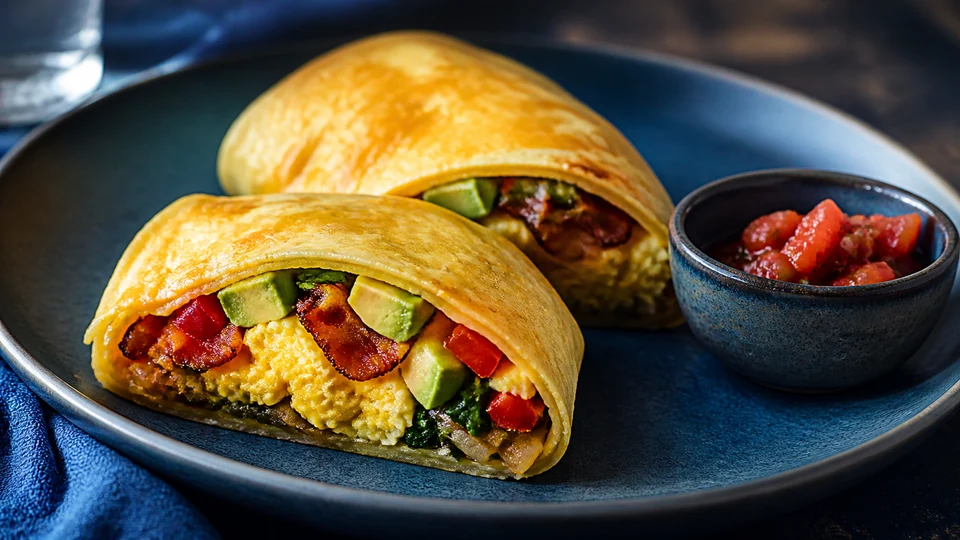
This page is a verification and assembly guide, not a Pancake World ketogenic prescription or tested recipe. See the breakfast hub for other morning formats, and visit Pancake World for the wider collection.
For broader context, continue with Healthy Pancake Guides.
Keto is narrower than “low carb”
A lower-carbohydrate burrito is not automatically ketogenic. The Scientific Foundation for the Dietary Guidelines for Americans, 2025–2030 uses 20 to 50 grams of carbohydrate per day and less than 10% of energy as review terminology for ketogenic diets. It describes ketogenic diets as a subset of low-carbohydrate diets.
That federal scientific appendix does not assign a universal number to breakfast. It does not say that a burrito with 20 grams is keto, that every person should eat 20 to 50 grams a day, or that consuming a food below a threshold guarantees measurable ketosis. Research definitions, clinical protocols and self-selected plans can use different rules.
Use this sequence:
- obtain the actual plan and its calculation method;
- identify the amount allocated to this meal;
- calculate every eaten component on that method;
- decide whether the complete burrito fits;
- avoid turning the result into a promise about the body’s response.
If no plan has been defined, “keto” remains an aspiration or product label, not a verified meal classification.
Decide which carbohydrate number you are counting
The FDA Nutrition Facts panel provides Total Carbohydrate in grams per stated serving. FDA guidance explains that carbohydrate information includes dietary fiber, sugars and, when present and declared, sugar alcohols.
“Net carbs” is not the same printed line and is not governed by one universal household subtraction rule. Manufacturers and diet plans may use different conventions. Subtracting all fiber and all sugar alcohols without checking the plan can create a number that is neither the FDA Total Carbohydrate value nor the method a clinician intended.
For transparent comparison:
- record Total Carbohydrate first;
- record the label serving size;
- multiply when using more than one serving;
- keep dietary fiber and sugar alcohol information as separate fields;
- apply an alternative calculation only when the plan defines it;
- label the result with the method used.
Do not place two products side by side using Total Carbohydrate for one and a manufacturer’s front-of-pack “net” value for the other. Put them on the same basis before deciding.
The wrapper is a design decision, not a magic switch
The wrapper determines hand-held structure, but the filling still counts.
Packaged reduced-carbohydrate tortilla
This is the closest to a conventional burrito. Read the exact label for one tortilla, not the front claim. Check whether the serving is one whole tortilla, a fraction or a gram weight. Also review allergens and preparation instructions.
Why a labelled tortilla may work:
- familiar fold and eating experience;
- repeatable label data;
- easy batch assembly.
What to check before choosing it:
- formulations and serving sizes vary;
- some are less flexible or more prone to tearing;
- a favorable wrapper number does not account for sauce, vegetables or sides;
- a product called keto does not establish fit with an individual medical plan.
Egg-based wrap
Commercial egg wraps have product-specific labels. A homemade egg sheet would need its exact ingredients and amounts calculated; its foldability also depends on thickness and cooking.
Why an egg wrapper may work:
- can hold a compact filling;
- changes the wrap’s ingredient profile;
- may be useful when avoiding a flour tortilla for a particular plan.
What an egg wrapper changes:
- adds egg as both wrapper and possibly filling;
- may split when overcooked or overfilled;
- creates an egg-allergen issue;
- should not be assigned nutrition from a different brand or internet recipe.
Cheese-based wrap
Cheese wraps can become flexible when warm and firmer as they cool. Packaged products require their own label; a homemade version needs the actual cheese weight.
Why a cheese wrapper may work:
- cohesive when prepared correctly;
- distinct savory flavor.
What a cheese wrapper changes:
- dairy allergen;
- saturated fat, sodium and energy remain separate considerations;
- hot melted cheese can be difficult to handle;
- “nearly no carbohydrate” cannot be assumed without the product data.
Lettuce, cabbage or another leaf
A large flexible leaf can contain a small filling, but the result eats more like a wrap than a flour-tortilla burrito.
Why a leaf wrapper may work:
- fresh texture;
- ingredients are visible;
- no specialty packaged wrapper required.
What a leaf wrapper changes:
- tears under heavy filling;
- leaks with hot sauce or juicy vegetables;
- smaller capacity;
- still needs ingredient calculation when the plan requires precision.
Tortilla-free bowl
A bowl removes the wrapping problem and lets components stay separate. Call it a breakfast burrito bowl rather than promising the same hand-held format.
Why a bowl may work:
- easiest way to see portions;
- reheats without a soggy tortilla;
- accommodates crisp cold toppings added later.
What a bowl changes:
- not portable in the same way;
- larger bowl portions can erase the intended meal allocation;
- beans, sauce, onions, tomatoes and other ingredients still count.
Audit the entire filling
Create one row for every ingredient. “Egg, meat and cheese” is a description, not a calculation.
| Component | Evidence to use | Frequent mistake |
|---|---|---|
| Wrapper | Exact current product label | Using a front-of-pack net-carb slogan |
| Eggs or liquid egg product | Package label or matched USDA record | Assuming every liquid product is identical |
| Meat | Exact product label or matched food record | Ignoring sugars or binders in processed meat |
| Cheese | Label and actual weight | Treating all cheeses as zero carbohydrate |
| Vegetables | Measured weight and matching record | Calling vegetables free or unlimited |
| Sauce | Label and spooned weight | Forgetting sweetened or thickened sauces |
| Avocado or guacamole | Measured edible amount | Excluding it because it is high in fat |
| Coffee, drink or side | Its own full serving data | Calling the burrito total the breakfast total |
The point is not that each item contains a large amount. The point is that precision requires a complete ledger.
Eggs
Whole eggs, egg whites and liquid egg products are not interchangeable database entries. Choose the record that matches the food and amount. If both an egg wrapper and scrambled egg filling are used, count both.
Meat and meat alternatives
Plain cooked meat, breakfast sausage, bacon, deli meat and plant-based crumbles differ in ingredients and labels. Some processed products contain sugars, starches or binders. Compare the exact item rather than using a generic “meat” value.
Cheese
Use the weight actually added. Shredded cheese can be packed loosely or densely in a volume measure. Record its sodium, saturated fat and other label information as separate questions; keto does not make them irrelevant.
Vegetables
Peppers, mushrooms, spinach, onions, tomatoes and salsa can contribute flavor and texture. Count them according to the plan rather than omitting them by rule. Cook high-moisture vegetables until excess liquid has evaporated so the wrapper remains functional.
Condiments
Hot sauce, salsa, ketchup, flavored mayonnaise and creamy dressings differ. Read the serving size and multiply for the amount used. “A drizzle” is not a reproducible measure.
A reproducible worksheet
Use a kitchen scale and a simple table.
| Ingredient | Grams used | Label serving grams | Total Carbohydrate per serving | Batch contribution | Plan-adjusted value, if defined |
|---|---|---|---|---|---|
| Wrapper | |||||
| Egg product | |||||
| Main filling | |||||
| Vegetables | |||||
| Cheese | |||||
| Sauce |
Calculate each packaged ingredient:
batch Total Carbohydrate = grams used ÷ label serving grams × Total Carbohydrate per serving
For a unit count, multiply the label value by the number of units actually used.
An arithmetic demonstration can show the method without claiming nutrition for a real product. If a fictional wrapper label states 12 grams Total Carbohydrate per one wrap and four wraps are used, the batch wrapper contribution is 48 grams. If four equal burritos are produced, each receives 12 grams from the wrapper. The numbers are invented for arithmetic only.
Then add all ingredients and divide by the number of equal finished units. Preserve Total Carbohydrate and any plan-adjusted field separately. Never overwrite the original label value.
If filling remains in the skillet, subtract its measured share or record the actual quantity placed into the wraps. Do not count the planned batch while eating a different one.
Build a filling that folds
Carbohydrate calculation does not solve texture. A practical burrito needs a compact, relatively dry center.
Select one main protein pattern
Choose egg alone, egg plus one meat, or tofu plus vegetables rather than stacking every available item. Multiple proteins can crowd the wrapper and complicate both measurement and reheating.
This is a structural choice, not a rule about nutrient need.
Cook vegetables separately
Mushrooms, spinach, tomatoes and peppers release different amounts of water. Cook and drain them before combining with egg. Cool very hot vegetables briefly so they do not continue steaming inside the wrap.
Keep egg firm
Scrambled egg should not be runny. Larger curds remain distinct among chopped filling, while very small curds can disappear into meat and cheese. FoodSafety.gov lists 160°F for egg dishes.
Measure sauce before assembly
Thick salsa or a measured condiment is easier to control than a free pour. Add cold avocado or fresh herbs after reheating when their texture matters, and include the actual amount in the worksheet.
Respect wrapper capacity
Lay the filling in a short horizontal band, leaving side margins. Fold the sides inward, bring the bottom edge over the center, tighten gently and roll seam-down. Remove filling if the seam cannot close.
An extra wrapper changes the carbohydrate calculation. It is not just a repair.
Compare five practical builds
These are patterns to calculate, not tested recipes.
Egg, cheese and pepper
This simple pattern minimizes the number of components. It still requires wrapper, egg, cheese, pepper and cooking additions in the ledger. Cook peppers dry enough that they do not release liquid into the seam.
Egg and breakfast meat
Check the exact meat product for carbohydrate, sodium, saturated fat and serving size. “Keto sausage” is not a universal category. Add a vegetable or fresh herb for flavor if it fits the plan.
Egg, avocado and salsa
Add avocado and salsa after reheating for fresher texture. Count both. Avoid assuming avocado is unlimited simply because much of its energy comes from fat.
Tofu and vegetable
Press or drain tofu as appropriate and use matched product data. Season directly. Packaged meat alternatives or marinades require their own labels.
Leftover chicken and egg
Use only chicken with known safe storage history. Chop it small for even heating, combine with firmly cooked egg and bring a leftover assembled burrito to 165°F at the center.
Meal prep and food safety
Diet labels do not change microbiological controls.
- Cook poultry, including ground poultry, to 165°F.
- Cook ground meat and sausage to 160°F.
- Cook egg dishes to 160°F.
- Reheat leftovers to 165°F.
- Refrigerate perishable filling and burritos promptly.
Use a food thermometer. A melted wrapper or browned exterior does not prove the center is safe.
Refrigerating
Cool filling in shallow containers. Assemble once heavy steam has dispersed, label the preparation date and follow the shortest storage limit among the ingredients. A later assembly date does not reset the clock on older chicken, meat or egg.
Freezing
Freeze only safely handled food. Protect the burrito from freezer drying and label its contents because wrappers can look similar once frozen. Texture may change; vegetables can release water and egg can become firmer.
Reheating
Remove any non-microwave-safe foil before microwaving. Rotate the burrito, allow standing time and verify the center at 165°F. In an oven or air fryer, follow appliance-safe packaging directions and do not infer center temperature from a crisp exterior.
Cold avocado, greens and salsa can be added after heating. Update the meal calculation when they are eaten.
Ordering a keto breakfast burrito
Restaurant shorthand makes verification difficult. Ask:
- What is the wrapper and size?
- Is official nutrition available for the standard unit?
- Are potatoes, beans, corn, sweetened meat or sauce included?
- Is the egg mixed with milk or another ingredient?
- Can sauce be served separately?
- Does replacing the tortilla change the filling amount?
If the restaurant publishes nutrition, confirm the serving and whether customization data are included. If it does not, avoid inventing an exact value from generic databases. Say “ordered without potatoes” or “served as a bowl,” not “contains X net carbs.”
A lettuce wrap can still include sweet sauce. A bowl can be larger than the wrapped meal. A “keto” menu label is evidence of the operator’s naming, not a guarantee that it fits a medical plan.
Keto is not the same as these other labels
Low carb
Low-carbohydrate definitions cover a wider range. The federal scientific review calls keto a subset of low-carbohydrate diets. A food can be lower in carbohydrate than a comparison and still not fit a particular ketogenic plan.
Low calorie
Carbohydrate and calories are different measurements. Cheese, oil, butter, avocado and fatty meat may add energy while contributing relatively little carbohydrate. Keto does not mean low calorie.
High protein
Ketogenic patterns are not simply maximum-protein plans. The federal scientific appendix describes adequate but not excessive protein in its research terminology. Individual medical protocols may calculate protein precisely.
Gluten free
Removing wheat does not establish carbohydrate quantity, and a low-carbohydrate wrapper does not establish freedom from gluten or cross-contact.
Diabetes safe
No burrito label proves individual suitability. Diabetes type, medication, kidney function, glucose patterns and the clinical plan matter.
Medical safety boundaries
Very-low-carbohydrate eating can interact with medical treatment. The 2026 American Diabetes Association Standards identify very-low-carbohydrate patterns as a risk factor for diabetic ketoacidosis in people taking SGLT inhibitors. This article cannot determine medication risk and must not be used to reduce, stop or reschedule any medicine.
People with diabetes, pregnancy, kidney disease, liver disease, pancreatic conditions, eating-disorder history or other clinical concerns should discuss major carbohydrate restriction with their care team.
Ketogenic diet therapy for epilepsy is a separate medical use. The National Institute of Neurological Disorders and Stroke describes it as a treatment for some medication-resistant epilepsies and says users need monitoring for adequate nutrients. Johns Hopkins states that people using ketogenic therapy for epilepsy should do so with a knowledgeable team including a doctor and licensed dietitian.
A breakfast article cannot calculate an epilepsy diet ratio, alter seizure medicine, approve ingredients or replace clinical monitoring. Follow the exact medical plan.
Nutritional ketosis and diabetic ketoacidosis are not interchangeable terms. Anyone with symptoms or a clinical concern should seek appropriate medical care rather than using a food article to self-diagnose.
Common keto-burrito mistakes
Declaring the wrapper keto and stopping the count
Correction: calculate wrapper, filling, vegetables, sauce, drink and sides covered by the statement.
Inventing net carbs
Correction: preserve FDA Total Carbohydrate and use only the alternative method explicitly defined by the plan.
Turning a daily research range into a meal allowance
Correction: 20 to 50 grams per day is terminology in the federal scientific review, not a universal breakfast prescription.
Assuming zero-carb meat
Correction: check processed meat, sausage, deli meat and meat alternatives for sugars, starches and serving size.
Ignoring vegetables
Correction: measure them according to the plan. Do not label them free without evidence.
Calling keto a weight-loss guarantee
Correction: one meal or eating-pattern label does not establish an individual outcome.
Confusing ketosis with safety
Correction: food temperature, storage, allergens and medical risk remain separate.
Borrowing nutrition from a similar recipe
Correction: products, weights and yields must match. Calculate the actual unit.
Frequently asked questions
How many carbs can a keto breakfast burrito have?
There is no universal burrito amount. Use the meal allocation and calculation method in the person’s defined ketogenic plan. The federal 20-to-50-gram daily research terminology is not a per-meal target.
Can a regular tortilla be keto?
Only the complete calculation and individual plan can answer. Read the exact tortilla’s Total Carbohydrate per actual unit and include the filling.
Should I count total carbs or net carbs?
FDA labels provide Total Carbohydrate. Use that as the transparent baseline unless a clinician-directed or otherwise clearly defined plan specifies an alternative calculation. Do not invent a subtraction.
Are eggs keto?
Eggs can fit many ketogenic plans, but “egg” does not classify a complete meal. Count the amount and all other components according to the plan.
Is a burrito bowl automatically keto?
No. Removing the tortilla removes one component. Beans, potatoes, corn, onions, tomatoes, sauce, sweetened meat and portion size still affect the total.
Can I meal-prep keto breakfast burritos?
Yes, when the calculated format is safely cooled, stored and reheated. Bring leftovers to 165°F and update the calculation for toppings added later.
Can keto breakfast treat epilepsy?
Ketogenic therapy for epilepsy is medically calculated and monitored. A generic breakfast burrito guide cannot prescribe it.
Does eating this guarantee ketosis?
No. A food label or calculated meal cannot guarantee an individual metabolic state.
Final verification checklist
- The ketogenic plan and its carbohydrate method are defined.
- The meal allocation comes from that plan, not a generic article.
- Total Carbohydrate and serving size are recorded for the exact wrapper.
- Egg, meat, cheese, vegetables, sauces, drinks and sides are included.
- Any net-carb field is kept separate and follows a named method.
- Batch totals are divided only among equal finished units.
- Keto is not presented as low calorie, gluten free, high protein or diabetes safe by default.
- No ketosis, glucose, seizure or weight outcome is promised.
- Poultry, ground meat, egg dishes and leftovers reach the correct safe temperatures.
- Clinical ketogenic therapy and medication questions remain with the care team.
A verifiable keto breakfast burrito begins with a defined plan, not a fashionable wrapper. Count the exact unit on a consistent method, keep Total Carbohydrate visible, make the filling dry enough to fold and preserve food-safety controls. If the full burrito fits the plan, describe the result precisely. If it does not, change one measurable component and recalculate rather than subtracting imagined carbs or making metabolic promises.
Explore related Pancakes World guidance on American Pancakes, American Breakfast: Pancakes, Diner Plates and Brunch, and Maple Syrup.
Sources and editorial references
- USDA and HHS, The Scientific Foundation for the Dietary Guidelines for Americans, 2025–2030: Appendices —
https://cdn.realfood.gov/Scientific%20Report%20Appendices.pdf - U.S. Food and Drug Administration, Total Carbohydrate Nutrition Facts Label guidance —
https://www.accessdata.fda.gov/scripts/interactivenutritionfactslabel/assets/InteractiveNFL_TotalCarbohydrate_October2021.pdf - U.S. Food and Drug Administration, How to Understand and Use the Nutrition Facts Label —
https://www.fda.gov/food/nutrition-facts-label/how-understand-and-use-nutrition-facts-label - American Diabetes Association, Standards of Care in Diabetes —
https://professional.diabetes.org/standards-of-care - American Diabetes Association, Pharmacologic Approaches to Glycemic Treatment: Standards of Care in Diabetes—2026 —
https://doi.org/10.2337/dc26-s009 - National Institute of Neurological Disorders and Stroke, Epilepsy and Seizures —
https://www.ninds.nih.gov/node/647 - Johns Hopkins Epilepsy Center, Ketogenic Diet Therapy for Epilepsy —
https://www.hopkinsmedicine.org/neurology-neurosurgery/specialty-areas/epilepsy/diet-therapy - FoodSafety.gov, Safe Minimum Internal Temperature Chart —
https://www.foodsafety.gov/food-safety-charts/safe-minimum-internal-temperatures - USDA FoodData Central, Data Documentation —
https://fdc.nal.usda.gov/data-documentation/