Japanese pancake
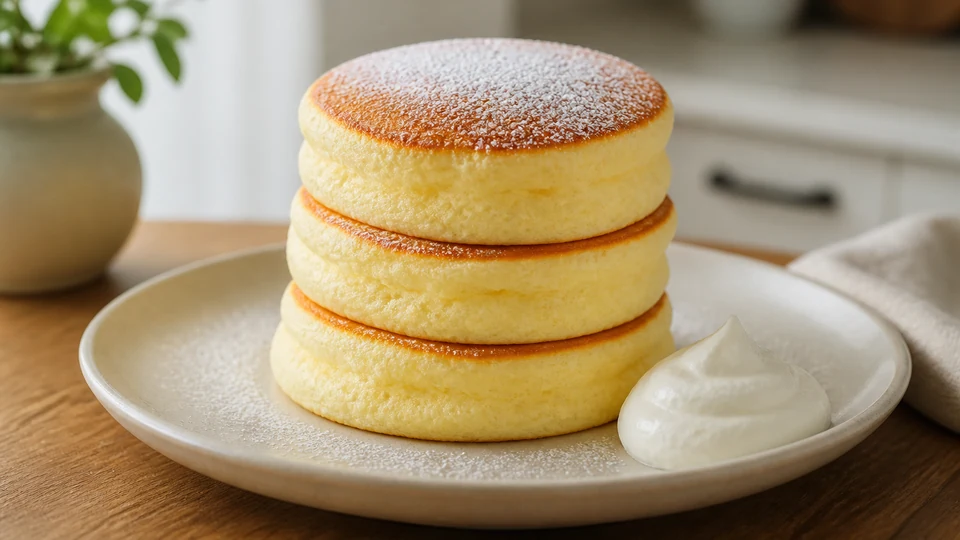
At Pancakes World, “Japanese pancake” usually points to one of two very different dishes: a tall sweet soufflé pancake made by folding stiff meringue into a cake-flour batter and cooking it slowly under a lid, or okonomiyaki , a savory pancake built around cabbage and other ingredients. For a soufflé-style result, use a complete tested formula, low heat, molds, a lid, and a careful flip; King Arthur Baking’s published version makes six 3½-inch pancakes at 250–300°F. For a savory result, choose an okonomiyaki recipe instead of adding cabbage to sweet batter.
For broader context, continue with World Pancakes: Dishes and Traditions.
Direct answer for “Japanese pancake”
The search term does not establish one universal recipe. Decide which format you mean before measuring ingredients.
What the reader needs to know
Japanese soufflé pancakes and okonomiyaki share the English label “pancake,” but they solve different eating and cooking tasks.
- Soufflé pancakes are sweet, tall, individual cakes. Their height depends on separated eggs, whipped whites, gentle folding, ring support, low covered heat, and full setting before removal.
- Okonomiyaki is savory. Kikkoman explicitly describes okonomiyaki as a Japanese savory pancake; one of its published recipes combines cabbage, grated nagaimo, green onion, eggs, cornstarch, and salt.
This article explains both so a reader does not begin with a photo of a tall dessert-like pancake and accidentally follow a cabbage-pancake method, or search for okonomiyaki and receive a meringue formula. For a wider survey of regional formats, use the world pancakes guide.
The two primary culinary sources are also different in status. King Arthur Baking supplies a tested, precise soufflé-pancake formula with temperature, mold dimensions, portion, timings, and cues. Kikkoman supplies an official culinary recipe that identifies and demonstrates a savory okonomiyaki-inspired format. Pancake World has not independently cooked either formula.
Choose the right Japanese pancake approach
| Your intended result | Choose | Core technique | Main equipment | First failure to prevent |
|---|---|---|---|---|
| Tall, sweet, jiggly individual pancake | Soufflé pancake | Stiff meringue folded into yolk batter | Lidded low-temperature skillet, rings, parchment | Deflating whites or scorching before center sets |
| Savory cabbage pancake | Okonomiyaki | Vegetable-rich batter cooked on both sides | Frying pan and turner | Calling sweet batter and cabbage interchangeable |
| Fast familiar breakfast stack | Standard pancake recipe | Mixed batter on moderate griddle | Skillet or griddle | Expecting soufflé height without soufflé technique |
| First attempt with no molds or lid | Use a source written for free-form cooking | Follow that source exactly | Equipment named by source | Improvised rings, unsafe materials, uncontrolled heat |
| Dietary substitution required | Complete formula written for that requirement | Ingredient-specific method | Label-checked tools and products | Assuming “Japanese” proves allergen or dietary suitability |
The decision should happen before shopping. Soufflé pancakes require time and focused handling; okonomiyaki requires a savory ingredient set; a standard breakfast pancake is a separate route.
Practical option 1: Japanese soufflé pancakes
King Arthur Baking’s Japanese Soufflé Pancakes recipe yields six pancakes about 3½ inches across and 1 to 1¼ inches tall. Its preparation is 20 minutes and total plan is one hour. The formula uses four separated eggs, warm water, melted butter, vanilla, cake flour, baking powder, salt, cream of tartar, and granulated sugar.
Source ingredient framework
- 4 large eggs, separated
- 3 tablespoons (43g) warm water
- 2 tablespoons (28g) melted butter
- 1/2 teaspoon vanilla bean paste or 2 teaspoons vanilla extract
- 1/2 cup (60g) cake flour
- 1 1/4 teaspoons baking powder
- 1/4 teaspoon plus 1/8 teaspoon table salt
- 1/4 teaspoon cream of tartar
- 3 tablespoons (37g) granulated sugar
The source uses six parchment strips measuring about 1¼ by 12¼ inches and 3½-inch English muffin rings. A ring substitute must be genuinely suitable for cooking, stable in the pan, and approximately the source diameter; do not improvise with coated, glued, plastic, or unknown materials.
Source-based method overview
- Preheat gently. Set a lidded electric skillet to low, roughly 250–300°F. King Arthur allows a large lidded nonstick frying pan but notes that an electric skillet maintains low heat more consistently.
- Prepare rings. Line each ring with a parchment strip and lightly grease the cooking surface and parchment.
- Make the yolk batter. Whisk yolks with warm water, melted butter, and vanilla. Add cake flour and baking powder, mixing until mostly smooth; small lumps are allowed.
- Whip the whites. In a clean bowl, beat whites until foamy. Add salt and cream of tartar, beat to soft peaks, then gradually add sugar and continue to stiff peaks.
- Fold in stages. Lighten the yolk mixture with about one-half cup meringue. Fold the remaining meringue in three or four additions, stopping when white streaks disappear.
- Portion. Put three lined rings on the skillet and add about one-half cup batter to each.
- Cook covered. Cover and cook 5 to 8 minutes. The source cue is a center that jiggles but is not wavy or completely set.
- Flip the whole unit. Use a flat spatula underneath and tongs on the ring, carefully turning pancake, parchment, and ring together.
- Finish covered. Cook another 2 to 3 minutes, until set and springing back to touch.
- Serve promptly. Remove ring and parchment. Repeat for the remaining three. The source allows a 300°F oven hold for the first batch while the second cooks.
These are published source times, not a Pancake World guarantee. Skillet output, actual batter temperature, ring material, folding loss, and lid fit can change performance.
Heat, structure, and doneness cues
| Stage | Source control | Cue | What it prevents |
|---|---|---|---|
| Preheat | 250–300°F, low, covered capability | Stable gentle surface | Dark exterior before tall center sets |
| Meringue | Soft peaks before gradual sugar; finish at stiff peaks | Peak stands | Weak structure from underwhipped whites |
| Folding | Three or four later additions | No white streaks; stop immediately | Deflation from unnecessary mixing |
| First side | Covered, 5–8 minutes | Center jiggly, not wavy | Flipping a fluid center |
| Second side | Covered, about 2–3 minutes | Set and springs back | Serving a wet center |
| Service | Immediate or short 300°F source hold | Ring releases; structure remains upright | Expecting stored pancakes to retain fresh height |
King Arthur’s formula uses raw egg at the mixing stage. Keep raw batter and its tools away from toppings and plates, wash hands after handling raw egg, and cook the pancake through. The culinary source’s set and spring-back cues control the endpoint used here; no unsupported internal temperature is invented.
Three soufflé-pancake scenarios
First attempt with the specified equipment
Make one source batch and cook only three pancakes at a time. Prepare rings and parchment before whipping whites. Measure the first-side interval, observe the jiggle, and perform the ring-assisted flip exactly once. This keeps the meringue from waiting while tools are found.
Stovetop instead of an electric skillet
Use a large nonstick pan with a lid, as the source permits, but treat heat stability as the variable. Start low and observe browning before changing anything else. Do not increase heat just to shorten the 5-to-8-minute covered stage; the tall center needs time to set.
Serving six pancakes together
Cook the first three, move them to the source’s 300°F oven, then cook the second three. Have toppings ready before batter is mixed. The source says these pancakes are best served immediately, so holding is a compromise rather than a make-ahead promise.
Common soufflé-pancake mistakes
Whites will not reach stable peaks
Check that the bowl and whisk are clean and that no yolk entered the whites. Follow the source’s order: foamy whites, salt and cream of tartar, soft peaks, then gradual sugar to stiff peaks. Do not compensate with extra baking powder.
Batter loses volume during folding
Use the staged method. The first meringue portion lightens the yolk mixture; the rest is folded in three or four additions. Stop when streaks disappear. Repeated stirring turns a soufflé method into a deflated batter.
Bottom darkens before the center sets
Reduce heat. The source specifies roughly 250–300°F and a lid. High heat creates exterior color without providing the gentle covered interval the tall center requires.
Pancake breaks at the flip
Wait until the center is jiggly rather than wavy. Support the base with a flat spatula and control the ring with tongs. The source turns ring, parchment, and pancake as one unit; pulling the ring away first removes support.
Pancake collapses after cooking
Confirm the meringue reached stiff peaks, folding stopped promptly, and the second side cooked until set and springy. A visibly tall pancake can still contain an unset center. King Arthur and Just One Cookbook both emphasize full cooking and careful meringue handling.
Practical option 2: savory okonomiyaki
Kikkoman’s official food forum describes okonomiyaki as a Japanese savory pancake. Its 2024 fusion recipe is not a canonical definition of every okonomiyaki; it is a precise example showing how different the format is from soufflé pancakes.
For eight small pancakes, its batter uses 150g chopped cabbage, 150g grated nagaimo, three or four chopped green onions, two eggs, four tablespoons cornstarch, salt, and canola oil. The source mixes cabbage and yam until thick and sticky, adds onions and eggs, then cornstarch and salt. It portions about 80ml, spreads to a 10cm circle, and cooks each side over low-medium heat for roughly 60 to 90 seconds until firm to touch.
That recipe then serves the pancakes with a beef-and-vegetable stir-fry. This article does not reproduce or merge the topping formula because the reader’s first decision is format: savory cabbage pancake or sweet soufflé pancake.
Choosing okonomiyaki responsibly
- Use a complete recipe written for the desired regional or ingredient style.
- Do not assume cabbage quantity, yam, flour, eggs, or sauce are universally interchangeable.
- Check soy sauce, sauces, toppings, and processed ingredients by label when allergens or dietary requirements matter.
- Keep raw meat preparation separate if the chosen topping contains meat.
- Do not use the soufflé-pancake temperature, rings, meringue, or timing for okonomiyaki.
Step-by-step Japanese pancake checklist
- [ ] Decide: sweet soufflé pancake or savory okonomiyaki.
- [ ] Select one complete tested or official recipe for that format.
- [ ] Confirm equipment before measuring ingredients.
- [ ] For soufflé pancakes, prepare rings and parchment before whipping whites.
- [ ] Keep the egg-white bowl clean and yolk-free.
- [ ] Fold in stages and stop when streaks disappear.
- [ ] Use low covered heat at the source’s 250–300°F range.
- [ ] Portion one-half cup into each 3½-inch ring.
- [ ] Flip only when the center jiggles but is not wavy.
- [ ] Finish until set and springing back.
- [ ] Serve immediately or use only the source’s short hold.
- [ ] For okonomiyaki, follow its own savory batter, size, heat, and completion cues.
Variations and substitutions
King Arthur publishes one direct gluten-free variation: substitute an equal amount of its Measure for Measure flour for cake flour and cook the first side 2 to 3 minutes longer before flipping. That is a named-source variation, not proof that any gluten-free flour works or that the result is suitable for every gluten-related requirement.
Just One Cookbook publishes a separate three-pancake soufflé formula using two eggs, milk, cake flour, baking powder, sugar, pan oil, and steaming water. It builds height free-form rather than with the same ring system. Do not combine its water-steaming method with King Arthur’s ring quantities and expect a tested hybrid.
Storage and service
King Arthur says soufflé pancakes are best served immediately. It permits refrigeration in an airtight container for several days and reheating, while warning that the fresh light texture will not be the same. Because Pancake World has not independently verified stored quality, plan the batch for immediate service.
For leftover safety, follow current government guidance for prompt chilling and reheating. Do not leave egg-based pancakes uncontrolled while preparing a second elaborate dish. Okonomiyaki storage depends on its complete ingredients and toppings, so use the chosen recipe’s instructions.
For more evidence-bounded global pancake work, visit Pancake World.
Explore related Pancakes World guidance on American Pancakes, American Breakfast: Pancakes, Diner Plates and Brunch, and Maple Syrup.
Sources and editorial references
- King Arthur Baking, “Japanese Soufflé Pancakes,” six-pancake formula, ring dimensions, 250–300°F low heat, meringue and folding method, half-cup portion, covered cooking ranges, flip technique, doneness cues, short hold, storage limitation, and published gluten-free variation:
https://www.kingarthurbaking.com/recipes/japanese-souffle-pancakes-recipe - Just One Cookbook, “Fluffy Japanese Soufflé Pancakes,” independent recipe-development account, separate three-pancake formula, stiff-peak guidance, low covered cooking, free-form height-building, and collapse troubleshooting:
https://www.justonecookbook.com/souffle-pancake/ - Kikkoman Corporation, “Okonomiyaki Pancakes with Beef Stir-Fry,” official savory-pancake identification and complete eight-pancake cabbage, nagaimo, egg, cornstarch, portion, heat, and firmness method:
https://www.kikkoman.com/en/culture/foodforum/recipe/fusion-38-3.html - USDA Food Safety and Inspection Service, “Leftovers and Food Safety,” prompt chilling and leftover reheating guidance:
https://www.fsis.usda.gov/food-safety/safe-food-handling-and-preparation/food-safety-basics/leftovers-and-food-safety