Italian sausage breakfast
At Pancakes World, the editorial platform presents this evidence-bounded guide for the exact route intent.
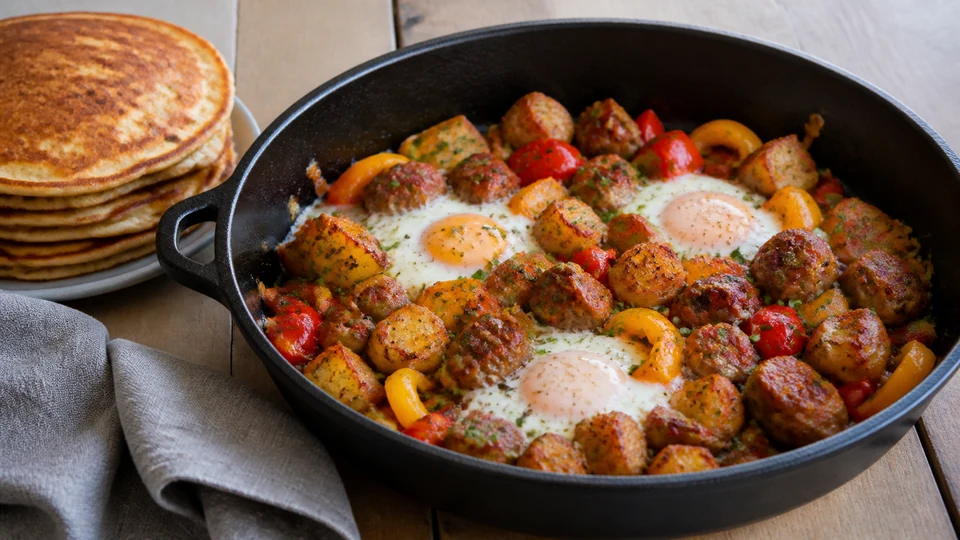

This guide belongs to Breakfast. For an Italian-sausage breakfast, cook the sausage safely by its product form, then use it as one savoury component in a skillet, egg dish, sandwich, polenta bowl or breakfast pizza. Keep fennel, pepper, tomato and cheese choices deliberate, and do not let the sausage fat turn every supporting ingredient greasy.
Italian sausage describes a product style, not one protected breakfast tradition. Current labels and safe cooking directions control the actual ingredient.
| Guide sections |
|---|
| Give sausage one clear role |
| Sequence meat, vegetables and the breakfast base |
| Correct grease, moisture and doneness |
| Food safety, labels and claim boundaries |
For broader context, continue with American Breakfast: Pancakes, Diner Plates and Brunch.
Give sausage one clear role
A practical plan can be built around pepper and onion skillet, polenta breakfast bowl and egg scramble, with breakfast sandwich and roasted potato tray added only when they serve a defined role. The remaining decisions concern control, service and repeatability. Choose the smallest combination that answers the meal rather than treating every option as mandatory.
Choose the sausage form first
Links, bulk sausage and patties do not share one cooking path. A link has casing and a deeper centre, bulk sausage can be crumbled for distribution, and a patty creates a broad contact surface. Read the current package for ingredients, allergens, ready-to-cook status and preparation directions. If the breakfast needs small pieces in a skillet or pizza, bulk sausage may be easier to portion than cutting partly cooked links. If links are the intended centre of the plate, keep them intact and cook them by a validated method rather than borrowing the timing of crumbles.
Manage rendered fat before vegetables
Sausage fat can help flavour a skillet, but an uncontrolled pool prevents potatoes from crisping and makes peppers or greens feel heavy. Cook the sausage through its required path, remove or redistribute excess fat as appropriate, and only then decide how the vegetables will cook. Mushrooms and watery greens need room to release steam. Potatoes need contact with the pan. Adding every ingredient at once usually gives the wettest component control of the skillet. A staged method lets each item reach its intended texture before the final combination.
Pick one base for the plate
Eggs, polenta, toast, potatoes and pizza crust are five different bases; the breakfast does not need all of them. A polenta bowl accepts a spooned sausage-and-pepper topping. Toast needs a filling dry enough to remain handheld. Eggs require raw-egg separation and a reliable endpoint. Potatoes need enough pan area. Pizza moves the problem into the oven. Choosing one base clarifies equipment and portioning and prevents the phrase Italian sausage breakfast from becoming an unstructured pile of rich foods.
Balance salt and moisture at service
Sausage, cheese and prepared sauce can all contribute salt. Review their labels before adding extra seasoning. Tomato brings acidity but also liquid, so use a controlled sauce or drained fresh component rather than flooding a sandwich or skillet. Fresh herbs or pepper can sharpen the plate without extra bulk. Serve sauce separately when transport or holding time threatens the bread. The final check is the thickest sausage piece and the wettest centre of the dish, not merely the browned surface.
A controlled skillet example
For a sausage, pepper and potato skillet, prepare potatoes by a complete method that gives them a head start. Cook sausage according to its product form and safe endpoint, manage the rendered fat, then cook peppers or onions without crowding. Combine only when the potatoes can retain some crust and the sausage is already safe. Taste before adding salt because sausage and any cheese may supply enough. This is a sequence example, not a universal recipe or timing chart.
Sandwich assembly without collapse
Choose a roll, toast or flatbread strong enough for the filling. Keep tomato or sauce measured and place it away from the cut surface until service when possible. Use sausage pieces that do not roll out and a cheese quantity that melts without sealing in excess grease. For transport, cool prepared filling through a supported route and assemble near eating, or choose a documented make-ahead sandwich method.
Separate flavour style from cultural claims
Fennel, pepper, tomato and cheese can create an Italian-American sausage profile, but their presence does not establish one traditional Italian breakfast. Name the actual dish and ingredients. Avoid claiming that a skillet, pizza or sandwich is how Italy eats breakfast unless route-specific cultural evidence supports that statement. The practical promise is limited to using an Italian-sausage product effectively in a morning meal.
Additional route decisions
Pepper and onion skillet
Cook vegetables to the intended texture and combine with safely cooked sausage near the end.
Polenta breakfast bowl
Prepare polenta from a complete method and spoon a measured sausage topping over it.
Egg scramble
Finish sausage first, manage rendered fat and add eggs only within a reliable egg method.
Breakfast sandwich
Choose bread that can contain the filling and keep juicy tomato or sauce controlled.
Roasted potato tray
Give potatoes enough surface area and add sausage according to its complete cooking route.
Tomato braise
Use tomato as a distinct sauce and avoid claiming one seasoning profile is universally Italian.
Greens and sausage plate
Wilt greens separately so their water does not steam the entire skillet.
Make-ahead filling
Cool a finished filling promptly and reheat only through an evidence-supported path.
Cheese finish
Select one cheese for salt and texture rather than layering several rich additions.
Portion plan
Treat sausage as a strong component and give fruit, bread or vegetables visible space.
Sequence meat, vegetables and the breakfast base
The sequence below ties the first control to pepper and onion skillet, the equipment decision to egg scramble, and the service check to portion plan. It is intentionally narrower than a universal cooking timetable.
1. Define the result
For pepper and onion skillet, write the intended texture, serving format and dietary boundary before shopping.
2. Verify the inputs
For polenta breakfast bowl, read the complete formula and current package labels, then record every consequential variation.
3. Stage the equipment
For egg scramble, reserve the pan, oven, counter, cooling space and serving utensils the method actually needs.
4. Prepare one control
For breakfast sandwich, keep the first portion close to the source so a later correction has a clear baseline.
5. Observe before changing
For roasted potato tray, note spread, moisture, release, colour and centre condition rather than guessing from the clock.
6. Serve and record
For tomato braise, protect safe handling, label the finished components and write one useful note for the next batch.
Correct grease, moisture and doneness
Greasy skillet
Drain or redistribute excess rendered fat before adding absorbent components.
Raw centre
Continue cooking under the product and safety guidance rather than trusting exterior colour.
Watery vegetables
Cook high-moisture vegetables in a sequence that lets steam escape.
Salty plate
Review sausage and cheese labels before adding extra salt.
Broken sandwich
Reduce filling height and isolate sauce from the bread until service.
Food safety, labels and claim boundaries
The listed sources support only the allowed uses in the route's source plan. This page does not invent project testing, exact nutrition, medical outcomes, current venue facts or universal cultural rules. Where italian sausage breakfast requires a complete formula, that formula remains the authority for quantities, timing, yield and equipment.
A better next batch
Record the exact condition of pepper and onion skillet, the preparation of polenta breakfast bowl, the equipment used for egg scramble, and the service result of portion plan. Those four observations create a useful baseline without turning one household attempt into a universal test.
If the main defect was greasy skillet, repeat the complete method with only the bounded correction recorded above. If the result instead showed raw centre, return to the preparation stage that creates that symptom. Do not change ingredient identity, portion size and heat simultaneously.
Verify the result before service
Review tomato braise first because it is the control that commits the remaining batch. Apply its stated action—use tomato as a distinct sauce and avoid claiming one seasoning profile is universally italian—and compare the result with greens and sausage plate. The second element matters because wilt greens separately so their water does not steam the entire skillet. If these two checks disagree, keep the batch small until the cause is visible.
Next inspect make-ahead filling in the condition in which it will actually be served. The route plan says to cool a finished filling promptly and reheat only through an evidence-supported path. Do that before adding cheese finish, since the latter is intended to select one cheese for salt and texture rather than layering several rich additions. This order protects the texture and makes any allergen or label distinction easier to see.
Finish with portion plan. Its purpose is to treat sausage as a strong component and give fruit, bread or vegetables visible space. Check the thickest or most heavily loaded portion, not the most attractive one, and compare it with the two leading warning signs: greasy skillet and raw centre. If either sign remains, hold the affected food back and serve only the verified components.
Frequently asked questions
Can I use links or patties?
Yes, but follow the exact product form and do not copy timing between shapes.
Is the casing edible?
Check the current package because casings and removal directions vary.
Can I prepare it ahead?
Only with prompt cooling, protected refrigeration and a supported reheating plan.
What is a lighter pairing?
Use that as a taste and portion question, not a health claim.
Can plant sausage work?
It can be a separate labelled option when its ingredients and cooking directions are verified.
Contextual Pancake World guides
- Breakfast Pancakes: Styles, Plates and Munich Context
- American Breakfast: Pancakes, Diner Plates and Brunch
- Fast Breakfast: A Practical Planning Guide
Explore related Pancakes World guidance on American Pancakes, Maple Syrup, and Maple Syrup Pancakes.
Sources and editorial references
- U.S. Food and Drug Administration: Handling Flour Safely —
https://www.fda.gov/consumers/consumer-updates/handling-flour-safely-what-you-need-know - U.S. Food and Drug Administration: Food Allergies —
https://www.fda.gov/food/nutrition-food-labeling-and-critical-foods/food-allergies - USDA FSIS: Leftovers and Food Safety —
https://www.fsis.usda.gov/food-safety/safe-food-handling-and-preparation/food-safety-basics/leftovers-and-food-safety