High fiber breakfast
At Pancakes World, a high-fibre breakfast should be built from measured foods whose labels or recipe calculation support the claim. Practical foundations include porridge oats, a higher-fibre wholegrain cereal, wholemeal toast, fruit, nuts or seeds, and beans or pulses where they fit the meal. Combine one wholegrain base with fruit or vegetables, then add a suitable dairy, alternative, egg, pulse, or other accompaniment. In Great Britain, “high fibre” is a regulated nutrition claim, so a dish should not receive that label merely because it contains one fibre-bearing ingredient; verify the finished product against the applicable conditions.
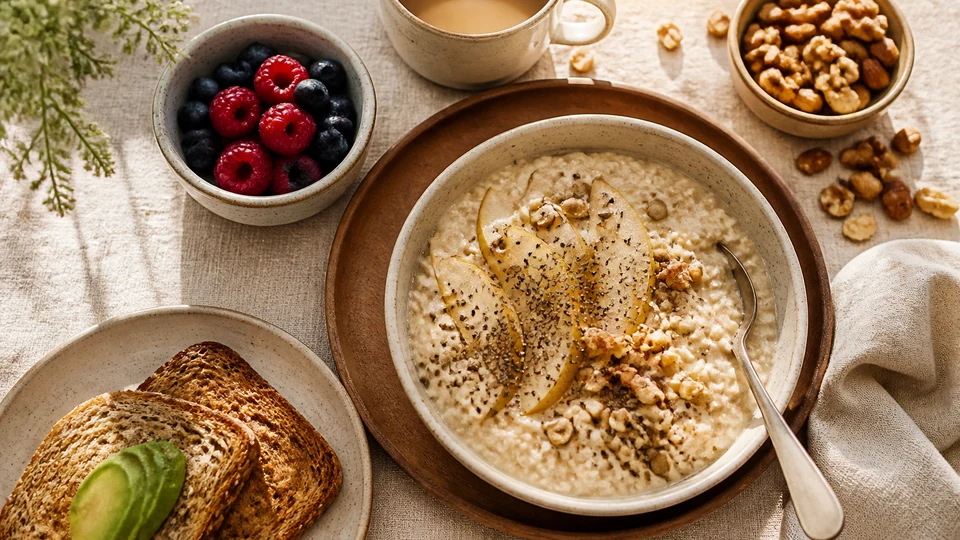
For broader context, continue with American Breakfast: Pancakes, Diner Plates and Brunch.
Direct answer for a high-fibre breakfast
Three easy structures are porridge with fruit and seeds, wholegrain toast with beans and vegetables, or a labelled higher-fibre cereal with milk or an alternative and fruit. NHS guidance specifically recommends higher-fibre breakfast cereal or porridge oats and advises obtaining fibre from varied sources. Its Healthier Families recipes provide documented porridge and overnight-oat examples with calculated fibre per serving.
Use those exact recipe values only for those exact recipes and servings. If ingredients, yield, or portion change, the number changes. For a packaged cereal, start with the declared serving and nutrition panel. For a homemade breakfast sold or described with a formal nutrition claim, use an appropriate calculation and follow current UK claim rules.
What the reader needs to know
“High fibre” has a specific commercial meaning
UK government material explains that voluntary nutrition claims must comply with the applicable rules. A current government policy document restates the conditions: a food described as high in fibre must contain at least 6 grams of fibre per 100 grams or at least 3 grams per 100 kilocalories. “Source of fibre” has lower conditions. The wording may be legally significant when used for product labelling, presentation, or advertising.
This cooking guide does not certify any unpublished bowl or plate. It shows how to select foods and where calculation is required. A breakfast with a spoonful of berries on a low-fibre base cannot be promoted automatically as high fibre. Conversely, a packaged product may support the claim when its current label provides the required evidence.
Build from a base, not a decorative topping
| Breakfast base | Fibre-building addition | Other component | Verification point |
|---|---|---|---|
| Porridge oats | Apple, berries, seeds | Milk, yoghurt, or suitable alternative | Recipe and portion |
| Wholegrain cereal | Fresh fruit or permitted dried fruit | Milk or alternative | Label serving and claim |
| Wholemeal toast | Beans, tomato, mushrooms | Egg or another accompaniment | Bread and bean labels |
| Overnight oats | Berries, chopped fruit, seeds | Yoghurt or alternative | Full jar yield, not one ingredient |
| Savoury grain bowl | Vegetables and pulses | Herbs and a suitable sauce | Cooked weights and final serving |
Variety matters. NHS guidance advises getting fibre from multiple sources rather than relying on one food. Rotate oats, wholegrain breads and cereals, fruit, vegetables, and pulses according to preference and dietary requirements.
Practical options and examples
Porridge route
The NHS porridge-with-fruit recipe combines high-fibre porridge oats, milk, natural yoghurt, apple, and raspberries and publishes a fibre value for its defined serving. Follow that page when using its number. A home variation with a different oat quantity, drink, topping, or yield needs a fresh calculation.
For a simpler bowl, cook plain oats and add chopped fruit. Add nuts or seeds only after checking allergies and portion. Do not attach an unsupported medical outcome to the bowl.
Overnight-oat route
NHS Healthier Families also publishes overnight oats with high-fibre oats, dried fruit, apple juice, yoghurt, and berries. The recipe gives a defined yield and calculated fibre. It demonstrates that make-ahead breakfast can be evidence-based, but its sugar, fibre, and energy numbers belong to its ingredients and four servings.
Keep refrigerated as the recipe instructs. If using a plant alternative, verify its label and do not assume nutritional equivalence.
Savoury toast route
Choose a wholemeal or wholegrain bread with a current nutrition panel. Add beans or another pulse and vegetables. NHS starchy-food guidance identifies wholegrain bread, breakfast cereals, brown rice, and potato skin among fibre-bearing choices. It also cautions that added cooking fats affect the meal separately.
Choosing the right approach
For speed, choose a packaged cereal whose serving and claim can be read directly. For cost and flexibility, use oats with seasonal, frozen, or canned fruit as appropriate. For a savoury breakfast, use wholegrain toast plus pulses and vegetables. For medical dietary needs, follow the person’s clinician or dietitian rather than a general target.
The breakfast hub covers broader planning. Pancake World uses “high fibre” here with a verification boundary, not as a casual superlative.
Common mistakes
- Calling the meal high fibre because it contains one piece of fruit.
- Comparing cereal values without normalising serving size or per-100-gram data.
- Copying a recipe’s fibre figure after changing quantities and yield.
- Adding bran or seeds abruptly to every meal without considering tolerance.
- Ignoring fluid intake when substantially changing fibre intake.
- Treating fibre advice as treatment for a medical symptom.
- Assuming gluten-free bread is necessarily higher in fibre.
- Assuming vegan food is necessarily high in fibre.
- Using a front-of-pack claim after the product has been reformulated without rechecking.
Step-by-step checklist
Choose the evidence path
- For packaged food, read fibre per 100 grams and per serving.
- For a published recipe, retain the exact ingredients, yield, and serving.
- For a homemade variation, calculate the complete batch and actual yield.
- For a public or commercial claim, check current applicable UK rules.
- Do not use an ingredient-level number for the whole plate.
Assemble breakfast
- Select one wholegrain or pulse-based foundation.
- Add fruit or vegetables.
- Add nuts or seeds only where suitable.
- Add dairy, an alternative, egg, or another component according to the overall meal.
- Measure sweet spreads, granola, and dried fruit rather than treating them as invisible extras.
- Keep make-ahead food refrigerated according to its recipe.
Check the serving
- Record the weight or count actually served.
- Include every component covered by the claim.
- Recalculate when the batch yields more or fewer portions.
- Keep product labels for traceability.
- Avoid disease, weight-loss, or guaranteed digestive claims.
Variations or substitutions when relevant
For vegan breakfast, use plant drink or yoghurt whose label meets the need and choose an egg-free accompaniment. For gluten-free needs, select appropriately labelled oats, cereal, bread, and toppings and apply required cross-contact controls. Neither change guarantees a high-fibre result.
For nut-free service, use permitted seeds or omit both; compensate only through a calculated base such as oats, wholegrain cereal, fruit, or pulses. For lower-cost planning, compare price per serving while keeping the serving definition consistent.
Increase fibre gradually when appropriate and drink according to normal needs or professional advice. The British Dietetic Association notes that different fibres occur across fruit, oats, wheat bran, nuts, pulses, and other foods, and that some people with conditions such as IBS may experience symptoms from larger amounts. Personal clinical advice takes priority.
The contextual guides fiber-rich breakfast, gluten-free vegan pumpkin pancakes, and gluten-free vegan sourdough pancakes answer different selection or recipe questions. English breakfast recipe and vegan GF protein pancakes do not inherit a high-fibre claim without calculation.
A seven-day rotation without invented totals
Rotate structures rather than promising a fixed nutrient outcome: porridge with apple; wholegrain toast with beans; overnight oats with berries; labelled cereal with fruit; savoury oats with vegetables; wholemeal toast with hummus and tomato; or yoghurt with oats and fruit. Use actual labels and recipes each day.
The rotation is a planning example, not a prescription. Portions, products, allergies, cultural preferences, and medical needs differ. Its purpose is to avoid relying on one fibre source every morning.
Verify a homemade serving step by step
Begin with the batch, not the bowl. Record the uncooked weights of oats, fruit, seeds, milk or alternative, and every other ingredient. Obtain fibre data from current package labels or an appropriate composition source. Calculate the total for the complete recipe, then divide by the actual number of equal servings produced.
Next, evaluate the claim on the basis required by the applicable rule. A per-serving figure alone may not prove a per-100-gram or per-100-kilocalorie condition. The finished food’s total weight and energy calculation can therefore matter. This is a task for a suitable nutrition calculation and compliance process when the result will be marketed.
If one bowl receives extra granola, fruit, or seeds, it is a different serving. Do not retain a batch-wide figure without recording the change. Likewise, if the cooked porridge yields three portions instead of four, the published four-serving number no longer applies.
For personal planning, exact commercial claim analysis may be unnecessary; labels and established recipes can guide choices. The boundary is language: avoid presenting an unverified homemade breakfast as meeting a regulated threshold.
Four operational breakfast patterns
The hot five-minute pattern uses quick-cooking porridge oats, fruit prepared while the oats cook, and a measured topping. Keep the oat-to-liquid formula from the selected recipe and add the topping after portioning.
The cold overnight pattern combines oats and liquid in a covered refrigerated container, with fresh or frozen fruit handled as the recipe directs. Add crisp seeds or cereal at service. A jar that sits unrefrigerated through a commute needs an appropriate chilled transport plan.
The toast-and-pulse pattern uses wholegrain bread and beans, lentils, or hummus with vegetables. Read fibre values on both bread and packaged pulse product. A sauce-heavy canned bean serving can contribute other label considerations, so fibre is not the only selection criterion.
The cereal comparison pattern chooses between two products by examining per-100-gram fibre and the realistic serving. Add fruit separately and keep the product label. Do not rank the cereal solely by a word such as multigrain, natural, or rustic.
These patterns show process, not guaranteed totals. Each needs its own evidence before receiving the formal high-fibre description.
Retain the calculation date and source version so a later label or recipe change triggers review rather than silent reuse.
Review annually.
Explore related Pancakes World guidance on American Pancakes, Maple Syrup, and Maple Syrup Pancakes.
Sources and editorial references
- NHS: How to get more fibre into your diet —
https://www.nhs.uk/live-well/eat-well/digestive-health/how-to-get-more-fibre-into-your-diet/— official guidance on higher-fibre cereal, porridge, varied sources, and gradual food choices. - NHS: Starchy foods and carbohydrates —
https://www.nhs.uk/live-well/eat-well/food-types/starchy-foods-and-carbohydrates/— wholegrain, oat, fruit, and breakfast examples. - NHS Healthier Families: Porridge with fruit —
https://www.nhs.uk/healthier-families/recipes/three-bears-breakfast/— defined recipe, yield, and calculated fibre per serving. - NHS Healthier Families: Easy overnight oats —
https://www.nhs.uk/healthier-families/recipes/easy-overnight-oats/— defined make-ahead recipe with published serving calculation. - GOV.UK: ACBS policy on nutrition claims —
https://www.gov.uk/government/consultations/oral-nutritional-supplements-acbs-policy/acbs-policy-on-oral-nutritional-supplements— current official statement of “source of fibre” and “high fibre” claim conditions. - British Dietetic Association: Fibre —
https://www.bda.uk.com/resource/fibre.html— professional overview of fibre types, food sources, and individual tolerance considerations.
Evidence checked 16 August 2026. Labels, recipes, and claim rules may change; verify the current source before using a formal claim.