Healthy Vegan Oat Pancakes
One oat-based vegan pancake formula with explicit untested editorial status where appropriate, reliable method and bounded nutrition wording.
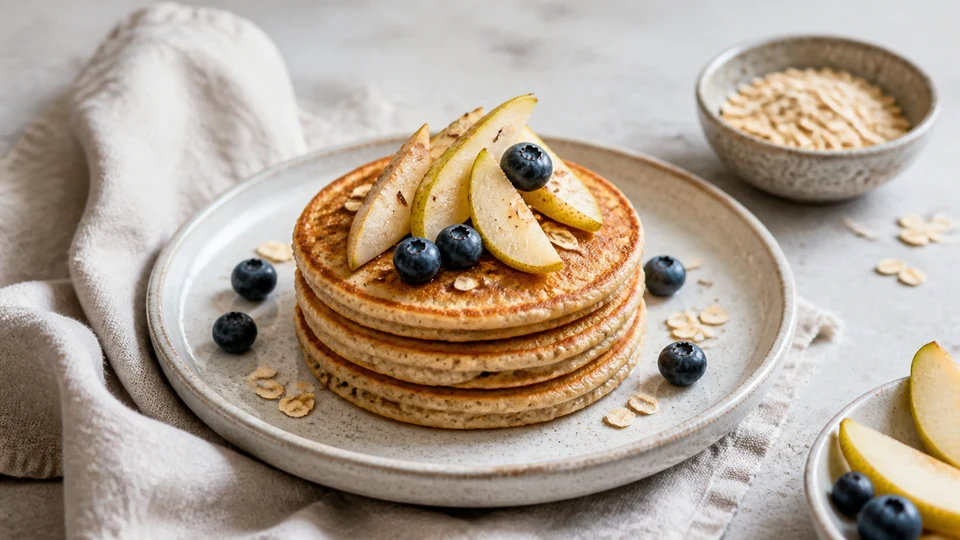
The Pancakes World guide begins this Healthy Vegan Oat Pancakes discussion with a practical decision: For this vegan oat pancake recipe, use quick-cooking oats with all-purpose flour, mix the measured batter briefly and start cooking promptly. Portion a quarter cup per pancake and turn when bubbles appear and the edges look dry. This is Alison Andrews’s oat-and-wheat formula from Loving It Vegan, presented with attribution and additional kitchen guidance.
It is not an all-oat, flour-free or automatically gluten-free recipe, and Pancake World has not independently tested it.
This page owns one complete cooking method. “Healthy” in the route title does not promise a medical benefit or make sugar and toppings irrelevant. The parent healthy pancake guides provide broader context for choosing a breakfast that suits the eater.
Quick-oat pancakes with soy milk and vegan butter
The batter quantities and main cooking sequence follow Loving It Vegan’s Vegan Oatmeal Pancakes. The measured oil allowance below is an editorial pan-preparation allowance: the source specifies butter or oil for frying without a quantity. It does not change the source’s measured butter in the batter.
Yield: approximately 10 pancakes, using the source’s quarter-cup portions. The source counts pancakes, not complete breakfasts; choose the number served with the rest of the meal.
Published timing: 5 minutes preparation and 30 minutes cooking, 35 minutes total. This accommodates roughly ten one-at-a-time rounds at the source’s approximately three minutes per pancake. Allow pan heating, handling and any extra time needed for doneness; the first pancake is part of the batch, not an additional test portion.
Equipment: mixing bowl, sieve, whisk or spoon, scale, measuring spoons, quarter-cup measure, non-stick skillet, thin spatula and a clean plate or rack. Melt the measured vegan butter gently before mixing.
Ingredients
- 125 g all-purpose flour, source measure 1 cup
- 40 g quick-cooking oats, source measure ½ cup
- 3 tablespoons white granulated sugar
- 1 tablespoon baking powder
- ¼ teaspoon salt
- 300 ml soy milk, source measure 1¼ cups; another nondairy milk is a source-supported option
- 57 g vegan butter, melted, source measure ¼ cup
- 1 teaspoon vanilla extract
- 1 tablespoon/15 ml neutral oil set aside for a thin pan film across the batch; the amount actually needed depends on the pan
Cook the batch
- Sift the flour into the bowl. Mix in the quick oats, sugar, baking powder and salt so the dry ingredients are evenly distributed.
- Add soy milk, melted vegan butter and vanilla. Stir until combined, scraping the bottom for dry pockets. Stop when the batter is mixed; do not beat it until perfectly smooth.
- Heat the skillet over medium heat. Apply a small amount of the reserved oil to form a light film. The pan should be hot enough to start cooking the batter but not smoking.
- Measure a quarter cup of batter into the pan. For the first round, cook one pancake so you can watch its edge and underside without managing several at once. Begin cooking promptly after mixing rather than adding an unsourced resting stage.
- When bubbles appear on top and the edge looks dry, slide the spatula underneath and turn. Cook the second side until browned and the centre is cooked through. The source estimates about three minutes total per pancake; follow the condition of the food if your pan needs longer.
- Transfer to a clean plate or rack. Check the first pancake’s centre before repeating with equal portions. Continue through the remaining batter, renewing only the light pan film as needed and moderating heat if the underside colours too quickly.
Doneness: browned surfaces, an edge firm enough to lift, and an interior that is set rather than streaked with wet batter. A small oat texture is expected. Open the first pancake after a brief rest; surface colour alone cannot tell you whether a thick centre has finished.
Keep the quick oats and the flour in their assigned roles
The source prefers quick-cooking oats. It allows rolled oats processed to a finer consistency, but it does not call for turning this batter into an oat-flour-only mixture. Keep the stated 40 g oat amount if making that source-supported preparation change.
Steel-cut oats are not the named alternative.
Weigh the flour when possible. If using the source cup measure, spoon flour into the cup and level it rather than scooping and packing it from the bag. Nebraska Extension explains that wheat flour forms a gluten structure with water, whereas oat flour is a different ingredient.
Replacing the 125 g wheat flour with more oats removes part of this recipe’s design.
This is also why the recipe does not need an added flax egg or banana. It is already formulated without eggs. A spoonful of seed meal, fruit purée or commercial replacer would add another source of solids or liquid.
If an all-oat version is essential, choose a complete recipe written for that requirement rather than applying the mixed-grain quantities to a new base.
The companion guide to oat form, hydration and binding explains these ingredient decisions. Use it to understand a change, while keeping this page’s first batch intact.
Why this batter goes straight to the pan
Loving It Vegan specifically recommends cooking once the batter is mixed and warns that an extended wait can affect the texture. Do not import an eight-minute rest from a different banana-oat or flax-based recipe. Set out the pan, spatula and serving plate before combining wet and dry so the first portion is not delayed by finding equipment.
Some waiting is unavoidable while ten pancakes cook. Observe whether the later batter pours differently from the first quarter cup. Keep the scoop and pan routine consistent so you can distinguish a change in the bowl from a change in surface heat.
Avoid repeatedly stirring, adding milk and dusting in flour without recording what happened.
If the later batter becomes difficult to portion, first check that the source amounts and oat form were followed. The source does not provide a universal extra-liquid allowance. A measured adjustment would be your modification, with a potentially different final yield.
For a later attempt, a half batch may be a cleaner solution to a long single-pan wait.
Five, ten or twenty pancakes: keep the scoop unchanged
| Ingredient | Half batch, about 5 | Full batch, about 10 | Double batch, about 20 |
|---|---|---|---|
| Flour / quick oats | 62.5 g / 20 g | 125 g / 40 g | 250 g / 80 g |
| Sugar / baking powder | 1½ tbsp / 1½ tsp | 3 tbsp / 1 tbsp | 6 tbsp / 2 tbsp |
| Salt / vanilla | ⅛ tsp / ½ tsp | ¼ tsp / 1 tsp | ½ tsp / 2 tsp |
| Soy milk / vegan butter | 150 ml / 28.5 g | 300 ml / 57 g | 600 ml / 114 g |
| Oil available for pan film | ½ tbsp / 7.5 ml | 1 tbsp / 15 ml | 2 tbsp / 30 ml |
The half and double columns are arithmetic scaling, not separately tested publisher recipes. A quarter-cup portion stays a quarter cup. At one pancake per round and approximately three minutes per pancake, plan around 15, 30 or 60 minutes of cooking respectively, plus handling and any extra cooking required. A larger pancake does not shorten this schedule without changing the recipe’s thickness and endpoint.
A wider pan may hold more than one round with room for a spatula, but assess each pancake separately and do not crowd the surface. More burner output is not a substitute for space. For twenty pancakes on limited equipment, two freshly mixed source-size batches can reduce the time that the second half of the batter waits in the bowl.
Dark underside, wet centre
Verify the quarter-cup portion and reduce excessive pan heat for the next round. Finish the current pancake properly; do not serve it simply because the surface is attractive. Check whether later rounds brown faster as the pan remains on the burner.
A pancake tears at the turn
Wait for the edge to look dry and support the round with a thin spatula. Check the pan film and whether the pancake is stuck before lifting. Adding a new binder to the bowl is not the first response to one premature turn.
The result is unexpectedly heavy
Review flour measurement, oat preparation, baking-powder measurement, mixing and waiting. The recipe uses one tablespoon of baking powder, not one teaspoon. More than the stated amount is not a reliable correction for a different flour or a long-held batter.
The first serving is better than the last
Compare both the batter wait and the holding method. Hot pancakes stacked tightly can soften with steam. Serve smaller waves when possible and keep sauces separate until the base pancake has been assessed.
Record the small details that change between rounds
Use the same pan area for your first and later comparison, and keep the oil application, scoop and burner setting repeatable. Note how the batter falls from the measure before the first pancake and again midway through the bowl. Inspect a centre after the same short rest rather than comparing one piping-hot pancake with another that has cooled for several minutes.
Write one next-batch change linked to the strongest observation. If the later batter waited too long, try a smaller batch. If one pan edge consistently darkened a portion, reconsider placement.
If a new plant beverage changed the result, retain the original oat form and measurements while investigating it. The pancake troubleshooting guide provides broader diagnostic context.
Choose a documented variation before mixing
The source permits another nondairy milk and allows white sugar to be replaced with light brown or coconut sugar. Those are supported options, not proof of identical flavour or nutrition across brands. Keep the source quantity and record the chosen ingredient.
A syrup is not the same dry-sugar substitution.
It also suggests an all-purpose gluten-free flour blend for the wheat flour. That is a different version requiring suitable oats and checks on every ingredient. FDA’s gluten-free labeling criteria are not satisfied merely by removing an obvious bag of wheat flour; cross-contact and the actual products matter.
Do not use a single nut flour as though it were the named all-purpose blend.
Fruit is easiest to add at serving on the first batch. A large handful of juicy berries mixed into the bowl would change the batter and how a pancake turns. Serve a chosen amount of maple syrup separately if desired.
FDA includes syrup sugars among added sugars, so changing from white sugar to a natural-sounding sweetener does not erase that consideration.
For meal planning, other breakfast options can help put the pancake portion alongside different foods. No calorie, protein, weight-loss or disease-related claim is calculated for this home batch, and vegan ingredients do not automatically make it suitable for every allergy.
Store leftovers using the shorter general safety window
The publisher suggests up to five refrigerated days. This guide instead adopts Illinois Extension’s more conservative general leftover guidance of three to four days, or a shorter relevant ingredient limit. That is an editorial safety choice, not a quotation of the recipe author’s storage period.
Refrigerate promptly in shallow containers at 40°F/4°C or below. FDA advises refrigerating perishables within two hours, or within one hour above 90°F/32°C. Keep raw-food utensils away from finished pancakes and label the container with the date.
Do not leave the whole batch out while waiting for it to become completely cold.
Reheat the needed portion to 165°F/74°C under the general leftovers guidance. Use equipment suitable for the pancake size and follow its instructions; the source’s toaster suggestion is not a universal appliance safety guarantee. Freezing may be convenient, but no tested freezer-quality duration is asserted here.
A previously unsafe batch is not repaired by freezing or a fresh browned surface.
Sources and editorial references
- Alison Andrews, Loving It Vegan, Vegan Oatmeal Pancakes: primary formula and documented options. https://lovingitvegan.com/vegan-oatmeal-pancakes/
- Nebraska Extension, Choose the Right Flour When Baking. https://food.unl.edu/choose-right-flour-when-baking/
- FDA, Questions and Answers on Gluten-Free Food Labeling. https://www.fda.gov/food/nutrition-food-labeling-and-critical-foods/questions-and-answers-gluten-free-food-labeling-final-rule
- FDA, Added Sugars on the Nutrition Facts Label. https://www.fda.gov/food/nutrition-facts-label/added-sugars-nutrition-facts-label
- FDA, Safe Food Handling. https://www.fda.gov/food/buy-store-serve-safe-food/safe-food-handling
- Illinois Extension, Leftovers. https://extension.illinois.edu/food-safety/leftovers
Reviewed 28 August 2026. Additional pan-oil allowance, batch arithmetic and diagnostic guidance are editorial additions. The source formula has not been independently tested by Pancake World.